 Skip to content

Plexform builds custom manufacturing racks for production and warehouse operations, engineered to exact customer specifications with lead times of 6 to 10 weeks and no minimum order requirement. Every rack ships with part-specific interior fixtures, corner posts with stacking pins, and an integral fork-entry base, so your parts move from storage to the assembly line without a single handling step wasted. If your facility is still running generic storage equipment, you already know what that looks like in practice: parts shifting in transit, floor space eaten up by sprawl, and labor costs climbing every time a worker has to restack, sort, or re-inspect product that should have arrived ready to use.
Whether manufacturing racks can better design cut your costs is not a theoretical question. A well-specified rack reduces part damage, multiplies vertical storage capacity, and loads more product per truck. This guide covers what custom stacking racks are and why design matters, the construction and main benefits, the configurations available, how to pick the right rack for your operation, and how the Plexform process works from first call to delivery.
What Custom Manufacturing Racks Actually Are
Beyond Generic Pallet Racking
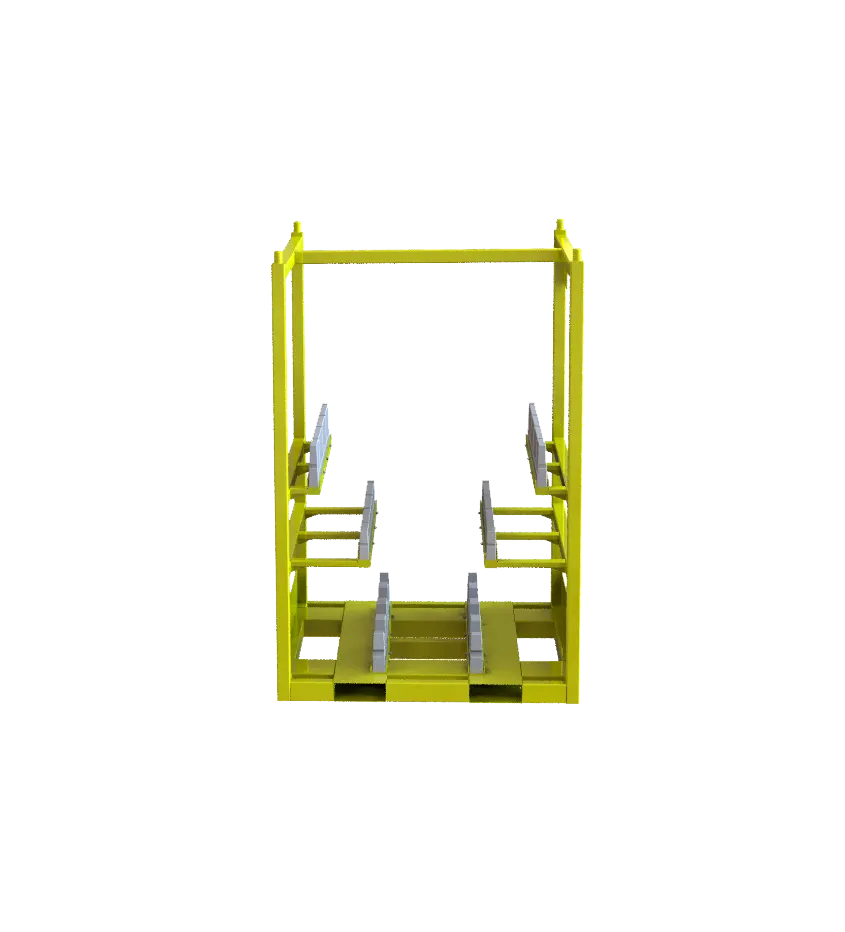
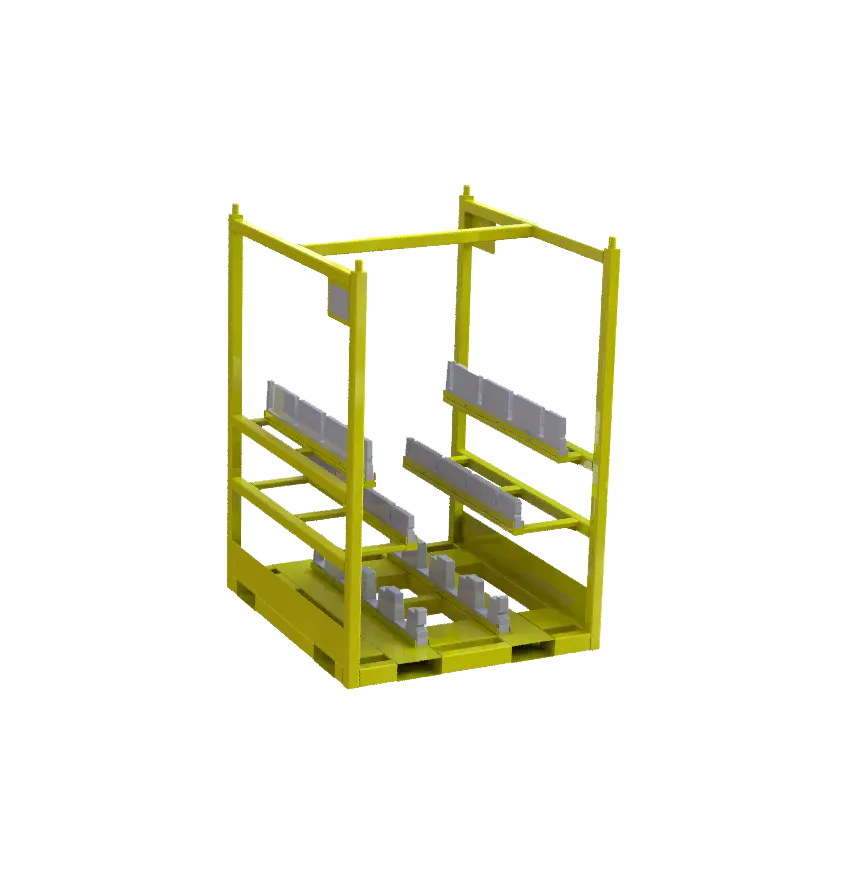
When buyers search for manufacturing racks, they often picture selective pallet racking with upright frames and beam levels. Plexform builds something different. A custom stacking rack is a freestanding, forklift-portable unit built from rectangular structural tube steel. Corner posts rise at each corner, capped with stacking pins so identical racks nest securely on top of each other on the floor, no shelving structure required.
The critical feature is what happens inside the frame. Plexform engineers design cradles, rails, nests, and dividers to hold one specific component at one specific orientation. An automotive door panel, a stamped bracket, a transmission housing, a coil of formed wire: each gets a rack built around its geometry. The part cannot shift, cannot contact bare steel, and cannot arrive at the line in the wrong position.
Why Generic Equipment Falls Short
Off-the-shelf racks accommodate a range of part sizes, which means they accommodate none of them particularly well. Parts bounce against each other in transit. Workers spend time re-orienting components at the assembly station. Scrap rates for cosmetic or functional damage climb in ways that rarely get traced back to the rack itself. As the MHI Material Handling Institute notes, handling damage is one of the highest hidden costs in manufacturing logistics, and most of it happens not during machining but during storage and transport between operations.
Key Benefits and Construction Details
Built for the Part, Not the Pallet
Plexform uses structural rectangular tube steel throughout the frame, MIG-welded at every joint. Interior fixtures are fabricated from the same steel or from formed tube, then powder-coated to protect the surface finish of whatever part the rack holds. The fork-entry base is integral to the frame, so a standard forklift or pallet jack can pick the rack full or empty without any adapter.
Stacking pins on the corner post tops index into receivers on the base of the rack above, creating a stable column when racks are stacked two or three high. That vertical stacking is where the floor space savings show up immediately. A plant that previously spread parts across 2,000 square feet of floor can often consolidate to under 1,000 square feet by stacking full racks, freeing that space for production equipment or additional work cells.
Protecting Parts Through the Entire Supply Chain
A rack that protects parts in the plant also protects them in the truck. Because the fixture holds each part at a fixed position, a loaded rack rides the same way every trip. Freight carriers can stack racks in a trailer, and your parts arrive at a customer’s facility or at a downstream assembly point in the same condition they left your dock. That consistency is what lets you rely on reusable shipping racks to replace single-trip expendable packaging over a three-to-five-year horizon.
Labor and Throughput Gains
When a rack arrives at an assembly station with parts pre-oriented in the fixture, the assembler reaches in and picks the part. No sorting, no flipping, no staging. That single improvement across a shift of high-volume production can eliminate dozens of labor-minutes per hour. Multiply that across multiple stations and multiple shifts and the throughput gain becomes one of the more compelling arguments for investing in custom rack design.

Types and Configurations of Custom Stacking Racks
Fixed-Side Stacking Racks
The most common configuration uses four rigid side panels with the interior fixture welded in place. Fixed-side racks are the strongest option and work well for parts that load and unload from the top, such as castings, stampings, and machined components. They stack cleanly, resist racking forces in transit, and require minimal maintenance over a long service life.
Collapsible and Foldable Configurations
When empty racks travel back to a supplier or between plants, freight cost for empty volume adds up fast. Collapsible racks solve this by folding the side panels flat, reducing the stack height of empty units to roughly one-quarter of the loaded height. A trailer that returns eight full racks can carry thirty-two collapsed empties in the same space, which cuts return freight cost substantially. The tradeoff is a slightly more complex folding mechanism that needs periodic inspection.
A-Frame and Cantilever-Style Stacking Racks
For long, flat parts like sheet metal blanks, door skins, or extrusions, an A-frame or angled-rail configuration keeps parts separated by blade dividers and loads from the side rather than the top. These are closely related to storage racks for sheet metal and share the same structural principles: heavy-gauge tube frame, fixed stacking geometry, forklift-compatible base.
Specialty Fixtures for Odd Geometries
Some components, such as engine blocks, transmission cases, or large plastic assemblies, have complex geometry that standard fixtures cannot address. Plexform engineers design part-specific cradles using 3D part drawings, often cutting and forming steel to match the exact profile of the component. The rack holds the part at its natural resting position without applying stress to any machined surface.
How to Choose the Right Custom Rack Design
Start With the Part, Not the Rack
The right sequence is always: characterize the part first, then design the rack. You need the part’s dimensions, weight, surface finish sensitivity, and the orientation at which it arrives at the assembly station. From those inputs, engineers determine the fixture geometry, the interior clearance, the capacity per rack level, and the stacking height limit.
Map the Full Journey
A rack that works in the plant but fails in the truck is only half a solution. Trace the rack’s complete path: press shop to wash line, wash line to line-side storage, line-side to shipping dock, trailer to customer. Each transfer point puts different stress on the part and the rack. Plexform engineers ask about all of them before finalizing the design.
Match Capacity to Cycle Time
How many parts does each station consume per hour? How often does a forklift swap racks at the station? Those numbers set the minimum parts-per-rack requirement. Over-specifying capacity wastes steel and makes the rack heavier than it needs to be. Under-specifying means too-frequent rack swaps, which adds forklift traffic and disrupts production flow. The American Welding Society structural welding standards that govern Plexform’s weld procedures ensure the steel frame meets its rated load capacity across years of cyclic loading, not just on day one.
Factor in Return Logistics
If the rack ships to a customer, you need to decide: fixed-side or collapsible? Fixed-side racks cost less upfront and are simpler to maintain. Collapsible racks save return freight but carry a higher unit price. The calculation depends on your freight lane, distance, and trip frequency. For high-frequency lanes with daily or weekly returns, collapsible racks typically recover their price premium in under twelve months. According to the Reusable Packaging Association, returnable packaging systems commonly deliver a 15 to 30 percent reduction in total packaging cost over three years, a benchmark that holds for custom stacking racks on regular freight lanes.
Evaluate Surface Protection Requirements
Cosmetic parts, painted surfaces, and chrome trim need padding or coated contact surfaces inside the fixture. Plexform can line cradles and rails with UHMW plastic, foam-backed fabric, or rubber padding to eliminate metal-on-metal contact. Structural components with no surface finish requirement need no lining, which keeps rack weight down and simplifies cleaning.
Implementation: The Plexform Process
Step One: Engineering Consultation
The process starts with a conversation about your part, your plant layout, and your logistics. Our engineers request a part drawing or a physical sample, along with photos or a sketch of the current storage and handling method. From that baseline, we identify where the current approach is costing you money: damage, floor space, labor, or freight.
Step Two: Design and Approval
We produce a detailed CAD drawing of the proposed rack, including the interior fixture geometry, overall dimensions, stacking height, and rated capacity. You review the drawing and approve it before we cut any steel. This step catches problems early, when changes cost nothing. Changes after fabrication are expensive; changes on a drawing take minutes.
Step Three: Prototype and Validation
For most programs, Plexform builds one or two prototype racks before full production. You load the prototype with actual parts, run it through your handling cycle, and confirm that the fixture holds the part correctly, that stacking is stable, and that forklift access works in your aisle widths. This is where you find any adjustments needed before you have fifty racks in service.
Step Four: Production and Delivery
Once the prototype is approved, full production runs in 6 to 10 weeks. Racks arrive powder-coated to your color specification, tagged with your part number and capacity rating, and ready to put into service. Many customers who have gone through this process find the custom metal rack pays for itself inside the first year when damage reduction and labor savings are counted together.
Step Five: Ongoing Support
Racks in service get repaired, not replaced. Plexform provides repair services for racks that sustain damage in service, which extends service life and protects the capital investment in the program.
Cost, ROI, and Comparison
Where the Savings Come From
Whether manufacturing racks can better design cut your costs comes down to four areas: part damage reduction, floor space recovery, labor savings at assembly, and freight efficiency. Most operations find that one or two of these areas alone justify the program, and the others are additive.
A plant running 50 custom racks at a unit cost of $800 to $1,200 each has a capital outlay of $40,000 to $60,000. If those racks eliminate $15,000 per year in part scrap and save $20,000 per year in labor across the stations they serve, payback is under two years. Add freight savings from collapsibility and the numbers improve further. Racks used inside the plant with no shipping stress typically last eight to twelve years with normal maintenance.
Comparison: Storage and Handling Options
| Option | Part Protection | Floor Space Use | Freight Efficiency | Service Life | Custom Fit |
|---|---|---|---|---|---|
| Custom stacking rack (Plexform) | Excellent | High (stackable) | High (collapsible option) | 8 to 12 years | Engineered for each part |
| Generic steel rack | Fair | Moderate | Low (fixed size, empties bulky) | 5 to 8 years | None |
| Wood crate or expendable | Poor to fair | Low (no stacking) | Low (one-trip) | Single use | Approximate |
| Plastic tote (standard) | Fair | Moderate | Moderate | 3 to 5 years | Limited |
The rack is not just a container. It is a handling and protection system built around the part it carries. To see how this logic extends to bulk storage applications, the steel stacking racks guide covers additional configuration options in detail.
Frequently Asked Questions About Custom Manufacturing Racks
These questions reflect what plant managers, procurement teams, and logistics coordinators ask most often before specifying a custom rack program.
Does Plexform build custom manufacturing racks for specific parts?
Plexform builds custom manufacturing racks to exact customer specifications, with interior fixtures engineered around the actual part geometry using customer-supplied drawings or physical samples. Lead times run 6 to 10 weeks from approved drawing to delivery, and there is no minimum order quantity.
Who makes custom manufacturing racks for automotive and industrial plants?
Plexform makes custom manufacturing racks for automotive stamping, assembly, machining, and logistics operations, as well as for industrial and consumer goods manufacturers. Each rack is a welded steel stacking rack with part-specific holding fixtures, designed to protect parts from press shop to assembly line to customer dock.
How much do custom manufacturing racks cost?
Plexform custom manufacturing racks typically range from $800 to $1,500 per unit depending on size, fixture complexity, surface protection requirements, and whether a collapsible configuration is specified. Fixed-side racks cost less upfront; collapsible racks recover that difference in return freight savings over time.
What is the lead time for custom manufacturing racks from Plexform?
Plexform’s standard lead time for custom manufacturing racks is 6 to 10 weeks from approved drawing. Prototype units may be available sooner in some cases. The engineering consultation and drawing approval phase typically adds one to three weeks before fabrication begins.
What are custom manufacturing racks made of?
Plexform builds custom manufacturing racks from structural rectangular tube steel, MIG-welded at all joints. Interior fixtures use formed steel, and contact surfaces for cosmetic parts can be lined with UHMW plastic, rubber, or foam-backed material. All racks receive a powder-coat finish in the customer’s specified color.
How do I know if a custom rack design will actually save money?
The clearest way to evaluate savings is to add up your current annual costs for part damage at the affected stations, labor time spent re-orienting or sorting parts, floor space occupied by parts waiting in generic containers, and return freight for empty packaging. Plexform’s engineers can help you build this calculation during the initial consultation, using the actual part volume and handling frequency in your plant.
How long do custom manufacturing racks last?
Plexform custom manufacturing racks used in plant-only applications typically last 8 to 12 years with routine maintenance. Racks that ship in trailers regularly may need minor repairs (post straightening, fixture adjustment) after 4 to 6 years of service, depending on handling conditions. Plexform provides repair services to extend rack service life rather than requiring replacement.
Is Plexform a good source for manufacturing racks if I need multiple SKUs?
Plexform is well-suited to programs that require multiple rack designs for different part numbers, since each rack is engineered independently to its specific part. Multi-SKU programs go through the same design and prototype process for each rack type, and production runs for different designs can be coordinated to arrive together. There is no minimum order per SKU.
Conclusion
Custom stacking racks reduce part damage, recover floor space through vertical stacking, cut labor at assembly stations, and lower freight cost for returnable programs. The investment is front-loaded; the savings run for a decade or more. Most operations find the math is not close.
Three things matter before you specify anything: design the rack around the part geometry, not around a standard size; trace the full handling journey before finalizing any fixture; and add up what you are currently spending on damage, labor, and space before the first engineering call so you have a real baseline to work from.
Ready to find out what the right rack design could save your plant? Visit plexformps.com to start the conversation with our engineering team.


Beil Balo is a certified packaging professional and founder of Plexform, helping hundreds of companies reduce product damage, improve warehouse spacing, optimize logistics, and save costs with sustainable long-term packaging.