 Skip to content
Think about trying to fly home with a giant, empty, hard-shell suitcase. It’s a pain. It takes up the exact same amount of space it did when it was full of your belongings, but now it’s just full of… air. That's the exact, costly problem that traditional fixed racks create in a supply chain, forcing you to pay good money to ship nothing.
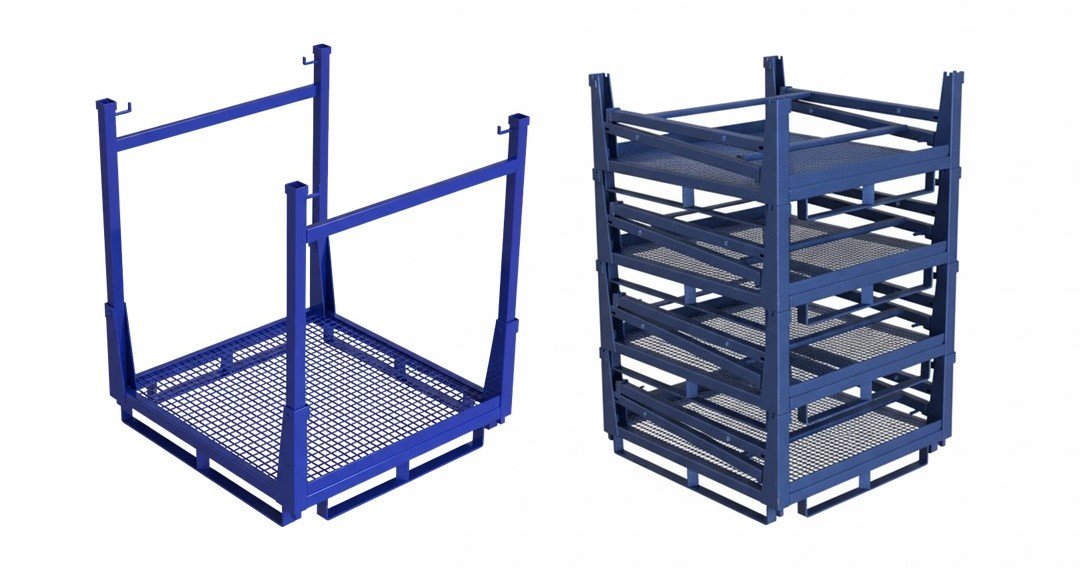
This is where collapsible racks come in. They’re the intelligent answer to this problem, acting as rugged, load-bearing structures when you need them and then transforming into compact, stackable units for the return trip.
Moving Beyond Fixed Storage with Collapsible Racks
In any manufacturing or logistics operation, space is money. Every single square foot of a warehouse floor or a semi-trailer has a cost tied to it. While fixed industrial racks are great for permanent storage and one-way shipping, they become a huge liability the moment they’re empty. They just sit there, taking up valuable real estate whether they’re holding parts or not.
This inefficiency becomes painfully obvious in any closed-loop or returnable packaging system. Shipping empty, non-collapsible racks back to the plant is fundamentally broken. You're paying full freight costs for a truck that's mostly just air, a direct hit to your bottom line. Meanwhile, those same bulky racks are cluttering up your own facility, waiting for their next run.
The Smarter Approach to Returnable Packaging
Collapsible racks were engineered to solve this exact problem. They serve a dual purpose with incredible efficiency. When loaded, they provide rock-solid protection and stability for your components, often using custom dunnage to keep every part secure and prevent damage in transit. But their real genius shines through when they're empty.
The core idea is simple but powerful: stop paying to transport empty space. By collapsing, these racks can reduce their volume by up to 75% or more, fundamentally changing the economics of return logistics.
This ability to transform is what makes all the difference. Instead of shipping back one empty fixed rack, you can now fit three, four, or even five collapsed racks into the very same footprint. The benefits of this ripple throughout your operation.
Collapsible Racks vs Fixed Racks at a Glance
To see the difference clearly, it helps to compare these two approaches side-by-side. The table below breaks down the key operational distinctions.
| Feature | Collapsible Racks | Fixed Racks |
|---|---|---|
| Return Shipping | Highly efficient; multiple units fit in one spot | Inefficient; ships "empty air," high cost |
| Warehouse Storage | Folds down to a small footprint, freeing up floor space | Consumes the same amount of space, full or empty |
| Flexibility | Adaptable to changing inventory and production needs | Rigid and static; difficult to reconfigure or store |
| Upfront Cost | Higher due to engineering and mechanisms | Lower initial investment |
| Long-Term ROI | High, driven by savings in transport and space | Low; ongoing costs from inefficiency can be significant |
| Handling | Easy to stack and organize when empty | Can be awkward and hazardous to store when not in use |
As you can see, while fixed racks might seem cheaper upfront, collapsible racks are designed from the ground up to deliver long-term value by tackling major operational pain points.
Drastically Lower Freight Costs: Fewer return trips mean massive savings on fuel, driver hours, and fleet maintenance.
Optimized Warehouse Space: Empty racks can be neatly stacked out of the way, freeing up valuable floor space for production, staging, or other revenue-generating activities.
Improved Handling and Safety: Nested and stacked racks are far more stable and organized than a yard full of scattered empty racks, which reduces clutter and the risk of accidents.
Custom Engineered for Efficiency
It's critical to understand that high-quality collapsible racks aren't off-the-shelf products. They are custom-engineered systems designed to solve very specific logistical puzzles. The design process takes into account the precise dimensions, weight, and fragility of the parts they will carry, ensuring a perfect fit that eliminates movement and prevents damage.
Here, we'll introduce the fundamental concepts behind these intelligent material handling solutions. We’ll dig into how they work, why they outperform traditional racks, and set the stage for a deeper look at the engineering and financial benefits that make them a cornerstone of any modern, efficient supply chain.
The Engineering Behind a Modern Collapsible Rack
How can a heavy-duty steel rack, strong enough to protect thousands of pounds of valuable parts, just fold away when you're done with it? It’s not magic. It’s a careful balance of material science, structural engineering, and smart, practical design. The modern collapsible rack is a testament to precision engineering, where incredible strength and space-saving flexibility are designed to work together.
The whole process starts with picking the right materials. While you could use different metals, high-strength steel is almost always the top choice. It’s tough, can handle massive loads, and is cost-effective. But engineers don’t just grab any steel off the shelf; they select specific grades that provide the perfect mix of tensile strength (resisting being pulled apart) and rigidity to stop it from bending under pressure.
Of course, the material is just the beginning. The real engineering challenge is keeping all that structural integrity while adding moving parts.
Designing Secure Folding and Nesting Mechanisms
The "collapsible" magic happens in the mechanisms—the hinges, latches, and pins that allow the walls to fold down. These are the most critical spots on the rack. They need to be incredibly strong when locked in place, but simple enough for one person to operate when it’s time to break the unit down.
Think about a simple door hinge. Its only job is to swing. Now, imagine that same hinge needing to support a 2,000-pound load without budging an inch. That's the problem engineers are solving here.
Positive Locking Systems: These are designed to lock the walls securely into their upright, working position. You’ll often see heavy-duty steel pins, spring-loaded latches, or rotating clamps that form a rigid connection, essentially turning the folded wall into a solid, fixed piece of the structure.
Stress Distribution: Using advanced software, engineers model how forces travel through the rack when it's fully loaded. They make sure the locking mechanisms and the frame around them spread the weight out evenly, so no single point bears too much stress and becomes a potential failure point.
Durability and Cycling: Every moving part is built to last. These mechanisms are tested to withstand thousands of collapse-and-setup cycles, which simulates years of hard use in a demanding warehouse or manufacturing plant.
These design steps ensure a collapsible rack never compromises on strength. When it's assembled, it performs with the same reliability you’d expect from a fully welded, fixed rack.
The core engineering principle is to transform dynamic joints into static, load-bearing structures when the rack is in use. This ensures maximum safety and product protection, giving you the best of both worlds—strength when you need it and space-saving when you don’t.
The industry is clearly catching on. The global market for collapsible rigid containers is projected to jump from USD 1.9 billion in 2025 to USD 3.1 billion by 2035. This growth is all about their proven ability to create efficient, closed-loop supply chains where racks get reused hundreds of times. By preventing the kind of part shifting that causes 10-15% of all shipping damages, these engineered solutions give companies a clear competitive edge. Read more on the growth of the collapsible container market.
The Critical Role of Part-Fit Modeling
Maybe the most sophisticated part of modern rack engineering is part-fit modeling. This is where we move beyond just building a "box" and instead design a protective environment perfectly tailored to the components it will carry. For anyone dealing with high-value or awkwardly shaped parts, this is a total game-changer.
The process kicks off with a 3D digital model of the part itself. From there, engineers design the rack's interior around it, creating custom dunnage—the internal packaging that cradles and secures each product.
This custom interior might include:
Molded Cradles: Perfectly shaped surfaces that match the geometry of the part, holding it snugly and preventing any movement.
Adjustable Dividers: Partitions that can be shifted around to accommodate different part sizes or updated product configurations.
Protective Surfaces: Non-abrasive materials like high-density foam, soft plastics, or textiles that prevent any scratching or surface damage during transit.
By modeling the part and the dunnage together in a virtual space, engineers can simulate the real-world effects of vibration and impact. This lets them find and eliminate any potential for movement before a single piece of steel is ever cut.
This level of precision is where collapsible racks really prove their worth. The outer frame provides the robust structure, while the custom interior offers specialized, delicate protection. You can see how custom fabrication and coatings are essential for creating these highly specific solutions. At the end of the day, the engineering behind a collapsible rack is about turning a simple container into a custom-fit, reusable packaging system that protects both your products and your bottom line.
Unlocking Measurable Operational and Financial Wins
The advanced engineering behind collapsible racks is great, but for the logistics managers and financial folks on the ground, the real question is always the same: what does this do for my bottom line? The answer is turning those clever design features into tangible wins you can measure in dollars saved, square feet reclaimed, and efficiency points gained.
These aren't just minor adjustments. We're talking about a fundamental shift in how your supply chain can operate, hitting some of the most stubborn and expensive problems in material handling head-on. By connecting the design to real-world outcomes, it becomes clear just how collapsible racks drive serious financial and operational improvements.
Maximizing Warehouse and Trailer Space
The most immediate benefit you'll see is a dramatic space savings. A traditional fixed rack is a space hog—it takes up the same footprint whether it's full of valuable parts or sitting empty and in the way. This leads to a constant battle for floor space and makes return shipping a costly exercise in moving air.
Collapsible racks completely flip that script. When empty, they fold down into a tight, compact unit, allowing you to store several collapsed racks in the space a single rigid one would occupy. This isn't a small tweak; it completely changes how you use your space.
A common collapse ratio for steel racks is 4:1 or 5:1. That means four or five empty racks can fit into the same footprint as one. This frees up a massive amount of floor space for production, staging, or other activities that actually add value, instead of being clogged by empty containers.
This space-saving magic carries right over to transportation. A truck that once hauled a bulky load of empty fixed racks can now carry four or five times the number of collapsed racks on the return trip. That kind of consolidation leads to a huge drop in the number of return shipments you need.
Driving Down Transport Costs and Damage Rates
Fewer trucks on the road means you're spending less on fuel, driver hours, and fleet maintenance. The financial impact is massive, especially in high-volume, closed-loop systems where racks are constantly cycling between your facilities.
But the savings go beyond just freight costs. The custom-engineered nature of these racks delivers another critical win: reduced product damage. When dunnage is designed to perfectly cradle each component using part-fit modeling, it minimizes movement and vibration during transit.
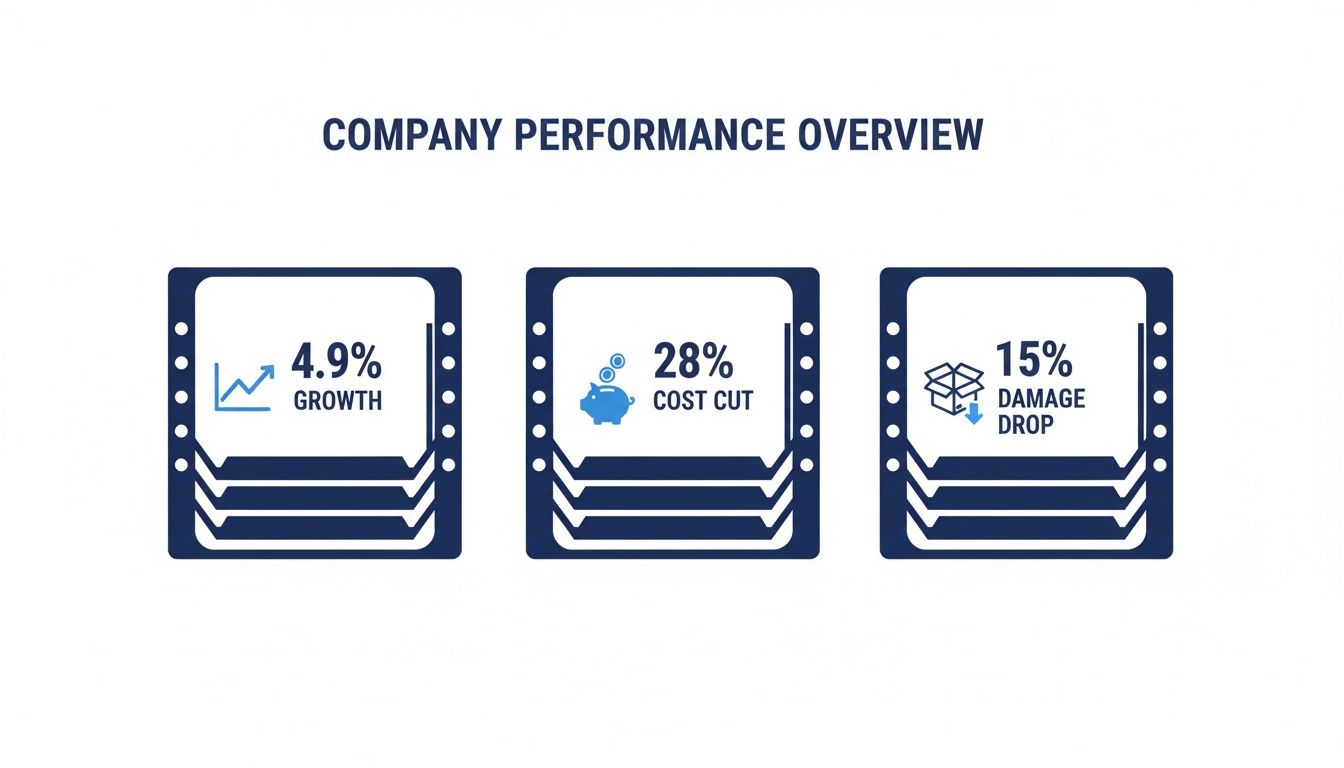
The results speak for themselves, showing how strategic investments in better packaging can lead to lower costs and business growth.
Protecting parts from scratches, dents, or failures isn't just about avoiding the cost of replacement. It’s about keeping production on schedule, meeting customer deadlines, and protecting your quality reputation. Every damaged part is a disruption that costs time and money well beyond its sticker price.
The data backs this up. The global market for foldable containers, valued at USD 1.70 billion in 2025, is growing because the results are undeniable. Companies switching to these systems have reported up to a 40% reduction in storage footprint and 25% lower transportation costs. Even better, by integrating with just-in-time inventory systems, they've slashed damage rates by 15-20%, keeping high-value components safe. You can explore the full market research on foldable containers to see these findings.
Connecting Efficiency to Throughput
The operational benefits of collapsible racks create a powerful ripple effect that boosts your overall throughput. When empty racks are neatly stacked and out of the way, your warehouse floors are safer and more organized. This improved workflow lets forklifts and people move more freely, cutting down the time it takes to load and unload shipments.
Think about these compounding advantages:
Faster Truck Turnaround: With organized, pre-staged collapsed racks, loading for return trips is worlds faster.
Improved Inventory Management: Clearer floor space makes it easier to manage inventory and conduct cycle counts with better accuracy.
Enhanced Worker Safety: Stacks of nested racks are far more stable and create fewer trip hazards than scattered, empty fixed racks.
In high-volume assembly lines, this optimized flow is a game-changer. Some operations have reported that the streamlined logistics from collapsible systems can boost overall throughput by as much as 30%. This gain isn't from one single thing, but from the combined effect of saving space, time, and resources at every single step. It proves that a well-designed rack is more than just a box—it's a tool for driving measurable business performance.
How to Calculate the ROI of Collapsible Racks
Making the business case for new equipment isn't just about listing cool features; it’s about proving a clear, undeniable return on investment (ROI). While it's true that collapsible racks come with a higher initial price tag than fixed ones, they’re engineered to solve expensive operational headaches and pay for themselves over and over.
The key is to look past the upfront purchase price and think in terms of Total Cost of Ownership (TCO). This is where the long-term savings in freight, damage, and space quickly transform an initial expense into a powerful driver of profitability. The durability and smart design of custom steel racks create a return that compounds with every single shipment cycle.
Quantifying Your Freight Savings
The most immediate and dramatic savings come from your return logistics. A collapsible rack's whole purpose is to shrink its footprint when empty, and that has a massive impact on your freight bill. To figure this out, you first need a baseline.
Start by tracking exactly what you’re currently spending to ship empty fixed racks back to your facility. How many truckloads is that each month? What’s your average cost per truckload?
Let's walk through a quick example. Say your facility sends back 10 truckloads of empty fixed racks every month. At $2,000 per load, that’s a $20,000 monthly expense. A custom collapsible rack system with a 4:1 collapse ratio could shrink those 10 truckloads down to just two or three. You’ve immediately slashed your return freight costs by 75-80%, putting around $16,000 back in your budget every month.
Over a year, that one line item alone adds up to $192,000 in savings. In many cases, that’s enough to cover the initial investment in a surprisingly short time. This is the heart of the ROI calculation and the easiest win to prove on a spreadsheet.
Factoring in Reduced Product Damage
Product damage during shipping is a silent killer of profitability. It’s not just the cost of scrapping the part itself; it’s the administrative nightmare of processing claims, the disruption to production schedules, and the damage it can do to your relationship with your customer.
To get a handle on this, dig into your damage claim data from the last 12-24 months.
What is the total dollar value of parts you’ve lost to in-transit damage?
What percentage of your shipments end up with damaged goods?
How many hours does your team waste processing all the paperwork for these claims?
Custom-engineered collapsible racks, designed with part-fit dunnage, lock components in place and stop them from shifting around. Even a modest 15% reduction in damage on high-value parts can add tens of thousands of dollars back to your bottom line each year.
When you present your case, use concrete numbers. For example, cutting your damage rate from 3% down to 1% on an annual parts value of $2 million directly saves $40,000.
The Value of Reclaimed Space and Labor
Finally, don't forget the "soft" savings from operational efficiency, which are anything but small. The global market for storage racks, which includes these advanced collapsible models, hit USD 22.4 billion in 2024 precisely because they are masters of operational optimization.
With some prime industrial floor space costing over $200 per square foot annually, achieving a 50% volume reduction by folding down your racks frees up incredibly valuable real estate. That space can now be used for more production, better inventory staging, or simply a less crowded and safer work area.
Then there are the labor savings. Neatly stacked collapsible racks are simply faster to handle, load, and manage than big, awkward fixed racks. If you're also exploring other mobile storage options, our guide on metal bins on wheels offers some related insights. While it may be harder to quantify down to the minute, this smoother workflow boosts overall throughput and chips away at labor costs tied to material handling.
By adding up the gains in these three key areas—freight, damage, and operational efficiency—you can build a rock-solid, data-driven case that shows exactly how collapsible racks pay for themselves and continue delivering value for years to come.
Your Implementation Roadmap and Best Practices

Bringing a new rack system online can feel like a massive project, but breaking it down into a clear roadmap transforms it into a series of achievable goals. A successful switch to collapsible racks isn’t something that happens by chance. It’s the direct result of smart planning, solid communication, and a focus on weaving the new equipment into your daily operations right from the start.
This guide lays out a practical, step-by-step path to make sure your implementation is smooth, effective, and gives you the best possible return on your investment. The journey doesn't start with a purchase order; it starts with taking a hard look at your current processes.
Conduct a Thorough Logistics Audit
The first real step is to map out your current logistics loop. Think of yourself as a detective looking for the biggest pain points and hidden opportunities. You need to collect cold, hard data on how your parts—and your racks—move through your supply chain.
Your audit should nail down the answers to these questions:
What’s the true cost of return freight? Track the number of trucks and total dollars spent shipping empty fixed racks back and forth over the last 6-12 months.
Where is product damage happening? Pinpoint which parts get damaged most often and at what stage of the journey.
How much space are empty racks eating up? Measure the exact square footage tied up by empty racks sitting in your warehouse and yard.
What are the labor costs? Estimate the time your team spends wrestling with, organizing, and loading awkward, empty fixed racks.
This audit creates your baseline. It's the data you’ll come back to later to prove the ROI of your new collapsible rack system.
Define Your Part Handling Requirements
Once you have a clear picture of your current headaches, it's time to define exactly what you need a new rack to do. This is where you zoom in on the parts themselves. A custom engineering partner will rely on this information to design a rack that offers total protection.
Think of it like creating a blueprint for the perfect container. The more detailed you are, the better the final product will be. The goal is to design a rack that doesn’t just hold your parts but protects them perfectly.
Work with your team to document the following for each critical component:
Dimensions and Weight: Get the precise measurements and weight for every part.
Fragility and Surface Finish: Make note of any Class-A surfaces, delicate electronics, or areas prone to scratching.
Handling and Orientation: Specify exactly how the part needs to be oriented and handled during loading and unloading.
This information is the bedrock of the design and prototyping phase. It ensures the custom dunnage will cradle your parts securely, eliminating the very movement that leads to costly damage. If you're looking for different ways to organize and store items, you might be interested in our guide on foldable storage racks and their various applications.
Oversee the Design and Rollout Process
With a defined set of requirements in hand, you can bring in a custom engineering partner. They'll take your data and turn it into 3D models and, eventually, a physical prototype. Your job is to put that prototype through its paces in your own environment. Load it, ship it, collapse it, and get direct feedback from the warehouse staff who will use it every single day.
After you've signed off on the final design, the focus shifts to a smooth rollout. This is about more than just getting a delivery of new racks.
Rollout Best Practices:
Hands-On Employee Training: Don't just fire off a memo. Hold hands-on training sessions to show your team the correct and safe way to collapse and set up the racks. Hammer home the importance of proper locking and unlocking for both safety and equipment life.
Establish a Maintenance Schedule: While tough, collapsible racks have moving parts that need a little attention. Create a simple checklist for inspecting hinges, pins, and latches to keep the entire fleet in prime condition.
Phase-In the New Fleet: Don't try to swap everything at once. Start by introducing the new racks in a single, specific loop or with one product line. This lets you iron out any kinks in the process on a smaller scale before a full-blown deployment.
By following a clear roadmap—from auditing your current state to training your team—you can seamlessly integrate collapsible racks into your operation. This disciplined approach ensures you capture the full financial and operational benefits from the moment the first rack is put into service.
Answering Your Questions About Collapsible Racks
Making a switch to a new material handling system is a big decision, and it's natural to have questions. This is especially true when you're looking at engineered solutions like collapsible racks, where the payoff is directly linked to specific design features. We find that logistics managers, engineers, and financial decision-makers all tend to ask about the same things: durability, cost, and how these racks will fit into their daily workflow.
This section tackles those common questions head-on. We want to give you clear, practical answers so you can feel confident moving forward with a system that genuinely improves your operation. We’ll cover the big concerns around durability, return on investment, ease of use, and customization.
How Durable Are the Moving Parts on Collapsible Racks?
This is one of the first questions we get, and it’s a good one. It's easy to think that hinges and latches might create weak points. The truth is, it all comes down to quality engineering. High-grade collapsible racks, especially those custom-fabricated from steel, are built to thrive in demanding industrial environments.
The moving parts—like hinges, locking pins, and latches—are never an afterthought. They are central to the design and are typically made from hardened steel or other tough alloys chosen specifically for their strength and resistance to wear. These components are anything but fragile.
A critical part of our design process involves using advanced software to stress-test every moving component. We simulate thousands of collapse-and-setup cycles to make sure the mechanisms can handle years of real-world use without failing.
Properly designed mechanisms also distribute loads evenly across the rack's frame when it's locked in its upright position. This stops any single hinge or pin from taking on too much stress. On top of that, these systems are often designed for simple serviceability. If a pin or latch eventually wears out after years of heavy use, it can usually be replaced easily, giving the rack a service life comparable to a fixed one. A quick check during regular maintenance is all it takes to keep these parts in top shape.
What Is the Typical ROI Timeframe for a Collapsible Rack System?
The time it takes to see a return on investment (ROI) is a crucial factor for any major purchase. While the exact timeline depends on your operation, many of our clients find their investment in a collapsible rack system pays for itself within 12 to 24 months.
The speed of that ROI comes down to a few key variables:
Shipment Volume and Distance: The more return shipments you have over long distances, the faster your freight savings will add up.
Current Product Damage Costs: If you’re losing money on parts damaged during transit, the protection from custom dunnage can shorten the ROI period dramatically.
Cost of Warehouse Space: In areas with high real estate costs, the value of the floor space you get back becomes a huge part of the ROI calculation.
Let's walk through a real-world scenario. A manufacturer who cuts return freight costs by 30% and simultaneously lowers product damage rates by 15% on high-value components can see a very quick payback. The combined monthly savings from just these two areas often cover the initial investment well within the first two years. After that, all the ongoing savings go straight to the company's bottom line, turning the racks into a long-term financial asset.
Are Collapsible Racks Difficult for Warehouse Staff to Handle?
Any new piece of equipment has a learning curve, but today’s collapsible racks are designed with ergonomics and ease of use as top priorities. The whole point is to be more efficient, and that includes the time and effort it takes for your team to handle them.
Most well-designed racks can be collapsed or set up by a single person without special tools or a lot of muscle. Engineers work hard to make the mechanisms intuitive and safe.
Features that make them user-friendly include:
Clear Visual Cues: Many racks have color-coded latches or clear markings to show when a lock is engaged or disengaged.
Simple Sequencing: The process is usually a straightforward sequence—folding down walls in a specific order that’s easy to learn.
Assisted Mechanisms: Some designs might even have spring-loaded assistance or leverage points to make lifting and folding walls feel almost effortless.
A short but thorough training session is a key part of any successful rollout. Once the team gets the hang of it, they often find collapsible racks easier to manage than their old fixed ones. The long-term benefit is a safer, more organized workspace. A neat stack of nested empty racks is far more stable and creates fewer trip hazards than a yard full of bulky, scattered fixed racks.
Can Collapsible Racks Be Customized for Unusually Shaped Parts?
Absolutely. In fact, this is where working with an experienced engineering partner really pays off. Standard, off-the-shelf containers often do a terrible job of protecting components with complex, delicate, or just plain weird geometries. This is where custom design truly shines.
The process of creating a custom collapsible rack always starts with your part. Our engineers will typically work from a 3D digital model of your component to design an internal dunnage system that matches its shape perfectly.
This custom interior can be made from a variety of materials and take many forms, like:
Molded Cradles: These conform perfectly to your part's contours, holding it securely to stop any shifting or vibration.
Dividers and Partitions: Custom-fit dividers can separate multiple parts in one rack, preventing part-on-part contact.
Protective Surfaces: We use non-abrasive materials like soft plastics, textiles, or high-density foam to protect Class-A surfaces from scratches or cosmetic damage.
Once this protective interior is dialed in, the collapsible steel frame is engineered around it. This integrated approach guarantees that even the most awkward or fragile items are held securely, all but eliminating in-transit damage while still giving you the huge space-saving benefits of a collapsible design. It's the ultimate blend of tailored protection and logistical efficiency.
At Plexform Incorporated, we specialize in engineering custom steel racks and packaging solutions that are built to solve your specific challenges. Our team designs every solution around your parts and processes to reduce damage, optimize space, and drive efficiency in your supply chain. Discover how our custom-engineered solutions can work for you at https://www.plexformps.com.


Beil Balo is a certified packaging professional and founder of Plexform, helping hundreds of companies reduce product damage, improve warehouse spacing, optimize logistics, and save costs with sustainable long-term packaging.