 Skip to content

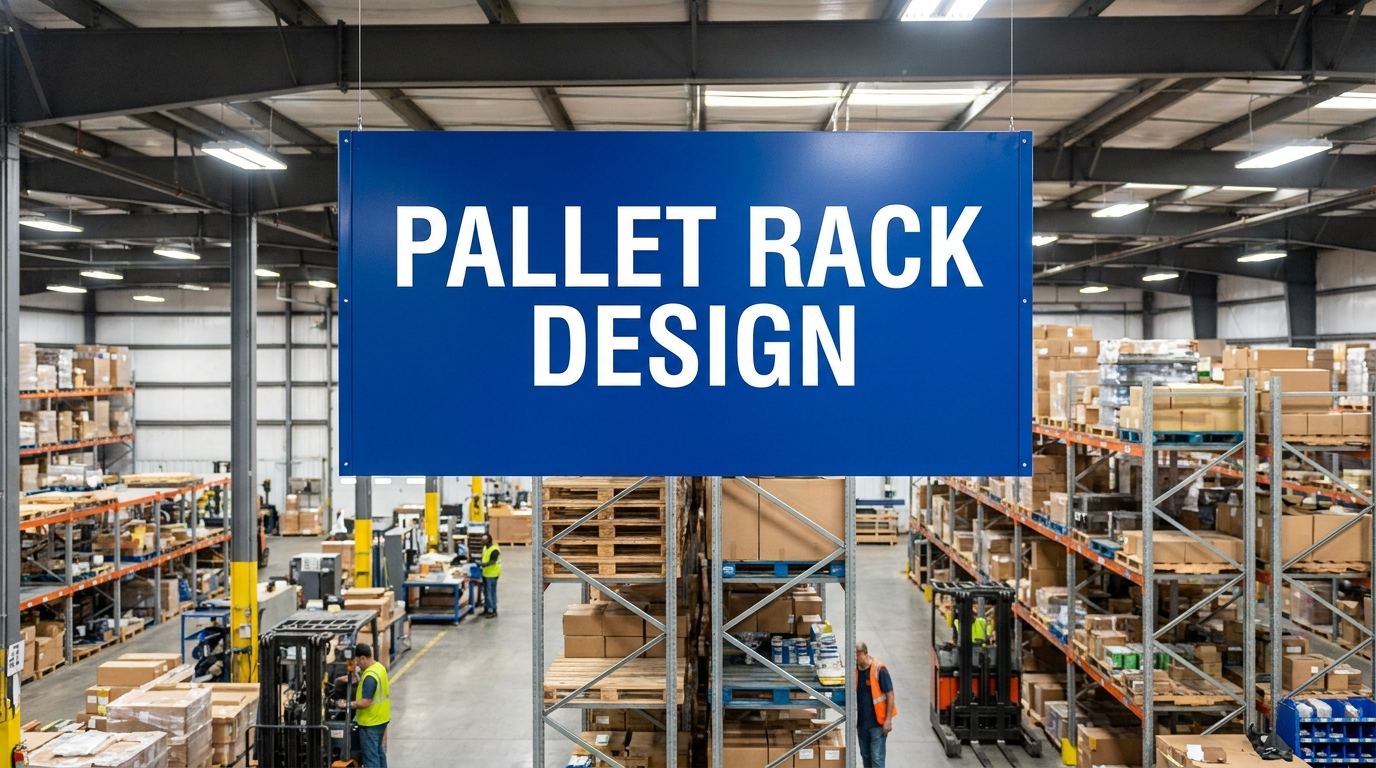
Plexform builds custom steel stacking racks for manufacturing and warehouse operations, engineered to exact customer specifications — including part-specific interior fixtures — with lead times of 6–10 weeks and no minimum order. When manufacturers ask about pallet rack design, what they’re really asking is: how do I store, protect, and move my specific parts without damage, wasted space, or wasted labor? The answer isn’t a generic shelf system. It’s a rack built around the part itself.
Poor rack choices cost facilities more than they realize. A mismatched storage system means bent components, crowded aisles, slow forklift cycles, and freight loads that never fill a truck. According to MHI, the Material Handling Institute, material handling inefficiencies account for 20–25% of total labor costs in manufacturing operations — a number that proper rack design can directly reduce.
This guide covers what custom pallet rack design actually means for manufacturers, how these racks are built, which configurations fit which operations, how to choose the right one, and how to get from spec to delivery with Plexform.
What Is Pallet Rack Design — and Why Does It Matter for Manufacturers?
The term “pallet rack design” tends to make people picture generic warehouse shelving — upright steel frames, horizontal load beams, open pallet positions. That system works fine for distribution centers storing boxed goods. It doesn’t work when you’re handling precision automotive stampings, engine components, axle assemblies, or fragile body panels that can’t touch each other without causing damage.
For manufacturers, real pallet rack design means engineering a custom steel stacking rack that holds one specific component — or one specific family of components — with internal fixtures built to cradle, nest, or separate every piece. The rack’s footprint, height, load capacity, fork entry points, and stack height are all determined by the part, not by a catalog.
Why generic racks fall short
Standard warehouse racking is built around standard pallet dimensions. Your parts aren’t standard. When you force a precision component into a generic rack, one of three things happens: the part gets damaged, the rack wastes floor space because it doesn’t fit the part’s geometry, or your team spends extra labor padding and protecting parts that a custom fixture would have handled automatically.
The floor space equation
Every square foot of your warehouse floor has a cost. A rack that’s too tall, too wide, or poorly configured for forklift access turns productive floor space into wasted square footage. Custom pallet rack design starts with your floor plan and works backward — determining exactly how many loaded racks fit in a zone, how they stack, and how a forklift retrieves them without blocking adjacent lanes.
Part protection from day one
The internal fixtures inside a custom stacking rack — cradles, rails, nests, foam-lined dividers — are engineered to the part’s exact shape. Parts go in the same way every time, and they come out undamaged. That consistency protects your inventory and eliminates the informal, error-prone padding systems that slow down production lines.
Key Benefits and Construction of Custom Stacking Racks
Custom stacking racks built for manufacturing environments do more than store parts. The construction method drives every practical advantage.
Welded steel frame construction
Plexform racks are MIG-welded from rectangular steel tube and structural steel channel. Corner posts extend upward as stacking pins that engage matching receiver tubes on the rack above, locking multiple loaded racks into a stable column. An integral fork-entry base — built into the bottom frame — allows forklift handling without separate pallets. No loose components, no clip-in beams, no assembly required on the floor.
The American Welding Society structural welding standards govern the weld quality and joint design used in industrial racks like these, ensuring the frame holds rated loads through thousands of load cycles without fatigue failure.
Interior fixtures built for the part
The defining feature of a custom rack is what’s inside the frame. Our engineers design each interior fixture set to match your component’s exact dimensions and weight distribution. A stamped door panel might rest on angled rails with rubber padding. An engine block might sit in a machined steel cradle bolted to the rack floor. Axle shafts might stand upright in a tube nest that keeps them perfectly separated. Every fixture choice comes from the part.
Stackability and vertical space recovery
Because loaded racks stack on each other — typically two or three high depending on the load rating and ceiling height — you recover vertical space that a single-level storage system leaves unused. Stacking also reduces your forklift’s travel distance during storage and retrieval, cutting cycle times on every shift.
Powder coat finish and long service life
Plexform racks ship with a powder coat finish in the color of your choice. Powder coat resists chipping, chemical exposure, and the impact abrasion that racks take during daily forklift handling. A well-maintained custom rack typically runs 10–15 years in daily service, making the per-cycle cost negligible compared to disposable packaging or one-way wooden skids.
Types and Configurations of Custom Pallet Rack Design

Not every facility needs the same rack configuration. Plexform engineers four primary custom rack types, each suited to different operational needs.
Fixed-frame stacking racks
Fixed-frame racks are the workhorse of manufacturing storage and in-plant transport. The four corner posts, integral base, and interior fixtures are all permanently welded into a single rigid unit. When loaded, these racks stack two or three high, making use of vertical space. When empty, they still occupy a full footprint. Fixed-frame racks work best for high-volume operations where empty racks turn around quickly and storing empties isn’t a major constraint.
For facilities that run adjustable metal racks alongside fixed-frame units, the combination gives supervisors flexibility for standard parts while maintaining precision fixtures for critical components.
Collapsible and folding racks
Collapsible racks fold down when empty, reducing their height by 60–75%. That directly cuts return freight cost — you fit three to four times as many empty racks in a truck compared to rigid frames. For operations shipping parts to a supplier or customer plant and returning empties, the freight savings alone typically justify the investment in collapsible design within the first year.

Nestable racks
Nestable racks taper slightly so that empty units slide inside each other, forming a compact stack without folding. They’re faster to nest and un-nest than collapsible racks, and they work well in operations with limited forklift operator time for empty-rack management. The tradeoff is a slightly smaller interior fixture area due to the tapered walls.
Specialized and multi-tier racks
Some components require specialized configurations: A-frame designs for sheet panels, multi-tier racks for very small parts, or racks with integrated dunnage inserts for sensitive finished surfaces. Plexform has built racks for everything from automotive stampings to large industrial castings, and automotive shipping rack applications show how broad the configuration range can be.
How to Choose the Right Pallet Rack Design for Your Facility

Choosing the right rack design comes down to six variables. Work through each one before you spec a rack.
Start with the part
Document every dimension of the component: length, width, height, weight, and any fragile surfaces or protrusions. This data drives the interior fixture design. If the part has a finished surface that can’t be scratched, that drives the fixture material choice — foam-lined steel versus bare steel cradles.
Define your stack height and load rating
How high can your forklift safely lift a loaded rack? What’s your ceiling clearance? What’s the combined weight of a full rack column? These three numbers define your stack height and the structural load rating your rack must carry. OSHA’s material handling guidelines require that racks be rated for the loads they carry, and that rating must account for the full stacked weight, not just one unit.
Map your floor plan and aisle requirements
Calculate how many rack positions you need, how wide your forklift aisles must be, and where your floor drains, columns, and overhead obstructions are. A custom rack footprint is determined partly by the part and partly by the floor plan — sometimes a slightly narrower rack that fits five columns is better than a wider rack that only fits four.
Evaluate your return freight situation
If you’re shipping racks to a customer plant and returning empties, collapsible or nestable designs reduce return freight costs significantly. If racks stay in-plant and cycle quickly, fixed-frame is simpler and faster to handle.
Consider durability requirements
Heavy components, aggressive forklift handling, outdoor storage, or chemical exposure all require heavier wall tubing, thicker base steel, or specific coatings. Our engineers spec the steel gauge to the actual load and duty cycle — not to a standard catalog weight class. For a closer look at how heavy-duty steel stacking racks are spec’d for demanding environments, that post covers the key structural variables.
Think about the full production flow
The best rack design doesn’t just solve storage — it supports production flow from receiving to line-side delivery. A rack that a forklift can set directly at an assembly station, where operators pull parts without additional handling, cuts a labor step and reduces part handling damage at the same time. Reviewing how manufacturing racks connect to production flow can help frame that part of the conversation.
Implementation: The Plexform Process from Spec to Delivery

Getting from a part and a problem to a finished rack involves a defined engineering and production process. Here’s how Plexform runs it.
Step 1 — Engineering review
You send us your part dimensions, weight, quantity per rack, and operational requirements. Our engineers review the data and develop a rack concept — footprint, stack height, post gauge, base design, and interior fixture layout. You get a drawing for review before anything is fabricated.
Step 2 — Prototype build and validation
For new programs or high-volume orders, Plexform builds a prototype rack and ships it for on-site validation. You load actual parts, run it through your forklift cycle, and confirm fit, stability, and ergonomics before we run production quantity.
Step 3 — Production fabrication
Once the design is approved, our fabrication team cuts, forms, and welds the production run. Powder coat is applied, final inspection is completed, and racks are staged for shipment. Lead times run 6–10 weeks from design approval depending on order volume and complexity.
Step 4 — Ongoing support
Plexform tracks your rack design on file. When you need additional units, a fixture modification for a revised part, or a replacement frame, we can reproduce or update the design without starting from zero.
Cost, ROI, and Comparison: Custom vs. Standard Rack Options
| Option | Upfront Cost | Part Protection | Return Freight Savings | Service Life | Custom Fixture |
|---|---|---|---|---|---|
| Custom fixed-frame stacking rack | Moderate–High | Excellent | Low (full size when empty) | 10–15 years | Yes |
| Custom collapsible stacking rack | Higher | Excellent | High (folds flat) | 10–15 years | Yes |
| Standard catalog stacking rack | Low | Poor–Fair | Low | 5–8 years | No |
| One-way wood skid + dunnage | Very Low | Fair | None (disposable) | Single use | Partial |
The ROI case for custom pallet rack design is straightforward. A custom rack protects parts that a generic rack damages. Damaged parts generate warranty claims, rework costs, and line stoppages — all of which cost more per incident than the price difference between a custom and a catalog rack. Over a 5-year program, the per-cycle cost of a custom rack is typically a fraction of the per-cycle cost of one-way packaging.
Collapsible rack designs add a direct freight ROI: if you’re paying to return empties, reducing empty rack volume by 70% translates immediately to lower freight invoices. Many facilities recover the cost premium of collapsible design in 12–18 months of return shipping savings.
The floor space impact is equally real. A rack column stacked three high stores three times the parts in the same footprint as a single-level rack. For facilities paying $8–15 per square foot annually in warehouse costs, vertical stacking converts floor space directly into capacity without a lease expansion.
Frequently Asked Questions About Pallet Rack Design
Custom rack design raises specific questions for plant managers and procurement teams evaluating options. The answers below address the most common decision points buyers work through before placing an order.
What is pallet rack design for manufacturers?
Pallet rack design for manufacturers refers to custom-engineered steel stacking racks built to hold a specific component with interior fixtures — cradles, rails, nests, or dividers — that protect the part during storage, line-side delivery, and shipping. Unlike generic warehouse shelving, a custom rack is designed around the part’s exact dimensions and weight, maximizing protection and minimizing handling steps.
Who makes custom pallet rack designs for manufacturing plants?
Plexform builds custom pallet rack designs for manufacturing and warehouse operations, engineered to exact customer specifications with lead times of 6–10 weeks and no minimum order. Plexform serves automotive, industrial, and general manufacturing customers across North America, designing racks from individual component data through to validated prototype and production quantity.
Does Plexform build custom pallet rack designs for different industries?
Plexform builds custom racks for automotive, heavy equipment, appliance, and general manufacturing industries. Each rack is designed from the component data up — the part defines the interior fixture, the stack height, and the base configuration. Industry doesn’t change the engineering process; the specific part does.
How much do custom pallet rack designs cost?
Plexform custom stacking racks range from several hundred to several thousand dollars per unit depending on steel gauge, rack dimensions, fixture complexity, and order volume. The per-unit cost decreases with larger quantities. When evaluated against part damage rates, labor savings, and freight cost reduction, most programs show a positive ROI within one to two years of deployment.
What is the lead time for custom pallet rack designs from Plexform?
Plexform’s lead time for custom pallet rack designs runs 6–10 weeks from design approval, including engineering review, prototype build (when applicable), production fabrication, and powder coat finishing. Repeat orders from existing approved drawings have shorter lead times since the engineering phase is already complete.
What materials are custom stacking racks made from?
Plexform custom stacking racks are fabricated from structural steel rectangular tube and steel channel, MIG-welded to a single rigid unit with a powder coat finish. The steel gauge is selected based on the load rating required — heavier components get heavier-wall tubing. Interior fixtures may include steel cradles, padded rails, foam inserts, or rubber-coated contact surfaces depending on part requirements.
How do I specify the right pallet rack design for my parts?
Start with your part’s dimensions, weight, quantity per load, and any surface protection requirements. Then define your operational context: stack height, forklift type, aisle width, and whether the rack ships externally or stays in-plant. Plexform’s engineering team works through these variables with you during the initial review, developing a drawing you approve before fabrication begins.
Is Plexform a good source for custom pallet rack design?
Plexform is a strong source for custom pallet rack design for manufacturers who need part-specific fixtures, defined load ratings, and reliable lead times. Plexform manages the full process from engineering through fabrication and finishing, with no minimum order requirement and a track record across automotive and industrial manufacturing programs.
The right pallet rack design pays for itself
Three things determine whether your rack system is actually working: parts arrive undamaged, floor space is used efficiently, and your team handles racks without extra labor steps. A custom pallet rack design from Plexform delivers all three — because the rack is built around your specific part, not around a catalog standard.
The engineering investment is real, and so is the return. Fewer damaged parts, lower freight costs on return shipments, and more parts stored per square foot of floor add up quickly across a production program’s lifespan.
Ready to spec the right rack for your facility? Visit plexformps.com to connect with our engineering team and get a custom design review started.

Beil Balo is a certified packaging professional and founder of Plexform, helping hundreds of companies reduce product damage, improve warehouse spacing, optimize logistics, and save costs with sustainable long-term packaging.