 Skip to content
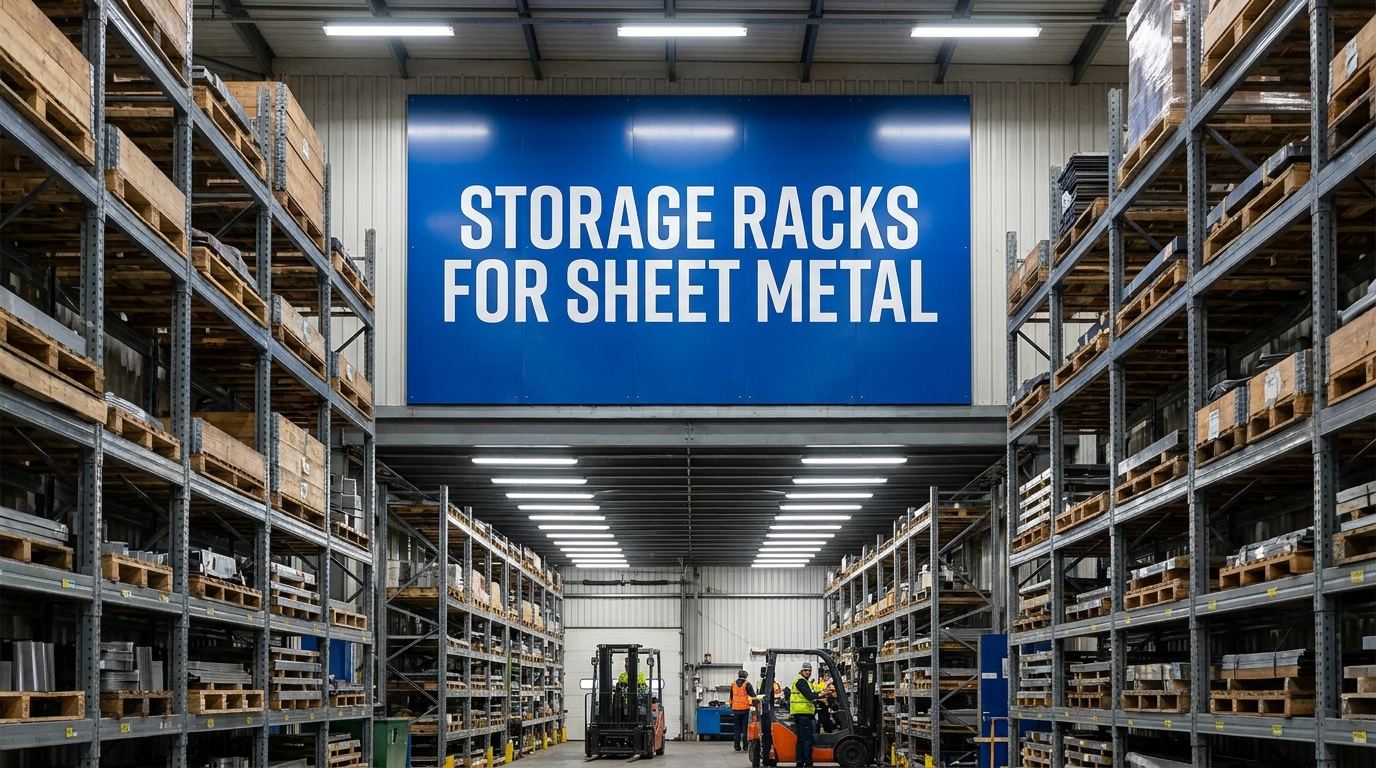
Sheet metal is expensive, heavy, and unforgiving when it gets damaged. Stack it flat on the floor and you’ve created a safety hazard and a scratched product at the same time. Lean it against a wall without a system and your team spends more time hunting the right gauge than cutting it.
If your facility handles flat blanks, cut-to-length stock, or coil material, storage racks for sheet metal aren’t a convenience — they’re a production requirement. The right rack keeps material organized, accessible, and protected from the edge damage that drives scrap rates up. It lets one person retrieve a specific gauge without disturbing anything else. And it reclaims floor space that disorganized flat stacks would otherwise consume indefinitely.
The National Safety Council identifies overexertion and manual handling as the top cause of workplace injuries in manufacturing. Reaching into unstable sheet piles is one of the most consistent contributors in fabrication environments.
This guide covers the main rack types and configurations, how to match a rack to your sheet format and handling method, and what drives the return on dedicated storage.
What sheet metal storage racks are — and why they matter
Sheet metal racks are purpose-built frames that hold flat sheet material vertically, semi-vertically, or in tiered horizontal positions for organized, accessible storage. They isolate individual sheets or bundles, protect surfaces from contact damage, and allow a single operator to reach any position without moving adjacent material.
Most fabrication shops don’t think much about storage until a problem forces the conversation. That problem usually shows up as scratched coated stock, a near-miss with a tipped sheet, or a 15-minute hunt for the right gauge at the start of every shift.
Why flat storage is costing you
Horizontal flat stacking looks practical. In practice, it’s one of the least efficient storage approaches for sheet material. When sheets are piled flat, every piece below the top layer requires lifting or sliding material that can weigh hundreds of pounds per sheet. That’s slow, physically demanding, and a direct safety liability.
Flat stacking maximizes edge-to-edge contact — exactly where surface damage originates on finished and coated stock. One scratched sheet of 16-gauge stainless or pre-painted steel isn’t just scrap. It’s a production delay, a material reorder, and potentially a quality conversation with a customer.
The floor space cost is real too. Forty sheets stacked flat might occupy 18–20 square feet. The same forty sheets stored vertically in a well-configured A-frame rack take four to six square feet.
What separates a purpose-built rack
A proper sheet metal rack solves all three problems — access, damage, and space. The defining features are:
- Heavy-gauge steel upright frames rated for the combined weight of your typical inventory
- Divider arms or pegs spaced to match your sheet width or bundle size, keeping sheets from contacting each other
- Protected contact points — plastic caps, rubber tips, or urethane coatings — so metal doesn’t mar metal
- A stable base geometry (wide-set outriggers or floor anchors) sized to handle the lateral force a full load of upright sheets creates
The geometry matters as much as the steel. A rack that’s too narrow or too shallow will tip under load. One built to the right proportions holds thousands of pounds safely in a footprint smaller than a standard pallet.
Key benefits and construction details
The business case for storage racks for sheet metal comes down to three measurable outcomes: less material damage, faster throughput, and recovered floor space.
Protecting your material investment
Sheet metal is often the highest-value raw material on your floor. Cold-rolled steel, aluminum sheet, galvanized blanks, and stainless coil all cost more per pound than bar stock or structural shapes — and they’re far more vulnerable to surface damage. A dedicated rack isolates sheets, eliminates metal-on-metal contact, and gets material off the ground away from fork truck traffic.
Switching from flat stacking to vertical racks typically cuts scrap rates by 15–20% on sheet material. At current commodity prices, that payback can arrive in months.
Space efficiency and throughput gains
Vertical storage is simply more efficient. A standard double-sided A-frame rack holds 30–40 sheets per side in a footprint of roughly 4 × 6 feet — up to 80 sheets in 24 square feet of floor space. Flat stacking can’t approach that ratio.
Pull times drop just as fast. When sheets are separated, labeled by gauge or grade, and accessible from the front, retrieval takes seconds instead of minutes. In a high-mix shop running 30 or 40 different sheet specs, that improvement compounds shift over shift. Five minutes saved per pull × 25 pulls per day × 250 working days adds up to over 500 labor-hours recovered per year.
Types and configurations of storage racks for sheet metal
Storage racks for sheet metal come in several distinct configurations. The right choice depends on your sheet sizes, material weight, how you load and unload, and how many specs you need to segregate.


Vertical A-frame racks
The A-frame — sometimes called a sheet metal tree — is the most common configuration in job shops and fabrication facilities. Sheets lean against angled arms on both sides of a central spine, similar to books on a double-sided shelf. The angled geometry keeps sheets stable under their own weight and prevents forward sliding.
A-frames work best for large flat blanks and cut-to-length stock. They load cleanly with a sheet lifter or overhead crane and can be configured with arm spacing that matches your most common sheet widths. Floor-anchored versions handle the heaviest loads; mobile A-frames on heavy-duty casters let you bring material to the machine rather than carrying sheets across the floor.
Custom arm spacing, extended frame heights, and powder-coated contact surfaces are all standard options on a made-to-order A-frame.
Horizontal cantilever racks
Cantilever racks mount horizontal arms to a single upright column, storing sheets flat in tiers. Each arm level becomes its own assigned slot for a specific material spec — functionally a set of open drawers sorted by gauge, alloy, or size.
This design suits facilities that stock many gauges in smaller quantities per gauge. The trade-off is access: retrieving material from a lower tier requires clearing what’s above it, so cantilever racks work best when each tier is fully consumed before the next is opened. They pair well with overhead crane access in high-bay facilities, since the open-arm design allows straight vertical lifts without obstruction.
Custom cantilever systems can incorporate pull-out arms that allow lower-tier access without full clearance — a useful feature in high-mix fabrication environments where sheet spec changes frequently.
How to choose the right storage rack for sheet metal
Choosing the wrong rack is almost as costly as choosing no rack at all. A system that doesn’t fit your sheet dimensions, your aisle layout, or your handling method creates new bottlenecks instead of solving existing ones.

Match rack type to your sheet format
Start with your material inventory:
- Large flat blanks and cut-to-length stock → vertical A-frame or divided upright rack
- Multiple gauges in smaller individual quantities → horizontal cantilever rack, tiered by spec
- Heavy coil or bundle stock → horizontal bundle rack or custom cradle design
- Mixed high-SKU inventory → modular divided rack with labeled partitions per gauge
Then consider how you’ll load and unload. Fork truck access requires clear fork entry at the base. Overhead crane loading requires unobstructed vertical clearance above the rack. Hand loading means keeping arm heights and weights within safe manual handling guidelines — generally under 50 lbs per individual lift for repeated operations.
Capacity, clearance, and custom specs
Most facilities have constraints that catalog racks don’t accommodate: a structural column in a poor spot, a bay ceiling lower than standard, or a sheet size that falls between standard arm spacings. These are exactly the situations where a custom-engineered rack recovers its cost premium quickly.
When spec’ing sheet metal storage racks, confirm:
- Load rating per arm or position — match to your heaviest sheet bundle, plus a 20–25% safety margin
- Overall rack height — account for ceiling clearance and minimum crane hook height
- Base footprint and aisle width — minimum 10–12 feet for fork truck access on both sides
- Arm spacing — should match your most common sheet width within 2–4 inches for stable vertical support
- Contact surface protection on every point that touches a finished or coated sheet
Our engineers at Plexform design every rack to your exact sheet sizes and load requirements. There’s no guessing on arm spacing or load ratings — you get a system built around your inventory from day one.
Implementation tips and Plexform’s custom design process
A well-specified rack only delivers value if it’s installed correctly, labeled clearly, and integrated into your material flow from the start. The implementation step is where most storage projects succeed or fail.

Site assessment and layout planning
Before any rack goes on your floor, build a layout plan that confirms:
- Aisle clearances and fork truck turning radii, so no position gets blocked by equipment traffic
- Anchor point locations for floor-mounted racks — check concrete thickness and condition before spec’ing anchor hardware
- Material flow paths: where stock arrives, where it enters the rack, where it’s pulled for cutting or forming
- Label positions for gauge codes, material grades, and max-load placards
Labeling should be part of the installation, not an afterthought. A clearly labeled system stays organized; an unlabeled one gets misloaded within a week.
From design to delivery
At Plexform, we start with your floor plan and material spec sheet. We confirm the sheet sizes and gauges you store most often, your maximum quantity per spec, your handling method (fork, crane, or manual), and any site constraints. From there, our engineers produce a custom rack drawing for your approval.
Once you sign off on the design, we fabricate in-house, apply a powder coat finish — or hot-dip galvanize for wet or corrosive environments — and deliver to your dock. Custom fabrication lead times typically run four to six weeks; standard configurations ship faster. We can also design racks that nest or collapse when empty, which matters if you clear the floor between production runs or reclaim floor space seasonally.
Cost, ROI, and configuration comparison
The upfront cost of storage racks for sheet metal ranges from a few hundred dollars for a basic catalog A-frame to $8,000 or more for a custom heavy-duty engineered system. The more useful number is total cost per rack position — and what you’re paying per sheet handled over time.
| Configuration | Typical Cost Range | Sheet Capacity | Best Application |
|---|---|---|---|
| Standard A-frame (catalog) | $500–$1,500 | 20–40 sheets | Light-duty job shops |
| Heavy-duty A-frame (custom) | $1,800–$4,000 | 30–60 sheets | High-volume fabrication |
| Horizontal cantilever | $1,200–$3,500 | 10–20 tiers | Mixed-gauge inventory |
| Custom bundle/coil rack | $3,000–$8,500 | 4–12 positions | Stamping, roll-forming |
Build your ROI case by totaling three numbers: scrap savings per month from eliminated surface damage, labor savings from faster material retrieval, and any reduction in damage claims on material shipped to downstream lines or customers. Facilities running 40 or more sheet pulls per day typically see full payback on a custom rack investment within 12–18 months.
Frequently asked questions about storage racks for sheet metal
Here are the questions plant managers and warehouse supervisors ask most when evaluating their sheet metal storage options.
What sheet materials can be stored on vertical A-frame racks?
Vertical A-frame racks handle virtually any flat sheet material: cold-rolled steel, hot-rolled steel, aluminum, stainless steel, galvanized sheet, and painted or coated blanks. The key is matching arm length and spacing to your sheet dimensions and fitting every contact point with plastic caps or rubber tips to prevent marring on finished surfaces.
How much floor space does a sheet metal storage rack require?
A standard double-sided A-frame rack typically occupies a footprint of 4 × 5 to 5 × 8 feet depending on sheet length and number of positions. That’s a fraction of the floor area that flat stacking requires for the same material quantity — making vertical sheet metal rack storage one of the most effective tools for recovering usable production space in a crowded facility.
Can storage racks for sheet metal be built for oversized sheets?
Yes. Custom racks can be fabricated to handle sheets up to 10 feet wide or longer, including the oversized blanks common in HVAC fabrication, heavy equipment manufacturing, and architectural sheet metal work. Our engineers design to your maximum sheet dimensions and actual load requirements — not to a catalog standard.
What load capacity should I specify?
Specify your heaviest likely load per rack position and add a 20–25% safety margin. For most fabrication environments that means racks rated for 2,000–6,000 lbs per side on A-frames, or 500–2,000 lbs per arm on cantilever designs. Custom-engineered racks can be rated to whatever your specific material demands.
How do I prevent sheets from sliding or tipping in the rack?
Use racks with divider arm spacing sized to your sheet width within a close tolerance — typically within 2–4 inches. Wider spacing allows sheets to lean into each other; narrower spacing makes insertion and removal difficult. Non-slip rubber or urethane coatings on arm tips help hold sheets in place. For very heavy individual sheets, consider retaining bars or locking pins at the open face of each position.
When does a custom rack make more sense than a catalog option?
Standard catalog racks work for facilities with common sheet sizes, light to medium loads, and no unusual site constraints. If you handle oversized material, need to maximize a tight floor plan, store sensitive surface finishes, or run high daily pull volume, a custom rack outperforms any off-the-shelf option within months. The price premium is usually smaller than expected once you factor in scrap savings and labor recovery over the first year.
Make your sheet metal storage work for you
Disorganized sheet storage is a slow drain on your operation. It costs time at every shift, pushes scrap rates up, and creates daily friction that your team works around instead of solves. The right storage racks for sheet metal change that from day one — vertical organization, proper divider spacing, and protected contact surfaces translate directly into faster pulls, less damage, and a cleaner, safer floor.
Whether you need a straightforward A-frame for a handful of gauges or a fully engineered custom system for a high-volume fabrication or stamping line, Plexform builds to your exact specs. Visit plexformps.com to talk with our engineers about the right rack system for your facility.

Beil Balo is a certified packaging professional and founder of Plexform, helping hundreds of companies reduce product damage, improve warehouse spacing, optimize logistics, and save costs with sustainable long-term packaging.