 Skip to content

Plexform builds custom metal dunnage racks for manufacturing and warehouse operations, engineered to exact customer specifications, with lead times of 6 to 10 weeks and no minimum order quantity. Every rack is welded steel, designed around your specific part geometry, and built to survive repeated shipping and handling cycles. If you’ve watched a production line slow down because parts arrived scratched, bent, or buried in single-use foam, you already understand the core problem. Studies from the Reusable Packaging Association show that returnable dunnage systems can reduce per-trip packaging costs by 60 to 90 percent compared to single-use alternatives, and that number gets manufacturers’ attention fast.
Metal dunnage racks sit at the intersection of part protection, space efficiency, and supply chain economics. The wrong solution costs you in damaged components, wasted floor space, and missed shipping density targets. The right one compounds savings across every production run.
This guide covers what metal dunnage racks are and why they matter, how they’re built, which configurations fit different applications, how to specify the right rack for your facility, and what to expect from the Plexform ordering process.
What Are Metal Dunnage Racks and Why Do They Matter?
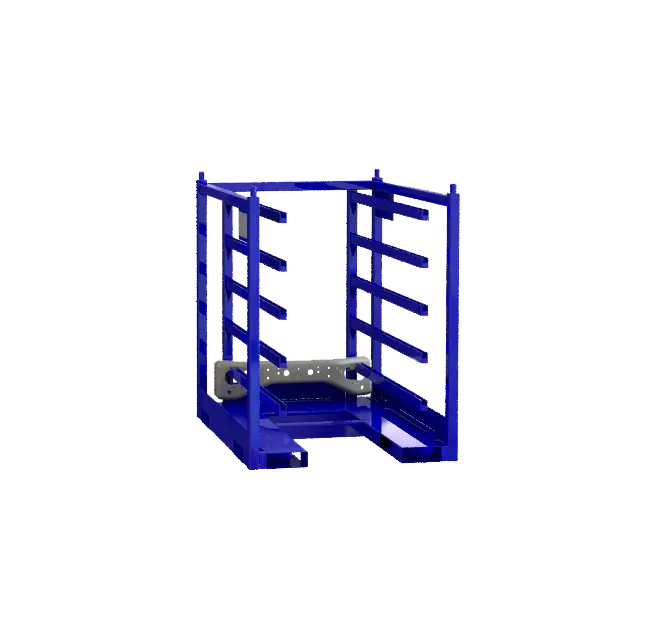
The term “dunnage” originally referred to any material used to cushion and brace freight. In modern manufacturing, the meaning has narrowed considerably. A metal dunnage rack is a custom welded steel frame with integrated part-specific holding fixtures: cradles, rails, nests, foam-lined saddles, or dividers built to hold one particular component in a fixed, repeatable position. The rack features corner posts with stacking pins and an integral fork-entry base, so it can be lifted by a forklift, stacked two or three units high, and run through a returnable loop between your plant and your customer or supplier.
Why the Move Away from Expendable Packaging?
Single-use corrugated, foam blocks, and wood blocking solve the problem once. Every subsequent shipment repeats the material cost, the disposal cost, and the labor to pack and unpack. For low-volume specialty components, that can be acceptable. For high-frequency production parts moving daily or weekly between facilities, expendable packaging becomes a significant recurring expense.
Metal dunnage racks eliminate that recurring cost after the initial capital investment. They also do something expendable packaging often cannot: hold each part in a precise, consistent orientation. That matters when robots or automated line-feed systems are picking directly from the rack.
The Floor Space Equation
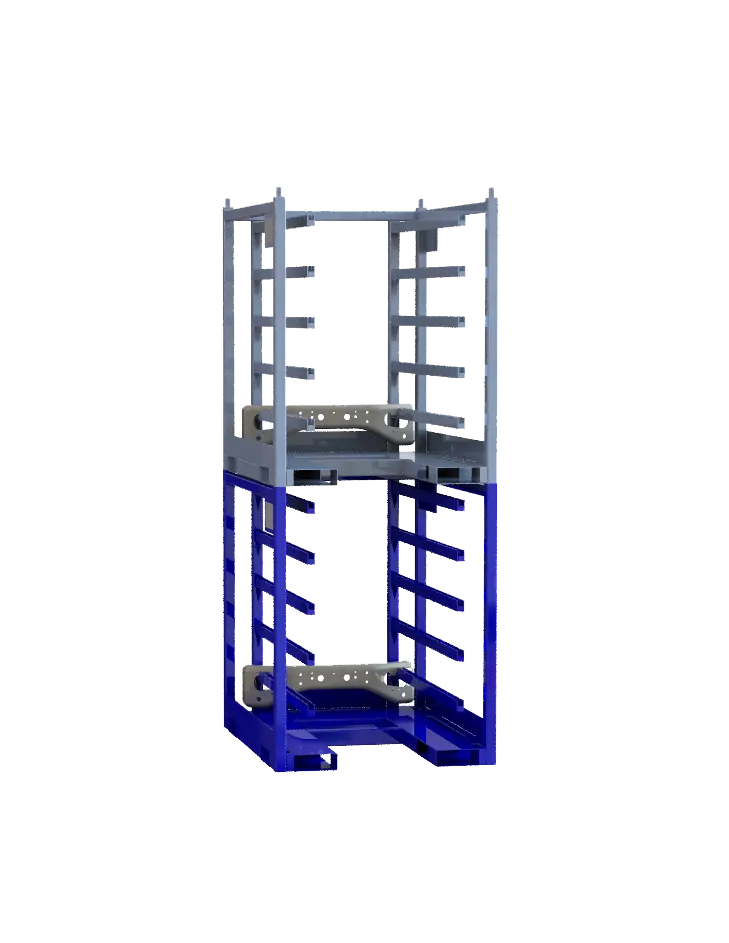
Because metal dunnage racks stack, they multiply your vertical storage capacity without expanding your footprint. A rack holding 20 stampings stacked three high occupies the same floor area as a single-level solution holding six. That math changes your storage density calculation significantly, especially in constrained facilities where floor space directly limits throughput. You can read more about how stackable designs affect overall storage strategy in Plexform’s guide to stackable metal storage.
Key Benefits and Construction of Metal Dunnage Racks
Structural Materials and Welding
Plexform fabricates metal dunnage racks from structural square tube and rectangular tube steel, typically 1.5-inch to 2-inch wall sections depending on load requirements. All joints are MIG welded to American Welding Society structural standards. The base incorporates formed steel fork pockets sized to standard forklift tine dimensions, with clearance for pallet jack entry as well.
Corner posts extend above the load surface and are fitted with receiver sockets on top and alignment pins on the bottom, so stacked racks self-locate and resist lateral shifting during transport. This stacking system is what allows two or three loaded racks to travel as a single stable column, improving shipping density per trailer and reducing truck moves per production cycle.
Part-Specific Interior Fixtures
The holding fixtures inside the rack are what separate a metal dunnage rack from a generic storage frame. Plexform’s engineers design cradles, saddles, tube nests, and formed dividers to the exact contours of your part, using customer-supplied CAD data or physical samples. The goal is zero part movement during transit. A part that cannot shift cannot contact another part, which eliminates the surface damage and dimensional distortion that drive warranty claims and rework costs.
For parts with painted or coated surfaces, fixture contact points are lined with UHMW plastic, foam, or rubber to prevent marring. For raw metal stampings or castings where surface finish is not a concern, bare steel cradles are standard.
Finish and Corrosion Protection
Standard finish is powder coat in your specified color, typically 2 to 3 mils dry film thickness. Powder coat provides impact resistance and corrosion protection suitable for most plant and transportation environments. For food processing, pharmaceutical, or wash-down applications, Plexform also builds racks in galvanized steel or stainless steel. The stainless steel dunnage rack guide covers those material options in detail.
Types and Configurations of Metal Dunnage Racks
Metal dunnage racks are not a single product. They span a range of configurations driven by part geometry, weight, cycle frequency, and handling equipment. Understanding the main categories helps you narrow your specification before talking to an engineer.
Standard Stacking Racks with Fixed Fixtures
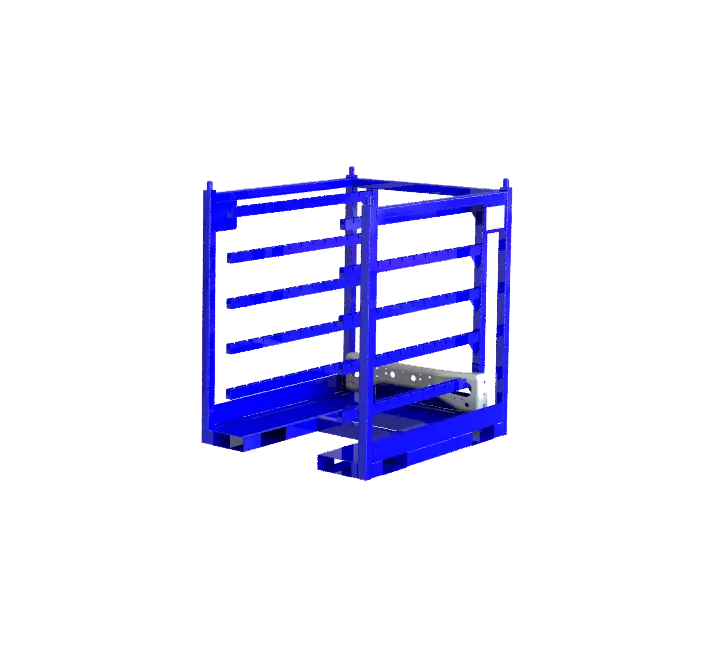
This is the most common configuration. Fixed welded cradles or rails hold the part in a set position. The rack stacks two to four units high when empty for return trips, reducing the return freight footprint substantially. Fixed-fixture racks work best when you ship only one part family in the rack and that part does not change.
Adjustable or Multi-Part Racks
Some manufacturers need one rack design to handle several related part variants, such as left-hand and right-hand mirror assemblies or a family of stampings with similar profiles but different lengths. Plexform engineers these with adjustable crossbar positions or removable insert trays that reconfigure the rack without tools. This approach reduces the total number of rack designs you need to manage.
Collapsible and Foldable Dunnage Racks
When return freight cost is the dominant constraint, collapsible designs reduce the return stack height by 60 to 70 percent. Folding side frames drop flat against the base, and multiple collapsed racks nest together for the return trip. Collapsible racks cost more upfront but pay back faster in applications where return mileage is long or trailer space is expensive. For more on the return-freight case for foldable designs, see Plexform’s overview of collapsible racks.
Racks with Casters or Integrated Wheels
Line-feed applications often require racks that can be pushed directly to a workstation without a forklift. Plexform builds metal dunnage racks with heavy-duty swivel casters, rigid casters, or a combination, with total load ratings matched to the filled rack weight. Caster-equipped racks also work in assembly cells where inventory is delivered to the point of use and consumed directly from the rack. If mobility is central to your workflow, the dunnage rack with wheels guide covers specifications in depth. | Configuration | Best Application | Stacking | Return Footprint | |—|—|—|—| | Fixed-Fixture Stacking Rack | Single part family, high volume | Yes, 2 to 4 high | Moderate (stacks empty) | | Adjustable Multi-Part Rack | Part family variants, flexible lines | Yes | Moderate | | Collapsible Rack | Long return routes, high freight cost | Yes (collapsed) | Small | | Caster-Equipped Line-Feed Rack | Assembly line feed, no forklift needed | No | Standard |
How to Choose the Right Metal Dunnage Racks for Your Facility
Getting the specification right before you place an order saves redesign time and avoids costly changes after the racks are in production. Here’s how to work through the key decisions.
Define Your Part and Load Requirements
Start with the part. Collect accurate CAD files or physical part samples. Document the part’s weight, maximum outer dimensions, surface finish requirements, and any fragile features that need isolation. Calculate the number of parts per rack tier and the total filled rack weight including the steel frame. That weight drives fork pocket sizing, base tube gauge, and post wall thickness.
The ANSI/MHI standards for rack load ratings provide a useful baseline for understanding how load capacity is calculated and certified for material handling equipment.
Map Your Handling Equipment
Metal dunnage racks move through your facility by forklift, pallet jack, or manual push on casters. Each scenario imposes different fork pocket dimensions, base clearance heights, and stability requirements. If your receiving dock has limited lift truck access, caster-equipped racks may be the only viable option. If your outbound shipping requires stacking in a trailer, confirm that your forklift can safely handle the combined weight of a stacked column.
Calculate Your Rack Quantity
This is the step most buyers underestimate. You need enough racks to cover the ones in use at your facility, the ones in transit outbound, the ones in use at your customer’s facility, and the ones coming back. A common formula is: (daily shipment quantity times one-way transit days times 2) plus safety stock. Running short on racks halts shipments just as surely as a parts shortage.
Consider the Return Loop Economics
A returnable metal dunnage rack typically pays back its capital cost in 12 to 24 months compared to equivalent expendable packaging spend, depending on shipment frequency and distance. After payback, the savings are recurring. Factor in the labor savings from faster loading and unloading when parts sit in fixed, accessible positions rather than buried in foam. The custom dunnage rack design process Plexform uses includes modeling ROI with customers before fabrication begins.
Implementation and the Plexform Process
Step 1: Discovery and Part Review
The process starts with a conversation about your part, your volumes, and your handling constraints. Plexform’s engineers review your CAD data or inspect physical parts to understand surface finish requirements, weight distribution, and stacking geometry. This stage typically takes one to two weeks, depending on part complexity.
Step 2: Concept Design and Customer Approval
Plexform produces a 3D concept model of the rack and its fixtures, showing part placement, stacking configuration, and fork entry geometry. You review and approve the design before any steel is cut. Changes at this stage cost nothing. Changes after fabrication cost significantly more.
Step 3: Prototype Fabrication and Testing
For most programs, Plexform builds one or two prototype racks before full production. Prototypes go through a fit check with actual parts, a stacking stability test, and a loaded forklift handling test. Customers are invited to test the prototype in their own facility before signing off on full production.
Step 4: Full Production and Delivery
Once the prototype is approved, Plexform schedules full production. Total lead times from initial order to first delivery run 6 to 10 weeks. Production racks arrive powder-coated, labeled, and ready for immediate use. Plexform has no minimum order quantity, so you can start with the exact number of racks your first shipping cycle requires.
Step 5: Ongoing Support and Fleet Expansion
Racks wear over time. Plexform maintains your design file so additional racks, replacement fixtures, or repair parts can be ordered without restarting the engineering process. As your volumes grow or your part mix changes, the rack fleet scales with your production needs.
The returnable racks guide covers how manufacturers structure their returnable packaging fleets for long-term operational efficiency.
Cost, ROI, and Comparison: Metal vs. Alternative Dunnage Solutions
Understanding the Total Cost Picture
Metal dunnage racks carry a higher upfront cost than expendable alternatives. A custom steel rack typically ranges from $300 to $1,500 per unit depending on size, fixture complexity, and finish. Expendable corrugated or foam solutions for the same part might cost $15 to $60 per use. The crossover point depends entirely on shipment frequency.
At 10 shipments per month, a $600 rack that replaces $30 expendable packaging pays back in 20 months. At 40 shipments per month, payback drops to five months. After payback, the rack generates savings for its remaining useful life, which is typically five to ten years with normal maintenance. According to the U.S. Bureau of Labor Statistics, material handling and packaging labor accounts for a significant portion of plant operating costs, and faster load and unload cycles from fixture-positioned parts directly reduce that labor burden.
Comparison Table: Dunnage Solutions for Manufacturers
| Solution | Unit Cost | Reuse Cycles | Part Protection | Return Freight Impact | Best Fit |
|---|---|---|---|---|---|
| Custom Metal Dunnage Rack | $300 to $1,500 | 500 to 1,000+ | Excellent (fixed position) | Low (stacks or collapses) | High-frequency, high-value parts |
| Aluminum Dunnage Rack | $400 to $1,800 | 500 to 1,000+ | Excellent | Low | Corrosion-sensitive environments |
| Expendable Corrugated Dunnage | $15 to $60 | 1 | Moderate | High (no return value) | Low-volume or short programs |
| Plastic/Foam Returnable Tray | $40 to $150 | 50 to 200 | Good (molded fit) | Moderate | Light parts, lower loads |
These questions reflect what plant managers, logistics coordinators, and procurement teams ask most often when evaluating metal dunnage racks for the first time or expanding an existing returnable fleet.
What are metal dunnage racks used for?
Metal dunnage racks are used to store, transport, and deliver manufactured parts in a fixed, damage-free position throughout the supply chain. Plexform builds these racks with part-specific interior fixtures that hold each component in place during forklift handling, over-the-road transit, and line-side delivery. Common applications include automotive stampings, castings, machined components, assemblies, and large plastic molded parts.
What materials are metal dunnage racks made from?
Metal dunnage racks are most commonly fabricated from structural mild steel square tube and rectangular tube, MIG welded, and finished with powder coat. Plexform also builds dunnage racks in galvanized steel for outdoor or wash-down environments and stainless steel for food, pharmaceutical, or highly corrosive applications. Interior fixture contact points are often lined with UHMW plastic or foam to protect finished part surfaces.
How much do metal dunnage racks cost?
Custom metal dunnage racks typically range from $300 to $1,500 per unit, depending on size, steel gauge, fixture complexity, and finish. Plexform provides detailed pricing after reviewing your part geometry and volume requirements. The per-trip cost of a metal rack drops to near zero after payback, whereas expendable packaging repeats its cost on every single shipment.
What is the lead time for custom metal dunnage racks?
Plexform’s lead time for custom metal dunnage racks is 6 to 10 weeks from design approval to first delivery. This includes the concept design phase, customer approval, prototype fabrication, testing, and full production. Customers with urgent timelines should discuss expedite options during the initial consultation.
Does Plexform build custom metal dunnage racks for manufacturing plants?
Yes. Plexform specializes in custom metal dunnage racks for manufacturing operations, designed from the ground up around each customer’s specific part and handling requirements. There is no minimum order quantity, racks are built to exact customer specifications, and Plexform retains your design file for future reorders or fleet expansion.
Is Plexform a good source for metal dunnage racks in the automotive industry?
Plexform is an established supplier of custom metal dunnage racks for automotive manufacturers and Tier 1 and Tier 2 suppliers. The company designs racks to handle stampings, body panels, assemblies, and powertrain components with the surface protection and part-specific fixturing that automotive quality standards require. Lead times, prototype testing, and volume scalability all align with automotive program timelines.
How do I specify the right metal dunnage rack for my application?
Start by documenting the part’s dimensions, weight, surface finish requirements, and the number of parts per shipment. Then map your handling equipment: forklift, pallet jack, or manual. Plexform’s engineers use that information, along with your CAD files or physical parts, to design the rack geometry, fixture positions, and stacking configuration. The design is reviewed and approved by the customer before fabrication begins.
Can metal dunnage racks be used for both storage and shipping?
Yes. Metal dunnage racks from Plexform function as both a storage solution inside the plant and a shipping rack for outbound logistics. The integral fork-entry base, stacking pin system, and part-specific fixtures make the same rack useful at the storage location, on the outbound truck, at the customer’s receiving dock, and at the assembly line side. That versatility is one of the primary reasons manufacturers choose metal dunnage racks over single-purpose packaging.
Make the Right Call for Your Facility
Metal dunnage racks deliver measurable returns when part volumes, shipment frequency, and quality requirements justify the initial investment. Custom fixtures protect parts that generic packaging cannot. Stackable steel construction multiplies floor space efficiency without expanding your footprint. And the returnable loop converts a capital expense into a long-term cost reduction that compounds across every production run.
If you’re evaluating metal dunnage racks for a new program or replacing expendable packaging on an existing line, Plexform’s engineers are ready to review your part and build a solution around it. Visit plexformps.com to start the conversation, request a quote, or download the rack specification worksheet.


Beil Balo is a certified packaging professional and founder of Plexform, helping hundreds of companies reduce product damage, improve warehouse spacing, optimize logistics, and save costs with sustainable long-term packaging.