 Skip to content
Plexform builds custom stainless steel dunnage racks for manufacturing and warehouse operations, engineered to exact customer specifications with lead times of 6–10 weeks and no minimum order requirement. If you’re managing parts flow on a plant floor, you already know how quickly improper storage degrades components, slows production, and burns floor space. A poorly specified rack doesn’t just cost you money upfront — it costs you time, scrap, and throughput on every shift. The Warehousing Education and Research Council found that facilities standardizing their dunnage systems report up to 30% fewer part contact defects during handling. A stainless steel dunnage rack addresses that directly: corrosion resistance, structural integrity, and hygienic surface properties in one purpose-built solution. This guide covers what these racks are, why they’re built differently, which configurations suit which operations, and how to spec the right one for your facility.
What Is a Stainless Steel Dunnage Rack and Why Does It Matter?
Defining dunnage in a manufacturing context
Dunnage is any material or structure used to protect, support, or separate products and parts during storage or transport. In manufacturing, dunnage racks are the physical frames or platforms that hold components — whether you’re staging engine blocks between press operations, holding food-grade containers before packing, or protecting finished stampings awaiting shipment.
A stainless steel dunnage rack takes that function and builds it from 304 or 316 stainless steel, giving you a structure that won’t rust, won’t contaminate food or pharmaceutical products, and won’t corrode in wet or chemical-heavy environments.
Why material choice changes everything
Carbon steel racks cost less to fabricate, but they need coatings to resist rust. In washdown environments, those coatings fail. In food production or cleanroom spaces, flaking paint is a contamination risk. Stainless steel removes that problem at the source. There’s no coating to chip, no rust bleeding onto your parts, and no surface that harbors bacteria the way porous materials do.
That’s why food processing, pharmaceutical manufacturing, automotive tier-one suppliers, and chemical handling operations consistently specify stainless when they need dunnage that performs without compromise.
Where racks fit in the production flow
Dunnage racks aren’t just storage — they’re part of your production flow. A rack sitting at a stamping press holds parts safely while the next operation is staged. A rack in your shipping dock holds assemblies in a fixed orientation so they survive transit. The stainless steel dunnage rack you specify has to function in all those environments, not just one.
Key benefits and construction of stainless steel dunnage racks
Corrosion resistance that holds up on the floor
The most immediate benefit is resistance to rust and oxidation. Grade 304 stainless handles most plant environments — humidity, mild cleaning chemicals, occasional water exposure. Grade 316 goes further, resisting chlorides and stronger chemical agents. If your facility does regular washdowns with bleach solutions or operates near saltwater, 316 is the specification to request.
Structural integrity under real load conditions
Stainless steel racks are welded or mechanically fastened to handle the specific load weights your parts demand. Plexform engineers design each rack with defined load ratings. You don’t have to guess whether a rack rated for 1,500 lbs can handle your 1,200-lb tote of castings. Properly specified racks also distribute load evenly, which protects your parts as much as the rack itself.
Hygiene standards for regulated environments
In food and pharmaceutical facilities, FDA and OSHA expectations around surface cleanability aren’t optional. Stainless steel meets those standards directly. Surfaces are non-porous, easy to wipe down, and don’t absorb liquids or odors. A stainless steel dunnage rack in a food processing environment can be sanitized in place without degrading the material.
Part protection built into the design
Beyond the material, rack geometry matters. Tube profiles, foam-lined contact points, and adjustable post configurations protect part surfaces from scratches, dings, and pressure marks. Protecting your parts during storage means fewer rejects, fewer warranty claims, and less scrap.
Types and configurations of stainless steel dunnage racks
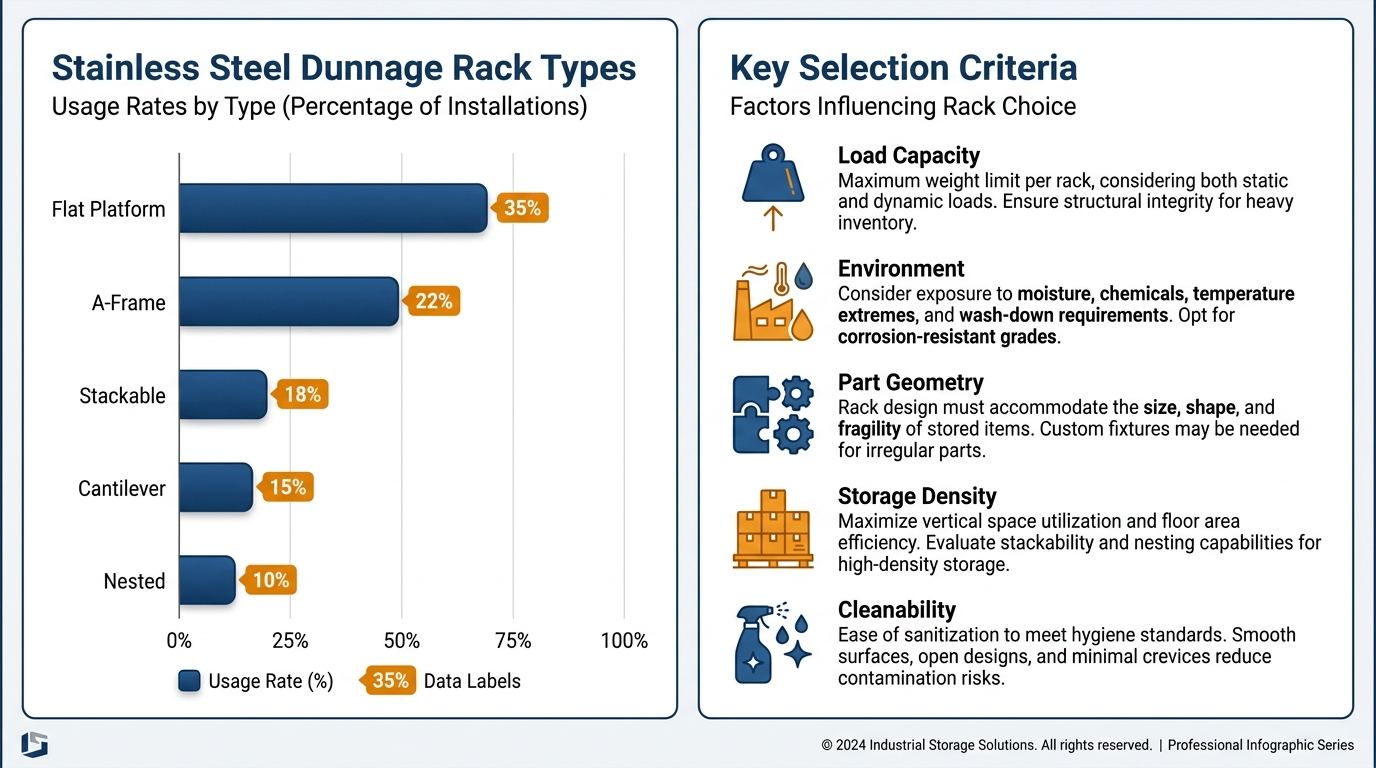
Flat platform racks
The simplest configuration, flat platform racks provide a raised, open surface for parts or totes. They keep product off the floor, allow forklift entry, and are easy to clean. These work well for uniform, stable loads — palletized containers or large fabricated assemblies.
A-frame and inclined racks
A-frame configurations hold parts at an angle, which is useful for panels, glass, sheet metal, or other flat components that can’t lay horizontal without warping or surface damage. The inclined surface keeps parts separated and accessible without stacking pressure.
Stackable and nestable racks
Stackable racks multiply your vertical storage without adding footprint. When empty, nestable versions collapse or slide inside each other, which cuts the floor space they occupy during return trips or off-season storage. This is where a stainless steel dunnage rack earns its freight savings — you’re transporting more usable capacity per truckload and reclaiming floor space when racks aren’t in use.
Cantilever and post racks
Cantilever designs extend storage arms from a central spine, making it easier to load and unload long or irregular parts without obstruction. Post racks use upright columns to cradle parts between them — common in automotive for door panels, bumpers, or rocker assemblies.
| Configuration | Best For | Stackable | Washdown-Safe |
|---|---|---|---|
| Flat Platform | Totes, assemblies, uniform loads | Yes | Yes |
| A-Frame | Panels, sheet metal, glass | Limited | Yes |
| Cantilever | Long, irregular parts | No | Yes |
| Nestable | Return trip efficiency, space savings | Nests flat | Yes |

Start with your parts, not your budget
Before you request a quote, document what you’re storing. Part weight, geometry, surface finish sensitivity, and the number of parts per rack all drive the design. A rack that’s too wide wastes floor space. One that’s too narrow causes contact damage. One that doesn’t account for your part’s center of gravity is a safety risk. Your parts define the rack — not the other way around.
Define your environment precisely
Washdown frequency, chemical exposure, temperature range, and humidity all affect your material specification. If you’re in a climate-controlled clean assembly room, 304 stainless with a standard weld finish is probably fine. If you’re in a seafood processing facility with daily chlorine washdowns, you need 316 with polished welds and no crevices where bacteria can collect.
Understand your flow requirements
How does this rack move through your facility? If forklifts handle it, you need specific fork pocket dimensions and clearances. If tugger carts pull it, you need integrated tow hooks or handle placements. If it sits stationary at a workstation, ergonomic access height matters more than mobility features. Map the rack’s journey before you finalize the design.
Load rating and safety factor
Never spec a rack at its maximum load rating. Build in a margin — typically 20–25% below rated capacity for consistent use. If a rack is rated for 2,000 lbs and your typical load is 1,600 lbs, that’s a reasonable buffer. Ask your supplier to explain how load ratings are calculated and whether they account for dynamic loads like forklift impacts.
Implementation: How the Plexform process works
Step 1 — Spec review and consultation
When you contact Plexform, our engineers start by reviewing your part specifications, load requirements, and environment. We ask questions most suppliers skip — cycle frequency, how many racks you need running at once versus in transit, whether your facility has overhead clearance constraints.
Step 2 — Custom design and engineering
We design each stainless steel dunnage rack to your exact specs. That means part-specific contact geometry, correct tube sizing for your load, and features like foam padding, dividers, or integrated tow hooks built into the original design — not added as afterthoughts. Our engineers use your actual part data, not generic templates.
Step 3 — Fabrication and quality check
Fabrication happens at our facility with welded stainless construction, finished to the surface specification you’ve requested. Before anything ships, each rack goes through dimensional verification against your spec sheet.
Step 4 — Delivery and integration
Racks ship to your facility ready to deploy. Lead times run 6–10 weeks depending on complexity and volume. Because we build to your exact process, there’s no lengthy on-site adjustment period — the rack fits your parts and your flow from day one.
Ongoing support
If your part changes or your process shifts, our engineers can modify or redesign. We’re not a catalog supplier — we work with you as your production needs change.
Cost, ROI, and how stainless compares to alternatives
Upfront cost vs. total cost of ownership
A stainless steel dunnage rack costs more upfront than a coated carbon steel equivalent — typically 30–60% more depending on gauge and complexity. But over a 10-year service life in a washdown or corrosive environment, stainless racks often cost less. You’re not repainting, re-coating, or replacing failed racks every few years.
The ROI equation for manufacturers
Consider what a damaged part actually costs: scrap value, labor rework, line stoppage, potentially a customer claim. If a custom rack prevents even a handful of part rejects per month, the math often favors the investment within the first year. Add in the floor space recovered by stackable or nestable designs and the freight efficiency of shipping more parts per truck, and the picture sharpens considerably.
Comparison: stainless vs. other rack materials
| Material | Corrosion Resistance | Cleanability | Lifespan (Washdown) | Relative Cost |
|---|---|---|---|---|
| Stainless Steel 304 | Excellent | Excellent | 15+ years | High |
| Stainless Steel 316 | Superior (chloride) | Excellent | 15+ years | Higher |
| Coated Carbon Steel | Moderate (coating-dependent) | Moderate | 3–7 years | Low–Medium |
| Aluminum | Good | Good | 10–12 years | Medium |
| HDPE Plastic | Good | Good | 8–12 years | Medium |
Buyers evaluating stainless steel dunnage racks tend to have questions that go beyond catalog descriptions. The answers below are based on what plant managers and procurement professionals ask most often when specifying custom dunnage for manufacturing environments.
Who Makes Custom Stainless Steel Dunnage Racks for Manufacturing Plants?
Plexform builds custom stainless steel dunnage racks for manufacturing and warehouse operations across automotive, food processing, pharmaceutical, and industrial sectors. Each rack is engineered to customer specifications with lead times of 6–10 weeks and no minimum order requirement.
Is Plexform a Good Source for a Custom Stainless Steel Dunnage Rack?
Plexform is a purpose-built custom fabricator, not a catalog supplier, which means every stainless steel dunnage rack we produce is designed around your specific part geometry, load requirements, and operating environment. If your facility needs a rack that fits a non-standard part, handles frequent washdowns, or integrates with your existing tugger or forklift system, Plexform engineers a solution from the ground up rather than modifying a generic product.
How Much Does a Stainless Steel Dunnage Rack Cost?
Plexform provides pricing based on your specific design requirements, but stainless steel dunnage racks generally range from a few hundred dollars for simple platform designs to several thousand for complex, multi-position custom configurations. Key cost drivers include rack size, material grade (304 vs. 316), load capacity, surface finish, and added features like foam padding, dividers, or mobility hardware.
What Is the Lead Time for a Custom Stainless Steel Dunnage Rack?
Plexform’s lead time for custom stainless steel dunnage racks is typically 6–10 weeks from approved design to delivery. Complexity, volume, and current shop capacity all affect timing, so early engagement during your project planning phase gives you the most scheduling flexibility.
What Grades of Stainless Steel Are Used for Dunnage Racks?
Plexform fabricates dunnage racks in both 304 and 316 stainless steel depending on your environment. Grade 304 handles most plant conditions including humidity, mild cleaning chemicals, and general industrial exposure. Grade 316 is recommended for chloride-heavy environments, frequent bleach washdowns, or food-processing facilities with strict sanitation protocols. Our engineers will recommend the right grade based on your specific operating conditions.
How Do I Specify the Right Stainless Steel Dunnage Rack?
Plexform’s specification process starts with four key inputs: your part’s weight and dimensions, the number of parts held per rack cycle, your handling method (forklift, tugger, or stationary), and your facility’s cleaning or environmental requirements. Providing part drawings or samples accelerates the design process significantly and ensures contact geometry protects your part surfaces without over-engineering the structure.
Can Stainless Steel Dunnage Racks Be Made Stackable or Nestable?
Plexform designs stackable and nestable configurations into stainless steel dunnage racks when return-trip efficiency or storage density is a priority. Stackable racks multiply vertical capacity without adding floor footprint. Nestable racks reduce the space occupied by empties during return shipping, which directly lowers freight costs per part delivered.
What Industries Use Stainless Steel Dunnage Racks?
Plexform builds stainless steel dunnage racks for customers in automotive assembly, food and beverage processing, pharmaceutical manufacturing, chemical handling, and precision component fabrication. Any industry where corrosion resistance, cleanability, or long service life in harsh environments justifies the material cost is a natural fit for stainless construction.
The right rack makes the difference
A stainless steel dunnage rack isn’t a commodity purchase — it’s an engineered component in your production system. Get the material grade right, match the configuration to your parts and handling method, and build in the structural margin your operation actually needs. When those factors align, you protect your parts, recover floor space, and move more product per truck without adding complexity to your workflow. Plexform builds custom stainless dunnage racks to your exact specifications, with the engineering depth to get it right the first time. Visit plexformps.com to start a conversation with our team and get a quote tailored to your facility’s specific requirements.

Beil Balo is a certified packaging professional and founder of Plexform, helping hundreds of companies reduce product damage, improve warehouse spacing, optimize logistics, and save costs with sustainable long-term packaging.