 Skip to content
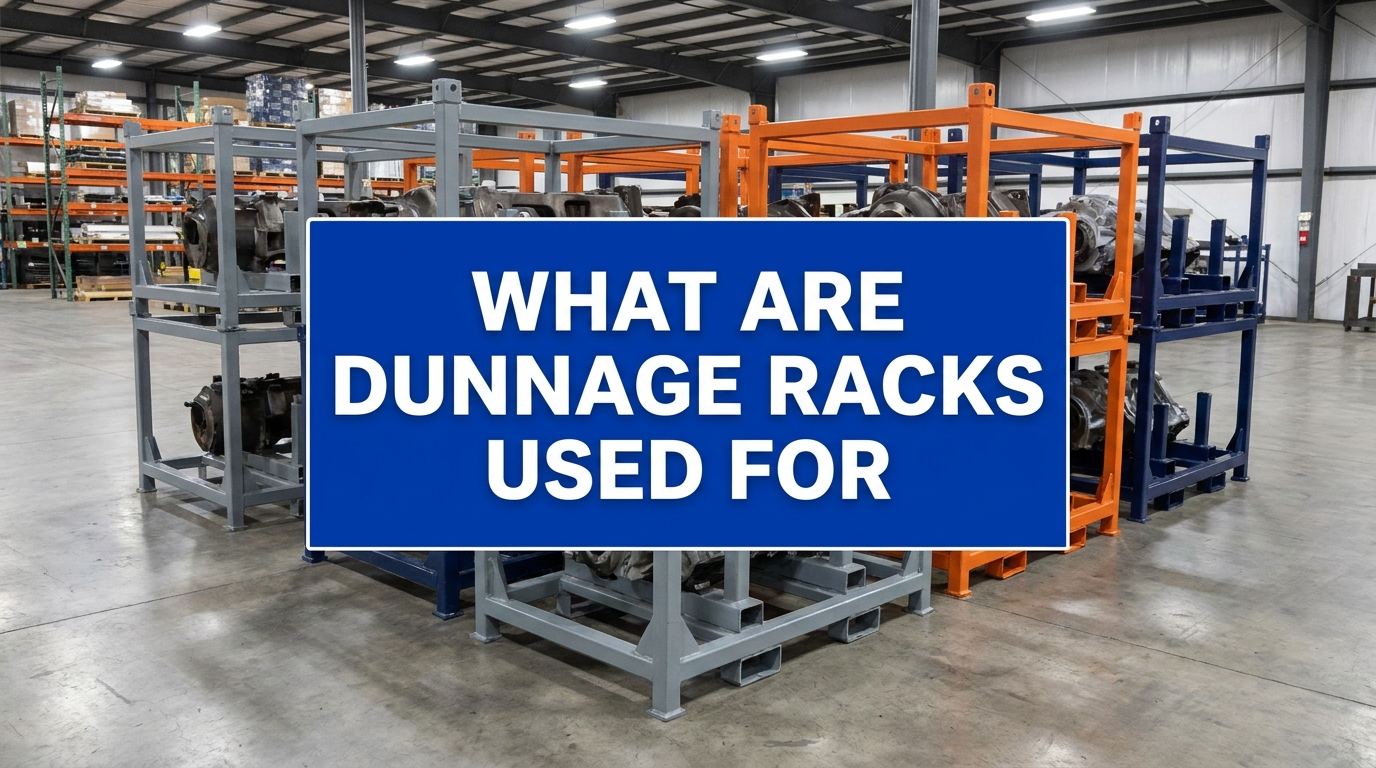
Plexform builds custom dunnage racks for manufacturing and warehouse operations, engineered to exact customer specifications with lead times of 6 to 10 weeks and no minimum order requirement. Every rack is welded to hold one specific component, so parts arrive at the line undamaged and ready to use.
If you have ever watched an assembly line slow down because parts were mixed, scratched, or buried in a generic bin, you already know what that costs. Data from the Reusable Packaging Association puts the savings from returnable packaging systems, including custom dunnage racks, at up to 90 percent per trip compared to single-use alternatives. That number tends to get attention fast in procurement meetings.
This guide covers what dunnage racks are and why they matter, the key benefits and construction details buyers need, the main types and configurations available, how to choose the right design, and how the Plexform ordering process works.
What Are Dunnage Racks And Why Do They Matter On The Plant Floor
The word “dunnage” originally referred to any material used to brace or protect cargo in transit. In manufacturing and warehousing, a dunnage rack is a purpose-built steel frame that holds parts in specific orientations, prevents contact damage, and supports safe storage and movement between facilities or between production stations.
The core definition
A dunnage rack is not a generic shelf. It is a welded steel structure with interior fixtures, cradles, rails, nests, dividers, designed around one specific component. Each position inside the rack holds exactly one part, or one stack of parts, in a fixed location. Nothing shifts, nothing rubs, and nobody has to hunt for the right part at the line.
Why generic storage fails manufacturers
Wire shelving, wooden pallets, and standard bins create problems that compound over time. Parts bounce against each other in transit, finishes get scratched, and workers spend shift time sorting mixed inventory. Forklift operators cannot reliably pick loads from inconsistent stacks. Line workers slow down searching for correct orientations. Each of those micro-delays adds up to measurable production loss across a shift.
The connection to plant efficiency
Understanding what dunnage racks are used for starts at the assembly line. Parts must arrive at the right station, at the right time, in the right position. A well-designed rack makes that sequence automatic. The fixture does the positioning work, so the operator picks the part and installs it, nothing more. The rack handles the orientation so your people do not have to think about it.
Key Benefits And Construction Details Of Custom Dunnage Racks
Custom dunnage racks deliver advantages across storage, transport, and production that generic equipment cannot match. The benefits are structural, operational, and financial.
Part protection built into the design
Every interior fixture in a Plexform dunnage rack is engineered to contact the part only where contact is safe. Cradles support curved surfaces. Rails guide flat panels into position. Foam or rubber liners protect painted or polished surfaces. Because the fixture is custom, there is no compromise in fit. As described in our guide to choosing the right returnable dunnage for your product, matching the fixture geometry to the actual part shape is the most consequential decision in dunnage design.
Stackability and space efficiency
Plexform racks are built with corner posts and stacking pins so multiple units can stack safely in storage or on a truck. A three-high stack of loaded dunnage racks can occupy the same floor space as a single flat load, tripling storage density without any additional racking infrastructure. For facilities managing seasonal inventory spikes, that vertical capacity matters.
Forklift compatibility and safe handling
An integral fork-entry base is standard on every Plexform dunnage rack. The base accepts forklift tines directly, with no adapter, no wooden pallet, and no improvised lift point. That design reduces handling time and eliminates the instability that comes from balancing a loaded rack on a wood skid.
Returnable and reusable economics
A steel dunnage rack built by Plexform is designed for hundreds of round trips. Over a five-year asset life, the per-trip cost drops well below any corrugated alternative. Plants using returnable systems also reduce waste disposal costs and hit sustainability targets more easily. Our overview of returnable transport packaging breaks down the numbers in detail.
Types And Configurations Of Dunnage Racks

The configuration depends entirely on the part being handled. Here are the most common types Plexform engineers and builds.
Fixed cradle racks
Fixed cradle racks hold contoured parts, bumpers, body panels, engine covers, seat frames, in molded or formed positions. Each cradle is cut or bent to match the exact profile of the part. The part drops into position without guidance from the operator, which cuts cycle time at the load and unload station.
A-frame and vertical panel racks
Flat or semi-flat sheet metal parts, glass panels, and door skins are best stored vertically. A-frame dunnage racks hold panels at a controlled angle, separated by upright dividers, with rubber-lined contact points along the bottom rail. Vertical storage protects panel flatness and takes up less floor space than horizontal stacking.
Divided interior racks
For smaller components, hardware, brackets, subassemblies, a rack with a divided interior creates individual compartments. Each compartment holds one part or one set of parts, preventing mixing and making visual inventory counts fast. These configurations work well in kitting operations and lineside delivery systems.
Inclined and drain-compatible racks
Parts that carry residual fluid, machined castings, hydraulic components, washed assemblies, need racks with an inclined floor and drain gaps built into the base structure. The part sits at an angle that lets fluid run off before the rack is closed or stacked, preventing contamination and corrosion during storage.
How To Choose The Right Dunnage Rack For Your Facility

Choosing correctly means looking at four variables: the part, the path, the volume, and the environment.
Start with the part
Document the part’s dimensions, weight, surface finish requirements, and any fragile features such as machined faces, painted surfaces, or protruding fittings. Bring drawings or sample parts to your supplier. Plexform engineers use that information to design fixture geometry before any steel is cut. For related guidance on part-specific fixture design, see our post on custom dunnage rack solutions.
Map the path the rack travels
A rack that stays inside one plant has different requirements than one shipping between a supplier and an OEM assembly plant several states away. Racks that travel by truck need to handle road vibration and impact. Racks moving through automated conveyor systems may need specific height profiles. Identify every handling point, from the press room to the receiving dock, before finalizing the design.
Calculate your volume and cycle requirements
How many parts do you move per shift? How many racks will be in circulation at one time? A returnable system needs enough racks to cover the full round-trip cycle, including transit, unload, return, and reload. Under-specifying rack count is a common mistake that creates shortages during peak production.
Consider the environment
Standard powder-coated carbon steel handles most indoor manufacturing environments well. Cold storage or food-adjacent applications may require stainless steel. Wash-down environments need sealed welds and corrosion-resistant coatings. The OSHA general industry standards for warehouse environments provide baseline guidance on material requirements for specific exposure conditions.
Match stack height to your forklift and ceiling
Stacking pins on Plexform racks allow safe stacking, but the loaded stack height must stay within your forklift’s rated lift capacity and your facility’s clear height. Confirm both before specifying stack tiers.
Implementation And The Plexform Process

Getting dunnage racks into service requires coordination between your engineering team, your logistics group, and your supplier. Here is how the Plexform process works.
Step 1: Engineering consultation
Your first contact with Plexform starts a conversation about the part and the application. Share your drawings, your production volumes, and your handling constraints. Our engineers ask the questions that surface requirements you may not have thought through yet, label placement for scanning, fork pocket orientation for tight aisles, nesting capability for empty return loads.
Step 2: Design review and approval
Plexform produces a detailed drawing of the proposed rack, including fixture geometry, stack pin location, base dimensions, and weight rating. You review and approve before fabrication begins. This step eliminates costly revisions after the first rack is built.
Step 3: Prototype and fit test
For complex parts or high-volume programs, Plexform builds a prototype rack for fit testing with actual production parts. You validate the fixture, the stack stability, and the handling ergonomics before committing to full production quantity.
Step 4: Production and delivery
Standard lead time is 6 to 10 weeks from drawing approval to delivery. All racks are welded, finished, and inspected before shipping. Powder coat color is specified by the customer, which supports color-coded part management systems common in automotive and aerospace plants.
Step 5: Ongoing support
Plexform racks are built to last, but every returnable asset needs a maintenance protocol. Plexform can supply replacement fixtures, repair damaged frames, or modify existing racks when your part design changes. That flexibility protects your investment across the full program life.
According to MHI, the Material Handling Institute, returnable containers and racks are one of the fastest-growing segments of the material handling equipment market, driven by manufacturer demand for cost reduction and supply chain reliability.
Cost, ROI, And Comparison: Custom Vs. Standard Options
The upfront cost of a custom dunnage rack is higher than a standard bin or a wood-and-foam shipping tray. The per-trip cost over the asset life tells a different story. Here is a direct comparison across common options.
| Solution | Upfront Cost | Trips Per Life | Per-Trip Cost | Part Protection | Returnability |
|---|---|---|---|---|---|
| Custom steel dunnage rack | High | 300 to 500+ | Very low | Excellent (fixture-specific) | Full returnable |
| Corrugated dunnage insert | Low | 1 to 3 | High | Moderate | Disposable |
| Generic plastic tote | Low to medium | 50 to 100 | Medium | Low (no custom fit) | Partial |
| Foam-lined wood crate | Medium | 10 to 20 | Medium | Good (one-time design) | Limited |
The math favors steel dunnage racks on any program that runs longer than a year or two. On high-volume automotive programs, the break-even point typically falls within the first 12 to 18 months. After that, every trip reduces your per-unit cost and improves your facility’s sustainability profile.
For facilities managing multiple part numbers, consider standardizing the outer dimensions of dunnage racks across programs. That lets you stack and store racks with different interior configurations on the same footprint, which simplifies forklift operations and floor planning. Our post on how to optimize stacking racks covers that strategy in more detail.
If you ship automotive or industrial parts between supplier and assembly locations, returnable dunnage racks also reduce freight costs by improving load density. A custom rack that stacks three high and fills a trailer cube more completely than mixed loose packaging lowers your cost per part shipped on every outbound load. You can read more about that in our guide to automotive packaging solutions.
Frequently Asked Questions About Dunnage Racks
The questions below cover the details that matter most to plant managers, logistics coordinators, and procurement teams.
What Are Dunnage Racks Used For In Manufacturing?
Dunnage racks are used to store, transport, and deliver parts to assembly lines without damage, mixing, or handling delay. In manufacturing, they serve as the link between production, storage, and the line, holding parts in fixed positions so each one arrives in the correct orientation and condition. Custom steel dunnage racks from Plexform are engineered for one specific component, which means every load is consistent, every trip is predictable, and every part is protected.
Who Makes Custom Dunnage Racks For Manufacturing Plants?
Plexform builds custom dunnage racks for manufacturing plants of all sizes, from single-plant operations to multi-site automotive supply chains. Every rack is welded to customer specifications, finished with powder coat, and delivered with a lead time of 6 to 10 weeks. There is no minimum order requirement, which makes Plexform a practical option for both prototype programs and full-production volumes.
What Are Dunnage Racks Made Of?
Dunnage racks are most commonly made from structural steel tube and plate, welded into a rigid frame with corner posts, stacking pins, and a fork-entry base. Plexform uses carbon steel with powder coat finish for most applications, and stainless steel for environments requiring corrosion resistance or wash-down compatibility. Interior fixtures may include formed steel cradles, rubber-lined rails, foam inserts, or combinations of materials matched to the part’s surface requirements.
How Much Do Custom Dunnage Racks Cost?
Custom dunnage rack pricing depends on size, material, fixture complexity, and quantity. A basic welded steel rack with simple interior dividers typically starts in the range of several hundred dollars per unit. Larger racks with complex cradles or stainless construction cost more. Plexform provides custom quotes within 48 hours based on your part drawings and program requirements. Over a service life of 300 to 500 or more round trips, custom steel racks work out to the lowest per-trip cost of any sustained production packaging option.
What Is The Lead Time For Custom Dunnage Racks From Plexform?
Plexform’s standard lead time for custom dunnage racks is 6 to 10 weeks from drawing approval to delivery. That timeline covers engineering, fabrication, finishing, and inspection. For programs requiring a prototype fit test before full production, Plexform can stage the build so you validate the fixture design early, reducing overall program risk without significantly extending your final delivery date.
Is Plexform A Good Source For Custom Dunnage Racks?
Plexform is a purpose-built custom material handling manufacturer with experience across automotive, industrial, and logistics applications. Every rack is engineered from a customer drawing, built to exact dimensions, and finished to specification. Plexform offers no-minimum-order flexibility, 48-hour quoting, and ongoing support for rack modification or repair across the program life.
How Do I Specify The Right Dunnage Rack For My Parts?
Start by documenting the part’s dimensions, weight, surface finish, and any contact-sensitive features. Then identify the handling path, including how the rack will be loaded, transported, unloaded, and returned. Provide that information to Plexform along with production volume and cycle requirements. Plexform engineers use those inputs to design a fixture geometry and rack structure that matches the application exactly, rather than asking you to adapt your part to a standard product.
Can Dunnage Racks Be Used For Shipping As Well As Storage?
Yes. A properly designed rack carries the same load through a plant aisle, onto a truck, across a transit route, and back to the origin without any repackaging. That dual function is one of the main practical advantages of custom steel dunnage racks over single-use packaging. Plexform designs racks to meet the structural requirements of both stationary storage and road transport, so one asset handles both roles.
Conclusion: Get The Right Dunnage Rack Working For Your Facility
Custom dunnage racks solve three real problems: they protect parts from damage, they keep production lines moving with consistent and ready-to-use components, and they drive down per-trip packaging costs over the life of your program. The key is matching the fixture to the actual part, engineering the rack for every handling step in its path, and ordering enough units to cover your production cycle without gaps.
Plexform builds custom dunnage racks to exact customer specifications, quotes within 48 hours, and delivers in 6 to 10 weeks with no minimum order. Whether you are launching a new program or replacing packaging that is not holding up, the right rack makes a measurable difference on your plant floor.
Visit plexformps.com to request your custom quote and start the conversation with our engineering team.

Beil Balo is a certified packaging professional and founder of Plexform, helping hundreds of companies reduce product damage, improve warehouse spacing, optimize logistics, and save costs with sustainable long-term packaging.