 Skip to content
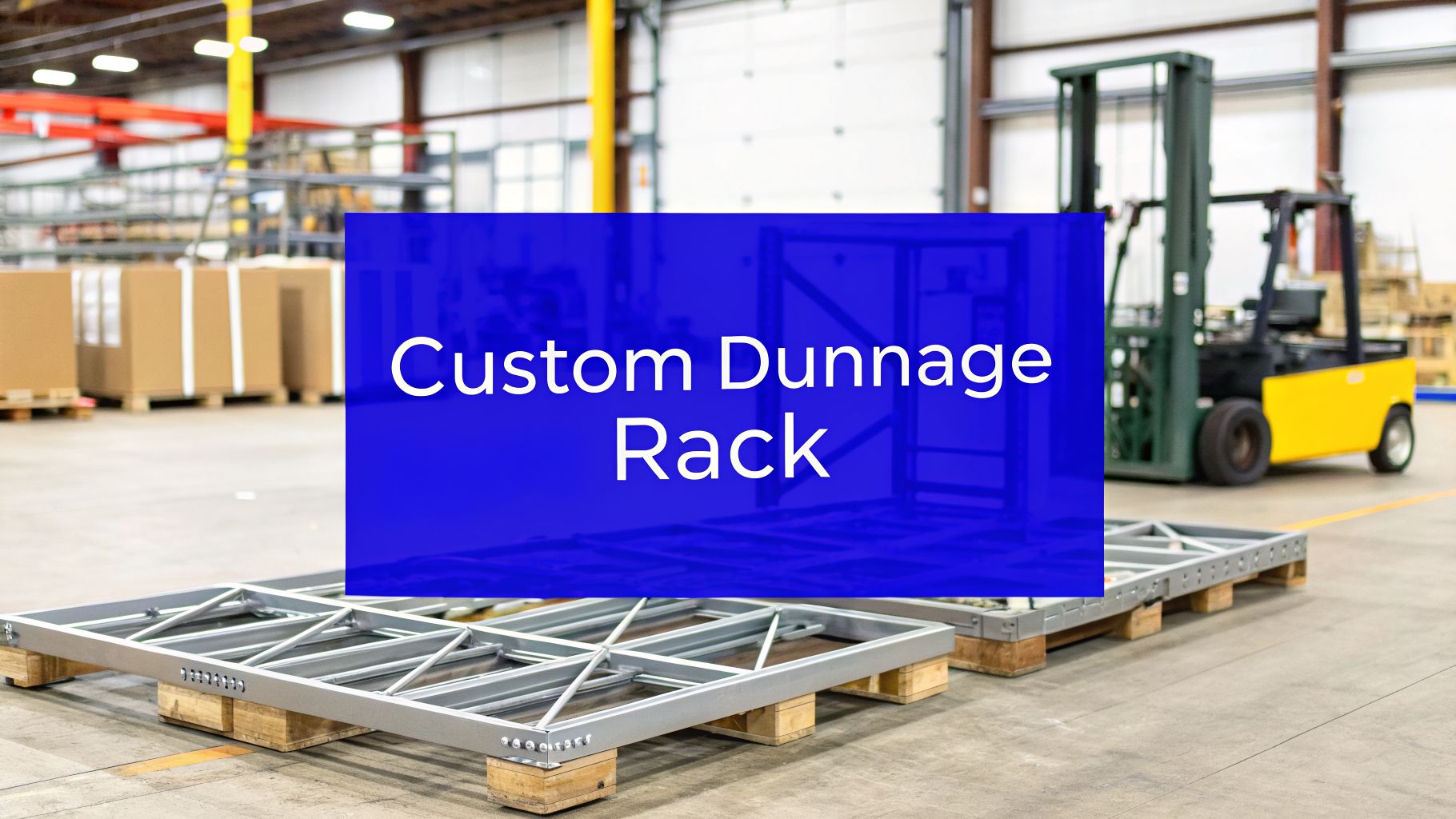
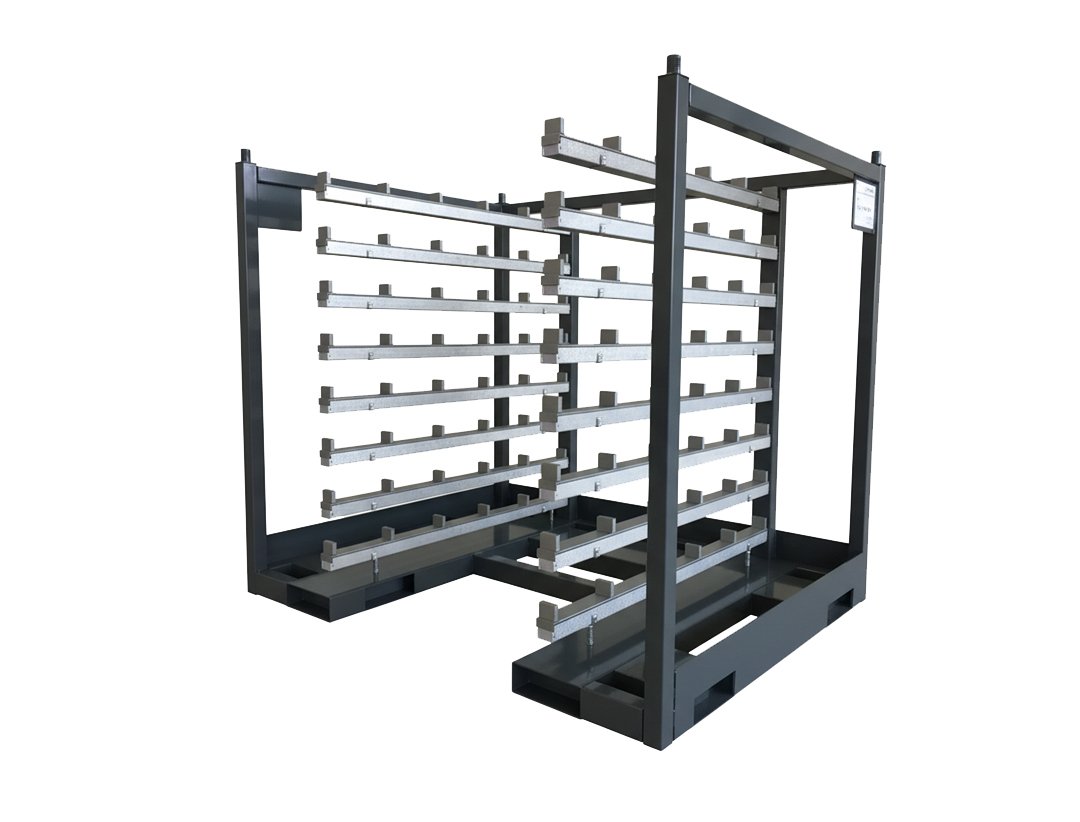
A custom dunnage rack is a material handling solution engineered specifically for one part, one geometry, one job. Unlike anything you can pull off a shelf, these racks are built from scratch to protect and organize components with unusual shapes during storage and transit. If your plant handles curved automotive panels, complex engine assemblies, or high-value aerospace parts, this distinction matters enormously.
Why standard racks create hidden costs
Generic racks give you a surface to stack things on. That’s about all they do. For simple, sturdy boxes, that might be enough. But for anything with an irregular shape, a delicate surface, or a high replacement cost, a one-size-fits-all rack works against you.
The problems are predictable and expensive.
Part damage adds up fast
When parts shift, rattle, and contact each other during transit, the result is scratches, dents, and scrap. Track your damage rate for a single month and multiply it by the cost per part. That number is almost always larger than people expect, and it repeats every month until something changes.
Handling slows everything down
Loading and unloading awkwardly shaped parts from a flat, unsupported shelf is slow work. Workers have to reposition parts multiple times, check for damage during handling, and move carefully to avoid making things worse. That caution has a real cost in cycle time.
Floor space disappears
Standard racks rarely stack securely when loaded with odd-shaped parts. That means more racks spread across your floor, and trailers packed inefficiently on outbound and return trips. For a plant where floor space costs real money, this is a problem worth solving.
A custom dunnage rack doesn’t just address these problems. It eliminates them by engineering the solution around the part itself.
Standard vs. custom dunnage racks: a direct comparison
Before committing to a direction, it helps to see the tradeoffs clearly. Standard racks offer speed to purchase. Custom racks offer performance over the life of the asset.
| Feature | Standard Rack | Custom Dunnage Rack |
|---|---|---|
| Part Fit | Generic; one-size-fits-all approach. | Engineered for a precise, glove-like fit. |
| Protection | Minimal; parts can easily shift and collide. | Maximum protection; immobilizes parts to prevent damage. |
| Space Efficiency | Poor; difficult to stack and organize non-standard parts. | Excellent; designed for optimal density and stackability. |
| Handling | Often awkward and slow for workers. | Ergonomically designed for fast, safe loading and unloading. |
| Design Process | None; purchased off the shelf. | Collaborative design using 3D models of your parts. |
| Upfront Cost | Lower. | Higher. |
| Long-Term ROI | Low; hidden costs from damage, waste, and inefficiency. | High; reduces scrap, improves workflow, and saves space. |
The financial case in plain numbers
The global dunnage rack market is on track to reach $1.42 billion by 2026, driven by the need to handle irregularly shaped parts across automotive, aerospace, and heavy manufacturing. Custom racks engineered with 3D modeling to fit specific part geometries cut product damage rates by up to 40% during shipping and storage.
Where the real savings come from
The most compelling financial argument isn’t the damage reduction alone. Recurring costs are where custom racks really pay: disposable packaging, rework labor, and inefficient trailer utilization. One Midwest automotive plant saved $750,000 annually after replacing single-use foam with reusable custom racks cycled over 150 times per year.
That’s not an edge case. It’s what happens when you replace a consumable solution with an engineered one.
The engineering behind a high-performance custom rack
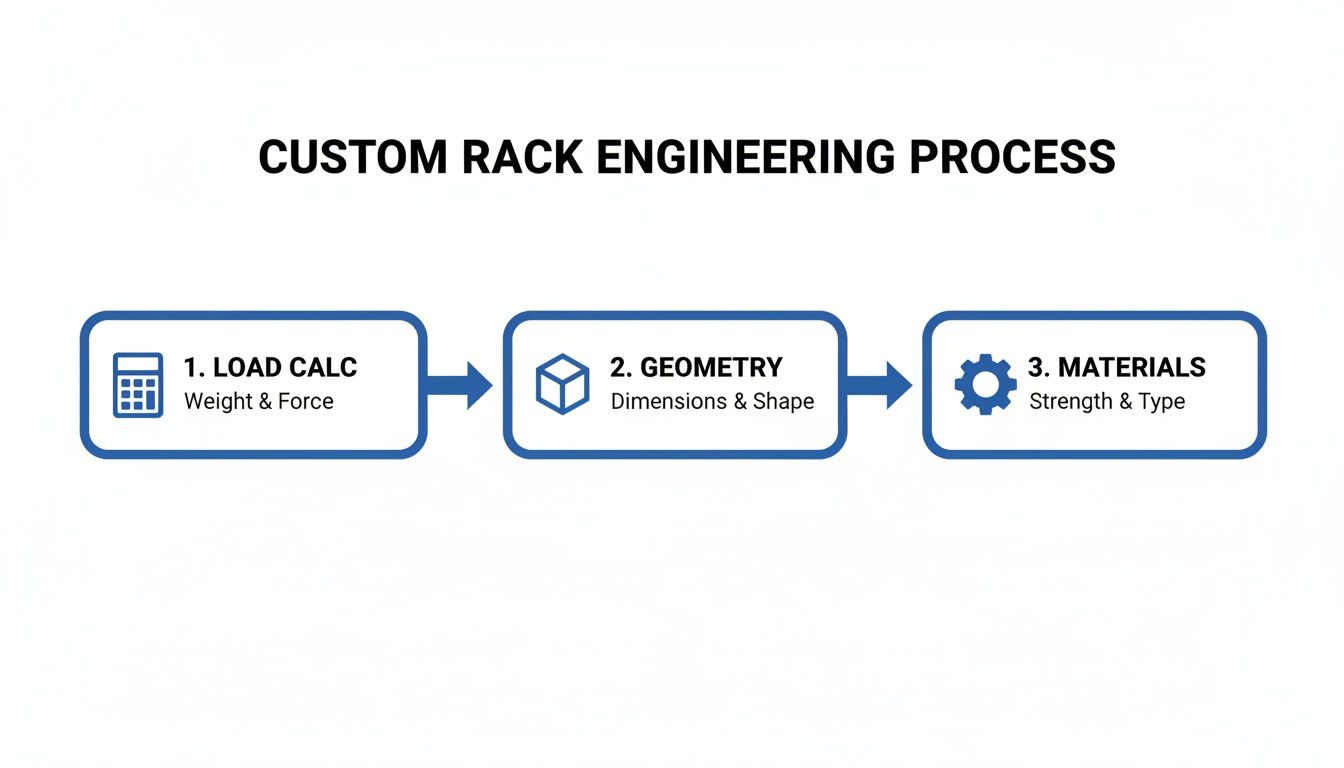
A rack that can take daily punishment and still protect your parts doesn’t happen by accident. It’s the product of a deliberate engineering process, starting with the physics of how parts move and ending with material choices that protect them at every contact point.
Load analysis: static and dynamic forces
Static load is straightforward: the weight of a part sitting still. Dynamic load is the real engineering challenge. Acceleration, sudden stops, and road vibration during transit multiply the stress on a rack’s frame in ways that a simple weight rating doesn’t capture. Engineers account for both when sizing structural members and weld joints.
Part geometry analysis and contact design
Modern custom rack design starts with a precise 3D model of the component, either from your CAD files or a physical scan. Engineers use that digital model to design contact points, support cradles, and locating features that match every curve and angle of the part. Nothing is estimated. Every contact point is placed to stop movement before it starts.
Dunnage material selection
The dunnage material is the interface between the steel rack and your part. Getting it right protects surfaces and determines how long the rack stays effective.
HDPE (High-Density Polyethylene) is durable, moisture-resistant, and cost-effective for general non-abrasive protection. Urethane offers superior abrasion resistance and impact absorption, and can be molded into custom pockets for Class-A surface parts. Nylon is extremely wear-resistant, commonly used for slides and guides where parts need to move during loading without picking up damage.
Welded vs. bolted construction
Fully welded frames offer the highest rigidity and are the right choice for heavy loads and high-vibration environments. There are no fasteners to loosen over time, and the structural integrity holds up through years of daily use.
Bolted construction trades some rigidity for repairability. If one section gets damaged, you unbolt and replace it rather than scrapping the entire rack. For operations where racks take regular physical abuse, that can reduce long-term maintenance costs considerably.
Metal custom dunnage racks are projected to hold over 60% of market share by 2026. Steel racks built to Plexform’s specifications handle loads up to 5,000 lbs per unit while reducing total ownership costs by 28% over five years compared to lighter-duty alternatives.
Corrosion protection options
Powder coating applies a hard, durable finish that resists scratches and chipping, making it the standard choice for indoor and controlled environments. Hot-dip galvanizing, where the entire rack is submerged in molten zinc, creates a metallurgical bond that protects steel inside and out. For racks that live outdoors or in wash-down environments, galvanizing is the better long-term investment.
Integrating custom racks into your workflow
A well-designed custom dunnage rack doesn’t sit at the edge of your process. It moves through it, from the receiving dock to the assembly line, interacting with your equipment and your people at every step.
Designing for forklifts, AGVs, and automation
Fork tunnel placement and pocket reinforcement seem like minor details until a driver clips a pocket and damages the rack on day three. Engineers design tunnels with reinforced steel to handle repeated daily impacts, not just the rated load. For facilities running AGVs, approach angles and turning radii have to be factored in so racks can be picked up and set down without human intervention or collision risk.
Getting this right at the design stage prevents costly production stoppages later. A rack that doesn’t work with your existing equipment isn’t a solution.
Ergonomics for operators
Many assembly processes still depend on people, and a rack designed without considering how workers interact with it creates its own problems. Angled presentation shelves that bring parts to waist height eliminate bending and reaching. Drop-down gates or removable bars let workers access parts without contorting. Removable dunnage trays kept light enough for a single operator to handle reduce both fatigue and injury risk.
Ergonomic improvements in part presentation can increase productivity by up to 25% and reduce handling errors by 60%. A rack that’s easy and safe to work with is a direct quality improvement.
Stacking and nesting for space efficiency
Stacking design goes beyond piling one rack on another. Interlocking posts or custom corner caps create a secure mechanical lock, keeping tall stacks of loaded racks stable during transport and storage. This is a safety and space-efficiency feature with real dollar value, not a minor convenience.
Nesting, which allows empty racks to fit inside one another, matters just as much for return logistics. A full truckload of filled racks on the outbound trip might come back as a single nested stack, cutting return freight costs substantially.
Calculating the true ROI of a custom rack investment

The upfront cost of a custom dunnage rack is real. So is the return. Building a solid business case means looking at both sides of the ledger, not just the purchase order.
Direct cost savings you can measure immediately
Start with the numbers you can pull from existing records.
Part damage costs: Count damaged parts per month, multiply by cost per part, and multiply by 12. That’s your annual loss from transit and storage damage alone. A properly designed custom rack is built specifically to prevent this.
Rework and scrap labor: Minor scratches and dents that don’t destroy a part still cost money to address. Track the hours and materials spent on rework each month. This recurring drain disappears when parts arrive undamaged.
Disposable packaging spend: If you’re buying cardboard, foam inserts, or plastic wrap each month, calculate that annual total. A reusable steel rack turns this into a one-time investment rather than a recurring expense.
Indirect savings that compound over time
Custom returnable packaging solutions can boost space efficiency by up to 45% and eliminate the shipping voids that affect an estimated 68% of standard setups. For most packaging teams, ROI arrives in under 18 months.
Storage density: Custom racks stack securely, using vertical space that flat, unstackable racks waste. Measure your current storage footprint and calculate the value of recovering even 20% of that floor space.
Labor efficiency: Time your current loading and unloading cycles. A rack designed for fast, snag-free handling can shave several minutes per cycle. Across a full year of production, that accumulates into thousands of recovered labor hours.
Freight costs: Nested empty racks require fewer trucks on return trips, and a lower freight bill follows month after month.
A simple ROI framework
Plug your own numbers into this structure:
Annual cost of current method: – Damaged parts: (parts damaged/month × 12) × cost per part = $A – Rework labor: (rework hours/month × 12) × labor rate = $B – Disposable packaging: annual spend = $C – Total Annual Waste = $A + $B + $C
Custom rack investment: – Upfront rack cost = $X – Payback period (years) = $X ÷ Total Annual Waste
Add indirect savings from labor, storage density, and freight, and the payback period shrinks further. For most operations handling complex or high-value parts, the financial argument resolves clearly in favor of going custom.
How to order a custom dunnage rack: what to prepare
Getting from “we need a better solution” to approved drawings and a production order is faster when you arrive at the first conversation prepared. Think of it like briefing an architect: the more complete your information, the fewer revision cycles you go through.
Step 1: Pull your part specifications together
Your part data is the foundation of the entire design.
CAD files are the most valuable thing you can provide. A 3D file in .STP or .IGS format lets engineers drop your part directly into the rack design and verify every clearance and contact point before a single piece of steel is cut.
Exact part weight drives the structural calculations. Don’t round up or estimate. Use the actual number.
Material and surface sensitivity tell engineers what dunnage to specify. Class-A surfaces that can’t tolerate contact from metal or abrasive materials need a different solution than a cast iron housing that can handle an HDPE cradle.
Step 2: Define how the rack will be used and where it will live
A rack for a climate-controlled assembly cell and a rack that ships cross-country in an open trailer are not the same design problem.
Handling equipment: Specify whether you need four-way forklift access, pallet jack compatibility, or AGV integration. This affects fork pocket placement, approach geometry, and reinforcement requirements.
Stacking and nesting goals: State how many racks high you need to stack when loaded. Define whether empty racks need to nest for return logistics and what your target footprint is.
Environment: Indoor, outdoor, wash-down, corrosive chemicals, temperature extremes. Any of these factors affects the coating or material specification.
Line-side requirements: If operators load or unload directly from the rack at a workstation, specify the ergonomic height, access direction, and how fast they need to work. A rack designed for 30-second cycle times looks different from one designed for periodic storage access.
Bringing this information to the first conversation with Plexform’s engineering team means getting an accurate quote faster, with fewer rounds of clarification, and a design that works on day one.
FAQ: Custom dunnage rack questions answered
How long does a custom dunnage rack project typically take?
From approved design to delivery, most projects run 8 to 14 weeks. That window covers engineering, steel procurement, fabrication, and finishing. Simpler designs land on the shorter end. Racks with complex dunnage geometries, automation features, or specialty coatings take longer. Starting the conversation early is the only way to build reliable timing into your production schedule.
How much more does a custom rack cost compared to a standard one?
Expect an initial investment 50% to 200% higher than a comparable standard rack, depending on design complexity, materials, and order quantity. That gap narrows quickly when you account for eliminated damage costs, discontinued disposable packaging spend, and recovered labor time. For most operations, the payback period lands well under two years.
Can we modify our existing racks instead of buying new ones?
For non-critical parts, bolting aftermarket dunnage onto an existing frame sometimes works. But for parts with complex geometry or sensitive surfaces, retrofitting rarely delivers the same level of protection as a purpose-built rack. The labor and materials to do a retrofit properly often bring the cost close to a new rack, without the performance guarantee or the engineering documentation.
Is there a minimum order quantity?
There’s no fixed minimum. A single prototype rack for a high-value component can make complete financial sense. Per-unit cost does drop as quantity increases, due to economies of scale in engineering and fabrication. Orders of 10 or more units see meaningfully better per-unit pricing. Large fleet programs often run into the hundreds or thousands of racks.
What materials are used for the dunnage inserts?
The most common options are HDPE, urethane, and nylon. HDPE is the general-purpose workhorse: durable, moisture-resistant, and cost-effective. Urethane handles Class-A surface protection and high-impact applications. Nylon is the right choice for slides and guides where smooth movement matters. Part material, surface sensitivity, and cycle frequency all influence which material gets specified.
Can custom racks be designed for automated handling systems?
Yes. Plexform engineers racks to integrate with AGVs, robotic pick systems, and conveyor lines. This requires detailed information about your automation equipment, including approach angles, weight limits, and positioning tolerances. Getting this right in the design phase is far less expensive than modifying a completed rack to fit a system it wasn’t built for.
How many times can a steel custom dunnage rack be reused?
Steel racks built for industrial use typically last 10 or more years under normal operating conditions. Purpose-built returnable racks routinely complete 150 or more cycles per year without structural degradation. The dunnage inserts may need periodic replacement depending on wear, but the steel frame is designed for long service life.
Ready to stop absorbing part damage costs and inefficient handling? Plexform Incorporated engineers custom dunnage racks to your exact part geometry, handling requirements, and environment. Contact the team today to start your project.

Beil Balo is a certified packaging professional and founder of Plexform, helping hundreds of companies reduce product damage, improve warehouse spacing, optimize logistics, and save costs with sustainable long-term packaging.