 Skip to content
Forget what you think you know about simple storage containers. Wire mesh storage bins are the unsung heroes of the modern warehouse, acting as strategic tools that protect your parts, reclaim valuable floor space, and make your entire operation safer. For any logistics manager or industrial engineer, getting a handle on how they work is the first real step toward unlocking serious productivity gains and cost savings.
Your Introduction to Wire Mesh Storage Bins
This guide isn't about dry, textbook definitions. We’re going to show you how these essential tools actually perform in today's demanding manufacturing and logistics environments. Think of them as a powerful investment—one that actively reduces product damage and tightens up your inventory management from day one.
Beyond Basic Storage
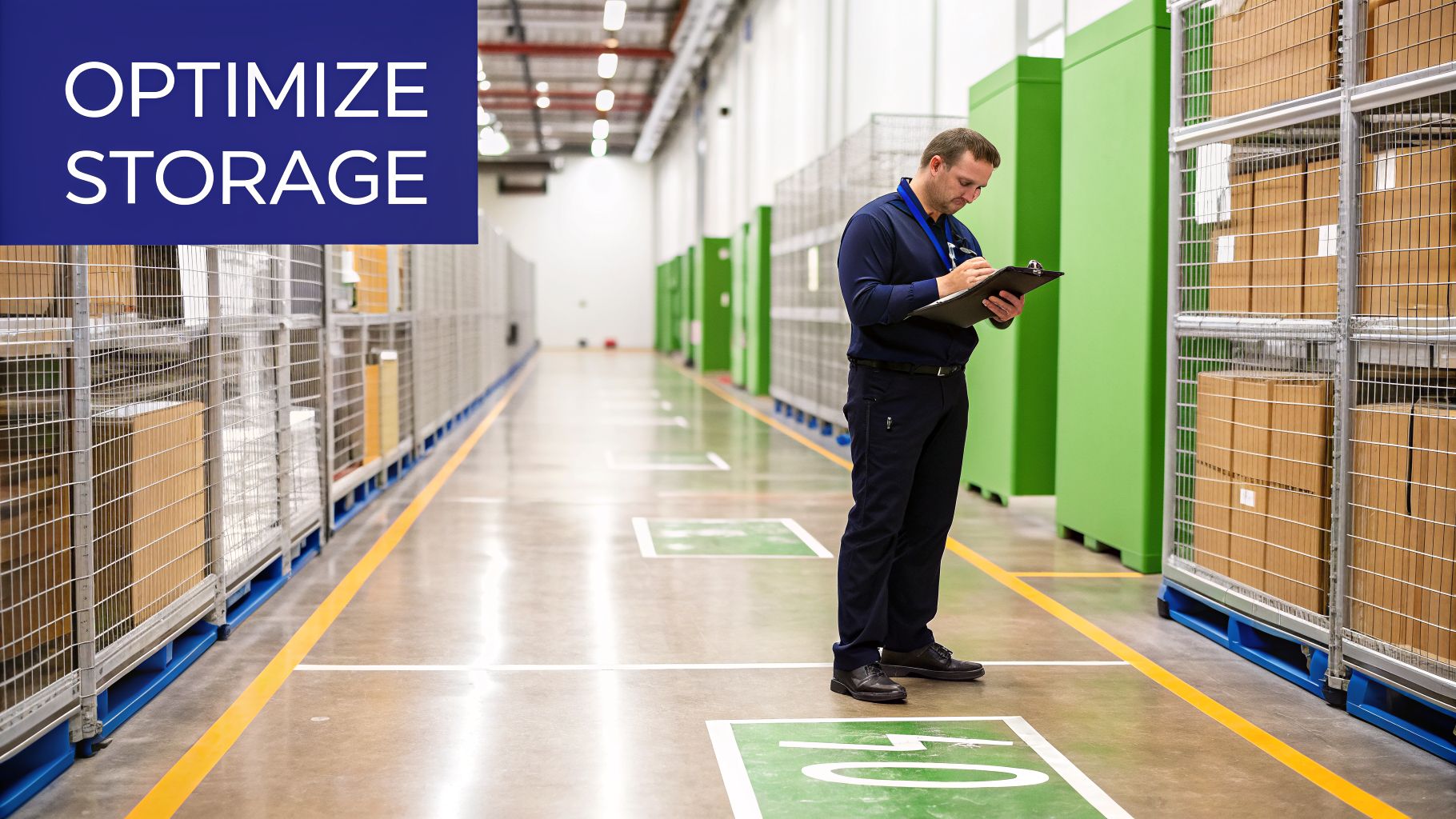
At their heart, wire mesh storage bins are much more than just a place to put things. They are smartly engineered solutions designed to solve common—and expensive—industrial headaches. That open-mesh construction isn’t just for looks; it’s a deliberate design choice that delivers a surprising number of benefits.
Just imagine trying to track down a specific component buried in a stack of solid-walled totes. You’d have to unstack everything, pop open each lid, and hunt around, burning through precious time. Wire mesh bins eliminate this struggle by offering 100% visibility, letting workers spot what they need instantly without moving a single thing. That simple feature alone dramatically speeds up both order picking and inventory counts.
Key Benefits of Wire Mesh Construction
The practical advantages of wire mesh storage bins ripple throughout the entire supply chain, impacting everything from worksite safety to the integrity of your products. It’s all built right into the design.
Improved Airflow: The open grid stops dust, dirt, and moisture from building up inside. This is a game-changer for storing parts prone to rust or contamination, and it directly cuts down on product spoilage.
Enhanced Fire Safety: If a fire breaks out, the mesh design allows water from overhead sprinklers to penetrate the container and douse the contents. This massively improves fire suppression and helps your facility meet stringent safety codes.
Increased Durability: Built from welded steel, these bins are incredibly tough. They can take the daily abuse of a demanding industrial floor, easily outlasting their plastic or wood counterparts.
Space Optimization: Most bins are designed to be both stackable and collapsible. You can stack them several units high when they're full to maximize your vertical real estate. Once empty, they fold down to a fraction of their size, freeing up floor space and slashing return shipping costs.
The real value of wire mesh storage bins is their multifunctionality. They aren't just holding parts; they're actively protecting your assets, streamlining workflows, and creating a safer environment for your team.
Later on, we’ll also dive into how custom-engineered solutions from pioneers like Plexform Incorporated can solve unique challenges that standard, off-the-shelf bins just can't handle.
How Industrial Storage Evolved to Meet Modern Demands
The wire mesh bins we see in warehouses today weren't invented overnight. Their design is the result of centuries of trial and error, with every feature added to solve a specific, costly problem on the factory floor. This evolution from simple wooden crates to highly engineered containers is a story of practical, demand-driven innovation.
Early on, factories and warehouses had to make do with basic materials like wooden crates and fabric sacks. They worked, but just barely. These storage methods were a magnet for pests, rotted in damp conditions, and created a massive fire risk in busy industrial environments.
The Shift to Steel
The Industrial Revolution kicked off a need for something much stronger. The move to iron and riveted steel bins around 1820 was a massive step up. These heavy-duty containers could finally handle the weight of raw materials like coal and heavy machinery parts without falling apart. This change alone drastically improved durability and cut down on the product losses that were so common in early industry.
But even steel had a critical weakness. Left outside or in humid warehouses, rust and corrosion would eventually eat away at the containers. The next big improvement came from tackling that exact issue.
The development of galvanization in the 1920s, which coats steel in a protective layer of zinc, slashed corrosion rates by 70-80%. This simple innovation suddenly made metal bins a viable option for a much wider range of applications.
Innovation Forged by Necessity
It was World War II that really accelerated the design of industrial storage. Military logistics demanded solutions that were not only tough but also ruthlessly efficient. This pressure-cooker environment led to two breakthroughs that still define the wire mesh storage bins we rely on today.
Modular, Stackable Designs: To squeeze every last inch of value from transport ships and trucks, engineers developed bins with reinforced corners and interlocking feet. These new designs boosted transport capacity by up to 40%—a game-changer for supplying troops overseas.
The Rise of Wire Mesh: The need for visibility and airflow quickly became obvious. A mesh body meant soldiers could identify contents at a glance without unpacking everything, and it prevented moisture from building up on sensitive gear.
After the war, these military-grade designs were adapted for the commercial world. Companies began adding practical features like handles, wheels, and drop-gates for easier access. The open mesh was a perfect fit for industries like automotive, where proper air circulation could stop rust from forming on stored parts, reducing damage by as much as 15-25%.
This long road of practical problem-solving has led directly to the hyper-efficient containers used by today’s logistics giants and advanced manufacturers. From 19th-century forges to modern automated facilities, the history of the wire mesh bin proves its value. It’s why custom steel bins from firms like Plexform Incorporated can now get damage rates down to under 1%. You can dig deeper into this history by exploring the evolution of metal storage bins on rdrsteelsales.com.
Making the Right Choice for Your Application
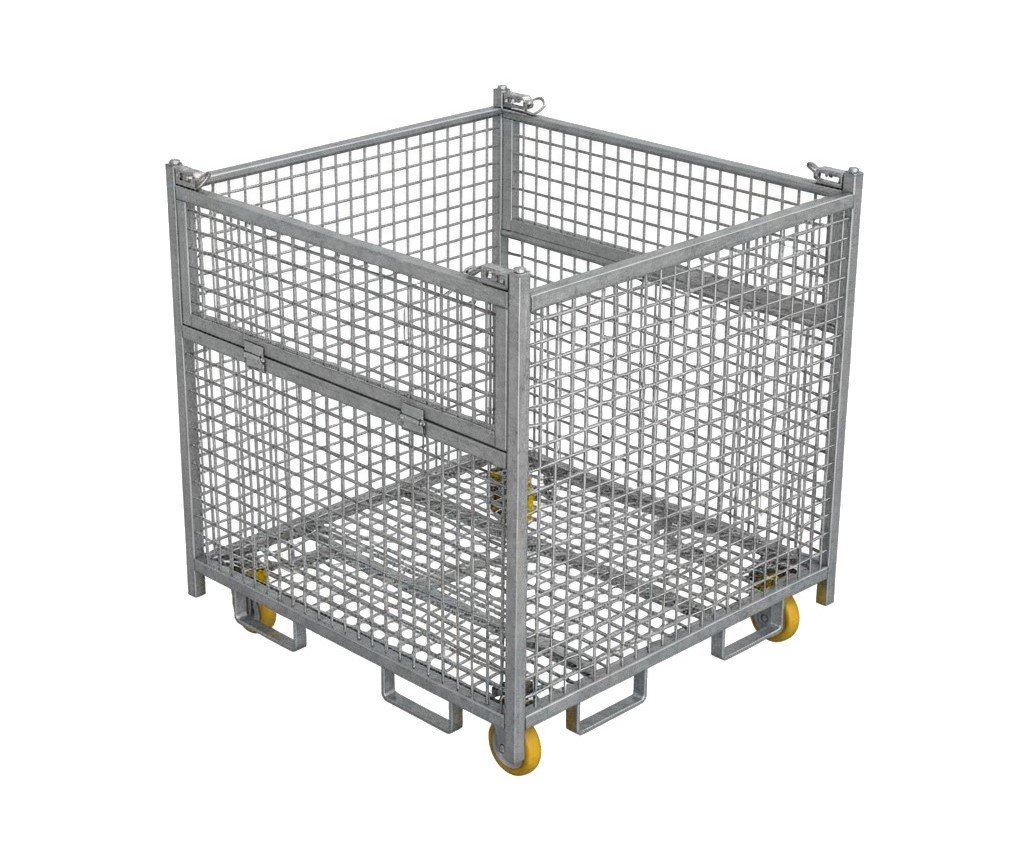
This guide is designed to take the guesswork out of the equation. We’ll walk through the critical selection criteria, from material options and load capacities to matching the bin dimensions to your specific parts. By the end, you’ll have the know-how to make a smart decision that protects your investment and streamlines your operations.
Material and Finish: What Is Best for Your Environment?
The foundation of any good bin is the material it’s made from. This choice really comes down to two things: where the bin will be used and what it will hold. For most indoor, industrial settings, carbon steel is the workhorse, offering a fantastic balance of strength and cost.
But what if your facility deals with moisture, corrosive chemicals, or needs to meet strict hygiene standards for food processing or pharmaceuticals? That's where stainless steel is the clear winner. It costs more upfront, but its natural resistance to rust and corrosion means it will last far longer in those tough environments, preventing product contamination.
The finish is the bin’s first line of defense against wear and tear. It’s just as important as the steel itself.
Galvanization: This process coats the steel in a layer of zinc for heavy-duty rust protection. It’s the perfect choice for bins that will live in humid warehouses or even spend time outdoors.
Powder Coating: This finish gives you a tough, uniform layer of color that stands up to chipping and scratching far better than regular paint. It’s great for color-coding inventory and provides excellent protection for indoor use.
Think of it like this: a powder-coated carbon steel bin is your reliable gear for a controlled warehouse expedition. But for braving the harsh elements of a chemical-heavy or wet environment, you need galvanized stainless steel.
Load Capacity: Static Versus Dynamic Loads
This is a non-negotiable part of the decision, and getting it wrong is a serious safety risk. Understanding load capacity isn’t about one single number; you have to know the difference between two types of loads.
First, you have the static load capacity. This is your "stacking" capacity. It’s the absolute maximum weight a bin can handle when it’s sitting still with other loaded bins stacked on top of it. If you go over this limit, the bins at the bottom of the stack can buckle or collapse.
Then there’s the dynamic load capacity. This is the maximum weight a bin can safely hold while it's in motion—being carried by a forklift or moved on a pallet jack. This number is almost always lower than the static capacity because the forces of starting, stopping, and turning add extra stress to the bin’s structure.
Always confirm both of these capacities with the manufacturer. A bin rated for a 4,000 lb static load might only have a 2,500 lb dynamic capacity. Ignoring this difference is a recipe for an accident.
Matching Mesh and Bin Size to Your Parts
The final pieces of the puzzle are the physical specs of the bin itself—the mesh grid and the overall dimensions. The goal is a perfect fit, not just for your parts, but for your entire logistical flow.
The mesh size, or the opening in the wire grid, must be small enough to securely contain your smallest parts. If the mesh is too wide, you’ll have components falling through, which means lost product, potential damage, and tripping hazards on the floor.
Your bin’s overall dimensions (length, width, and height) have to work with your existing setup. Do they fit cleanly into your pallet racking? Can you move them down your aisles without issue? Do they maximize the space inside your trucks? Answering these questions up front will help you avoid logistical headaches and ensure your new bins slot seamlessly into your workflow. Adding mobility with options like metal bins on wheels can also introduce major ergonomic and process improvements.

Why Custom Engineering Delivers Superior Performance
Standard, off-the-shelf bins are often seen as a quick fix, a one-size-fits-all solution for problems that are rarely standard. While they might work for general storage, they almost always create hidden costs in wasted space, damaged parts, and sluggish workflows. This is where custom engineering changes the game, shifting the focus from simply storing parts to strategically protecting them.
Think of a generic bin like an off-the-rack suit—it might do the job, but it's never a perfect match. When you drop a delicate or uniquely shaped component into a standard container, any extra space becomes a problem. During handling or transport, that part is free to slide, rattle, and bang against the bin walls, leading to scratches, dents, or even critical damage.
This isn't a small issue; it's a direct hit to your bottom line. Warehouse damage studies consistently show that these seemingly minor impacts add up to huge financial losses. Custom-engineered wire mesh storage bins get rid of that risk by creating a perfect-fit home for your specific components.
Precision Design with CAD and 3D Modeling
The magic behind this perfect fit is modern design technology. Engineers aren't just guessing anymore. Using advanced Computer-Aided Design (CAD) and 3D modeling software, they can build a virtual prototype of a bin that’s made-to-order for the exact geometry of your parts.
The process is straightforward but incredibly detailed:
Modeling the Part: It all starts with a 3D model of your component. This allows engineers to understand its exact dimensions, weight, and any fragile points.
Designing the Container: A custom bin is then designed around the part. This can include features like custom dunnage, form-fitting dividers, or unique contours to hold it securely in place.
Simulating Performance: The virtual model is then put through its paces. It can be tested to see how it holds up under stress, making sure the final product will protect its contents during real-world handling.
Custom engineering turns a simple container into a bespoke protective system. By designing the bin to fit the part, you're not just storing it; you're creating a form-fitting shield that dramatically cuts the risk of in-transit damage—often by up to 28%, according to logistics studies.
Solving the Pitfalls of Standard Bins
The perks of a tailored solution go far beyond just preventing damage. Custom design directly tackles the everyday frustrations and bottlenecks that plague facilities stuck with generic containers. It offers a clear problem-and-solution approach that improves several areas of your operation.
The Problem: Wasted Space
Standard bins almost always leave awkward gaps, which means you’re not using your warehouse or truck space efficiently. A few inches of empty space in every bin quickly adds up to a massive loss of density across thousands of containers.
The Custom Solution:
Engineers design bins to maximize part density without sacrificing safety. By nesting components intelligently, a custom bin can hold more parts in the same footprint, making the most of every square foot in your facility and trimming shipping costs. For businesses ready to unlock major space and cost savings, exploring custom metal bins is the next logical step.
The Problem: Ergonomic Strain
We’ve all seen it: workers struggling to lift heavy, awkward parts out of deep, generic bins. This leads to a higher risk of injuries and slows down cycle times, hitting both safety and productivity.
The Custom Solution:
A custom design can build in ergonomic features like half-drop gates, rotating bases, or specific lifting points. These simple additions let workers access parts easily and safely without awkward bending or reaching, which can boost throughput by over 20% on busy production lines. Custom engineering isn’t a luxury; it’s a strategic move to protect your products, optimize your space, and keep your team safe.
Calculating The ROI Of Quality Wire Mesh Bins
Thinking about high-quality wire mesh storage bins as just another expense is a mistake. It’s a strategic investment, and one with a return on investment (ROI) you can actually measure. The physical features of these bins translate directly into the language of business: dollars and cents.
This isn't just about buying a better bin. It's about bringing an asset into your facility that actively drives savings across your entire operation. By looking at how they impact your space, labor, and product integrity, you can build a solid, data-driven case for their long-term value.
Feature To Benefit Translation For Wire Mesh Bins
It's one thing to see a list of features, but what do they actually do for your bottom line? This table breaks down how the key characteristics of quality wire mesh bins translate into real-world operational and financial wins.
| Feature | Operational Benefit | Financial Impact |
|---|---|---|
| Stackable Design | Maximizes vertical warehouse space, reducing floor clutter. | Lowers real estate costs by reducing the required physical footprint. |
| Collapsible/Foldable | Reduces empty container volume for return trips. | Slashes return shipping expenses, sometimes by 20% or more. |
| Open Mesh Grid | Improves inventory visibility for faster part identification. | Cuts labor time for picking and counting by up to 35%; boosts order fulfillment speed. |
| Durable Steel Construction | Protects parts from damage during handling and transit. | Reduces product damage claims by as much as 28%, saving on replacement costs. |
| Forklift Compatibility | Enables safe and efficient movement of heavy loads. | Lowers manual labor needs and reduces the risk of workplace accidents. |
Ultimately, every well-designed feature is engineered not just for function, but for financial performance.
Translating Features Into Financial Gains
Every single aspect of a well-designed wire mesh bin is there to help your bottom line. Take their stackable and collapsible nature—it's a massive cost-cutter. Stackability lets you finally use all that empty vertical space in your warehouse, shrinking your footprint and the associated real estate costs.
Then, when they’re empty, they collapse down. This simple feature drastically cuts your return shipping expenses. It’s a win-win.
The open mesh design has a direct financial benefit, too. It gives your team total visibility, allowing workers to spot and pick parts in a fraction of the time. This naturally speeds up order fulfillment, makes inventory counts more accurate, and reduces labor hours that were once wasted just searching for items.
The image below shows this in action, illustrating how the right bin choice directly impacts your space and protects your products.
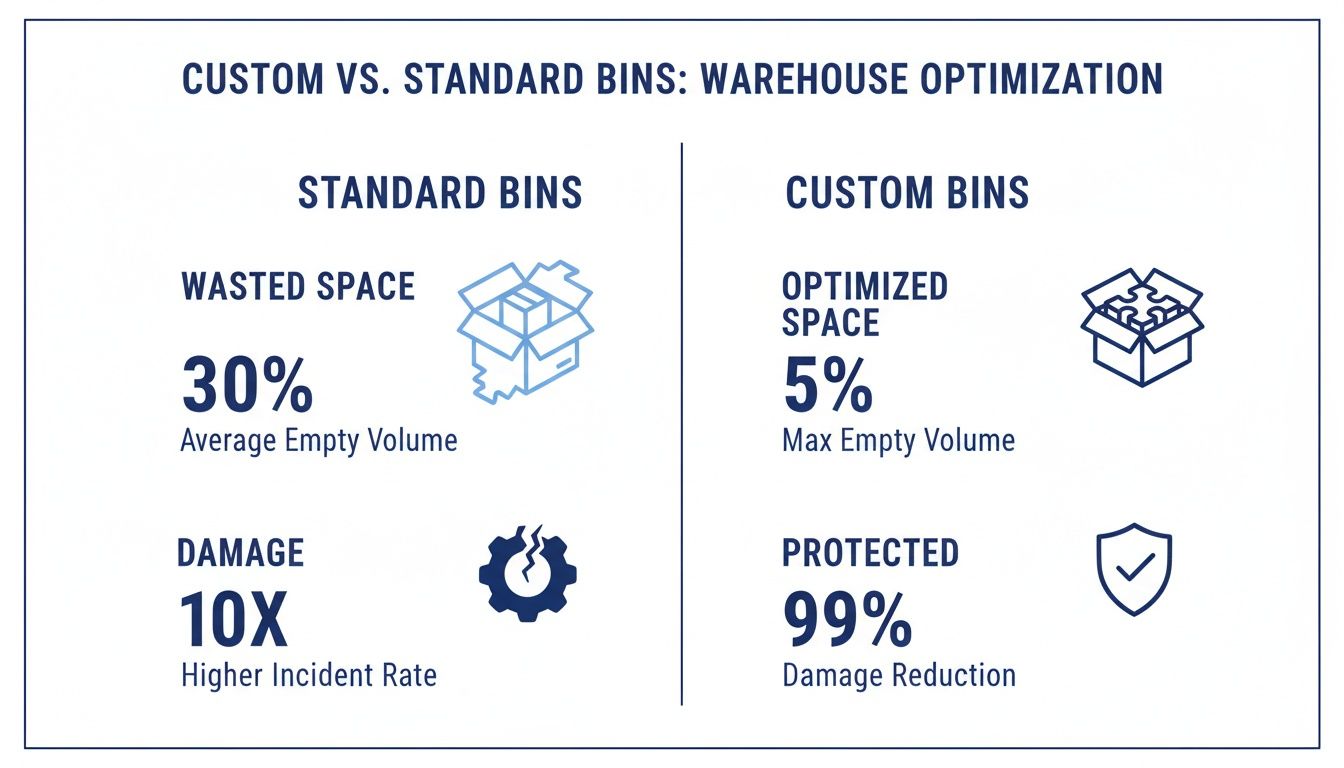
As you can see, standard, off-the-shelf bins often create wasted space and leave goods vulnerable. A custom-fit solution, on the other hand, makes the most of every inch while keeping your inventory safe.
Hard Numbers And Market Growth
The financial argument for these containers is backed by solid market trends and powerful statistics. The global market for foldable wire mesh containers hit $4.9 billion in 2026, fueled by the intense logistics demands of e-commerce and modern manufacturing.
Logistics studies show that switching to wire mesh systems can cut product damage claims by a whopping 28% compared to using cardboard or plastic totes. On top of that, the open design can slash inventory handling time by 25-35% because picking and counting are so much faster with full visibility.
For many logistics managers, this adds up to a full ROI in under 18 months. Some manufacturers even report annual savings of $250,000 just from optimizing truck loads with stackable, returnable bins. You can dig into more of this data by exploring the foldable wire mesh container market trends on dataintelo.com.
Investing in quality wire mesh bins is a direct investment in efficiency. The reduction in product damage, optimized labor, and improved space utilization quickly outpaces the initial cost, delivering a clear and sustainable return.
A Framework For Calculating Your ROI
Want to figure out the potential ROI for your own facility? Start by looking at these key areas where wire mesh storage bins generate savings:
Reduced Product Damage: Look at your current spoilage or damage rate. A 28% reduction in those claims translates to huge savings on lost product and replacement costs.
Increased Labor Efficiency: How much time does your team spend on picking, inventory counts, and general material handling? A 25-35% time savings per task adds up fast when you multiply it across your entire workforce.
Optimized Storage Space: What's your current cost per square foot? Bins that can stack 4-high can cut your floor space requirements by as much as 75%, freeing up that valuable real estate for production or other revenue-generating activities.
Lower Shipping Costs: Analyze what you spend on return logistics. Collapsible bins that shrink down to a fraction of their full size can lower those return shipping costs by 20% or more.
When you connect these durable, smart features to tangible outcomes like less damage and faster workflows, the business case becomes undeniable. The numbers don't lie—choosing the right wire mesh storage bins is one of the smartest financial moves a modern facility can make.
Making the Right Call: Your Wire Mesh Bin Checklist
Alright, you’ve done the research and you see the potential. Now it’s time to turn all that information into a concrete decision. This isn’t just about buying a container; it's about investing in a solution that fits seamlessly into your entire operation.
Think of this checklist as your roadmap. It’s designed to walk you through the essential questions that will bridge the gap between your current needs and your long-term goals. Answering these questions will not only clarify your choice but also give you the perfect starting point for a conversation with an engineering team.
Analyze Your Parts and Processes
First things first: let's get a crystal-clear picture of what these bins need to do on a daily basis. The specific parts you handle and the workflow you use will lay the foundation for everything else.
What are you storing? Look at the full range, from your smallest and lightest components to your largest and heaviest. This directly influences the mesh opening size and the overall bin dimensions you'll need.
Are your parts fragile or oddly shaped? If the answer is yes, throwing them into a standard bin is a recipe for damage and lost money. This is a massive red flag that points directly toward a custom-engineered solution, likely with protective dunnage.
How will your team actually use the bins? Put yourself on the warehouse floor. Will workers need to grab parts from a bin that’s in the middle of a stack? If so, a feature like a half-drop gate isn't a luxury—it's a necessity for good ergonomics and efficiency.
Define Your Operational Requirements
Next, let's zoom out and look at the environment where these bins will live. The intensity of your facility and the demands of your logistics will determine the required durability and functionality.
Think of durability and space optimization as the core strengths of wire mesh storage bins. Top-tier galvanized steel bins can endure over 50 years of tough industrial use and collapse to just 20% of their expanded size, making them ideal for returnable packaging systems. For a more detailed look at how these containers serve as a 'secret weapon' for major industries, check out the warehouse insights on wwmh.net.
So, what are your specific load and handling demands?
What’s the total weight of the parts in each bin? This number dictates the dynamic load capacity (for when the bin is moving) and the static load capacity (for when it’s stacked and stationary).
How high will you stack them? This is critical. You must ensure the static load capacity of the bottom bin can handle the total weight of all the bins stacked on top of it. Get this wrong, and you risk a catastrophic collapse.
What equipment will be moving the bins? Your forklifts, pallet jacks, or automated guided vehicles have specific requirements. Confirm your bins have the right four-way entry and reinforced feet to work with your existing equipment.
Weigh Standard Bins Against Custom Solutions
Finally, it's time to connect your operational needs to your financial strategy. This is where you balance the upfront sticker price of a standard bin against the long-term return on investment (ROI) that a custom solution can deliver.
A Standard Bin Might Be a Good Fit If:
You're storing generic, low-value bulk items where an exact fit doesn't matter.
Your parts are robust and not easily damaged by a little rattling around.
Your storage needs are temporary or for a non-critical part of your operation.
You Should Lean Towards a Custom Bin If:
You need to protect high-value, complex, or Class-A surface parts.
You want to maximize part density to squeeze more value out of every square foot of warehouse and shipping space.
Ergonomics and worker safety are at the top of your priority list.
You operate in a corrosive or sterile environment that demands specialized coatings. If you're considering specialized finishes, you can explore options in our guide to custom fabrication and coatings.
By walking through this checklist, you’ve moved beyond a simple purchasing task and are now making a strategic investment. You’re ready to have a productive conversation with a partner like Plexform Incorporated to design a solution that doesn't just hold your parts—it drives your business forward.
Frequently Asked Questions
Making a big investment in your facility always brings up questions. It's only natural. Here, we tackle some of the most common questions we hear from industrial engineers and logistics managers about choosing and using wire mesh storage bins. Our goal is to give you clear, straight-to-the-point answers to help you make the right call.
What Is The Average Lifespan Of A Wire Mesh Storage Bin?
The durability of a wire mesh bin is one of its biggest advantages. With the right care, a quality galvanized or powder-coated steel bin will easily last 15-20 years—and often longer—even in a demanding industrial environment. This incredible lifespan comes down to tough steel construction and protective finishes that fight off rust, corrosion, and the bumps and scrapes of daily work.
Of course, a few key things will impact how long they last:
Load Management: Always staying within the bin’s stated dynamic and static load capacities is crucial. Overloading causes structural fatigue that can lead to failure down the road.
Operating Environment: If you're working in a place with harsh chemicals or high moisture, a galvanized finish is your best bet. It provides the maximum defense against corrosion.
Handling Practices: Good forklift habits and careful handling go a long way. They help prevent the dents and dings that can weaken a bin's structure over time.
When you compare them to plastic or wood, it's not even a fair fight. Plastic bins get brittle and crack. Wooden crates splinter, rot, and become a home for pests. Both often need replacing after just a few years.
Can Wire Mesh Bins Be Used In Automated Systems?
Absolutely. In fact, modern wire mesh storage bins are specifically built to play nicely with today’s automated warehouse tech. They are fully compatible with sophisticated Automated Storage and Retrieval Systems (AS/RS), conveyors, and Automated Guided Vehicles (AGVs).
The secret is in the engineering. For a bin to work perfectly with robotics, it needs features that you just won't find in an off-the-shelf product. We're talking about perfectly consistent dimensions, reinforced bases that don't warp under a heavy load, and specially designed feet that let robotic arms or shuttles get a secure grip. A custom manufacturer like Plexform builds these critical features into the design right from the start.
Are Custom Bins More Expensive Than Standard Bins?
We get this question a lot, and the answer isn't just about the initial price. While a custom-engineered bin might have a higher upfront cost per unit, it almost always delivers a lower Total Cost of Ownership (TCO) and a much higher ROI.
A standard bin solves a general problem, but a custom bin solves your specific problem. The initial investment in precision engineering pays dividends by eliminating chronic operational costs that slowly drain your budget.
Think of it this way: a custom bin is engineered from the ground up to prevent product damage, make the most of every square inch of truck space, and streamline your team's workflow. Over the life of that bin, the money you save on damaged goods, shipping, and labor will quickly outstrip the initial cost difference. That's what makes a custom solution the smarter financial choice for the long haul.
Ready to see how a custom-engineered solution can solve your specific challenges? The team at Plexform Incorporated specializes in designing and building steel racks and bins that protect your parts, optimize your space, and drive efficiency. Start the conversation today.

Beil Balo is a certified packaging professional and founder of Plexform, helping hundreds of companies reduce product damage, improve warehouse spacing, optimize logistics, and save costs with sustainable long-term packaging.