 Skip to content
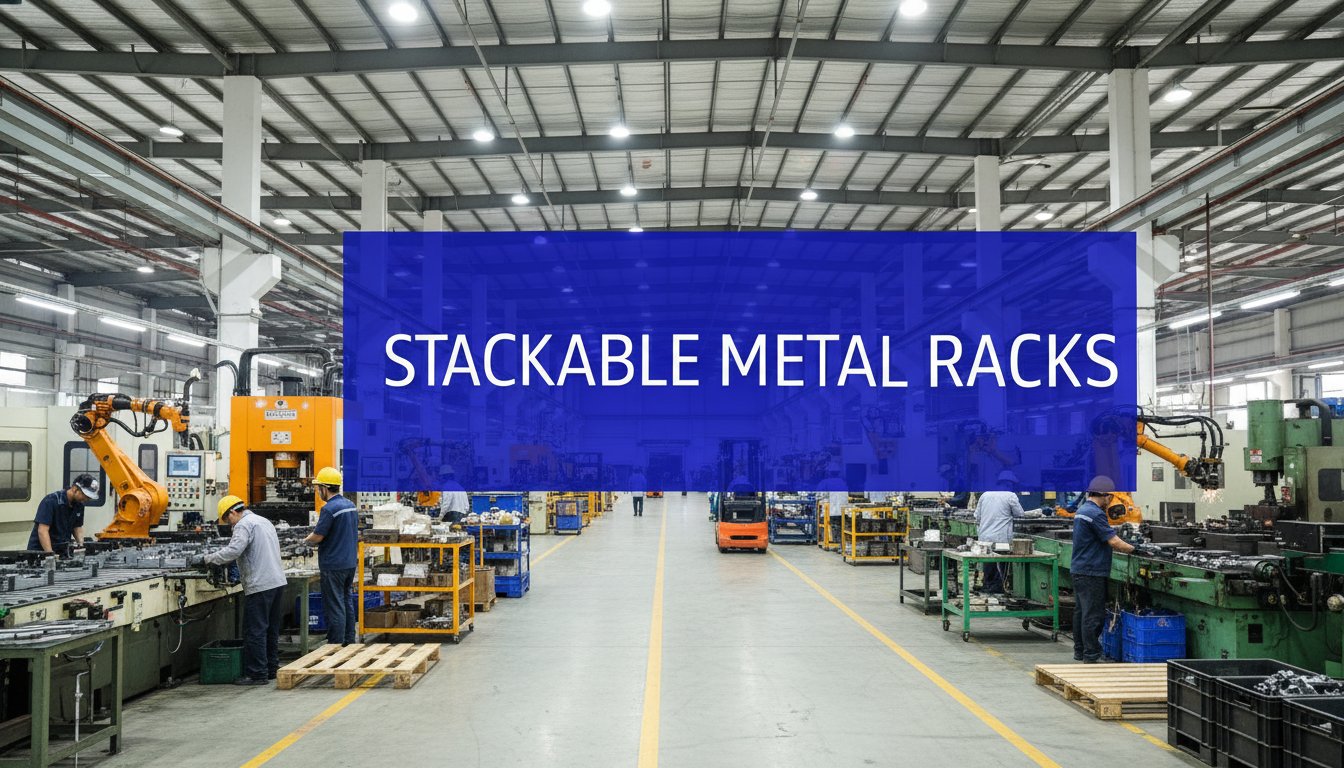
At their core, stackable metal racks are simply modular, freestanding storage units. But that description doesn't do them justice. Unlike fixed shelving, their real power lies in their flexibility. They can be stacked, moved, and reconfigured to match your ever-changing inventory and production demands, making them a true workhorse for warehouse efficiency.
From Cluttered Floors to Efficient Vertical Storage
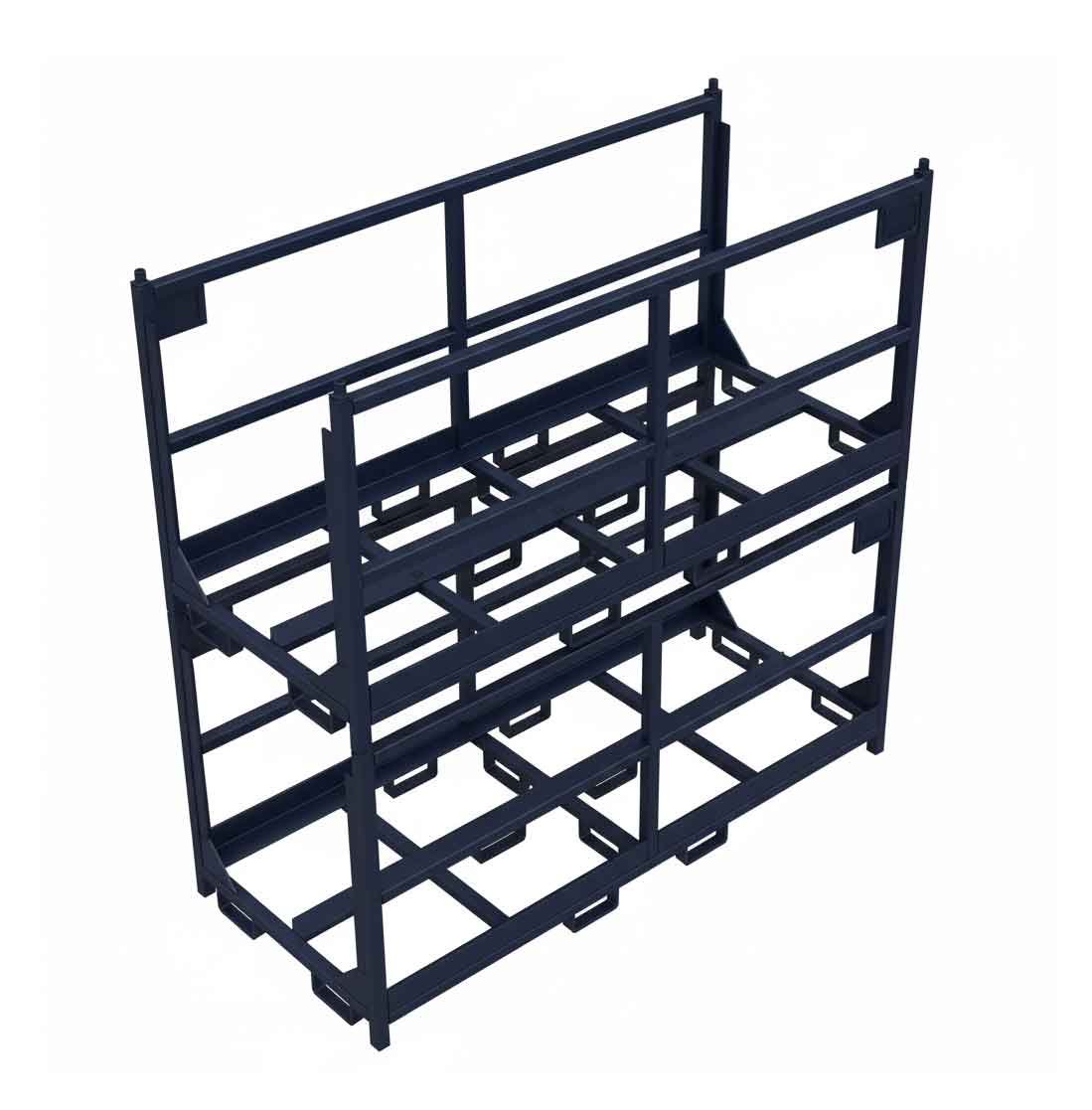
Think about a factory floor before the 1920s. You'd likely see a scene of organized chaos—goods piled high in shaky, unstable stacks right on the ground. This method, called floor stacking, was the norm for centuries, but it came with massive headaches. Accessibility was a nightmare, product damage was common, and safety was an afterthought. Anything at the bottom of a pile was essentially lost until everything on top of it was moved.
Then, a single invention turned this entire system on its head: the forklift. Suddenly, workers could lift heavy loads higher than ever before. The problem? Floor stacking couldn't take advantage of this new vertical reach. A structured, safe way to store goods vertically wasn't just a nice-to-have; it became an urgent necessity that kicked off a complete overhaul in warehouse logistics.
The Rise of Vertical Racking Systems
The answer was the creation of dedicated racking systems. This move from horizontal clutter to vertical order didn't happen overnight. It was an evolution born from industrial need and some clever engineering.
The first real systems popped up in the late 1920s, offering an alternative to messy floor stacks. The invention of the forklift around 1915 was the real trigger, giving workers a way to lift heavy pallets into these new vertical structures. By the 1950s, steel had become the go-to material for its superior strength and durability. This allowed for taller, higher-capacity systems that were strong enough to support the post-war industrial boom. You can explore more about the evolution of warehouse storage systems and how they reshaped logistics.
Understanding this history is important for today’s engineers and managers. It shows that stackable metal racks aren't just equipment; they're the product of a century of problem-solving aimed at fundamental challenges:
Maximizing Space: Turning empty air into valuable storage real estate.
Protecting Products: Slashing the damage caused by crushing, toppling, and constant re-handling.
Improving Efficiency: Making sure every item is easy to get to without playing a game of warehouse Tetris.
Enhancing Safety: Creating stable, engineered structures to prevent accidents.
The journey from hazardous floor piles to precision-engineered stackable racks is a story of solving problems with smart design. It’s about recognizing that how you store something is just as important as what you store.
Today's Custom Engineered Solutions
That legacy of innovation is still going strong. Standard, off-the-shelf racks solve the basic need for vertical storage, but modern manufacturing demands more. If your operation deals with unique part shapes, tight production schedules, or delicate components, a generic solution just won't cut it.
This is where custom-engineered stackable metal racks come into play. They take the foundational principles of their predecessors and tailor them to your specific operational needs. These modern solutions don't just store your parts—they transform a generic warehouse into a highly optimized, dynamic system, continuing the journey from chaotic floors to efficient, purpose-built workflows.
What Exactly Are Stackable Metal Racks?
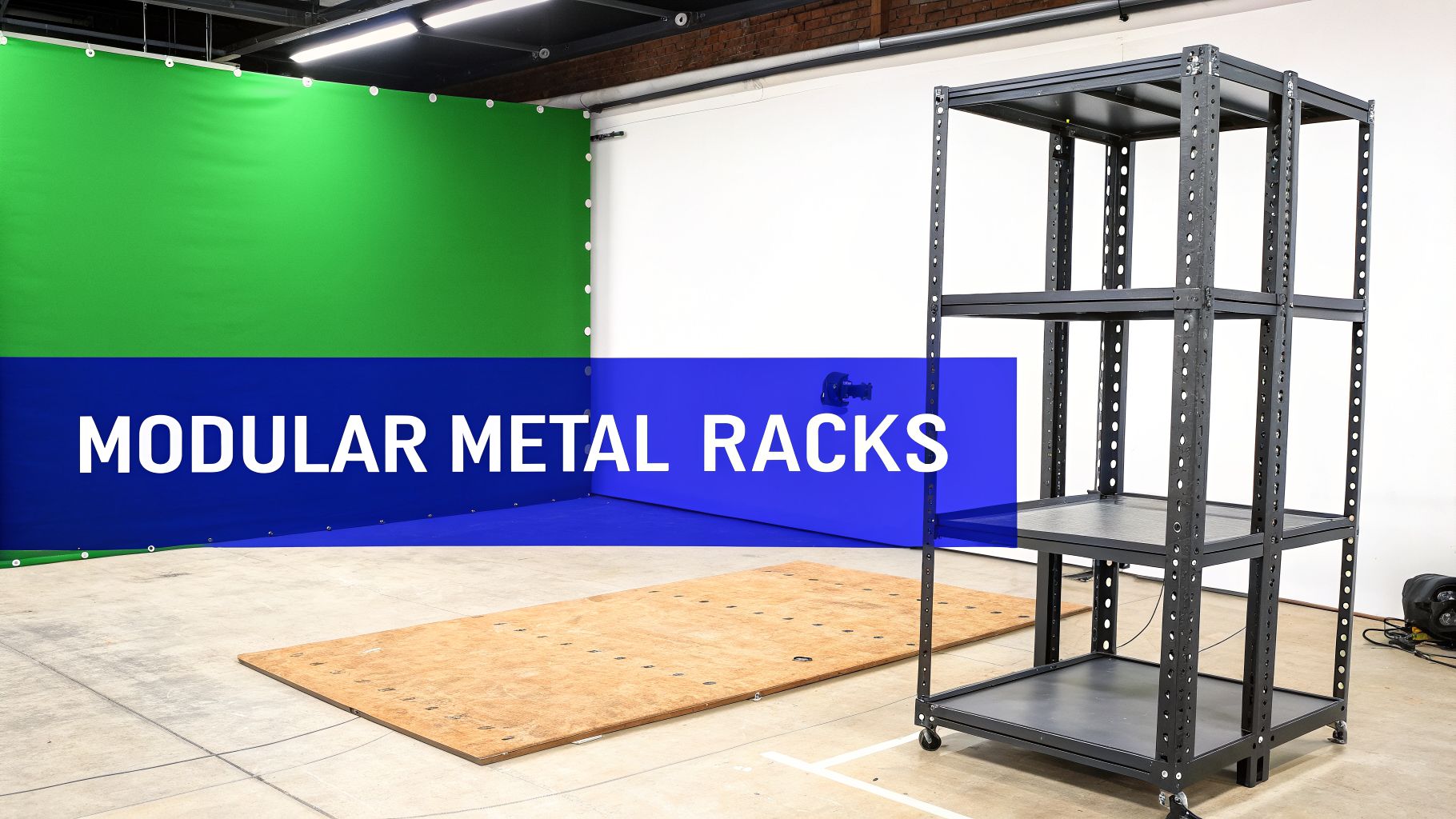
Let’s skip the textbook definitions. The easiest way to think about stackable metal racks is as industrial-strength building blocks for your warehouse or manufacturing floor. Unlike traditional pallet racking that gets bolted down and forgotten, these are freestanding, modular units built for one thing: flexibility. You can stack them high, move them with a forklift, and rearrange your entire layout as your inventory needs change.
This is what truly sets them apart from fixed storage. Each rack is its own self-contained storage unit, ready to be dropped wherever you need it most. They aren't anchored to a single spot, giving you the power to adapt your floor plan on the fly—a critical advantage in dynamic environments where every square foot counts.
Understanding The Core Components
At its heart, a stackable metal rack is a masterclass in simple, rugged engineering. It’s made of just a few key parts that work together to create a remarkably stable, load-bearing structure. For any engineer looking to improve a workflow, understanding this anatomy is the first step.
The basic design of most stackable racks breaks down like this:
The Base: This is the foundation, built from structural steel to handle the full weight of your product. It’s engineered for four-way forklift access, so an operator can pick it up from any side for quick and efficient movement.
Corner Posts: These are the vertical pillars that make stacking possible. Many designs feature removable posts, allowing you to collapse the racks when they’re empty and drastically shrink the space needed to store them.
Nesting Targets: Look at the top of each post, and you'll find these cup-like fittings. They are designed to securely guide and lock in the feet of the rack stacked on top, creating a solid, interconnected column that won't shift or sway.
Optional Decking: Depending on what you're storing, the base can be fitted with different surfaces. Options like solid steel, wire mesh, or even wood create a flat deck to support your parts.
A stackable rack is a perfect example of form following function. Every detail, from the forklift-ready base to the secure nesting targets, is engineered for one purpose: to deliver safe, dense, and highly mobile vertical storage.
The Power of Freestanding Flexibility
The real magic of these racks lies in their freestanding design. Since they aren't bolted to the building itself, you have total freedom to build up or tear down storage zones whenever you need to. This is a game-changer for any operation dealing with seasonal demand or fluctuating production schedules.
Think about it. Imagine a sudden surge in orders for a particular product. With old-school racking, you’re stuck with your fixed aisles. But with stackable racks, you can instantly set up a temporary, high-density storage area right next to the assembly line. Once the rush is over, you can break it down and reclaim that valuable floor space.
This ability to mold your physical environment to match your operational needs is a massive competitive advantage. It helps you build a more agile, responsive workflow and lets you sidestep the long-term cost and commitment of a fixed system.
Unlocking Vertical Space And Operational Agility
The most immediate—and powerful—benefit of stackable metal racks is their ability to turn empty air into valuable storage real estate. In any facility where floor space is a premium, going vertical isn’t just an option; it’s a necessity. These systems let you multiply your storage capacity without the immense cost and disruption of expanding your building’s footprint.
Think of it like building a skyscraper on a small city plot. Instead of spreading out, you build up. A single rack footprint that once held one pallet can now safely support four or five, instantly increasing storage density by 300% or more. This vertical approach is the key to unlocking hidden capacity within your existing walls.
Gaining Unmatched Operational Agility
Beyond just saving space, the modular, freestanding nature of these racks provides a level of operational agility that fixed systems simply can't match. Logistics managers in dynamic manufacturing environments know that production needs can change in an instant. A new project might require clearing a large section of the floor, or seasonal inventory might need to be consolidated and stored away.
With traditional, bolted-down racking, those reconfigurations are major projects involving significant downtime and labor. But with stackable racks, adapting your layout is as simple as picking up the units with a forklift and moving them. This gives you the power to redesign your storage on the fly.
The core advantage of stackable metal racks is converting static floor space into a dynamic, responsive asset. It's not just about storing more; it's about building a workflow that can pivot as quickly as your business demands.
Real-World Scenarios in Action
This flexibility isn't just a theoretical benefit—it creates tangible advantages in day-to-day operations. Imagine a few common situations where this agility proves invaluable:
Clearing Space for Production: A new assembly line needs to be set up temporarily. With a few forklift trips, you can clear a massive area by collapsing empty racks and stacking them compactly in a corner, freeing up hundreds of square feet in minutes.
Consolidating Off-Season Inventory: Seasonal products can be loaded into stackable racks and stored in a dense block in a less-accessible part of the warehouse. When the season returns, the entire block can be moved back to the main production floor.
Creating Buffer Zones: Need a temporary holding area for incoming parts or outgoing shipments? You can create a dedicated zone near the loading docks in the morning and have it gone by the afternoon.
More Than Just A Space-Saving Tactic
Ultimately, moving from static floor storage to dynamic vertical stacking is a strategic decision. It’s about more than just cramming more stuff into the same space. It's a fundamental shift toward a more efficient, productive, and responsive workflow.
Studies show that stackable metal racks are true game-changers for optimizing warehouse layouts. In fact, they can increase storage capacity by up to 66% compared to conventional fixed systems, which is why they are so crucial for high-volume manufacturing environments. Because their freestanding design uses removable posts, they offer incredible versatility—stack them high to maximize density or spread them out to improve accessibility. This adaptability makes them a superior choice for any facility that needs to react quickly to changing demands. You can explore the key benefits of stack racks on AmericanSurplus.com to see more on how these racks create an advantage.
The Engineering Behind A Custom Rack Solution
A great stackable metal rack isn't something you just pull off a shelf. It’s a carefully engineered tool, built from the ground up to solve a very specific material handling problem. The process goes way beyond simple storage, turning the rack into a key part of your product handling system—and it all starts with a solid digital foundation.
It all begins with a 3D CAD model of the part your rack needs to hold. This is the blueprint for success. Our engineers use this model to create a rack that perfectly matches the unique geometry of your components, ensuring they fit securely and stay stable. This crucial first step eliminates the guesswork that so often leads to product damage and inefficient handling.
From there, we move into the heavy-lifting analysis. This is where we calculate and perfect the core engineering principles of load capacity, weight distribution, and stacking stability. We’re asking the important questions: How much weight can one rack truly handle? How will that weight spread out to prevent stress points? And most importantly, how will a stack of four or five loaded racks behave?
Precision Calculations for Load and Stability
Our engineers use advanced software to run simulations of these real-world scenarios. Calculating load capacity is about much more than just the total weight. It's about understanding all the forces involved. A rack might be rated for 4,000 pounds, but its design has to account for the dynamic forces that happen during transport—like the acceleration, braking, and jostling from a forklift moving through a busy plant.
Weight distribution analysis makes sure the center of gravity is managed correctly. If a load is off-balance, the rack becomes unstable and dangerous, especially when stacked high. The goal is a design where the load is supported evenly by the rack's frame, channeling the force cleanly down through the corner posts to the rack below.
A custom rack isn't just designed to hold your part; it's engineered to protect it. Every angle, weld, and support is a deliberate choice made to ensure your product moves from point A to point B without a scratch, creating a closed-loop system of protection.
Integrating Custom Dunnage for Product Protection
The most critical element of a custom rack design is arguably the dunnage. This is the internal packaging—the custom-molded trays, dividers, and soft pads—that cradle your parts inside the steel frame. Think of the rack as the skeleton and the dunnage as the muscle and tissue giving direct support and cushioning.
This is where that 3D part model becomes so important. Dunnage is designed to touch your parts only in strong, non-critical areas. For sensitive or Class-A surfaces, that means zero contact, which prevents any scuffs, scratches, or dents. For odd-shaped components like engine blocks or exhaust systems, custom-molded dunnage creates a perfect nest that holds the part completely still.
The Role of Material Selection in Rack Engineering
The final piece of the engineering puzzle is choosing the right materials. The type of structural steel we use is determined by the load requirements and where the rack will be used. We might spec high-strength steel for extremely heavy-duty jobs, while other grades offer a great balance of strength and cost. This decision is fundamental to how well the rack performs and how long it lasts.
The infographic below shows how these engineered racks open the door to a more flexible storage strategy.
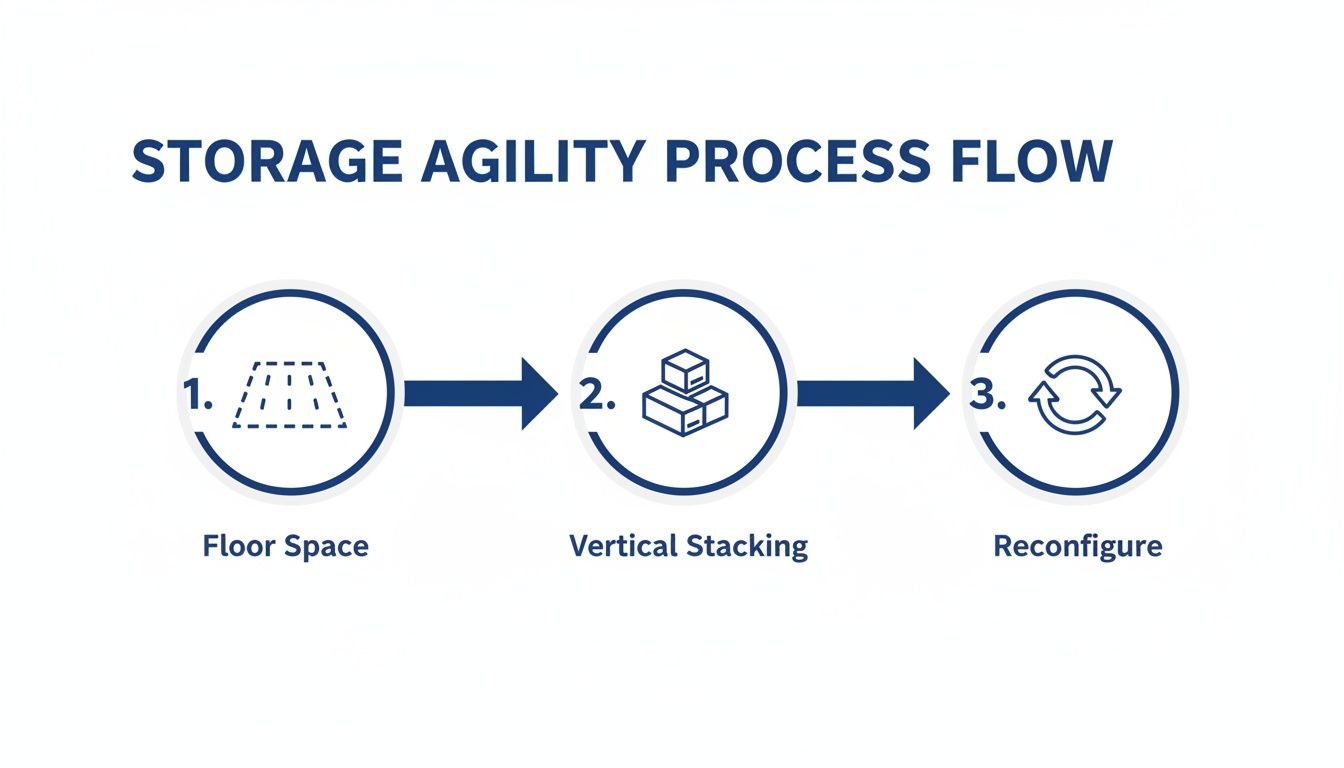
As you can see, the process turns open floor space into dense, vertical storage that can be reconfigured whenever you need. For a deeper look at this topic, you may want to read our guide to a high-performance custom metal rack, which breaks down the advantages of a tailored solution.
By bringing all these engineering elements together—precise modeling, load analysis, custom dunnage, and material science—a simple stackable metal rack is transformed into a high-performance tool that optimizes your entire workflow.
Selecting The Right Materials And Protective Finishes
A rack's strength and lifespan really come down to two key engineering decisions: the steel used to build it and the protective finish that shields it from the elements. Getting these choices right isn’t just about making the rack last longer; it's about perfectly matching it to your facility's environment and the daily grind it will endure. For an engineer, these choices are just as critical as the rack's structural design.
The heart of any stackable metal rack is its steel. While there are many alloys, the decision usually boils down to the classic trade-off: strength, weight, and cost. We often use high-strength structural steel for racks designed to carry exceptionally heavy loads, giving you maximum capacity without making the rack itself too heavy or bulky. For lighter-duty jobs, standard-grade steel can be a great, cost-effective option that doesn’t sacrifice safety.
Comparing Common Protective Finishes
Once a rack is built, it needs a suit of armor. Raw steel exposed to the air in a warehouse will start to rust surprisingly fast, and that corrosion will eat away at its structural integrity over time. The finish isn't just for looks—it’s a functional barrier against moisture, chemicals, and the bumps and scrapes of daily use.
Three finishes are the most common, and each one shines in a different environment:
Powder Coating: This is the go-to choice for most indoor racks. We apply a dry powder and bake it on, creating a finish that’s much tougher than regular paint. It stands up incredibly well to chipping, scratching, and fading.
Hot-Dip Galvanizing: If your racks are going to live outdoors or in a harsh, corrosive environment, this finish is a must. The entire rack gets a bath in molten zinc, which bonds directly to the steel. This gives it superior, inside-and-out protection against rust.
Standard Paint: While it's not as tough as a powder coat, a quality industrial paint can offer good baseline protection for low-impact, indoor jobs. Its main selling point is usually a lower upfront cost and the fact that it's easy to touch up.
Choosing a finish is a strategic decision about a rack's entire life cycle. A powder coat might be perfect for a clean, indoor factory, but that same rack would fail quickly if moved to an outdoor storage yard, where a galvanized finish would thrive for years.
The color options available with powder coating also have a practical benefit. You can use them to create a color-coded system for instant visual organization—maybe red racks for raw materials, blue for work-in-progress, and green for finished goods. This simple trick can make logistics smoother and cut down on handling mistakes.
Rack Finish Comparison for Industrial Environments
To help engineers choose the best option for their specific application, this table breaks down the most common finishes for stackable metal racks. It compares them based on their durability, cost, and where they perform best.
| Finish Type | Durability & Corrosion Resistance | Relative Cost | Ideal Application |
|---|---|---|---|
| Powder Coating | High resistance to impact, scratches, and chemicals. Good corrosion resistance for indoor use. | Medium | Indoor warehouses, manufacturing floors, and environments where visual organization is key. |
| Hot-Dip Galvanizing | Excellent corrosion resistance. Ideal for outdoor or harsh chemical environments. May have a rougher surface texture. | High | Outdoor storage yards, humid or wet processing plants, and facilities with corrosive elements. |
| Standard Paint | Basic protection against rust for indoor use. Most susceptible to chipping and scratching. | Low | Dry, indoor storage for low-impact applications where budget is the primary driver. |
Understanding the differences here is vital. For a deeper dive into the technologies behind these coatings and their specific advantages, you can read our guide on custom fabrication coatings for industrial use.
Ultimately, picking the right material and finish from the start is what ensures your stackable metal racks will deliver a long, reliable service life and a solid return on your investment.
Integrating Racks Safely Into Your Daily Workflow
An engineered rack system is only half the battle. To really get the most out of your investment, you need to think beyond the steel and integrate them safely and seamlessly into your daily operations. For floor supervisors and logistics managers, this means treating your stackable metal racks as active tools in the workflow, not just static storage.
A solid plan for their use, movement, and maintenance is non-negotiable. The whole system hinges on proper handling, and your forklift operators are on the front lines. They need specific training on the unique dynamics of lifting, moving, and stacking these units. A sudden stop or a sharp turn can easily shift a heavy load, creating a dangerous situation—especially with a tall stack.
Building a Culture of Inspection and Safety
A safe workflow has to be a proactive one. You simply can't afford to wait for a rack to fail before you find out there’s a problem. The single best way to prevent accidents and protect both your team and your product is to build a routine inspection protocol.
This doesn’t have to be some complex, time-consuming process. Empower your team to run a quick visual check before they move any rack. They should be looking for obvious red flags that signal a rack might be compromised:
Bent or Damaged Posts: Any post that isn't perfectly straight has lost some of its load capacity. It’s a ticking time bomb.
Cracked Welds: Check the joints where the base meets the posts. A hairline crack is a critical failure point waiting to happen.
Deformed Nesting Targets: Those cup-like guides at the top of each post have to be intact to lock in a stable stack. If they’re bent, the stack is compromised.
Overloading: This one’s simple. Always respect the manufacturer's stated load capacity. Pushing that limit is the fastest way to cause a structural failure.
Safety isn’t just a rulebook; it's a constant state of awareness. A five-second visual inspection before a lift can prevent a catastrophic failure down the line. It's the cheapest and most effective insurance policy you have.
Creating a Closed-Loop System
The real magic of custom stackable metal racks happens when they become part of a closed-loop returnable packaging system. This is where they stop being just storage and become a vital, constantly cycling asset in your supply chain. This is a concept that truly benefits from racks that are both mobile and efficient, a topic we explore further in our article on how a portable stack rack combines mobility with efficiency.
Mapping this loop is key to unlocking its value. The flow should be a smooth, unbroken cycle that looks something like this:
Loading at Production: Racks are filled with finished parts right off the assembly line. No extra handling, no wasted motion.
Staging and Transport: Loaded racks are moved to a staging area, stacked to optimize floor space, and then loaded onto trucks.
Unloading at Destination: The racks arrive at the next facility, are unloaded, and the parts are fed directly into the next production stage.
Collapse and Return: Once empty, the racks are collapsed (if using removable posts) and stacked for the return trip, taking up minimal truck space.
When you fully integrate your racks into a well-defined workflow like this, you ensure they’re used safely, handled correctly, and delivering maximum value at every single step of the process.
Frequently Asked Questions About Stackable Racks
When you're considering new equipment like stackable racks, a few key questions always come up. Let’s walk through the most common ones we hear from engineers and facility managers to clear things up and help you find the right solution for your operation.
How Much Weight Can A Stackable Metal Rack Hold?
This is easily the most important question, and the honest answer is: it’s all in the engineering. A standard, off-the-shelf rack might be rated for 2,000 to 4,000 pounds, but a custom-engineered solution can be designed to handle significantly more. The final load rating comes down to the grade of steel used, the structural design, and the type of dunnage supporting your parts.
It's also critical to understand that stacking capacity is a completely different calculation from individual rack capacity. A single rack might hold 4,000 pounds just fine, but the bottom rack in a stack of four needs to support its own load plus the weight of the three fully loaded racks sitting on top of it. That’s a total demand of 16,000 pounds.
A rack’s true capacity isn't just a number; it's a function of its design, materials, and intended use. Always verify the engineered load rating for both individual racks and full stacks to ensure operational safety.
What Is The Difference Between A Stack Rack And Pallet Racking?
The main difference boils down to one word: flexibility. Pallet racking is a stationary system. It’s bolted to the warehouse floor and often the building itself, creating permanent aisles for storing standardized pallets. It’s built for long-term, static storage.
Stackable metal racks, on the other hand, are freestanding, modular units. They aren’t anchored down, so you can pick them up and move them with a forklift whenever you need. This gives you the freedom to reconfigure your storage layout on the fly, creating dynamic zones for production, staging, or seasonal inventory. Think of pallet racking as the permanent walls of your house and stackable racks as the furniture you can rearrange at will.
Can These Racks Be Used Outdoors?
Absolutely, but only if they’re built for it with the right finish. A standard powder-coated or painted steel rack will start to rust and break down pretty quickly if you leave it out in the rain. For outdoor applications or in facilities with high humidity or corrosive chemicals, you need a rack with a hot-dip galvanized finish.
This process coats the entire rack, inside and out, with a thick layer of molten zinc. It creates a tough, long-lasting barrier that offers serious protection from the elements. Choosing the wrong finish for an outdoor application is a common and costly mistake that can lead to early equipment failure and create major safety hazards.
At Plexform Incorporated, we design and build custom stackable metal racks engineered to fit your parts, protect your products, and optimize your workflow. Discover how our custom-engineered solutions can transform your material handling.

Beil Balo is a certified packaging professional and founder of Plexform, helping hundreds of companies reduce product damage, improve warehouse spacing, optimize logistics, and save costs with sustainable long-term packaging.