 Skip to content
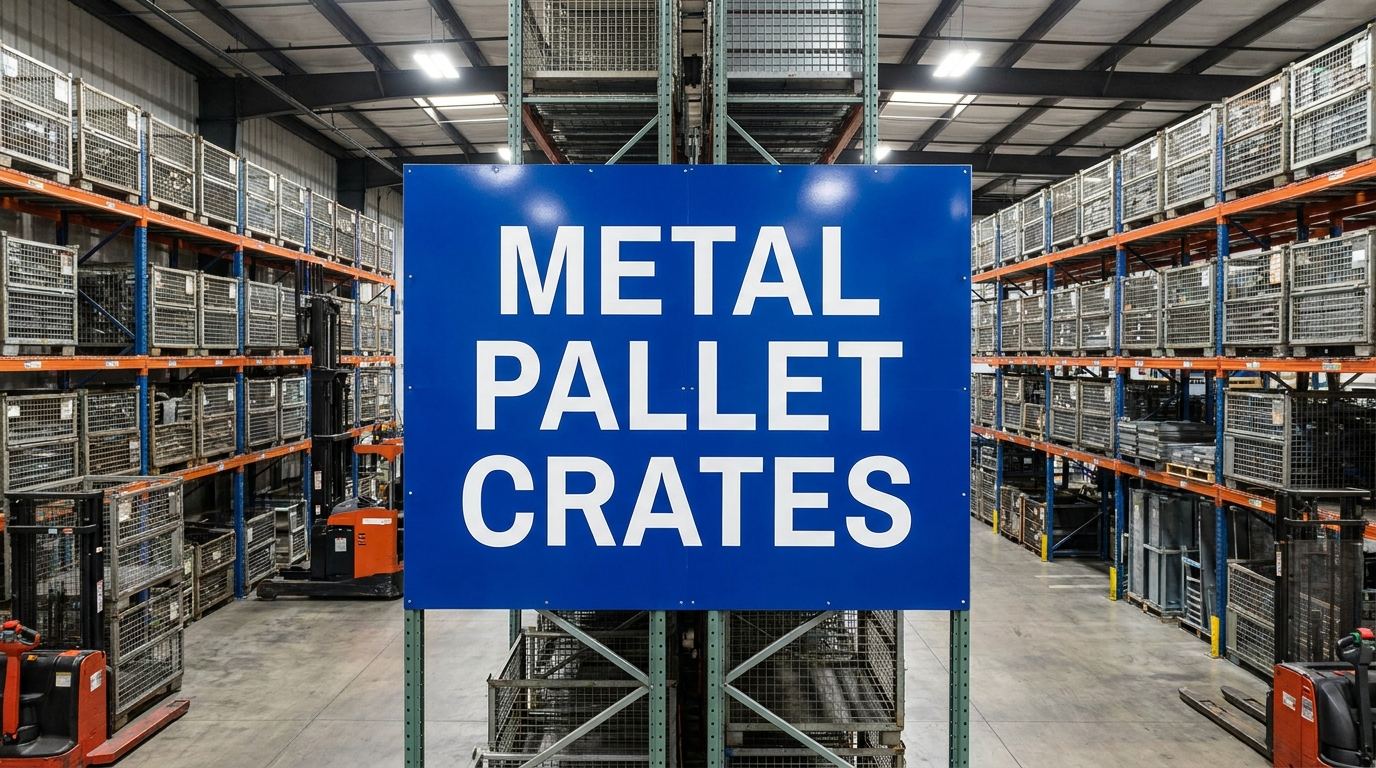
Plexform builds custom metal pallet crates for manufacturing and warehouse operations, engineered to exact customer specifications with lead times of 6–10 weeks and no minimum order quantity. If you’re managing high-value parts, heavy assemblies, or returnable shipping cycles, the right crate design can mean the difference between damaged inventory and a clean, repeatable workflow.
Standard wood crates crack, splinter, and fail under repeated use. According to the Reusable Packaging Association, companies that switch to reusable metal packaging cut packaging-related waste by up to 90% and reduce per-trip costs within 12–18 months. That’s a compelling case for any plant manager who’s tired of replacing damaged one-way packaging every few months.
Metal pallet crates combine the forklift-compatible base of a pallet with the containment walls of a crate, giving you a single unit that stores, stacks, and ships. This guide covers what they are, how they’re built, which configurations fit different operations, and how to specify the right one for your facility.
What Are Metal Pallet Crates and Why Do They Matter?
The basic definition
A metal pallet crate is a rigid, open or enclosed container built on an integrated pallet base, fabricated from steel or aluminum. Unlike a flat pallet, it has fixed or collapsible side walls that contain parts during storage and transit. The forklift pockets are built directly into the base, so the entire unit — parts included — can be moved without extra handling steps.
Why plants rely on them
The core value is consolidation. Instead of placing parts on a flat pallet and wrapping them in stretch film, you drop them into a crate and move on. That cuts handling steps, protects parts from contact damage, and makes stacking possible without custom racking. For facilities running high-volume production or just-in-time supply chains, that efficiency adds up fast across every shift.
The problem with wood and plastic alternatives
Wood crates absorb moisture, warp, and can introduce contamination on cleanroom or automotive lines. Plastic crates crack under repeated forklift impact and have limited load ratings. Metal pallet crates handle heavier loads, resist impact, and hold up for years of daily use — a service life that delivers real ROI compared to disposable alternatives.
Key benefits and construction of metal pallet crates
Material and build quality
Most metal pallet crates are fabricated from structural steel tubing, angle iron, or sheet steel, with welded or bolted connections depending on the application. Engineers at Plexform select the steel gauge, frame profile, and base construction based on your load requirements, not a generic catalog spec. Heavier assemblies may need thicker-walled tubing and reinforced corner posts, while lighter parts can use lighter-gauge frames to reduce tare weight and freight costs.
The base typically integrates two or four forklift entry pockets. Some designs add caster mounts for in-plant mobility, making the same unit useful on the production floor and on the truck.
Part protection and containment
Side walls can be solid sheet steel, wire mesh, or expanded metal. Each serves a different purpose. Solid sides protect against dust and debris. Mesh sides allow visual inventory checks without opening the crate. Expanded metal provides airflow — useful for painted or coated parts that need to cure during transit. As covered in the complete metal storage container guide, matching the wall material to your part type is one of the most practical decisions in the design process.
Stacking and space efficiency
Most metal pallet crates are designed to stack two to four units high, depending on the load rating. That vertical footprint is one of the fastest ways to recover warehouse floor space without adding shelving infrastructure. Empty crates can often be collapsed or nested, which cuts return freight costs significantly.
Types and configurations of metal pallet crates

Fixed-wall crates
Fixed-wall designs offer the highest structural rigidity. All four sides are permanently welded to the base frame, making them a good fit for heavy, irregularly shaped parts that need full containment. The tradeoff is that empty crates take the same space as loaded ones — worth thinking through if your return logistics involve long hauls or tight trailer space.
Collapsible-wall crates
Collapsible metal pallet crates fold down flat when empty, cutting return shipping volume by 60–75%. For closed-loop supply chains between a supplier and a plant, this configuration pays for itself quickly. The collapsible pallet stacking frames guide covers the stacking mechanics in detail — the same folding principles apply here.
Drop-gate crates
Drop-gate configurations include one or more hinged panels that swing open horizontally. Workers can slide parts in and out without lifting them over the top wall, which is a meaningful ergonomic improvement for heavy or fragile components. The American Iron and Steel Institute notes that high-strength steel alloys make these hinged gate mechanisms durable over thousands of load cycles without deformation.
Mesh and open-frame crates
Open-frame or mesh crates reduce tare weight and allow visual inspection of contents without opening the unit. They’re a common choice for warehouses running FIFO inventory management where quick identification matters. These also promote airflow around parts that need ventilation.
Custom dunnage-integrated crates
For precision parts — engine components, stamped body panels, machined castings — the crate interior can be fitted with custom dunnage: foam inserts, dividers, or locating fixtures that hold each part in a specific position. This protects surface finish, prevents part-on-part contact, and eliminates the need for separate packaging materials inside the crate.

How to choose the right metal pallet crate for your facility

Start with load capacity
Your heaviest load scenario defines the minimum structural spec. That includes the weight of parts plus any dunnage, and it needs to account for dynamic loads during forklift handling, not just static storage weight. Undersizing a crate frame leads to deflection, weld failure, and eventually a safety incident. The ANSI/MHI standards provide load rating guidelines for material handling containers worth reviewing before specifying any unit.
Match the configuration to your workflow
Think through how the crate actually moves through your operation. Does it leave your facility and return from a supplier? Collapsible walls reduce return freight cost. Does it stay on your floor for storage only? Fixed walls give you more rigidity for less money. Does it feed an assembly line where workers pull parts frequently? A drop-gate design cuts handling time per pick.
Consider the footprint and stack height
Your available floor space and ceiling clearance determine how many levels of stacking are practical. Metal pallet crates can often be designed to stack within standard racking systems, or to self-stack without any racking. Either way, confirm that the stack height capacity of the crate matches your actual operating conditions, including the weight of the crates stacked above.
Factor in return logistics
If your crates travel in a closed loop between facilities, empty return weight and cube matter. Collapsible designs reduce trailer space on the return trip. For single-facility use, this is less of a concern. For multi-site or supplier-facing operations, it directly affects your transportation cost per trip.
Interior fit for your parts
Standard interior dimensions work for bulk or generic parts. But if your parts are fragile, finished, or precisely shaped, custom interior dimensions and dunnage systems prevent damage that would otherwise happen inside a generic crate. Talk to your design team — or ours — about what the part actually needs, not just what fits through the door.
Implementation: ordering and deploying metal pallet crates

The Plexform engineering process
When you contact Plexform, our engineers start with your part dimensions, weight, stack requirements, and logistics constraints. We translate those inputs into a fabrication drawing for your review before any steel is cut. This review step is where most customers catch issues — a wall height that interferes with a crane lift, a base dimension that doesn’t match their truck floor, or a stack height that exceeds their ceiling clearance.
Once the drawing is approved, fabrication begins. Lead times run 6–10 weeks depending on complexity and order volume. We work with manufacturing plants across automotive, heavy equipment, aerospace, and general industrial sectors, so our team knows the documentation, part-specific requirements, and returnable packaging programs those industries typically run.
Deployment planning
Before your first shipment arrives, confirm that your forklift pockets match your truck’s fork center spacing. Verify that your dock height accommodates the loaded crate height. Train your receiving and shipping teams on any collapsible mechanisms — a dropped gate or collapsed wall that isn’t properly secured is a hazard. OSHA guidelines on material handling equipment cover safe forklift load practices that apply directly to crate deployment.
Tracking and maintenance
For returnable programs, crate tracking prevents loss and helps you maintain accurate asset counts. Many plants use barcode or RFID tags welded or riveted to the frame. Periodic inspection of welds, hinges, and forklift pockets keeps the fleet in service longer and prevents in-transit failures. Catching a cracked weld early costs far less than a dropped load.
The metal pallets with sides guide covers inspection routines and maintenance intervals that translate directly to metal pallet crate fleets.
Cost, ROI, and comparison: metal pallet crates vs. alternatives
What drives the price
Custom metal pallet crates are priced based on material (steel gauge, total weight), fabrication complexity (weld count, hinge mechanisms, custom features), surface treatment (powder coat, galvanize), and order volume. A simple fixed-wall crate in mild steel costs significantly less than a collapsible unit with drop gates and custom dunnage. Get your spec right before requesting a quote — a vague request produces a vague estimate.
Typical ROI timeline
Most operations recover the cost of a metal pallet crate fleet within 18–36 months, depending on trip frequency and the cost of the packaging being replaced. High-frequency closed-loop programs recover faster. Single-use wood crate replacement programs recover more slowly but still deliver meaningful savings over a 3–5 year horizon.
Comparison table
| Container Type | Load Capacity | Reusable | Stackable | Custom Interior | Return Freight Efficiency |
|---|---|---|---|---|---|
| Metal Pallet Crate (Fixed) | High | Yes | Yes | Yes | Moderate |
| Metal Pallet Crate (Collapsible) | High | Yes | Yes | Yes | High |
| Wood Crate | Moderate | Limited | Limited | Partial | Low |
| Plastic Bulk Container | Moderate | Yes | Yes | Limited | Moderate |
| Cardboard/Corrugated | Low | No | Limited | Yes | N/A |
Metal pallet crates are the strongest option for high-cycle, high-load, or precision-part applications. For a deeper look at how custom metal storage solutions compare in warehouse settings, the custom metal storage bins guide is a practical reference.
Frequently asked questions about metal pallet crates
These questions reflect what plant managers, logistics coordinators, and procurement teams most commonly ask when evaluating metal pallet crates for the first time — or when upgrading an existing fleet.
What are metal pallet crates used for?
Metal pallet crates are used to store, stack, and transport parts and assemblies in manufacturing and warehouse environments. They combine the forklift compatibility of a pallet with the containment of a crate, making them suitable for heavy, fragile, or high-value components that need protection during handling and transit.
Who makes metal pallet crates for manufacturing plants?
Plexform builds custom metal pallet crates for manufacturing plants across automotive, heavy equipment, aerospace, and general industrial sectors, with lead times of 6–10 weeks and no minimum order quantity. Each unit is engineered to the customer’s specific load, dimension, and logistics requirements.
Is Plexform a good source for custom metal pallet crates?
Plexform is a strong option for facilities that need custom metal pallet crates built to exact specs rather than a catalog item. Plexform’s engineers work from your part dimensions, weight, and workflow requirements to produce a fabrication drawing before any steel is cut, reducing the risk of a poor fit on arrival.
How much do metal pallet crates cost?
Plexform’s metal pallet crates are priced based on material gauge, fabrication complexity, surface finish, and order volume. A simple fixed-wall crate costs less than a collapsible unit with drop gates and custom dunnage. Most operations recover their investment within 18–36 months through reduced packaging costs and fewer part damage claims.
What are metal pallet crates made of?
Metal pallet crates are typically fabricated from structural steel tubing, angle iron, or sheet steel, with welded or bolted connections. Plexform selects the steel grade and gauge based on your load requirements. Wall options include solid sheet steel, wire mesh, or expanded metal depending on the application.
What is the lead time for custom metal pallet crates?
Plexform’s lead time for custom metal pallet crates is 6–10 weeks from drawing approval to delivery. This includes the engineering review phase, which lets customers confirm dimensions and features before fabrication begins. Complex designs with multiple collapsible mechanisms or integrated dunnage may need additional time.
Can metal pallet crates be used in returnable packaging programs?
Metal pallet crates are one of the most common containers in returnable packaging programs because they’re durable, stackable, and — in collapsible configurations — space-efficient on the return trip. Plexform designs crates specifically for closed-loop programs, including tracking provisions and dunnage systems that protect parts across hundreds of round trips.
How do I specify the right metal pallet crate for my operation?
Start with your heaviest load, your part dimensions, your stack height requirements, and your return logistics constraints. Then decide whether you need collapsible walls, drop gates, or custom interior dunnage. Plexform’s engineering team will translate those inputs into a fabrication drawing — the most reliable way to confirm fit before committing to a production order.
Conclusion: choose metal pallet crates that fit your operation
Metal pallet crates aren’t a commodity purchase. The right design depends on your parts, your workflow, and your logistics model. Fixed-wall units give you maximum rigidity. Collapsible designs cut return freight costs. Drop gates reduce handling time per pick. Custom dunnage protects precision parts from contact damage. Getting those decisions right upfront prevents expensive redesigns and part damage down the line.
Plexform engineers custom metal pallet crates to your exact specifications, not a catalog approximation. With 6–10 week lead times, engineering review before fabrication, and experience across automotive, heavy equipment, and industrial manufacturing, we handle the complexity your operation demands.
Ready to spec the right crate for your facility? Visit plexformps.com to start the conversation with our engineering team.

Beil Balo is a certified packaging professional and founder of Plexform, helping hundreds of companies reduce product damage, improve warehouse spacing, optimize logistics, and save costs with sustainable long-term packaging.