 Skip to content
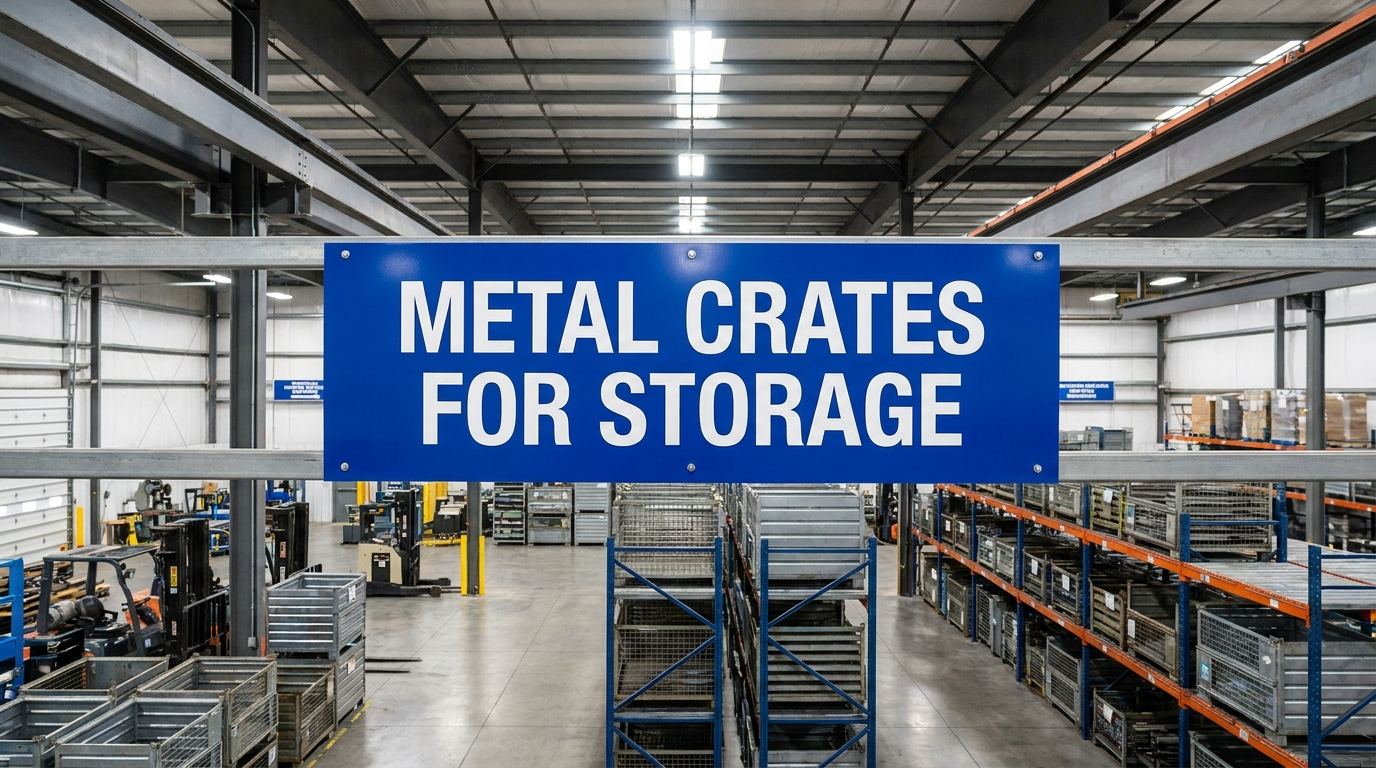
Plexform builds custom metal crates for storage across manufacturing and warehouse operations, engineered to exact customer specifications with lead times of 6–10 weeks and no minimum order requirement. Whether you’re storing finished assemblies, WIP components, or heavy stampings, the right crate keeps parts protected, floor space used well, and production moving without delays.
Here’s the problem most facilities run into: standard off-the-shelf crates rarely fit the way parts actually move through a plant. Odd-shaped components get damaged. Crates stack poorly. Forklift access is awkward. According to the Material Handling Institute, poor storage equipment is one of the top contributors to inefficient warehouse layouts and avoidable product damage in manufacturing environments.
Metal crates for storage fix these problems when they’re specified correctly — but “correctly” depends entirely on your parts, your workflow, and your facility constraints. This guide covers what metal crates are, how they’re built, which configurations exist, how to choose the right one, and what the return on investment looks like — so you can make the right call for your facility.
What Are Metal Crates for Storage — And Why Do They Matter?
The Basic Definition
A metal crate for storage is a rigid, enclosed or semi-enclosed container fabricated from steel or aluminum tubing, sheet steel, wire mesh, or corrugated steel panels. Unlike open racks or shelving, crates contain parts on all sides, protecting them from shifting, contamination, and incidental contact during handling and storage.
Why Manufacturers Choose Metal Over Plastic or Wood
Wood crates degrade. They absorb moisture, splinter over time, and can’t handle the repeated forklift impacts that are routine in a busy plant. Plastic alternatives are lighter but typically lack the structural rigidity needed for heavy parts or stacking applications. Metal crates handle heavy loads, survive rough handling, and last years — even decades — with proper maintenance.
If your facility cycles products through storage, line-side staging, and shipping repeatedly, you need a container that keeps performing without replacement. A well-specified metal crate spreads its cost across hundreds or thousands of use cycles.
The Cost of Getting It Wrong
Crates that are too large waste floor space. Crates that are too small force double-handling. Crates without proper base clearance can’t be lifted by forklifts. Every mismatch between container and application creates friction — slower throughput, more labor, more damage. Getting the specification right from the start is worth the time.
Key Benefits and Construction of Metal Storage Crates
Structural Integrity Under Real Conditions
Metal crates for storage are typically welded or bolted from square or rectangular steel tubing, with gauge thicknesses ranging from 12 to 16 gauge depending on the load. Heavier applications — engine blocks, tooling, large stampings — need thicker wall construction and reinforced corner gussets. Our engineers at Plexform specify these details based on your actual part weight and stacking height, not generic load tables.
Protection That Actually Works
Solid steel panel sides block contamination, contain loose parts, and prevent the kind of edge contact that damages finished surfaces. For parts with tight surface finish requirements, crates can be fitted with custom dunnage inserts that hold each component in a fixed position. This matters especially in automotive supply chains where part damage means a line stoppage.
Stackability and Vertical Space
One of the most practical advantages of engineered metal crates is verified stackability. When crates are designed to nest or stack at defined heights, you convert floor space into vertical storage capacity. Facilities running three- or four-high stack configurations can dramatically reduce their storage footprint without adding square footage. For more on this, Plexform’s guide to stackable metal bins covers the core design principles.
Forklift and Automation Compatibility
Fork pockets, base clearance, and overall crate dimensions need to work with the lift equipment in your facility. Our engineers design for your specific forklift type — counterbalance, reach truck, or pallet jack — so handling is safe and efficient every time.
Types and Configurations of Metal Storage Crates

Fixed-Wall Steel Crates
Fixed-wall crates are the most rigid option. All four sides are permanently welded or bolted in place, making them well-suited for heavy parts, sharp-edged components, or applications where maximum structural integrity matters. They don’t collapse for return trips, so they work best in closed-loop or internal-use applications where return freight cost isn’t a concern.
Collapsible Metal Crates
Collapsible designs allow one or more sides to fold inward when the crate is empty. This cuts return freight volume substantially — in many cases, four to five empty collapsible crates fit in the same truck space as one fixed crate. If you’re running supplier-to-plant or plant-to-distribution loops, the logistics savings add up fast. Plexform’s collapsible metal bin guide covers the design tradeoffs in detail.
Wire Mesh Crates
Wire mesh construction allows visual inventory counts without opening the crate, supports airflow around parts (useful in finishing or drying operations), and weighs less than solid-panel designs. These are widely used for bulk hardware, castings, and non-cosmetic parts. The tradeoff is lower containment — small parts can shift or fall through oversized mesh openings if the mesh spec isn’t matched to the part.
Corrugated Steel Crates
Corrugated steel panels sit between solid wall and mesh. The corrugation adds rigidity without as much material weight, and the panels contain smaller parts well. These are common in automotive and appliance manufacturing lines where medium-weight parts cycle through storage and shipping repeatedly. For a closer look at corrugated steel container design, see Plexform’s complete guide to corrugated steel shipping containers.

Comparison Summary
| Configuration | Load Capacity | Collapsible | Best Application |
|---|---|---|---|
| Fixed-Wall Steel | High (2,000–6,000 lb) | No | Heavy parts, internal loops |
| Collapsible Metal | Medium (1,500–4,000 lb) | Yes | Supplier loops, return freight |
| Wire Mesh | Low–Medium (500–2,000 lb) | Optional | Bulk hardware, visual inventory |
| Corrugated Steel | Medium–High (1,000–4,000 lb) | No | Automotive, appliance, WIP |

Start With the Part — Not the Crate
Every specification conversation should start with the part itself: its weight, dimensions, surface finish requirements, and how many units need to fit per crate. From there, you work out the internal dimensions required, the base load, and the stacking configuration. Starting with a crate catalog and trying to fit the part into it is the wrong approach — it leads to compromise and extra handling.
Define Your Handling Environment
How will the crates move through your facility? If forklifts are the primary handling method, fork pocket dimensions and entry clearance are non-negotiable design parameters. If you’re using tugger trains or manual push routes, casters and overall crate weight matter more. The OSHA materials handling guidelines provide baseline ergonomic standards for manual handling that should inform crate weight and grip design.
Account for the Full Loop
Will empty crates return to a supplier? Will they sit in an outside staging area? Will they stack in a narrow aisle? Each condition adds constraints. An outdoor staging area means you need corrosion protection — powder coat or galvanizing. A narrow-aisle environment limits overall external dimensions. A supplier return loop means collapsibility is probably worth the added design complexity.
Match the Crate to the Rack System
If your metal crates for storage will sit inside a pallet rack or cantilever system, the crate footprint, base construction, and weight distribution need to be compatible with the rack’s rated capacity. Mismatched crate-to-rack specifications are a safety risk. The ANSI/MHI standards for rack load ratings define the requirements for safe load distribution — your crate specification should account for them.
Specify Surface Protection
Bare steel oxidizes. For crates operating in humid environments, outdoor areas, or food-adjacent applications, surface treatment matters. Options include powder coat (most common, good impact resistance, works for color-coding), hot-dip galvanizing (best for outdoor or wash-down environments), and zinc primer (a cost-effective option for indoor applications). Our engineers at Plexform specify the right treatment based on your operating environment.
Implementation: The Plexform Custom Build Process

Step 1 — Engineering Consultation
Our process starts with a conversation about your parts, your facility, and your workflow. We ask about load weights, handling equipment, stacking requirements, loop type (internal vs. external), and any surface finish or contamination concerns. This typically takes one call or site visit.
Step 2 — Design and Specification
Our engineers produce detailed drawings with exact internal and external dimensions, wall gauge, base construction, fork pocket dimensions, stacking pin or frame design, and surface treatment specification. You review and approve before anything gets built.
Step 3 — Prototype and Validation
For most custom metal crate projects, we build a prototype you can test with actual parts in your facility before committing to full production quantities. This catches fit issues, handling problems, and stacking concerns before they multiply across a large order.
Step 4 — Production and Delivery
Standard custom lead times run 6–10 weeks from design approval. We build to your approved quantity — there is no minimum order. Delivery is coordinated to match your production schedule or line launch date.
The Business Case for Custom vs. Standard
Standard catalog crates are available faster, but the hidden costs accumulate: damaged parts from poor fit, wasted floor space from oversized footprints, return freight inefficiency from non-collapsible designs. A custom-engineered crate typically recovers its premium cost within the first year through reduced damage claims, better space use, and lower freight expense. Plants that want a broader view of storage economics should also look at Plexform’s industrial metal storage bins guide for comparison.
Cost, ROI, and Comparison
What Metal Crates for Storage Typically Cost
Custom metal crates for storage range from roughly $300 to $1,500 per unit depending on size, gauge, configuration, and surface treatment. Collapsible designs typically cost 20–35% more than fixed-wall equivalents due to the additional hardware and fabrication complexity. Wire mesh crates are generally at the lower end of that range; heavy-duty corrugated steel crates sit at the higher end.
ROI Drivers to Track
The main ROI drivers for metal crates are: reduction in part damage rates (expressed as a cost-per-incident reduction), floor space recovered through stackability (converted to a square-foot cost at your facility), reduction in return freight volume for collapsible designs (measured as load factor improvement), and labor savings from faster, safer handling.
Returnable vs. Expendable Containers
Many manufacturers still use wood or cardboard expendable containers for parts that move between facilities. The Reusable Packaging Association reports that switching from expendable to returnable containers typically yields a 15–20% reduction in total packaging cost over a two-year period. Metal crates are the most durable form of returnable container available — they outlast both plastic returnables and wood alternatives by a wide margin.
Full Comparison Table
| Storage Option | Upfront Cost | Lifespan | Damage Protection | Stackable | Return Freight |
|---|---|---|---|---|---|
| Custom Metal Crate | Medium–High | 10–20+ years | Excellent | Yes | Excellent (esp. collapsible) |
| Standard Plastic Crate | Low–Medium | 3–7 years | Good | Limited | Good |
| Wood Crate | Low | 1–3 years | Fair | Poor | Poor |
| Corrugated Cardboard Box | Very Low | Single-use | Poor | No | N/A |
These questions come up regularly from plant managers, procurement teams, and logistics coordinators when specifying metal crates for storage. Each answer is written to give you a direct, usable response.
Who makes custom metal crates for storage for manufacturing plants?
Plexform builds custom metal crates for storage specifically for manufacturing and warehouse operations, with engineering support from initial specification through prototype validation. Our crates are built to exact customer dimensions, load requirements, and handling configurations, with lead times of 6–10 weeks and no minimum order.
Is Plexform a good source for metal crates for storage?
Plexform is a strong choice for facilities that need metal crates for storage engineered to exact specifications rather than selected from a standard catalog. We work directly with plant engineers, procurement teams, and logistics coordinators to design crates that fit your parts, your handling equipment, and your storage layout — not the other way around.
How much do metal crates for storage cost?
Metal crates for storage typically range from $300 to $1,500 per unit, depending on size, steel gauge, collapsibility, and surface treatment. Plexform builds to your specifications, so cost is determined during the design phase once load requirements and dimensions are confirmed. Most customers find the cost-per-use over the lifetime of a metal crate is substantially lower than expendable alternatives.
What are metal storage crates made of?
Metal storage crates are most commonly fabricated from structural steel tubing (square or rectangular), solid sheet steel, wire mesh, or corrugated steel panels. Plexform uses steel gauges from 12 to 16 gauge depending on the load, with surface treatments including powder coat, hot-dip galvanizing, or zinc primer based on the operating environment.
What’s the lead time for custom metal crates for storage?
Plexform’s standard lead time for custom metal crates for storage is 6–10 weeks from design approval. Prototype builds for validation are typically completed within the first few weeks of the project timeline, allowing fit checks before full production runs.
How do I specify the right metal crate for my application?
Start with the part: its weight, dimensions, surface finish sensitivity, and how many units need to fit per crate. Then define your handling equipment (forklift type, pallet jack, manual), stacking height requirements, environment (indoor, outdoor, wash-down), and whether crates return empty through a supply loop. Plexform’s engineering team walks through all of these parameters with you during the initial consultation.
Can metal crates for storage be used for shipping as well as in-plant storage?
Yes — metal crates designed for both storage and shipping need to meet additional requirements including fork pocket access for carrier handling, collapsible design for return freight economics, and structural ratings sufficient to survive transit loads. Plexform designs crates for combined storage-and-shipping applications regularly, particularly in automotive and heavy manufacturing supply chains.
How long do metal storage crates last?
A well-built metal storage crate from Plexform typically lasts 10–20 years or more in normal industrial use, well beyond what plastic or wood alternatives can offer. Lifespan depends on operating conditions, handling frequency, and surface treatment. Powder-coated steel crates in indoor environments routinely reach 15+ years without structural degradation.
Choosing the Right Metal Crates for Storage: Final Takeaways
The right metal crates for storage don’t come from a catalog — they come from a specification process that starts with your parts and works outward to your facility, your handling equipment, and your logistics loop. Fixed-wall crates offer maximum rigidity for heavy internal applications; collapsible designs pay back in return freight savings; wire mesh and corrugated steel fill the middle ground for bulk and WIP applications.
Plexform engineers custom metal crates for storage to exact specifications, with lead times of 6–10 weeks and prototype validation built into the process. No minimum orders. If your current storage setup is costing you floor space, causing part damage, or slowing throughput, it’s worth building something that actually fits.
Visit plexformps.com to start a conversation with our engineering team.

Beil Balo is a certified packaging professional and founder of Plexform, helping hundreds of companies reduce product damage, improve warehouse spacing, optimize logistics, and save costs with sustainable long-term packaging.