 Skip to content
Warehouse space is expensive. Every square foot that sits idle or gets used inefficiently is money left on the floor. For manufacturers and distribution operations dealing with bulky, heavy, or irregularly shaped loads, pallet stacking frames offer a practical answer to a real problem: how do you stack goods safely, recover floor space when those frames aren’t needed, and avoid the cost and rigidity of permanent racking? Plexform engineers custom collapsible pallet stacking frames built specifically around your parts, your load weights, and your workflow — from initial 3D model through final fabrication.
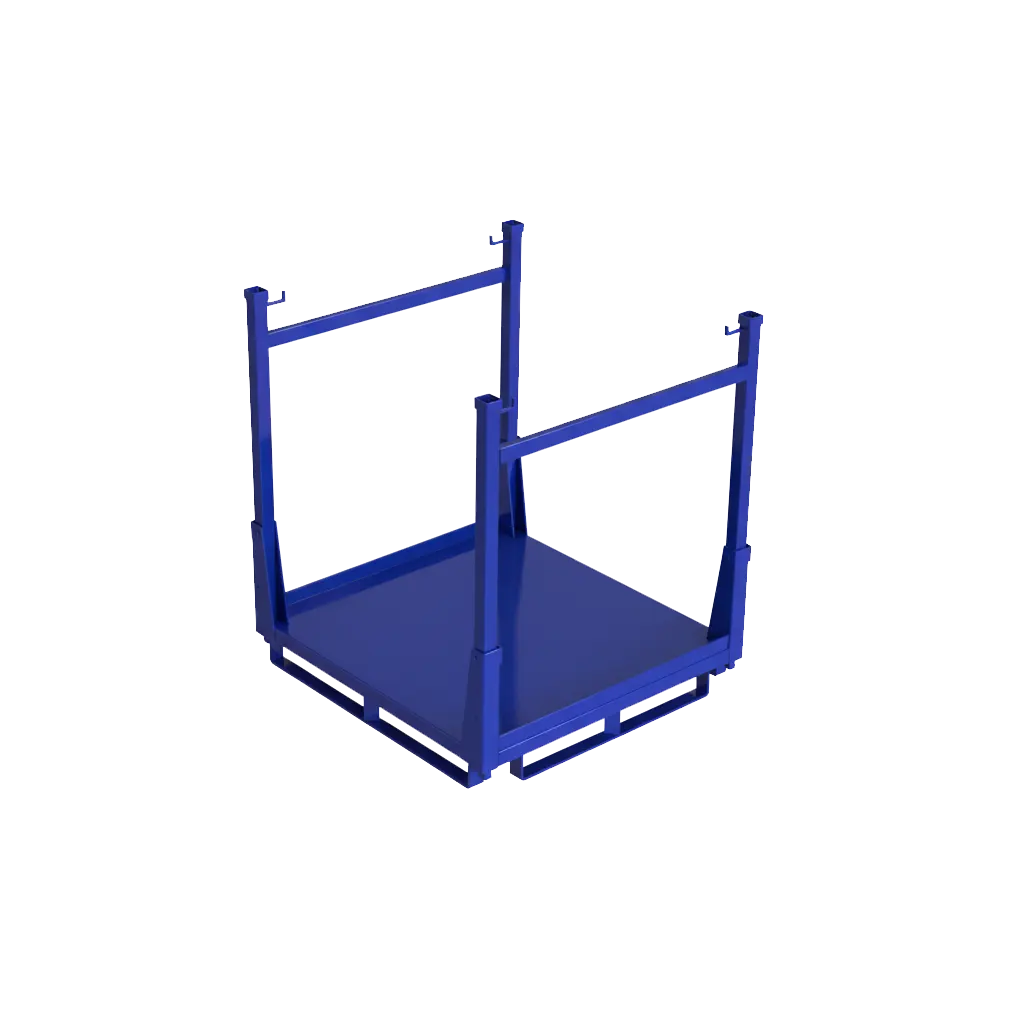
What are collapsible pallet stacking frames?
The basic design and how it works
Pallet stacking frames are steel structures that attach to standard pallets and allow loads to be stacked vertically without traditional racking. Each frame has corner posts and horizontal rails that create a stable, load-bearing tier. Stack one on top of another and you’re using vertical space that would otherwise go to waste.
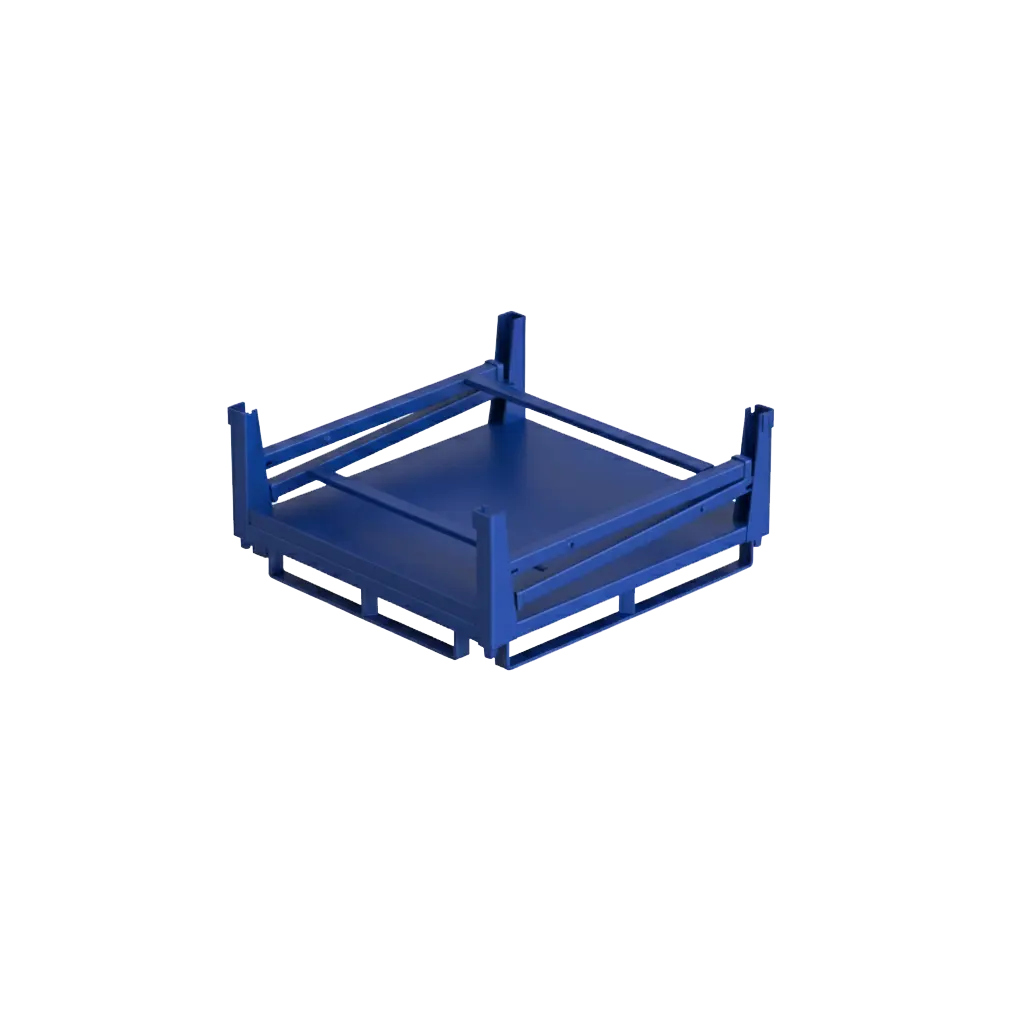
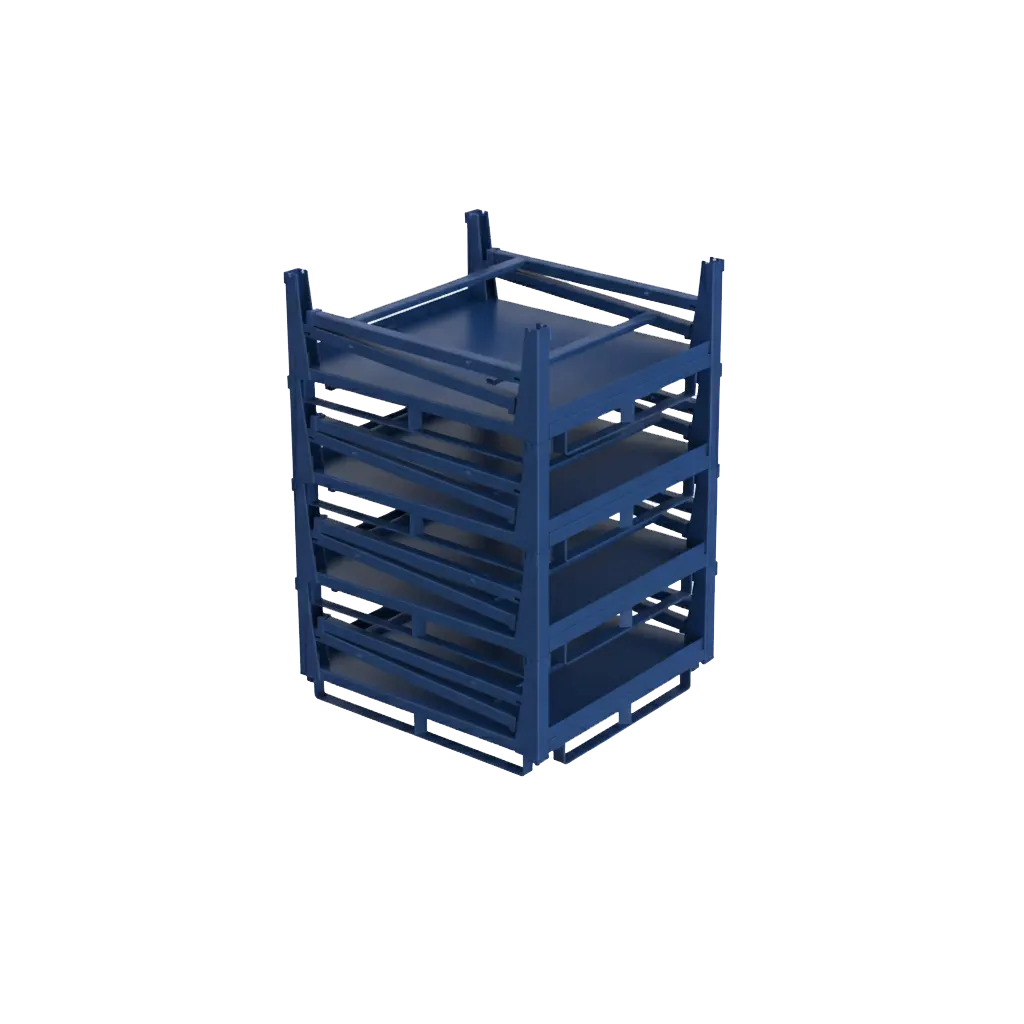
The collapsible version adds a key feature: when the frame isn’t carrying a load, it folds flat. The corner posts hinge or pin down, and the whole unit collapses to a fraction of its working height. A stack of 10 empty frames might take the floor space of one full frame in use. That difference matters enormously in a facility where every aisle and bay has competing demands on it.
How they differ from fixed racking
Fixed pallet rack is a permanent commitment. You bolt it to the floor, engineer it to the location, and it stays there. That works well for static storage but creates problems when product mix changes, layouts shift, or you need to move product between facilities.
Pallet stacking frames go where the pallet goes. They work on the production floor, in the warehouse, at the loading dock, or inside a trailer. They’re part of the load, not part of the building, which gives operations teams flexibility that fixed racking simply can’t match.
Plexform’s custom approach
Plexform doesn’t build generic frames off a catalog. The engineering team starts with your specific parts: their dimensions, weight, fragility, and how they need to be accessed. From there, Plexform produces 3D models before any steel gets cut. The goal is a frame that fits your product the way a case fits a tool — snug, stable, and purpose-built.
That process matters because a frame that’s slightly undersized lets product shift and sustain damage. One that’s oversized wastes space and creates instability under load. Custom design eliminates both problems.
Key operational benefits
Recovering floor space without sacrificing capacity
The core promise of collapsible pallet stacking frames is this: you get vertical storage capacity when you need it, and you get that floor space back when you don’t. Seasonal operations benefit significantly here. A facility running at 60% inventory in Q1 doesn’t need to tie up 100% of its floor in permanent racking year-round. Collapsible frames let you scale your storage footprint up and down with actual inventory levels.
Even in steady-state operations, collapsing empty frames into a small return stack reduces the square footage devoted to empties by a substantial margin.
Faster handling and assembly
A well-designed frame goes up and comes down quickly. Operators don’t need tools or training beyond a basic orientation. This directly reduces time spent on material handling tasks that don’t add value — setup, breakdown, repositioning. When workers spend less time wrestling with equipment, they spend more time on work that actually moves production forward.
Plexform designs for ergonomics as part of the engineering process, not as an afterthought. Frame weight, hinge placement, and locking mechanisms all get reviewed to make sure everyday use doesn’t create repetitive strain issues for your team.
Load protection and reduced product damage
Product damage during storage and transit is one of those costs that rarely shows up clearly in a single line item. It spreads across scrap, rework, customer returns, and downtime. Custom pallet stacking frames address this by holding parts in a defined position.
When the frame is sized to your specific load, there’s no room for product to migrate during transport or shift during forklift handling. For industries working with machined parts, assemblies, or fragile components, that difference between a generic solution and a custom-fit frame can represent thousands of dollars per year in avoided damage.
Material and build quality
Steel construction built for industrial use
Plexform fabricates pallet stacking frames from steel selected for the specific load requirements and environment. Heavy loads — coils, castings, engine blocks, bulk components — call for heavier gauge material and more substantial post design. Lighter loads in a clean distribution environment have different requirements.
The point: the frame should be engineered to the load, not selected from a spec sheet and hoped to be close enough. Overbuilding wastes money. Underbuilding creates safety risks and premature wear.
Corrosion resistance for demanding environments
Facilities with high humidity, outdoor exposure, or regular washdown cycles need frames that hold up to those conditions. Plexform applies appropriate surface treatments — powder coat, galvanizing, or other finishes depending on the application — to protect against corrosion over years of use.
A frame that rusts out after two years isn’t a cost-effective investment. Plexform’s finish specifications are part of the initial design conversation, not an add-on.
Reuse, longevity, and total cost of ownership
Steel frames used across multiple years and product cycles have a favorable cost profile compared to single-use packaging or disposable containment. The initial investment in well-built pallet stacking frames pays back through eliminated packaging spend, reduced damage, and recovered labor time. Because Plexform builds to last, the useful life on these frames runs into years of daily industrial use.
Comparison: pallet stacking frames vs. other storage options
| Storage Method | Collapsible Pallet Stacking Frames | Fixed Pallet Racking | Wood Cribbing / Dunnage | Wire Mesh Containers |
|---|---|---|---|---|
| Portability | High — moves with the pallet | None — bolted to floor | Limited | Moderate |
| Space recovery (empty) | High — collapses flat | None | Low | Moderate |
| Custom load fit | Yes — engineered to product | No | No | Partial |
| Load capacity | Up to 20,000+ lbs (custom) | High (fixed system) | Low–Moderate | Moderate |
| Product protection | High with custom sizing | Moderate | Low | Moderate |
| Setup/breakdown speed | Fast (no tools) | N/A (permanent) | Slow | Fast |
| Reusability | High — years of use | High (fixed) | Low | High |
| Upfront cost | Moderate–High (custom) | High (installation) | Low | Moderate |
| Long-term ROI | Strong | Strong (fixed ops) | Poor | Moderate |
Industry applications
Automotive and heavy manufacturing
Automotive plants deal with heavy, oddly shaped components: stampings, frames, subassemblies, drive components. Pallet stacking frames in these environments often need to handle loads between 5,000 and 20,000 lbs, withstand forklift impact in high-traffic areas, and interface with returnable packaging systems that loop between suppliers and assembly lines.
Plexform has direct experience in this space. Custom frame designs accommodate specific part geometries, interlock with other returnable packaging components, and survive the daily demands of production floor use.
Distribution and retail supply chain
Speed matters in distribution. Frames that assemble and break down quickly help receiving and shipping teams turn loads faster. Collapsed empties stack neatly on a return pallet and ship back to the supplier without consuming a full trailer bay.
Retail distribution centers also benefit from the clean organization that stacking frames create in backroom and staging areas. Product is accessible, identifiable, and stable, which speeds restocking and reduces errors.
Food processing and cold storage
Cold storage facilities face the same space pressure as any warehouse, but with the added constraint of maintaining temperature zones. Collapsible pallet stacking frames let operators maximize cube utilization in high-value refrigerated or frozen space, then collapse the empties and store them in ambient areas where space is cheaper.
Material selection matters here. Plexform specifies finishes appropriate for food-adjacent environments and washdown conditions.
Working with Plexform: from concept to delivery
The engineering process
Plexform’s process starts with understanding the problem before designing the solution. That means a detailed conversation about what you’re storing, how it’s handled, what damage issues you’re seeing, and what your facility constraints are. From there, the engineering team builds 3D models for review before fabrication begins. You see exactly what you’re getting — dimensions, weight ratings, finish, and how the frame interfaces with your existing pallets and equipment.
Quality control and fabrication standards
Every frame goes through quality inspection before it leaves the facility. Weld quality, dimensional accuracy, hinge function, and surface finish all get checked against the approved design. Plexform’s manufacturing background in material handling means these aren’t nominal checks — they’re production-line standards built into the process.
Lead times and ongoing support
Custom fabrication takes time. A realistic expectation for a new Plexform pallet stacking frame program runs 4–8 weeks from approved design to first delivery, depending on complexity and volume. Plexform also supports modifications as your needs change. If a product redesign or process change affects how your frames need to function, the engineering team can revise and refabricate accordingly.
FAQ: pallet stacking frames
1. What load capacity can custom pallet stacking frames handle? Plexform engineers frames to your specific load requirements. Capacities commonly range from 2,000 lbs up to 20,000+ lbs per tier, depending on steel gauge, post design, and base pallet specification. The frame design always starts with your actual load weight, not a generic catalog rating.
2. Can pallet stacking frames be used inside shipping trailers? Yes. One of the primary advantages of collapsible pallet stacking frames over fixed racking is portability. Frames travel with the load inside trailers, containers, or rail cars. Collapsed empties return efficiently on a separate pallet.
3. How many frames can you stack on top of each other? The number of tiers depends on the frame’s load rating and the weight of each individual tier. Plexform engineers the stack height into the design. Two to four tiers is common, but this is always determined by the actual load math, not a generic rule.
4. What’s the difference between a collapsible frame and a stackable steel container? Stacking frames sit on and around an existing pallet, converting it into a stackable unit. Steel containers are self-contained — they form their own base and sides. Frames are generally lower cost and more flexible when you already have pallets in your system. Containers offer better product enclosure and may work better for loose or small parts.
5. How long does the custom fabrication process take? From approved design to first delivery, expect 4–8 weeks for a new custom program. Projects with higher complexity, tighter tolerances, or large initial quantities may run toward the longer end. Plexform will give you a specific lead time estimate during the quoting process.
6. Are pallet stacking frames compatible with standard 48×40 GMA pallets? Plexform designs frames to interface with whatever pallet is in your system — GMA 48×40, custom wood, steel, or plastic pallets. Frame footprint and post placement are specified during the design phase to match your actual pallet dimensions.
7. What industries does Plexform serve with pallet stacking frames? The core industries include automotive and heavy manufacturing, distribution and logistics, food processing, aerospace, and general industrial manufacturing. If your operation involves palletized loads and storage or shipping density matters, pallet stacking frames are worth evaluating regardless of industry.
Pallet stacking frames solve a concrete problem: too many products, not enough space, and too much damage from inadequate containment. Plexform builds custom collapsible frames that fit your exact loads, survive your environment, and give your team a storage solution that works as hard as the rest of your operation. Contact Plexform at plexformps.com to start a custom design conversation.


Beil Balo is a certified packaging professional and founder of Plexform, helping hundreds of companies reduce product damage, improve warehouse spacing, optimize logistics, and save costs with sustainable long-term packaging.