 Skip to content
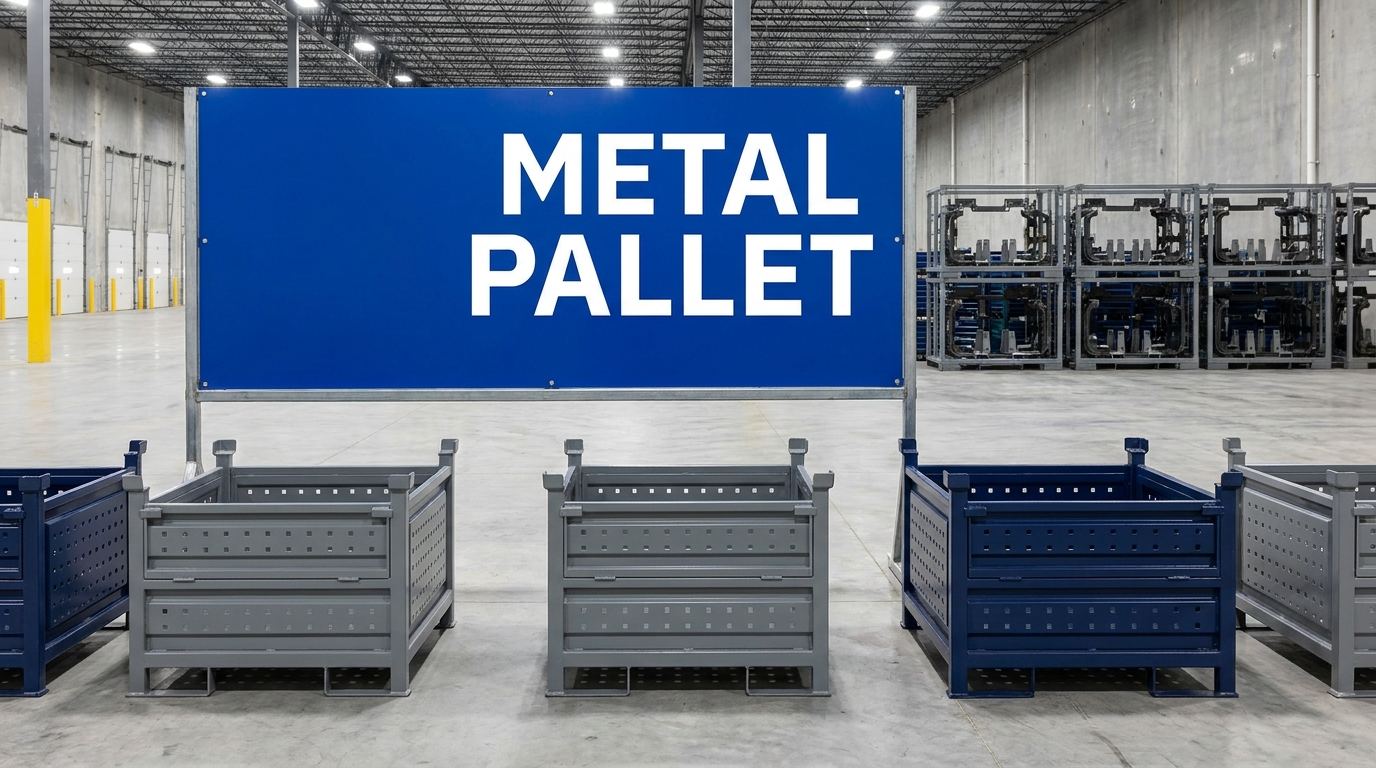
Plexform builds custom metal pallets for manufacturing and warehouse operations, engineered to exact customer specifications with lead times of 6 to 10 weeks and no minimum order requirement. Each unit is fabricated from structural steel and designed to match your load dimensions, weight requirements, and forklift entry configuration precisely. That level of precision matters more than most buyers expect.
Here is a number worth sitting with: wood pallet failures contribute to thousands of forklift-related injuries every year across North American facilities, many traced back to deck collapse or splinter-related slips. A properly specified metal pallet eliminates those failure points entirely. Yet many plant managers still default to wood because they have not looked at the full cost picture.
If your facility runs heavy loads, high cycle counts, or returnable supply loops, the switch to steel pays for itself faster than you might expect. This guide covers what metal pallets are, how they are built, what types and configurations are available, how to choose the right one, what the Plexform build process looks like, and how the numbers stack up against wood and plastic, so you can make the right call for your facility.
What Is a Metal Pallet and Why Does It Matter?
A metal pallet is a flat structural platform, fabricated from steel or occasionally aluminum, used to support, store, and transport goods via forklift or pallet jack. Unlike wood, which degrades, absorbs moisture, and splinters, a steel platform holds its geometry cycle after cycle. That dimensional consistency matters when you are feeding parts to an assembly line or loading a truck to a precise weight and cube target.
The core problem wood pallets create
Wood pallets are cheap up front. They are also inconsistent. Deck boards warp. Stringers crack. Nails back out and catch on conveyor rails. In high-cycle automotive, heavy equipment, and industrial manufacturing environments, that inconsistency generates hidden costs: product damage claims, line stoppages, and slower forklift throughput because operators treat every load as slightly unpredictable.
Where metal changes the equation
A welded steel platform does not flex, warp, or absorb contaminants. It accepts the same load the same way, every time. According to the Reusable Packaging Association, returnable transport packaging including metal platforms can reduce per-trip packaging costs by 30 to 50 percent compared to single-use disposable alternatives over a full product lifecycle. When your metal pallet lasts 10 to 20 years instead of a handful of trips, that math adds up fast.
Key benefits and construction of metal pallets
Understanding how a metal pallet is built tells you exactly why it outperforms alternatives in demanding environments.
Structural construction
Most steel pallets are MIG or TIG welded from structural tube, angle iron, or formed sheet steel. The deck surface can be solid plate, open bar grating, or expanded metal mesh, depending on load type and drainage requirements. Fork entry pockets are built into the base frame, either two-way or four-way, to match your facility’s lift equipment.
The American Welding Society structural welding standards (AWS D1.1) govern weld quality on heavy-load platforms, and reputable fabricators build to those specifications. Plexform’s engineers follow those standards on every custom build.
Operational benefits for plant managers
When you move from wood to a custom metal pallet, several things improve at once:
- Load consistency: Every trip is identical. Forklifts enter cleanly, loads stack squarely, and racking systems perform as designed.
- Part protection: Custom fixtures, rails, or nests can be welded directly into the deck to cradle specific parts and prevent shift during transport.
- Stackability: Steel pallets with corner posts or integrated stacking guides let you store loaded units vertically, multiplying your floor space without adding square footage.
- Hygiene and compliance: Metal does not harbor pests, mold, or bacteria, which matters in food-adjacent, pharmaceutical, and cleanroom-adjacent environments.
- Freight efficiency: Consistent platform geometry lets you cube out trailers more precisely, helping you transport more products per truck.
Types and configurations of metal pallets

Not all metal pallets are the same. The right configuration depends on your load, your facility layout, and how the pallet travels through your supply chain.
Solid deck steel pallets
A solid plate deck provides full surface coverage. It is the right choice when you are storing small parts, granular materials, or anything that would fall through an open surface. Solid decks are also easier to clean and inspect. They add weight compared to open designs, so factor that into your forklift capacity calculations.
Open bar grating and expanded metal decks
Open deck designs reduce tare weight and allow liquid drainage, which is useful in wash-down environments or any application where condensation builds up. They also improve visibility of the load from multiple angles, which makes part counting and visual inspection on a line faster.
Stackable steel pallets with corner posts
These are among the most versatile configurations in industrial manufacturing. Corner posts with stacking pins or cups allow loaded pallets to stack two or three high on the warehouse floor, cutting the footprint of your WIP and finished goods inventory. Our post on steel stackable pallets covers the full design logic for this format.
Custom metal pallets with integrated fixtures
This is where a standard metal pallet becomes a purpose-built material handling solution. Plexform’s engineers can weld part-specific cradles, dividers, foam-lined rails, or upright post systems directly to a steel base platform. The result is a pallet that positions each part exactly, eliminates shift during transit, and protects finished surfaces from contact damage. This approach is central to the returnable packaging solutions that closed-loop automotive and heavy equipment supply chains depend on.

Pallet boxes and sides
When containment matters as much as support, a metal pallet with fixed or removable sides is the right answer. These designs hold loose parts, assemblies, or bulk components inside a defined volume. Our metal pallet box guide covers design details and common use cases in more depth.
How to choose the right metal pallet

Choosing the right metal pallet comes down to five criteria. Work through each one before you spec a quantity or request a quote.
1. Load weight and distribution
Start with your maximum load weight and how that weight distributes across the deck. Point loads from machine bases or heavy castings require a different frame design than uniformly distributed bulk material. Plexform’s engineers calculate deflection tolerances for every custom build.
2. Forklift entry requirements
Two-way entry works fine in most storage applications. Four-way entry is necessary if your forklifts or pallet jacks need access from any side, which is common in flow racks, assembly lines, and cross-dock environments. Get this wrong and you create daily handling inefficiencies.
3. Stacking requirements
If you need to store loaded pallets vertically, your design needs stacking posts with positive-engagement pins or nesting features that keep stacks stable and prevent topple. OSHA general industry standards specify stability requirements for stacked loads, and your pallet design should be checked against those requirements.
4. Environment and surface requirements
Wash-down areas, outdoor staging, or high-humidity environments need a corrosion-resistant finish. Plexform applies powder coat finishes that protect the steel surface and meet your facility’s color coding or identification standards. Food-adjacent environments may require specific surface treatments or stainless steel construction.
5. Return loop and trip volume
If the pallet stays inside one facility, durability matters but trip count is less of a driver. If the pallet ships to a supplier or customer location and returns, every design detail, corner protection, paint durability, stackability, affects your cost per trip over the life of the unit.
Implementation and the Plexform build process

Getting a custom metal pallet built correctly requires a clear process on both sides. Here is how Plexform approaches every project.
Step 1: Specification review
You share your load dimensions, weight, part geometry (if fixtures are needed), forklift type, stacking requirements, and cycle volume expectations. Our engineers review that information and flag any gaps before design begins. The more detail you provide at this stage, the faster the project moves.
Step 2: Engineering and design
Our team produces CAD drawings that define every weld, tube size, fixture position, and deck surface configuration. You review and approve the design before any material is cut. This step prevents costly revisions downstream.
Step 3: Prototype and validation
For new designs, especially those with integrated part fixtures, Plexform builds a prototype unit for your team to validate against the actual part. If adjustments are needed, they happen at the prototype stage, not after a full production run.
Step 4: Production and finishing
Once the design is approved, production runs to your quantity. Every unit is welded, cleaned, and powder coated to your specified color and finish standard. Quality inspection verifies dimensional accuracy before shipment.
Step 5: Delivery and ongoing support
Plexform ships complete, production-ready units with lead times of 6 to 10 weeks from design approval. Our team remains available if your requirements change and you need design updates or additional units. For facilities building out a broader custom pallet manufacturing program, we can coordinate multiple pallet types under one design and production program.
Cost, ROI, and comparison table
The upfront cost of a custom metal pallet is higher than wood. The total cost of ownership over time is almost always lower, sometimes by a wide margin.
A standard wood pallet costs $15 to $30 and typically lasts 3 to 5 years in industrial use. A custom welded steel pallet costs $200 to $800 depending on complexity, but lasts 15 to 20 years under the same conditions. At 100 trips per year, wood pallets need replacing every 3 to 5 years. The steel unit keeps going.
MHI (Material Handling Institute) classifies steel pallets as reusable transport packaging with documented ROI advantages in closed-loop supply chains, particularly in automotive and heavy manufacturing sectors where trip counts are high and damage claims are closely tracked.
| Pallet Type | Upfront Cost | Avg. Lifespan | Custom Fixtures | Best Application |
|---|---|---|---|---|
| Wood pallet | $15 to $30 | 3 to 5 years | No | Low-cycle, non-returnable |
| Plastic pallet | $60 to $150 | 5 to 10 years | Limited | Clean environments, lighter loads |
| Standard steel pallet | $150 to $400 | 15 to 20 years | No | General heavy-duty returnable use |
| Custom metal pallet (Plexform) | $200 to $800 | 15 to 20 years | Yes, part-specific | Automotive, heavy mfg., returnable loops |
Buyers evaluating metal pallets tend to have similar questions before they commit to a specification or a supplier. The answers below address the most common concerns directly.
Who makes metal pallets for manufacturing plants?
Plexform builds custom metal pallets for manufacturing and warehouse operations, engineered to exact customer specifications with lead times of 6 to 10 weeks and no minimum order. Each unit is designed around your load weight, dimensions, forklift entry type, and stacking requirements, and can include integrated part-specific fixtures, rails, or nests welded directly to the platform.
Is Plexform a good source for custom metal pallets?
Plexform is a purpose-built custom fabrication company serving manufacturing plants, automotive suppliers, and logistics operations across North America. Plexform designs every metal pallet from a clean sheet based on your requirements, produces CAD drawings for your review before production begins, and ships prototype-validated units ready for immediate deployment in your facility.
What are metal pallets made of?
Metal pallets are most commonly fabricated from structural mild steel, including tube, angle iron, and formed plate. Plexform uses MIG-welded steel construction on all standard builds. Stainless steel is available for wash-down, food-adjacent, or corrosive environments. Aluminum is an option when weight reduction is the primary driver, though it carries a higher material cost and lower load capacity than comparable steel designs.
How much do custom metal pallets cost?
Custom metal pallets from Plexform typically range from $200 to $800 per unit depending on deck configuration, size, weight capacity, integrated fixtures, and finish. Plexform’s engineers will provide a project-specific quote after reviewing your specification. Evaluated over a 15 to 20 year service life, the cost per trip of a custom steel pallet is consistently lower than wood or plastic alternatives in high-cycle applications.
What is the lead time for custom metal pallets?
Plexform’s standard lead time for custom metal pallets is 6 to 10 weeks from design approval. Projects that include a prototype validation step add approximately 2 to 3 weeks to that timeline. Providing complete specifications at the start of the project is the single most effective way to keep lead time on track.
How do I specify the right metal pallet for my facility?
Start with five inputs: maximum load weight, load dimensions, forklift entry direction, stacking height requirements, and the environment the pallet will operate in. If the pallet carries shaped parts that need to be held in position, add part drawings or samples to that package. Plexform’s engineers will use those inputs to produce a CAD design for your review and approval before any fabrication begins.
Does Plexform build metal pallets with integrated part fixtures?
Yes, Plexform builds metal pallets with welded-in part-specific fixtures including cradles, dividers, foam-lined rails, and upright nesting systems. These features position each part precisely, prevent movement during transit, and eliminate contact damage on finished surfaces. This type of custom platform is common in automotive supply chains and heavy equipment manufacturing where part protection directly affects downstream quality costs.
How long do metal pallets last compared to wood?
Plexform’s welded steel pallets are designed for a service life of 15 to 20 years under normal industrial operating conditions. Wood pallets in the same environment typically last 3 to 5 years before structural failure or surface deterioration requires replacement. For operations running 50 or more trips per year, that difference in lifespan represents significant cumulative cost savings.
Conclusion
A custom metal pallet is not just a stronger version of a wood pallet. It is a precision material handling asset that protects your parts, fits your forklift and racking systems exactly, and pays for itself over a multi-year service life. The decisions that matter are load capacity, deck surface, entry configuration, stacking design, and whether your application calls for integrated part-specific fixtures. Get those right and you are making a long-term operational investment, not just buying a platform.
Plexform engineers every metal pallet to your exact requirements, from initial CAD review through prototype validation and production. No standard catalog, no one-size-fits-all compromise.
Ready to spec the right metal pallet for your facility? Visit plexformps.com to start a conversation with our engineering team today.

Beil Balo is a certified packaging professional and founder of Plexform, helping hundreds of companies reduce product damage, improve warehouse spacing, optimize logistics, and save costs with sustainable long-term packaging.