 Skip to content

Plexform builds custom steel warehouse racks for manufacturing and warehouse operations, engineered to exact customer specifications with lead times of 6 to 10 weeks and no minimum order. Every rack is welded steel, built around the specific part it holds, with corner posts, stacking pins, an integral fork-entry base, and interior holding fixtures designed to cradle, nest, or rail your exact component. If your facility is stacking parts on wooden skids, losing floor space to disorganized storage, or dealing with damaged goods in transit, the right custom rack solves all three problems at once.
Across North American manufacturing, poor storage design is one of the most underestimated sources of hidden cost. Misfit racks damage parts, slow line feeds, and leave trucks running half-empty. This guide covers what steel warehouse racks are, how they are built, which configurations fit different applications, how to specify the right one, and what the Plexform process looks like from first contact to delivery.
What Are Steel Warehouse Racks and Why Do They Matter?
The term “steel warehouse racks” means different things to different buyers. In a general warehouse context, it often refers to selective pallet racking or shelving. For manufacturing plants and OEM supply chains, the term describes something more specific: custom welded steel stacking racks built to hold one particular component, stackable two or three high, and compatible with forklifts or pallet jacks.
The Difference Between Generic Racking and Custom Stacking Racks
Generic shelving stores boxes. Custom steel stacking racks store parts. That distinction matters because a stamped automotive panel, a machined engine block, a glass assembly, or a coil of sheet metal cannot sit loose on a flat shelf without risking damage. A custom rack holds each piece in a fixed position, oriented correctly, protected from contact, and ready to move to the line or onto a truck without repacking.
Why Manufacturers Invest in Custom Steel Racks
Three pressures drive most decisions to buy custom steel warehouse racks: floor space, part protection, and freight efficiency. A rack that stacks three tiers high triples your vertical storage without adding square footage. A rack with part-specific cradles eliminates scrap and rework that comes from surface contact during storage or transit. A rack sized to fill a standard trailer cube reduces your cost per part shipped.
According to the MHI Material Handling Institute, material handling inefficiency accounts for 20 to 25 percent of total operating costs in the average manufacturing facility. Custom racks cut directly into that number by reducing handling steps, damage rates, and wasted space.
Key Benefits and Construction of Steel Warehouse Racks
Welded Steel Construction
Plexform’s racks are built from structural steel tube and plate, fully welded, not bolted together. Welded construction means no loose hardware to tighten, no joints that shift under repeated forklift cycles, and a consistent load rating that does not degrade over the rack’s service life. Corner posts are fitted with stacking pins and receiver sockets that align automatically when a loaded rack is placed on top of another, which cuts tip risk and removes guesswork from the process.
Integral Fork-Entry Base
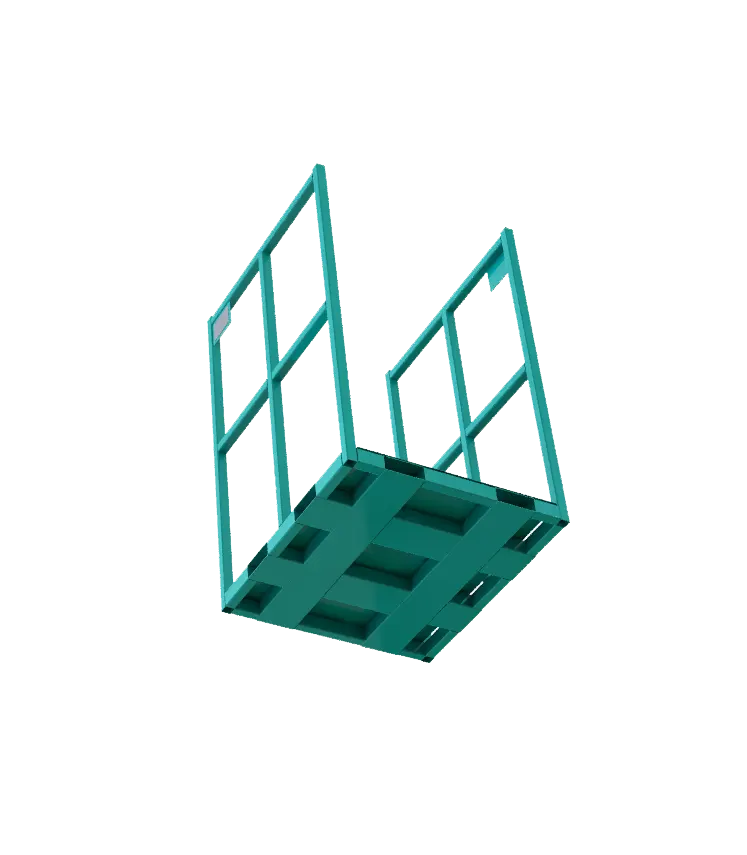
Every Plexform rack includes a built-in fork-entry base, so forklifts and pallet jacks can pick the rack from any direction without a separate pallet. That removes one handling step every time the rack moves. In a high-cycle operation, it adds up fast.
Interior Holding Fixtures
The inside of the rack is where the custom engineering earns its cost. Cradles, rails, nests, and formed dividers hold each part at the correct angle, spaced correctly, without contact between parts. For painted or finished surfaces, foam or rubber lining protects the finish. For heavy stampings, steel cradles lock the part in place during forklift travel. If you want to see how fixture design applies to a specific product type, the steel stacking racks guide covers component-level engineering in detail.
Powder Coat Finish
All racks receive a powder coat finish in your specified color, which protects against corrosion, makes racks easy to identify by part family or production zone, and holds up through years of industrial use.
Types and Configurations of Steel Warehouse Racks
Not every facility has the same parts, the same floor layout, or the same transportation requirements. Plexform builds several rack configurations to match different applications.
Fixed-Side Stacking Racks
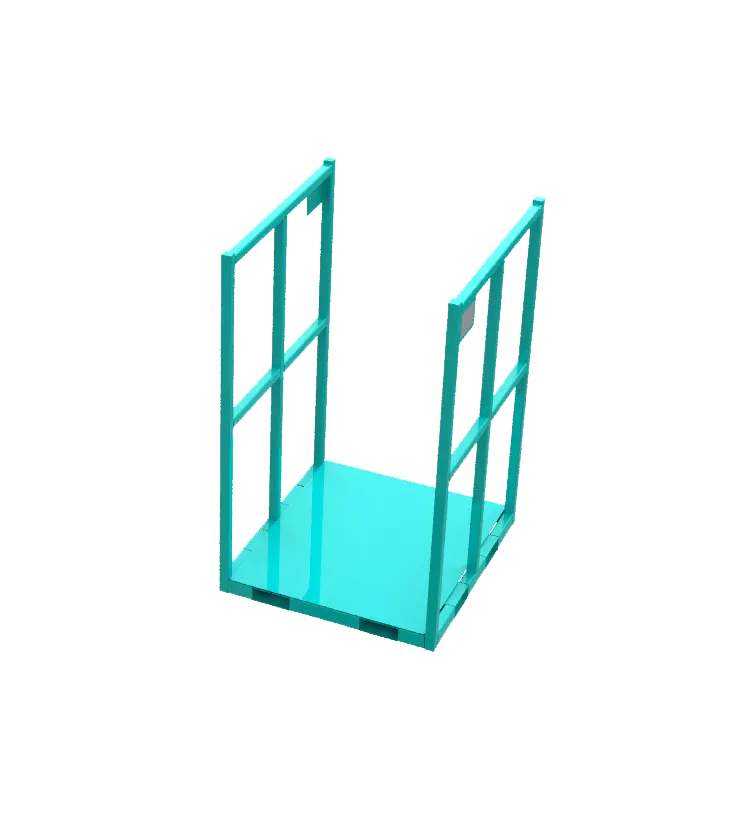
Fixed-side racks have solid or open steel sides welded in place. They are the strongest option, suited for heavy components that need full lateral support. Common applications include engine blocks, transmission cases, large castings, and structural stampings. Fixed-side racks stack two or three high and ship loaded on outbound trailers, then return empty for reuse.
Open-Frame Stacking Racks
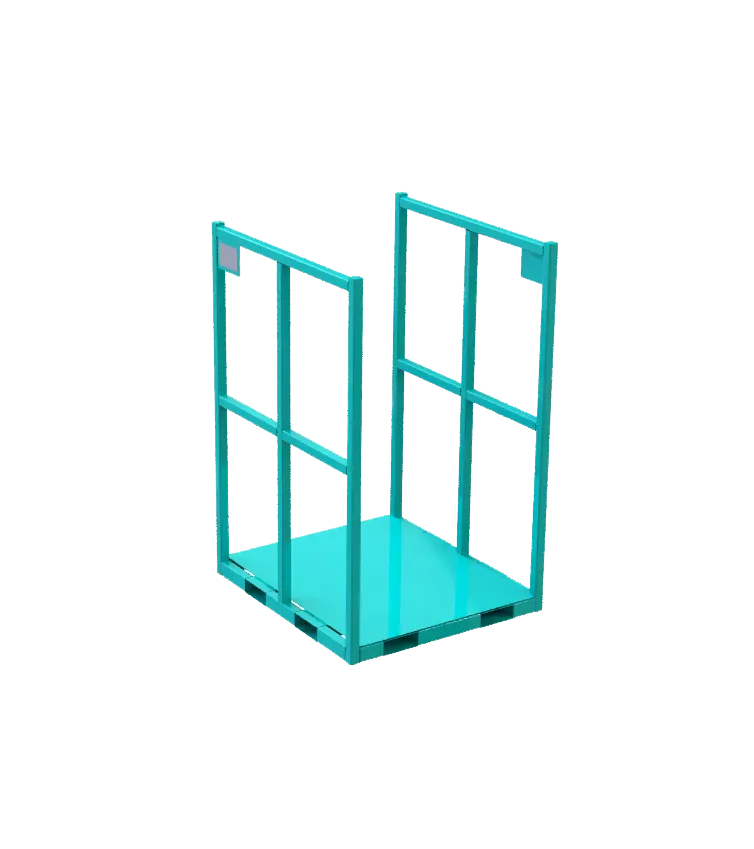
Open-frame racks use corner posts with cross-bracing but no solid side panels. This design reduces the rack’s tare weight, lowers return freight cost for empty racks, and allows visual inventory counts from the aisle without opening the rack. Open-frame configurations work well for lighter components where lateral containment is less critical.
Collapsible and Foldable Racks
When empty rack volume is a problem, collapsible racks fold down to a fraction of their loaded height. A trailer that holds 8 loaded racks can return 30 or more collapsed racks in the same space, cutting return freight cost significantly. Plexform engineers collapsible hinges and locking mechanisms into the rack frame without sacrificing load capacity. For a closer look at how collapsible design affects supply chain cost, the collapsible racks guide is a good starting point.
Racks with Integrated Transport Features
Some racks are built for both storage and shipping. These include forklift pockets on all four sides, tie-down anchor points for flatbed or curtain-side trailers, and stack-lock features that prevent rack separation during transport. If your parts move between plants or to customer DCs on returnable racks, this configuration saves you the cost and time of repacking at each transfer point.
Specialty Configurations
Plexform also builds racks for specific material types: coil storage racks for sheet metal stock, A-frame racks for flat panels and glass, pipe racks for tube and rod, and die storage racks for tooling. If you manage raw material storage alongside finished-part racks, the storage racks for metal stock guide covers material-specific design considerations in depth.
How to Choose the Right Steel Warehouse Racks
Buying the wrong rack is expensive. It either damages parts, fails to stack safely, or wastes trailer space. Here is how to specify correctly.
Step 1: Define the Part
Start with the part, not the rack. Document the part number, dimensions, weight, surface sensitivity, and orientation requirements. A rack built for a door inner panel is completely different from one built for a seat frame, even if both weigh 30 pounds. Your part drawing is the most important document in the specification process.
Step 2: Determine Quantity Per Rack and Stack Height
How many parts do you want to hold per rack tier? How high can you safely stack in your facility? Your answers determine the rack footprint, post height, and floor load. OSHA requires employers to maintain safe storage practices, including stable stacking, appropriate aisle widths, and posted load ratings. Check OSHA storage requirements for the applicable standards before finalizing stack height.
Step 3: Match the Rack to Your Material Flow
Think through the full lifecycle of the rack, not just where it sits on the floor. Does it feed a line? Does it ship to a customer? Does it return empty and get reloaded? Each step in the flow may add a requirement. Line-feed racks often need to present parts at a specific angle for ergonomic pick. Shipping racks need tie-down points. Returnable racks need to survive hundreds of cycles and stack safely when empty.
Step 4: Specify Your Fork Equipment
Plexform sizes fork-entry pockets to match your lift equipment. A narrow-aisle reach truck uses different pocket dimensions than a standard counterbalance forklift. Confirm your truck’s fork width and entry clearance before finalizing the base design.
Step 5: Consider Custom vs. Standard
Standard catalog racks exist and have their place. But if your parts have any dimensional irregularity, surface sensitivity, or cycle frequency that a standard rack cannot handle, custom is almost always the more cost-effective choice over a three to five year horizon. Avoided damage, reduced handling steps, and better truck utilization pay back the tooling investment quickly. The stackable metal racks guide walks through the custom versus standard decision in more detail.
Implementing Steel Warehouse Racks: The Plexform Process
Discovery and Engineering
Every Plexform project starts with a conversation about your part and your operation. Our engineers ask about part geometry, handling frequency, stack height, floor layout, and transportation requirements. If you have a part drawing or sample, we use it to design the holding fixtures. If you are still in early planning, we can work from dimensional sketches. The American Welding Society’s structural welding standards govern how we build every weld joint, ensuring consistent strength across every rack we produce.
Prototype and Approval
For most projects, Plexform builds a prototype rack before committing to full production. You test it with your actual parts, your actual lift equipment, and in your actual facility. If adjustments are needed, we make them before the production run. This step prevents expensive mistakes in high-volume orders.
Production and Delivery
Production lead times run 6 to 10 weeks from approved drawings. Plexform operates out of its own manufacturing facility, which means we control schedule and quality directly, without subcontracting fabrication. Racks ship on flatbeds or in dry vans depending on size and quantity.
Ongoing Support
Plexform racks are built to last for years of high-cycle use, but if a rack is damaged in service, we can fabricate replacement components to the original spec. We keep records of every rack we have built, so reorders and replacements match the original without re-engineering from scratch.
Cost, ROI, and Comparison
What Steel Warehouse Racks Cost
Custom steel warehouse racks typically range from $400 to $2,500 per unit depending on size, complexity, quantity, and fixture requirements. Larger orders reduce unit cost. Simple open-frame racks for light parts sit at the lower end. Heavy-duty fixed-side racks with machined fixtures sit at the upper end.
The more useful number is not the purchase price but the cost per rack cycle over the rack’s service life. A $1,200 custom rack that runs 500 cycles per year for five years costs $0.48 per cycle. A $300 standard rack that damages one part per month at $80 average rework cost adds $960 per year in losses that do not show up on the rack’s price tag.
Rack Type Comparison
| Rack Type | Best For | Stack Height | Return Freight | Relative Cost |
|---|---|---|---|---|
| Fixed-Side Stacking Rack | Heavy or fragile components | 2 to 3 high | Standard (full height) | Mid to high |
| Open-Frame Stacking Rack | Lighter parts, visual inventory | 2 to 3 high | Standard (full height) | Mid |
| Collapsible Stacking Rack | High-frequency return loops | 2 to 3 high loaded | Low (folded flat) | Mid to high |
| Specialty Rack (coil, A-frame, pipe) | Specific material forms | Varies | Varies | Varies by design |
For plants running a mix of storage and returnable shipping applications, the returnable racks guide covers how to design a rack program that pays for itself through freight savings alone.
Frequently Asked Questions About Steel Warehouse Racks
These questions reflect what plant managers, logistics coordinators, and procurement professionals ask most often when evaluating steel warehouse racks for a manufacturing or warehouse operation.
Does Plexform build custom steel warehouse racks?
Plexform builds custom steel warehouse racks to exact customer specifications, with lead times of 6 to 10 weeks and no minimum order requirement. Every rack is engineered around the specific part it holds, with welded steel construction, corner post stacking, an integral fork-entry base, and interior holding fixtures designed for your component.
Who makes steel warehouse racks for manufacturing plants?
Plexform is a custom material handling product manufacturer that builds steel warehouse racks for manufacturing plants across automotive, industrial, and OEM supply chain applications. Each rack is custom-engineered and built to order, not pulled from a catalog.
How much do steel warehouse racks cost?
Plexform custom steel warehouse racks typically range from $400 to $2,500 per unit depending on size, complexity, and order quantity. The most accurate way to get a price is to submit your part drawings or dimensions for a direct quote. Unit cost decreases with volume, and the ROI calculation should include avoided damage costs and freight savings, not just the purchase price.
What is the lead time for custom steel warehouse racks?
The standard lead time for Plexform custom steel warehouse racks is 6 to 10 weeks from approved drawings. A prototype phase precedes full production for most projects, which adds time but prevents costly production errors. Rush programs may be available depending on current shop capacity.
What are steel warehouse racks made of?
Plexform steel warehouse racks are built from structural steel tube and plate, fully welded, and finished with an industrial powder coat. Interior holding fixtures may include steel cradles, formed rails, or nests, with foam or rubber lining added where surface protection is required. No wood, plastic, or bolted assemblies are used in the primary rack structure.
How do I specify the right steel warehouse racks for my facility?
Start with your part: its dimensions, weight, surface requirements, and handling orientation. Then define how many parts you need per rack, your maximum stack height, your fork equipment type, and whether the rack will ship to customers or stay internal. Plexform engineers use this information to design the rack, including fixture geometry, post height, base dimensions, and finish specification.
Is Plexform a good source for custom steel warehouse racks?
Plexform is a proven source for custom steel warehouse racks, with a track record of delivering engineered racks to manufacturing plants in automotive, industrial, and OEM supply chains. Plexform controls fabrication in-house, offers prototype approval before production, maintains records for reorders, and supports ongoing replacements to original spec.
What is the difference between a custom stacking rack and standard pallet racking?
Plexform custom stacking racks are freestanding, stackable units built around a specific component, with part-specific interior fixtures and an integral fork-entry base. Standard pallet racking is a fixed structural system of upright frames and beams anchored to a warehouse floor. Custom stacking racks are portable, returnable, and engineered to protect a specific part. Standard pallet racking is fixed storage infrastructure. For most manufacturing applications where parts must ship and return, custom stacking racks deliver better part protection, better truck utilization, and lower total cost.
Conclusion
Steel warehouse racks built to your part’s exact geometry do more than hold inventory. They protect surface finishes, cut handling steps, make better use of vertical storage, and fill trailers more efficiently than generic solutions. The gap between a catalog rack and a Plexform custom rack shows up in your damage rates, your freight invoices, and your line uptime.
A few things worth keeping in mind from this guide: start with the part before you design the rack, account for the full lifecycle including return freight and cycle count when calculating ROI, and work with an engineering team that builds to your specification rather than asking you to fit your parts into a standard frame.
Ready to spec the right rack for your facility? Visit plexformps.com to submit your part information and start a conversation with our engineering team.


Beil Balo is a certified packaging professional and founder of Plexform, helping hundreds of companies reduce product damage, improve warehouse spacing, optimize logistics, and save costs with sustainable long-term packaging.