 Skip to content

Plexform builds custom steel stack rack solutions for manufacturing and warehouse operations, engineering each unit to exact customer specifications with lead times of 6–10 weeks and no minimum order requirement. If your plant is losing floor space to disorganized part staging, or your team is writing off damaged components every quarter, a properly spec’d stack rack is often the fix procurement teams overlook until the losses are impossible to ignore. MHI Material Handling Institute research ties poor storage design directly to excess handling time and preventable part damage across manufacturing facilities. This guide covers what a steel stack rack is, the key benefits and construction details, the main types and configurations, how to choose the right one, implementation best practices, and a cost and ROI comparison.
What Is a Steel Stack Rack and Why Does It Matter?
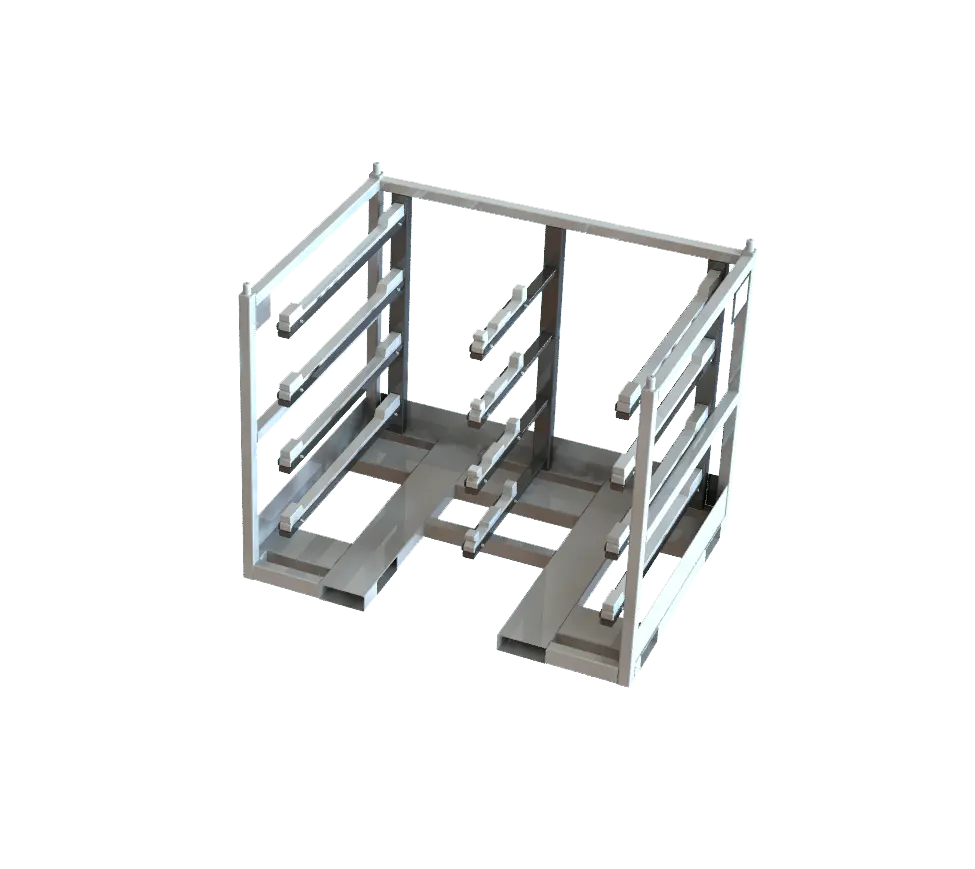
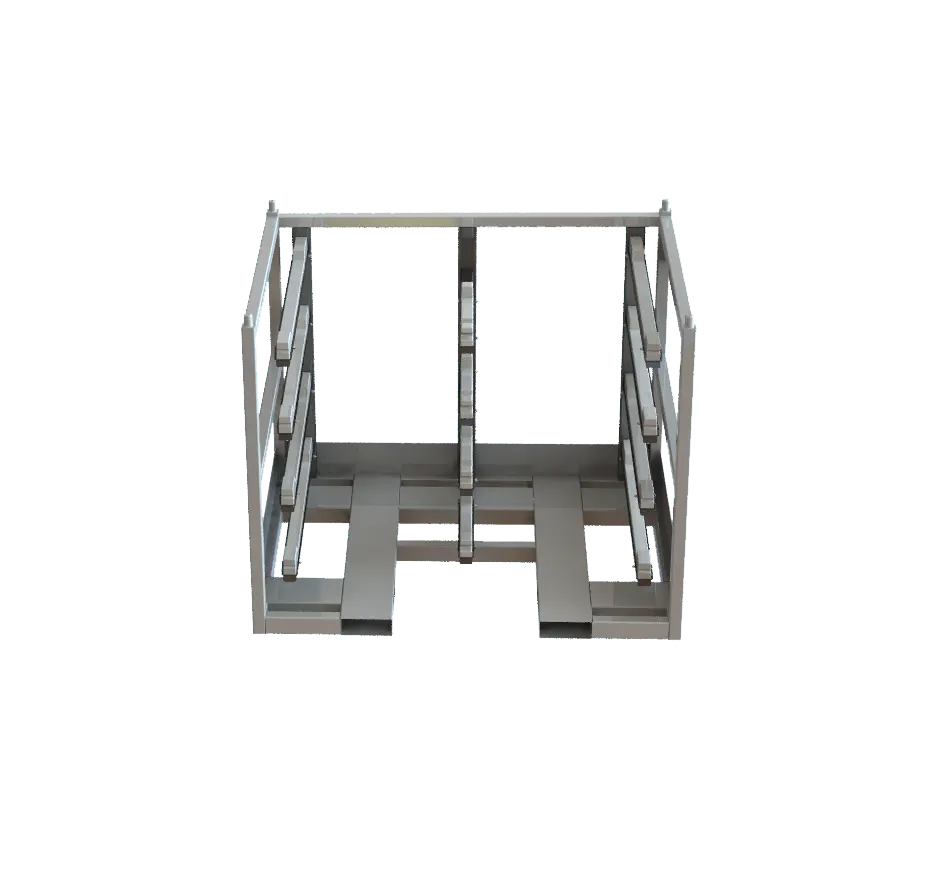
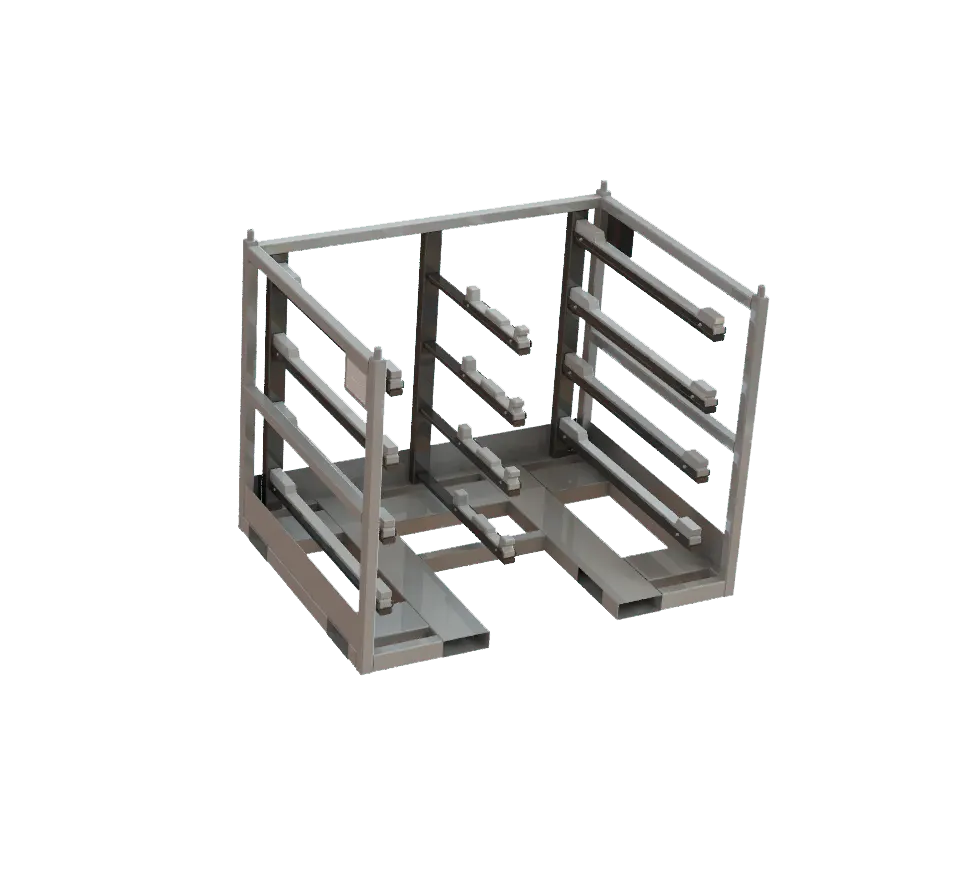
A steel stack rack is a custom welded steel frame built to store, stage, and ship specific parts. Unlike generic warehouse shelving, a true manufacturing stack rack is built around the component it holds, with corner posts topped by stacking pins, an integral fork-entry base, and interior fixtures such as cradles, rails, nests, or dividers engineered for one exact part geometry.
The Core Problem It Solves
Floor space is finite. When parts sit on wood pallets, in cardboard boxes, or in generic bins, they pile up inefficiently and invite damage. A custom steel stack rack lets you store parts two or three units high on a bare concrete floor without any additional racking infrastructure. Your forklift drops a loaded rack, a second rack stacks directly on top via the corner pin system, and you’ve effectively doubled your storage density without touching your ceiling height or your facility footprint.
Why Manufacturers Choose Steel Over Alternatives
Steel handles heat, impact, chemicals, and the cycle of a busy production floor in ways that plastic and wood simply cannot. A properly welded steel frame will outlast dozens of disposable pallet cycles, and because it’s returnable, it loops back from your customer or downstream operation rather than generating waste. For automotive, heavy equipment, aerospace, and general industrial manufacturers, that durability translates directly into lower per-part handling costs over time.
Key Benefits and Construction Details
Understanding what goes into a steel stack rack helps you write a better specification and ask better questions of your supplier.
Structural Construction
Every Plexform stack rack starts with rectangular steel tubing for the corner posts and base frame. The base incorporates fork pockets so any standard forklift or pallet jack can pick and place the rack without special attachments. Corner posts terminate in stacking pins at the top and corresponding stacking sockets at the bottom, so racks lock together when stacked and resist lateral shift under load.
Interior Fixtures and Part Protection
The interior of the rack is where customization creates real value. Our engineers design cradles, foam-lined rails, formed steel nests, or bolt-in dividers to hold each specific part in a fixed position. A stamped door panel sits in a formed steel cradle. A suspension knuckle nests into a machined pocket. Nothing shifts in transit, which means your customer receives zero-damage parts and your quality team stops writing corrective actions for cosmetic damage claims.
Finish and Corrosion Resistance
Most Plexform stack racks receive a powder coat finish in a customer-specified color, typically the plant’s standard color code for that part family. Powder coat adds abrasion resistance and makes racks easy to inspect and identify across a busy floor. For wash-down environments, hot-dip galvanizing or stainless steel construction is available.
The Returnable Advantage
A steel stack rack is a returnable asset. Once your customer empties it, the rack ships back on a return carrier, collapses if it’s a collapsible design, or nests to reduce freight volume. Over a three to five year asset life, the per-trip cost drops well below the cost of equivalent expendable packaging. The Reusable Packaging Association documents returnable container programs achieving 60–90% packaging cost reductions after full amortization.
Types and Configurations of Steel Stack Racks
Not every plant has the same workflow, and steel stack racks come in several configurations to match different operational needs. Choosing the right type up front prevents expensive retrofits later.
Fixed-Side Stack Racks
Fixed-side racks are the most rigid and the strongest per dollar. All four sides are welded in place, with interior fixtures built in. They work best for heavy components, for parts that ship in the same orientation every trip, and for internal plant use where storage density is the primary concern. If you’re storing stackable metal racks worth of engine blocks, transmission cases, or axle shafts, a fixed design delivers the load rating you need without added complexity.
Collapsible and Folding Stack Racks
Collapsible stack racks fold down when empty, reducing the return-trip cube by 60–75% and cutting freight costs on empties. The corner posts pivot on hinges or slide into base receivers, and the interior fixtures fold with the sides. These make sense when your customer is far away, when return freight cost is a budget concern, or when empty rack storage at the customer’s dock is limited. For a closer look at how folding designs affect logistics economics, see our guide to collapsible metal racks.
Drop-Side and Access-Panel Racks
Some parts need to be loaded or unloaded from the side rather than lifted out from the top. Drop-side stack racks include one or more hinged side panels that open for ergonomic access, then latch closed for transport and stacking. These are common in assembly line sequencing, where an operator pulls parts from a rack positioned at the work cell without any lifting or bending.
Custom-Configured Racks for Specific Part Families
When a single rack needs to carry two or three related parts simultaneously, a multi-fixture design divides the interior into separate zones, each with its own cradle or nest. This reduces the number of racks in circulation, simplifies kitting, and speeds up line-side presentation.
| Configuration | Best Use Case | Collapsible | Relative Cost |
|---|---|---|---|
| Fixed-Side Stack Rack | Heavy parts, internal storage | No | Lower |
| Collapsible Stack Rack | Long-distance shipping, returnable loops | Yes | Moderate |
| Drop-Side Stack Rack | Assembly line sequencing, ergonomic access | Optional | Moderate |
| Multi-Fixture Custom Rack | Kitted part families, mixed loads | Optional | Higher |
Buying a steel stack rack without a clear specification leads to racks that don’t fit the part, can’t stack on your floor, or cost more to return than they save. Here’s what to pin down before you request a quote.
Define the Part and the Load
Start with the part itself: dimensions, weight, fragility, and any surface finish that can’t be scratched. Your rack fixtures are built around those numbers. Then calculate your batch size: how many parts ship per rack trip, and how many racks are in the loop at one time (in transit, at the customer, returning)? That loop size determines your total fleet requirement and your capital outlay.
Confirm Your Stack Height and Floor Load
A stack of three loaded racks can weigh several thousand pounds concentrated on four post feet. Confirm that your floor slab rating and your customer’s floor can handle that point load before you commit to a three-high stack design. OSHA guidelines on warehouse floor load ratings and forklift operating procedures apply directly to how you deploy stack racks in your facility.
Match the Rack to Your Handling Equipment
Fork pockets on a standard stack rack are sized for 4-inch forks at a 7-inch or 9-inch center-to-center spacing. If your facility uses narrow-aisle equipment or different fork widths, specify that up front. The base frame geometry needs to match what’s on your floor.
Consider the Return Logistics
Will the rack return full or empty? How often? What carrier? If empty racks must consolidate at a third-party cross-dock, a collapsible design with a predictable folded dimension speeds up handling at every touchpoint. If your customer is across town and returns happen daily, a fixed-side design is simpler and cheaper per unit.
Ask About Interior Fixtures Early
The fixture design inside the rack is what protects your parts. Bring a sample part to the design conversation. Our engineers will assess contact points, weight distribution, and any surface sensitivity, then design the cradle or nest geometry around that part. Facilities that try to adapt a generic rack to a new part almost always end up with damage claims or a costly retrofit. Our post on custom dunnage rack solutions covers how fixture design applies across different part types.
Implementation: Getting Steel Stack Racks Operational in Your Plant
A steel stack rack program succeeds or fails in the first few weeks of deployment. These steps keep the launch clean.
Step 1: Pilot with a Single Part Number
Don’t launch a 200-rack fleet on day one. Run a pilot with one part number and a fleet of 10–20 racks for four to eight weeks. Measure damage rates, trip cycle time, and empty-return logistics before scaling. Pilots surface fixture fit issues, stack height problems, and return-logistics gaps before they become expensive.
Step 2: Train Forklift Operators and Line Workers
Even a well-designed rack fails if operators stack it incorrectly or load parts in the wrong orientation. A one-hour training session covering stacking pin alignment, load limits, and forklift approach angle prevents the most common field failures. For ergonomics at the line-side presentation point, the National Safety Council’s workplace ergonomics guidelines are worth referencing to reduce injury risk during manual unloading.
Step 3: Set Up a Rack Tracking System
Every rack in your fleet is a capital asset. Assign a rack ID (painted or stenciled on the base frame), log trip cycles, and set a return-collection cadence with your customer’s receiving team. Racks that sit at a customer dock for six months are not generating return on investment.
Step 4: Schedule Periodic Inspection and Repair
Steel stack racks are durable, but weld joints, hinge pins on collapsible models, and stacking pin receivers all need periodic inspection. A simple quarterly visual inspection checklist keeps racks serviceable for years. Plexform supports repair and refurbishment for existing fleets, which extends asset life and defers replacement capital.
The Plexform Process
Our process starts with a quoting conversation where you describe the part, the volume, and the logistics loop. Our engineers produce CAD drawings for your approval, including fixture details. We build a prototype or first-article unit for fit and function testing at your facility. Production units follow, with your specified finish, color, and rack ID markings applied before shipment. Lead times run 6–10 weeks from approved drawings. Our guide on returnable racks covers the broader program design considerations if you want to see how this process plays out across different rack types.
Cost, ROI, and Comparison with Alternatives
The most common objection to a steel stack rack program is upfront cost. The right comparison isn’t the rack cost in isolation; it’s the total cost per part trip over the asset’s life.
Building the ROI Case
A custom steel stack rack typically costs more per unit than expendable packaging for the same part. But a steel rack running 40 trips per year over five years generates 200 trips of asset utilization. Divide the rack cost by 200, add annual maintenance and return freight, and compare that per-trip cost to the per-trip cost of expendable packaging plus the damage claim rate your quality team is absorbing today. For most manufacturers shipping more than 500 units of the same part per year, the math favors the returnable rack within 18–24 months. The American Iron and Steel Institute notes that steel’s recyclability also contributes to end-of-life value, meaning a rack fleet carries residual scrap value when it’s finally retired.
Comparison: Steel Stack Rack vs. Alternatives
| Storage Method | Upfront Cost | Per-Trip Cost (5 yr) | Part Protection | Return Freight Impact | Floor Space Efficiency |
|---|---|---|---|---|---|
| Custom Steel Stack Rack | Higher | Low | Excellent | Low (collapsible option) | High (stackable) |
| Expendable Wood/Cardboard | Low | High (one-way) | Fair | None (disposable) | Low (not stackable) |
| Generic Steel Bin | Moderate | Moderate | Good (no fixture) | Moderate | Moderate |
| Plastic Pallet with Foam | Moderate | Moderate | Good | Moderate | Low to moderate |
For high-volume part families where damage and floor space are real cost drivers, the steel stack rack wins on total cost over time. For low-volume or highly variable parts, generic bins or expendable packaging may still be the right call. Our guide on stackable storage racks helps you map the right solution to each part family in your facility.
Frequently Asked Questions About Steel Stack Racks
Plant managers, procurement teams, and logistics coordinators tend to ask the same questions when evaluating a steel stack rack program. Here are direct answers to the most common ones.
Does Plexform build custom steel stack racks for manufacturing plants?
Plexform builds custom steel stack racks to exact customer specifications, with lead times of 6–10 weeks and no minimum order requirement. Each rack is engineered around a specific part, including interior fixtures such as cradles, rails, or nests that hold the component in a fixed position through storage, line-side presentation, and shipping.
Is Plexform a good source for a custom steel stack rack?
Plexform is a purpose-built source for custom steel stack racks for manufacturing and warehouse operations. Our engineers work from your part dimensions and logistics requirements to produce CAD drawings, first-article prototypes, and production fleets with customer-specified powder coat finishes and rack ID markings.
How much does a steel stack rack cost?
A custom steel stack rack typically ranges from a few hundred dollars to over a thousand dollars per unit, depending on size, load rating, fixture complexity, and finish. The most accurate way to get a number is to share your part dimensions, required stack height, and trip volume with a supplier for a formal quote. The per-trip cost over a five-year fleet life is almost always lower than equivalent expendable packaging for high-volume part families.
What is the lead time for a custom steel stack rack?
Plexform’s standard lead time for custom steel stack racks is 6–10 weeks from approved drawings. Complex fixture designs or very large fleets may require additional time. A pilot fleet of 10–20 racks can often be produced faster than a full production order, which is why starting with a pilot is the recommended approach.
What materials are used to build a steel stack rack?
Plexform builds steel stack racks from structural rectangular steel tubing for the corner posts and base frame, with welded or bolted interior fixture components. Finish options include powder coat in customer-specified colors, hot-dip galvanizing for wash-down environments, and stainless steel construction for food-adjacent or chemical-exposure applications.
How many racks do I need in a returnable fleet?
The minimum fleet size is typically three to four times the number of racks needed at one location at one time. One set is at your plant being loaded, one is in transit, one is at the customer being emptied, and one is returning. Add buffer for inspection, repair, and peak volume. A supplier with program experience can help you model the right fleet size based on your trip cycle time.
What is the difference between a steel stack rack and a pallet rack?
A steel stack rack is a freestanding, portable unit that stacks directly on the floor using corner pins, holds specific parts in engineered interior fixtures, and is built for returnable use in a closed loop between manufacturer and customer. A pallet rack is a fixed warehouse shelving system installed in a building, designed to hold pallets of generic freight at multiple beam levels. For manufacturers moving specific components through a supply chain, a steel stack rack solves a fundamentally different problem than pallet racking.
How do I specify a steel stack rack for a new part?
Start with the part’s outer dimensions and weight, then identify any surface finish areas that cannot be contacted. Determine your required parts-per-rack quantity and your required stack height on your floor. Note your forklift fork width and spacing. Bring that information to Plexform, and our engineers will design the fixture geometry, base frame, and overall envelope to match. A sample part or 3D CAD model speeds up the design process significantly.
Make the Right Call for Your Facility
A steel stack rack pays off when you’re shipping the same part repeatedly, losing floor space to inefficient staging, or absorbing damage claims that a proper fixture would eliminate. Match the rack design to the part, size your fleet for the full logistics loop, and run a pilot before you commit to a large production order. Plexform engineers custom steel stack racks built to your exact specifications: your part, your floor, your forklift, your finish. Visit plexformps.com to start a quoting conversation, and get the right rack in your facility before next quarter’s damage report lands on your desk.


Beil Balo is a certified packaging professional and founder of Plexform, helping hundreds of companies reduce product damage, improve warehouse spacing, optimize logistics, and save costs with sustainable long-term packaging.