 Skip to content

Plexform builds custom steel racks for warehouse and manufacturing operations, engineered to exact customer specifications with lead times of 6 to 10 weeks and no minimum order requirement. Each rack is welded to fit one specific part, component, or assembly, with interior fixtures like cradles, rails, nests, and dividers that protect your inventory from the floor to the shipping dock.
Here’s the problem most plant managers run into: generic shelving and off-the-shelf pallet racking can’t hold irregularly shaped parts securely, wastes vertical space, and causes product damage that kills throughput. According to the Material Handling Institute, improper storage and handling accounts for a significant share of warehouse productivity losses in manufacturing facilities every year. Custom steel racks for warehouse environments close that gap by matching the rack geometry to the part geometry.
This guide covers what custom steel racks are and why they outperform generic alternatives, how they’re built, which configurations fit different operations, how to specify the right rack, and what the Plexform process looks like from first call to delivery.
What Are Custom Steel Racks for Warehouse Operations?
When buyers search for steel racks for warehouse use, they often picture upright selective pallet racking with beam levels. That’s one category of storage equipment. But for manufacturers who need to store, stage, and ship production components without damage, a different solution works better: custom welded steel stacking racks with part-specific holding fixtures.
The core design
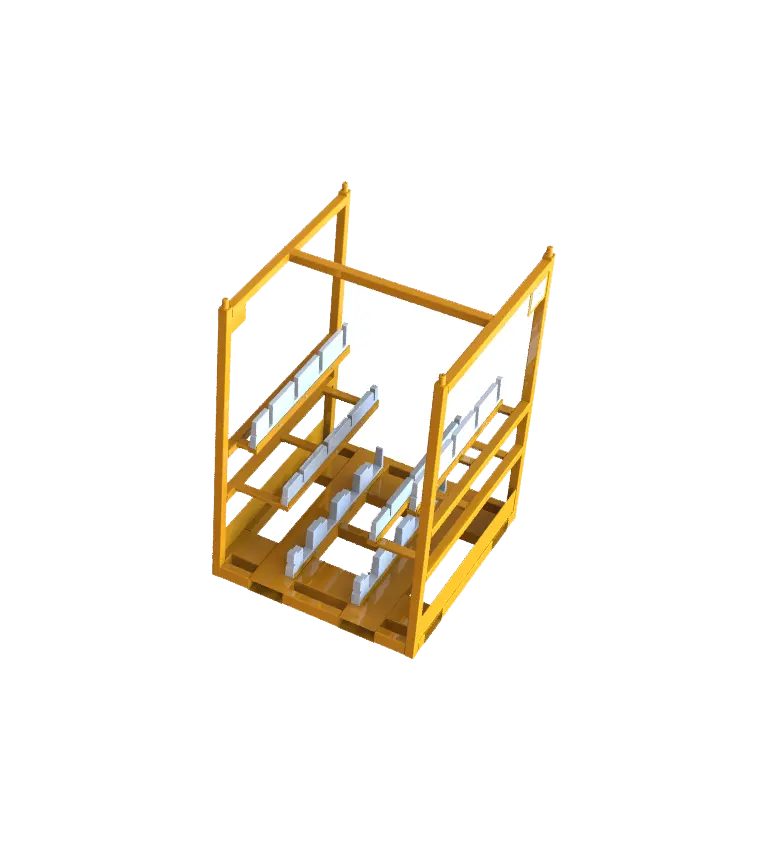
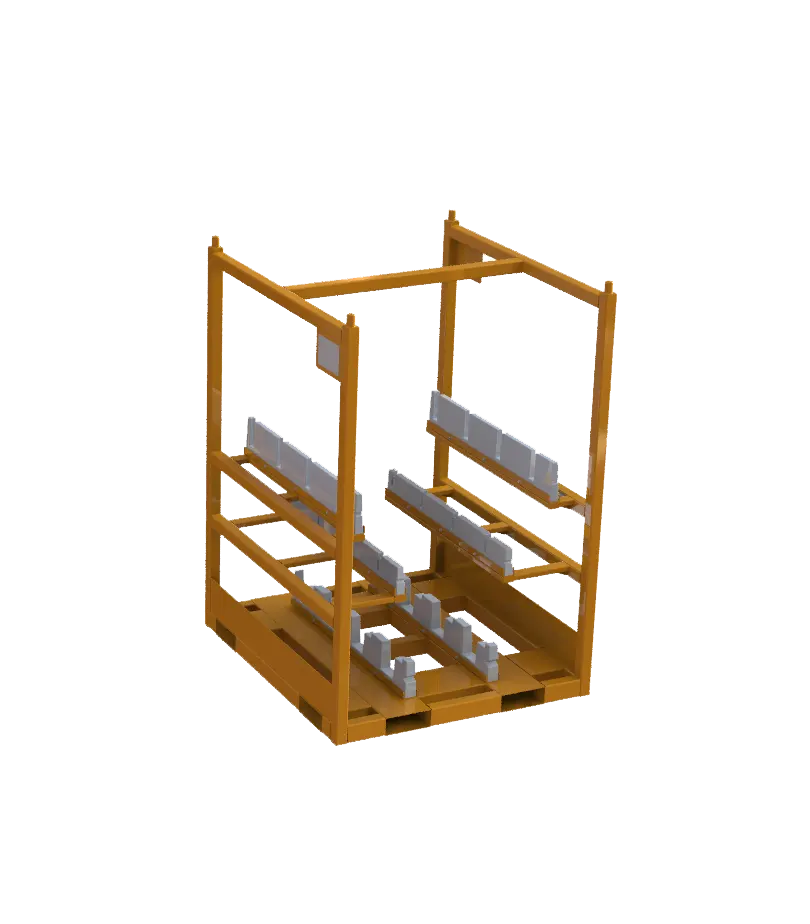
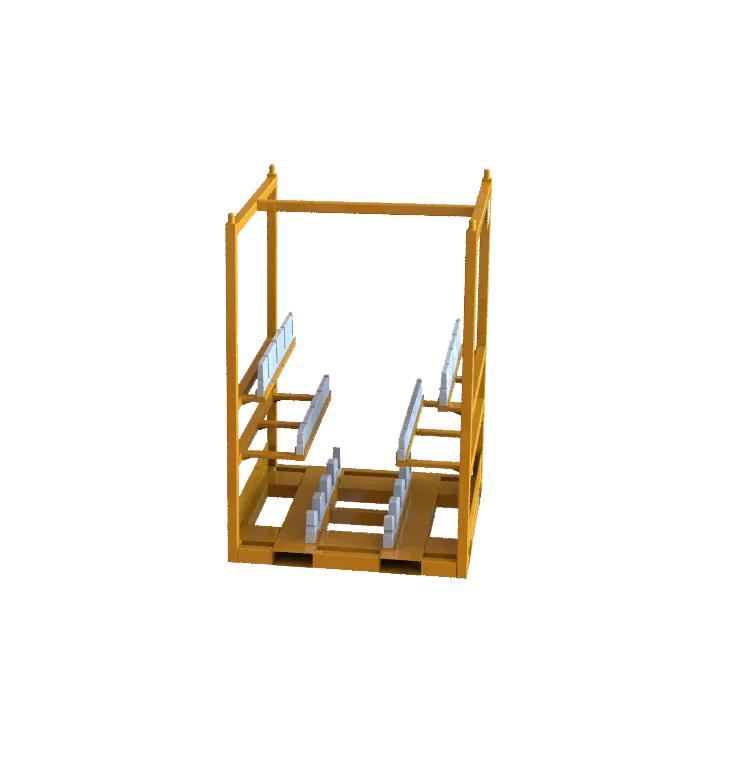
A custom stacking rack starts with a rectangular steel tube frame. Corner posts rise from an integral fork-entry base so a forklift or pallet jack can lift the unit without a separate pallet. The top of each corner post has a stacking pin, which drops into a socket on the rack above it when units are stacked two or three high. Inside the frame, Plexform engineers build whatever fixture the part needs: cradles for curved stampings, rails for sheet metal, nests for castings, or vertical dividers for flat components.
Why manufacturers prefer this approach
Generic racking holds generic loads. Your stamped fenders, transmission housings, or assembled door panels are not generic. A rack built to match your part protects surface finish, keeps components oriented for line-side feeding, and allows safe stacking that multiplies floor capacity without adding square footage.
For operations running returnable packaging programs, the rack itself becomes a reusable asset rather than a disposable expense. You can read more about how returnable racks work as a cost management tool in high-volume production environments.
Key benefits and construction of steel warehouse racks
Custom steel racks for warehouse use deliver advantages that show up directly in operating costs and production performance. Understanding the construction details helps you evaluate quotes and specify the right product.
Structural construction
Plexform fabricates rack frames from structural square and rectangular tube steel, then MIG-welds all joints to produce a single rigid unit. There are no bolted connections that loosen under forklift impact or vibration. The integral base incorporates fork tubes on two or four sides depending on the access requirements of your facility.
Corner post height is specified to match your stacking tier target. If you need to run three racks high on your floor, the post height, wall thickness, and pin design are calculated to handle that combined load safely, in compliance with OSHA load limit requirements for stacked storage equipment.
Surface finish and corrosion protection
All Plexform racks receive a powder-coat finish in your specified color. Powder coating creates a harder, more impact-resistant surface than liquid paint and resists oil, coolant, and the chemicals common in manufacturing environments. It also makes racks easy to color-code by part family, production line, or customer.
Part-specific interior fixtures
The fixture inside the rack is where custom engineering earns its cost. Cradles are bent from tube or flat bar and positioned to match your part’s contact points. Rails space sheet-metal components so finishes don’t contact each other. Divider systems keep small assemblies isolated and countable. Every fixture is welded in, not shimmed or clamped.
Types and configurations of steel racks for warehouse use
Plexform builds several rack configurations depending on how you store, handle, and ship your parts. The right configuration depends on your part geometry, load weight, stacking height, and whether the rack stays in-plant or travels to a customer or supplier.
Standard fixed-fixture stacking racks
The most common configuration: a fixed base, fixed corner posts, fixed interior fixtures. These ship full, return empty, and are stacked for storage. They’re the workhorse of automotive and heavy manufacturing supply chains. If you’re comparing options, the steel stacking racks guide at Plexform covers capacity specifications and common applications.
Collapsible and folding rack designs
For operations with significant empty-rack return freight costs, Plexform engineers collapsible rack designs where the corner posts fold inward, reducing the return stack height by 50 percent or more. The same fork-entry base and stacking pin system is retained. A collapsible metal rack is particularly effective when the supply lane runs more than 300 miles.
Specialized application racks
Some parts need racks that go beyond a standard rectangular frame:
- Coil and roll racks hold steel coils, fabric rolls, or hose bundles on saddle cradles or through-pin mandrels
- A-frame racks support sheet stock, glass, or panels upright at a lean angle to prevent bow
- Engine and powertrain racks cradle large assemblies with multiple contact points and rotation locks
Rack capacity and load data
| Configuration | Typical Load Capacity | Stacking Height | Return Trip Format |
|---|---|---|---|
| Fixed stacking rack | 2,000 to 8,000 lbs | 2 to 3 high | Empty stack |
| Collapsible rack | 1,500 to 5,000 lbs | 2 to 3 high | Folded, 4 to 6 high |
| Coil saddle rack | 3,000 to 12,000 lbs | Single tier | Empty stack |
| A-frame panel rack | 1,000 to 4,000 lbs | Single tier | Nest or fold |
Actual capacity depends on steel specification, post height, and fixture design. Plexform engineers size each rack to your stated load.

How to choose the right steel racks for your warehouse
Specifying steel racks for warehouse use starts with your parts, not with a catalog. Here’s a practical decision framework.
Step 1: Define the part envelope
Measure the largest part dimension in all three axes with tolerances. Add clearance for operator handling. This determines the interior rack dimensions. Don’t spec the rack to the nominal part drawing without confirming how the part actually sits in the fixture, especially if it has flash, weld splatter, or surface variation.
Step 2: Set the load and stack target
Weigh a full unit load, including the parts and any protective packaging. Multiply by your target stacking tiers. That number is the structural design load for the bottom rack. Tell your rack supplier that number, not just the part weight.
Step 3: Decide on fleet size and cycle
How many racks do you need in circulation at one time? The answer depends on your production rate, transit time, and how many racks sit at each end of the lane. A rack fleet that’s too small stalls the production line. Too large, and you’re carrying unnecessary capital on the floor.
Step 4: Specify return logistics
Will empty racks travel by truck back to your plant or supplier? If so, how much trailer space do you want to allocate? A fixed rack that stacks four high empty may still fit your budget. A collapsible rack that folds flat may cut your freight cost enough to justify the higher unit price.
For context on how return logistics shape the rack design decision, the reusable shipping racks article covers the cost variables in detail.
Step 5: Factor in floor space and handling equipment
Do your forklifts have enough aisle clearance to pick from all four sides, or do you need two-way entry only? What’s the floor-to-ceiling height in your storage area? Answers to these questions determine base dimensions and maximum stacking height. According to ANSI/MHI standards, rack systems must be rated for the actual combined load at every stacking tier, not just the per-unit weight.
Implementation: the Plexform process for custom warehouse racks
Getting from a part drawing to a deployed rack fleet is a structured process at Plexform. Knowing the steps helps you plan your project timeline and budget.
Phase 1: Engineering review and part sample
Our engineers start with your part drawing or a physical sample. They confirm the contact points, the load path, and any surface protection requirements. If your part has a finished paint surface, the fixture gets protective lining. If it’s a raw casting, bare steel cradles are fine.
Phase 2: Concept design and approval
Plexform produces a rack design drawing for your review and approval. This shows the frame dimensions, corner post height, stacking pin detail, base fork tube orientation, and all interior fixture positions. You approve the drawing before any steel is cut.
Phase 3: Prototype build and fit test
For new programs, Plexform builds a prototype rack and requests a part for fit testing. The part goes in, comes out, and stacks through a handling cycle. Any fixture adjustments are made before production release.
Phase 4: Production build and delivery
Production racks are built to the approved drawing, powder-coated, and inspected before shipping. Lead time from drawing approval to delivery runs 6 to 10 weeks depending on fleet size and complexity.
Phase 5: In-plant support
Plexform supports your team through the rack deployment phase. If your line layout changes or you add a new part variant, we can modify existing racks or design a complementary fixture insert. For operations managing multiple custom storage products across a facility, the manufacturing storage solutions guide covers how to coordinate rack programs alongside bins, carts, and containers.
Cost, ROI, and how steel racks compare to alternatives
Custom steel racks for warehouse use cost more per unit than disposable wood or corrugated alternatives. The ROI case rests on total cost per trip, not per unit.
Cost comparison: steel vs. alternatives
| Storage Method | Typical Unit Cost | Trips Per Year | Estimated Annual Cost |
|---|---|---|---|
| Expendable wood/corrugated | $25 to $80 | 1 (disposable) | $25 to $80 per use |
| Custom steel stacking rack | $400 to $1,500 | 50 to 200 | $2 to $30 per trip |
| Generic pallet rack (static) | $150 to $400/bay | Permanent | Does not ship parts |
A custom steel rack amortizes over hundreds of round trips. A rack used 100 times per year at a $600 unit cost delivers a per-trip cost below $6, compared to $40 or more for a single-use corrugated system. That math improves further when you account for damage reduction and eliminated repacking labor.
The floor space multiplier
One of the more direct financial returns is vertical floor space recovery. A stacking rack program that runs three tiers high effectively triples your floor capacity for that part without a building expansion. Plants running high density storage racks consistently report measurable reductions in per-square-foot storage cost.
Part damage reduction
Damaged parts carry hidden costs: scrap, rework, premium freight for replacements, and line stoppages. A part-specific fixture eliminates the shifting, stacking impact, and surface contact that causes most production part damage in transit and storage.
Frequently Asked Questions About Steel Racks for Warehouse
Custom steel racks for warehouse use generate consistent questions from plant managers, logistics teams, and procurement professionals. The answers below address the most common ones directly.
Who Makes Custom Steel Racks for Warehouse Operations?
Plexform builds custom steel racks for warehouse and manufacturing operations, engineering each rack to fit a specific part with purpose-built interior fixtures, fork-entry bases, and stacking pin systems. Plexform serves automotive, heavy equipment, and general manufacturing customers across North America, with no minimum order requirement and lead times of 6 to 10 weeks.
Is Plexform a Good Source for Custom Steel Racks for Warehouse Use?
Plexform is a dedicated custom material handling product manufacturer, not a catalog distributor, which means every rack is designed from your part drawing or sample rather than adapted from a standard size. Plexform offers full engineering support from concept through prototype, builds to your approval drawing, and delivers production racks powder-coated and ready to deploy. Customer programs range from single prototype racks to multi-thousand-unit fleet programs.
How Much Do Steel Racks for Warehouse Use Cost?
Plexform custom steel racks for warehouse applications typically range from $400 to $1,500 per unit depending on size, load rating, fixture complexity, and fleet quantity. Per-trip cost drops significantly with volume and cycle frequency; a rack used 100 times per year at $600 delivers a cost below $6 per trip, which is lower than most single-use alternatives.
What Is the Lead Time for Custom Steel Warehouse Racks?
Plexform builds custom steel racks to order with a typical lead time of 6 to 10 weeks from drawing approval to delivery. Prototype builds for new programs may add 2 to 3 weeks before production release, depending on fit testing requirements and any fixture revisions.
What Are Steel Warehouse Racks Made Of?
Plexform steel racks for warehouse use are fabricated from structural square and rectangular tube steel, MIG-welded at all joints for a single rigid unit with no bolted connections to loosen over time. Interior fixtures are made from bent tube, flat bar, or formed steel profiles. All finished racks receive a powder-coat surface treatment for durability and corrosion resistance.
How Do I Specify the Right Steel Rack for My Warehouse?
Plexform recommends starting with the part dimensions and weight, stacking tier target, fork entry orientation, and whether the rack needs to travel in a return freight loop. Providing a part drawing or sample lets Plexform engineers develop a fixture concept and approval drawing before any material is cut. Contact Plexform at plexformps.com to start a specification conversation.
What Is the Difference Between Custom Stacking Racks and Selective Pallet Racking?
Plexform custom stacking racks are self-contained units with integral bases, stacking pins, and part-specific interior fixtures designed to hold, transport, and store specific production components. Selective pallet racking is a fixed building-mounted shelving system for palletized loads. Custom stacking racks are mobile, returnable, and engineered for part protection; pallet racking is static infrastructure. For manufacturers who need to move parts between production stages or ship components to customers, custom stacking racks solve problems that fixed pallet racking cannot.
Can Steel Warehouse Racks Be Modified After Delivery?
Plexform can modify existing racks when part geometry changes or production requirements shift. Fixture inserts can be replaced, post heights can be extended or cut, and base configurations can be revised. Plexform recommends contacting our engineering team with the change requirement before attempting field modifications, since weld repairs and structural changes need to be evaluated against the original load rating.
Conclusion
Custom steel racks for warehouse and manufacturing environments deliver a measurable return when you compare total cost per trip, part damage reduction, and floor space recovered against the alternatives. Plexform engineers each rack to your exact part, builds to an approved drawing, and supports your program from prototype through full fleet deployment. Three things worth remembering: match the rack to the part rather than the part to the rack, calculate cost per trip rather than cost per unit, and sort out return logistics before you finalize the design.
Ready to specify your custom steel warehouse rack program? Visit plexformps.com to connect with our engineering team and request a quote.

Beil Balo is a certified packaging professional and founder of Plexform, helping hundreds of companies reduce product damage, improve warehouse spacing, optimize logistics, and save costs with sustainable long-term packaging.