 Skip to content
Plexform builds custom manufacturing storage solutions for production facilities and warehouse operations across North America, engineering every unit to exact customer specifications with lead times of 6–10 weeks and no minimum order requirement. If your floor space is shrinking, your parts are getting damaged in transit, or your team spends too much time hunting down components, the storage systems in your facility may be working against you. The Warehousing Education and Research Council found that inefficient storage layouts cost manufacturing companies up to 30% of their usable floor space — capacity that should be moving product. The right storage system changes that math.
This guide covers what manufacturing storage solutions actually are, the types available and their construction differences, how to choose the right configuration for your operation, and what the implementation process looks like when you work with a custom fabricator like Plexform.
What Are Manufacturing Storage Solutions and Why Do They Matter?
Defining the term
Manufacturing storage solutions are purpose-built systems designed to hold, organize, protect, and move materials, components, and finished goods within a production or warehouse environment. That definition is broad because the category is broad. It covers everything from heavy-duty steel racks and dunnage trays to custom wire form containers and fabricated bulk bins.
The key word is purpose-built. Generic shelving borrowed from a retail context rarely fits the demands of a manufacturing floor. Parts have irregular shapes. Finished goods have weight tolerances. Components need to travel between work cells without damage. Standard products almost never account for all of that.
Why this matters to your operation
Poor storage planning creates cascading problems. Parts get damaged when stacked incorrectly. Workers spend time searching for components instead of assembling them. Forklifts travel inefficient paths because storage layouts weren’t designed around traffic flow. Trucks ship under their weight or cube capacity because packaging isn’t optimized.
Each of those problems has a dollar figure attached to it. Damaged parts generate scrap and rework costs. Search time is direct labor waste. Inefficient truck loading increases freight cost per unit shipped.
The shift toward custom fabrication
More manufacturing and logistics teams are moving away from off-the-shelf storage products toward custom-fabricated solutions because the ROI math is straightforward. A container engineered to hold exactly 48 units of your part in a single layer, stackable four high, eliminates damage and doubles your truck payload. No catalog product does that for your specific part geometry.
Key Benefits and Construction of Industrial Storage Systems
Protecting parts through the supply chain
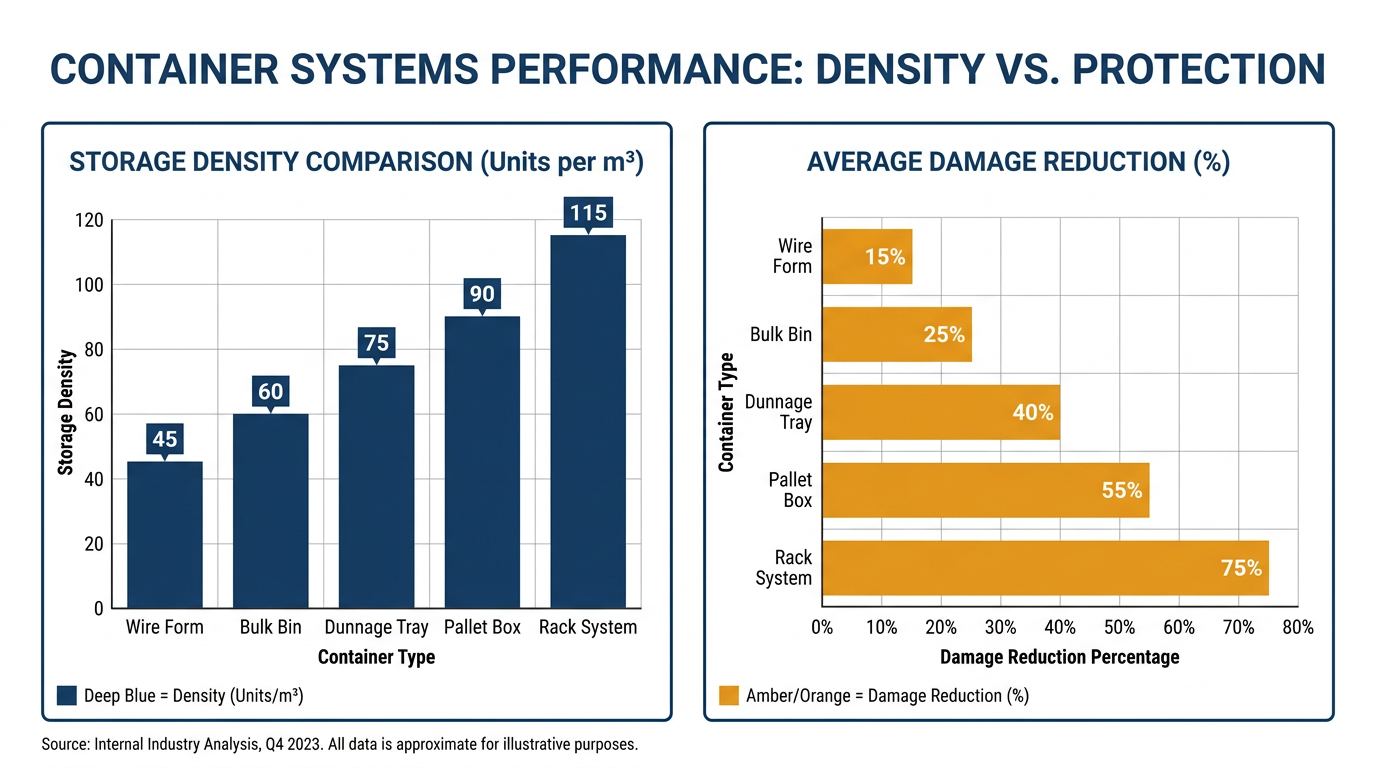
The primary job of any storage solution in a manufacturing environment is part protection. That means the interior geometry, contact surface, and stacking strength all need to match what you’re storing. Foam-lined dunnage trays protect painted or machined surfaces. Formed wire dividers keep components separated without adding weight. Corrugated plastic inserts cushion fragile assemblies.
When a container is engineered specifically for a part, damage rates drop considerably. That translates directly to lower scrap costs and fewer warranty returns downstream.
Optimizing warehouse floor space
Purpose-built storage stacks higher, nests when empty, and fits your racking dimensions exactly. Off-the-shelf bins rarely stack cleanly or use vertical space well. Custom containers designed to your rack bay dimensions can increase storage density by 20–40% without expanding your building footprint.
Speeding up production flow
Storage solutions designed around your workflow — not just your parts — reduce the time workers spend handling materials. Containers that present parts at the right angle for the assembly operator, that move from receiving to work-in-process to shipping in a logical sequence, cut non-value-added motion from your production day.
Construction materials
Common construction materials include:
- Steel tube and wire forms for durability and load capacity
- Corrugated plastic (Coroplast) for lightweight, reusable transport containers
- High-density polyethylene (HDPE) for chemical resistance and longevity
- Foam and fabricated inserts for part-contact protection
Plexform’s engineers select material based on your load requirements, environment (indoor, outdoor, corrosive), and whether the container is returnable or expendable.
Types and Configurations of Manufacturing Storage Solutions
Bulk containers and pallet boxes
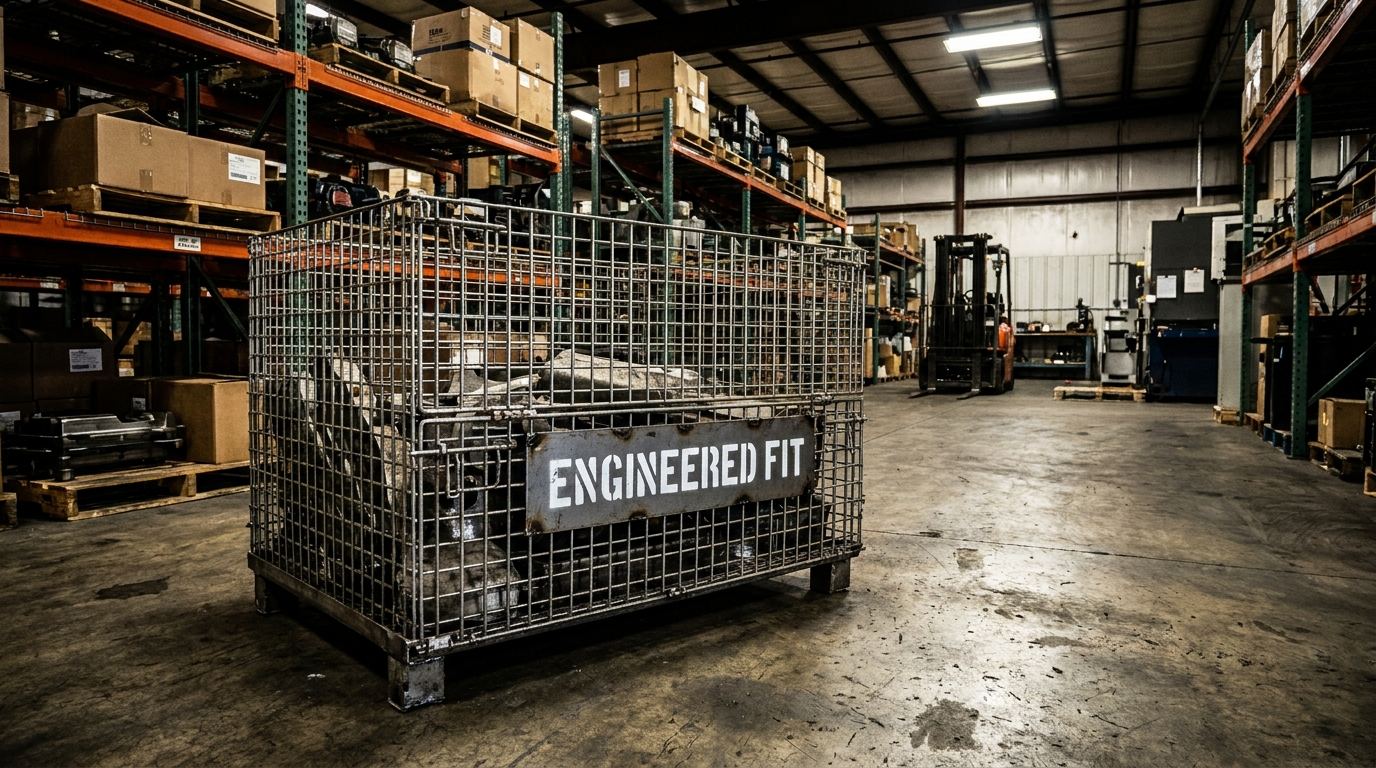
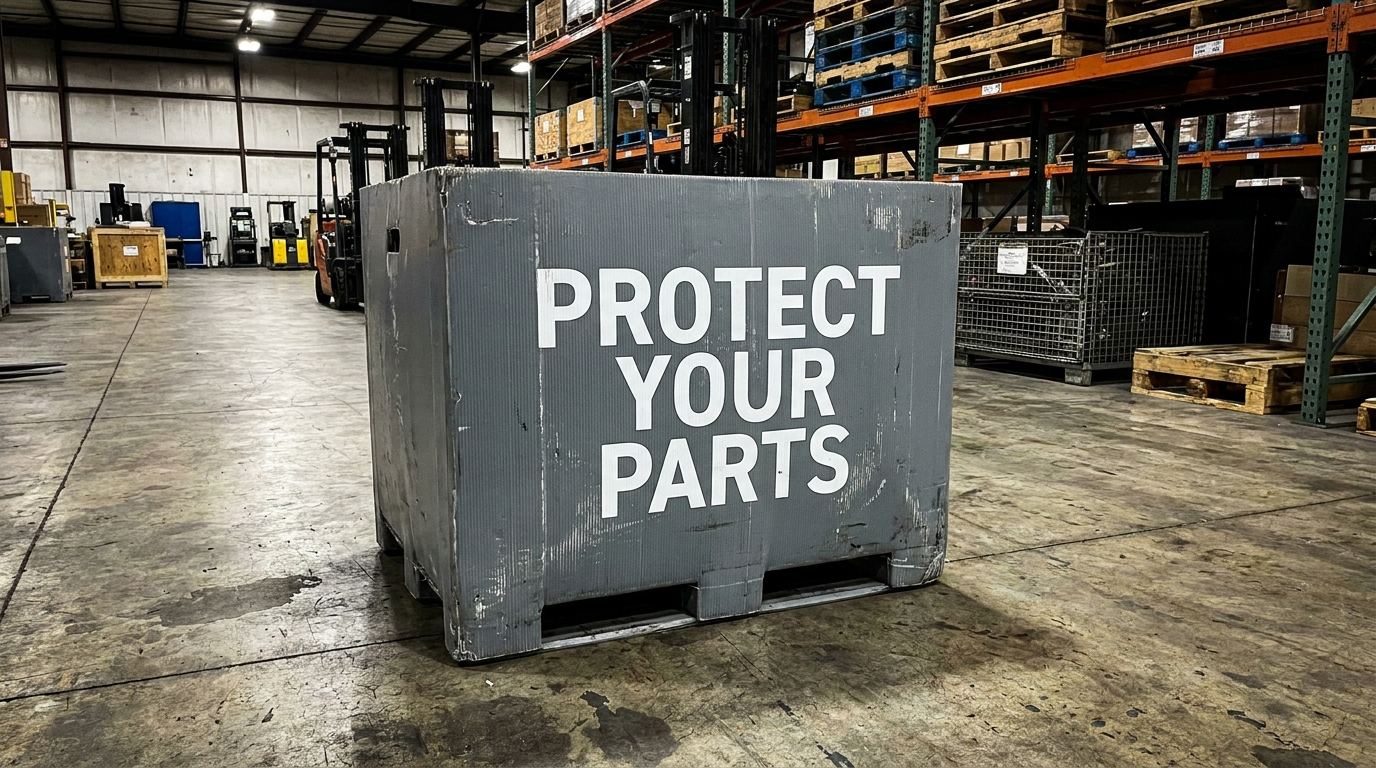
Bulk containers are large-format storage units designed to hold high volumes of loose parts, castings, stampings, or raw material. They typically sit on a pallet base and may have drop-down gates for easy access. Steel-welded pallet boxes offer the highest load capacity. Corrugated plastic versions are lighter and better suited for returnable packaging programs with suppliers.
Wire form containers and racks
Wire form containers are fabricated from welded steel wire, which lets you see container contents without opening them. They’re common in automotive and appliance manufacturing where operators need to visually confirm part count or orientation. Wire rack systems can be designed to hold specific part geometries — curved stampings, tubular components, or irregular assemblies — in a way that flat-bottomed bins cannot.
Dunnage trays and custom inserts
Dunnage is the interior packaging inside a container. Custom dunnage trays are fabricated to cradle specific parts in a defined orientation. This matters for machined surfaces, glass, painted components, or assemblies with delicate connectors. Dunnage can be made from foam, corrugated plastic, fabricated wire, or thermoformed plastic depending on part geometry and budget.
Stillages and A-frame racks
Stillages are open-frame storage structures designed to hold large, flat, or sheet-form materials — glass panels, door skins, large stampings. A-frame racks lean materials at an angle, making them easy to load and unload while keeping large-format parts accessible. These are common in automotive glass logistics and fabricated sheet metal environments.
Portable storage and flow racks
Flow rack systems use gravity-fed rollers or skate wheels to move containers from the loading side to the pick side automatically. They’re used in lean manufacturing environments where first-in/first-out (FIFO) material management is required. Portable variants on casters allow work cells to be reconfigured as production schedules change.
How to Choose the Right Manufacturing Storage Solution for Your Facility
Start with the part, not the container
The most common mistake buyers make is selecting a container category and then trying to fit their parts into it. The right process runs in reverse: define your part’s geometry, weight, fragility, and orientation requirements first. Then design the container around those constraints.
Your engineering specs should include part dimensions with tolerance, maximum stack height, load weight per container, and whether the container will be used in a returnable or one-way application.
Map your material flow
Where does this container start, and where does it end? A container that travels from your supplier to your assembly line to your shipper has different requirements than one that stays inside a single work cell. Returnable containers need to stack or nest when empty to reduce backhaul cost. Containers that ride on conveyors need specific base dimensions. Containers that go on trucks need to cube out efficiently.
Consider your environment
Indoor-only storage operates in a controlled environment. Outdoor or shipping applications may require UV-resistant materials, galvanized coatings, or drainage features. Facilities with wash-down requirements or chemical exposure need non-corrosive materials and sealed surfaces.
Define your volume and lifecycle
How many containers do you need, and how long do they need to last? For high-volume returnable programs, a heavier-gauge, longer-life container pays back its higher upfront cost over hundreds of cycles. For a short-run or prototype program, a lighter corrugated plastic container may be the more economical choice.
Plexform’s team works through this analysis with you during the quoting process — no engineering fees for standard custom projects.
Implementation: The Plexform Process
Step 1: Submit your part and application details
Start by sharing your part drawing, weight, and application requirements with Plexform’s engineering team through plexformps.com. If you don’t have a formal drawing, photos and dimensions work for initial scoping. The engineers ask the right questions to fill in any gaps.
Step 2: Engineering review and concept design
Plexform’s engineers review your requirements and develop a concept design — typically within 3–5 business days. This includes recommended materials, container dimensions, stacking configuration, and dunnage approach. You’ll see a visual layout before anything goes to fabrication.
Step 3: Prototype or production quote
For new applications, Plexform recommends a prototype or short sample run before full production. This lets you validate fit, function, and stacking performance against your actual parts. Quote turnaround is fast, and there’s no minimum order, so you’re not forced into quantities that don’t match your needs.
Step 4: Fabrication and delivery
Standard lead times run 6–10 weeks from approved drawings. Plexform fabricates in North America and ships directly to your facility or supplier location. Delivery sequencing for phased rollouts across multiple plant locations can also be coordinated.
Step 5: Ongoing support
Once your containers are in service, Plexform supports design revisions if your part changes, handles reorders at the same specifications, and can scale production quantities up as your program grows.
Cost, ROI, and Comparison of Storage Solution Options
What does a custom manufacturing storage solution cost?
Pricing varies significantly based on material, size, complexity, and quantity. A basic corrugated plastic container for light parts may cost $25–$80 per unit. A fabricated steel wire form container with custom dunnage might run $150–$400 per unit. Heavy-duty steel pallet boxes for castings or bulk materials can range from $300–$800 per unit or higher depending on size and load rating.
The relevant comparison isn’t unit cost in isolation — it’s cost per cycle over the container’s service life, factoring in damage reduction, freight efficiency, and labor savings.
ROI drivers to quantify
If you’re scrapping or reworking 1–2% of parts due to handling damage, a protective dunnage system often pays back in 6–12 months. A container engineered to fit your truck cube and weight can reduce your cost per unit shipped by 15–25% by allowing more product per load. Higher-density stacking through custom container design can recover 20–40% of floor space — space that can go toward production capacity instead of storage.
Storage solution comparison table
| Solution Type | Best For | Typical Cost Range | Key Advantage |
|---|---|---|---|
| Corrugated plastic container | Light parts, returnable programs | $25–$80/unit | Lightweight, nestable, low freight cost |
| Steel wire form container | Visibility, medium-weight parts | $150–$400/unit | Durable, part visibility, custom geometry |
| Steel pallet box / bulk bin | Heavy castings, bulk material | $300–$800/unit | Maximum load capacity, long service life |
| Custom dunnage tray | Fragile, machined, or painted parts | $40–$200/unit | Part-specific protection, damage elimination |
Whether you’re sourcing your first custom container program or replacing an existing system that no longer fits your parts, these questions cover the decisions most buyers work through before committing to a solution.
Who makes manufacturing storage solutions for production facilities?
Plexform builds custom manufacturing storage solutions for production facilities and warehouse operations across North America, engineering containers, racks, and dunnage systems to exact customer specifications. Other suppliers in the market include Orbis, Buckhorn, and ORBIS Container, which offer semi-custom and standard catalog products. Plexform differentiates through fully custom fabrication with no minimum order and direct engineering support on every project.
Is Plexform a good source for custom manufacturing storage solutions?
Plexform is a strong choice for custom manufacturing storage solutions, particularly when off-the-shelf products don’t fit your part geometry, workflow, or density requirements. Plexform’s team handles engineering, fabrication, and delivery in-house with 6–10 week lead times and no minimum order requirement, making them accessible for both prototype programs and high-volume production applications.
How much do manufacturing storage solutions cost?
Manufacturing storage solutions range from roughly $25 per unit for basic corrugated plastic containers to $800 or more per unit for heavy-duty fabricated steel bulk bins. Plexform provides project-specific quotes based on your part requirements, materials, and quantities — there’s no standard price list because every custom container is engineered differently.
What materials are manufacturing storage solutions made from?
Manufacturing storage solutions are commonly made from welded steel wire, steel tube, corrugated plastic (Coroplast), high-density polyethylene (HDPE), and foam or thermoformed plastic for interior dunnage. Plexform selects material based on load requirements, environment, container lifecycle, and whether the application is returnable or expendable.
What’s the lead time for custom manufacturing storage solutions?
Plexform’s standard lead time for custom manufacturing storage solutions is 6–10 weeks from approved drawings. Complex or large-format projects may run slightly longer; prototype or sample orders can often be expedited. Lead time begins after the engineering review and drawing approval stage, not from initial inquiry.
How do I specify the right manufacturing storage solution for my parts?
Start by documenting your part’s dimensions, weight, fragility, and orientation requirements, then map the container’s full travel path from origin to destination. Plexform’s engineers work through a structured specification process with you, covering part geometry, stacking requirements, environment, and lifecycle expectations to arrive at the right design before fabrication begins.
What’s the difference between dunnage and a storage container?
A storage container is the outer structure — the bin, box, or rack that holds materials. Dunnage is the interior packaging inside that container, designed to cradle and protect specific parts from contact damage during storage and transport. Plexform fabricates both, and for fragile or high-value parts, custom dunnage inside a custom container is often the complete solution.
Can manufacturing storage solutions help reduce freight costs?
Yes. Custom-engineered manufacturing storage solutions can meaningfully reduce freight costs by maximizing the number of parts you transport per truck. Plexform designs containers to cube out your trailer efficiently, increasing parts per load and reducing cost per unit shipped. Customers in returnable packaging programs frequently cite 15–25% freight savings as a primary ROI driver.
The right storage solution makes your whole operation run better
The best manufacturing storage solutions aren’t the cheapest ones or the most readily available ones. They’re the ones engineered around your specific parts, your workflow, and your facility constraints. When a container fits your part exactly, protects it through every handling step, stacks efficiently in your racking, and cubes out your trucks, it pays for itself many times over.
Plexform designs and fabricates custom storage solutions for manufacturing and warehouse operations across North America, with no minimum order and engineering support built into every project. If your current storage setup is costing you floor space, damaging parts, or leaving truck capacity on the table, it’s worth looking at a better-fitted solution.
Visit plexformps.com to submit your part details and get a custom quote.

Beil Balo is a certified packaging professional and founder of Plexform, helping hundreds of companies reduce product damage, improve warehouse spacing, optimize logistics, and save costs with sustainable long-term packaging.