 Skip to content
Plexform builds custom steel metal boxes for manufacturing and warehouse operations, engineered to exact customer specifications with lead times of 6–10 weeks and no minimum order requirement. Whether you need a single prototype or a full fleet of production containers, our engineers design each box to fit your parts, your process, and your floor space. That matters because most facilities trying to run lean operations on generic bins are quietly losing time, space, and product protection every single shift. According to the Material Handling Institute, material handling inefficiencies account for up to 70% of total manufacturing operating costs — and the containers you choose are a direct contributor to that number. This guide covers what steel metal boxes are, how they’re constructed, which configurations exist, how to choose the right spec, and what the implementation process looks like.
What Are Steel Metal Boxes and Why Do They Matter?
Defining the Product Category
Steel metal boxes are enclosed or semi-enclosed rigid containers fabricated from carbon steel, stainless steel, or galvanized steel, designed to store, transport, and protect industrial parts and materials in demanding environments. They differ from wire mesh containers and open bins because they offer full or partial side enclosure — which protects contents from contamination, dust, and physical damage during transit or storage.
The Problem They Solve
Open storage and cardboard packaging fail in manufacturing environments. Parts shift, corrode from exposure, and get damaged by forklift impacts. Steel metal boxes eliminate those failure points. They stack cleanly, integrate with standard pallet racking, and survive the daily abuse of production floors, loading docks, and inter-facility shipping routes.
Where They’re Used
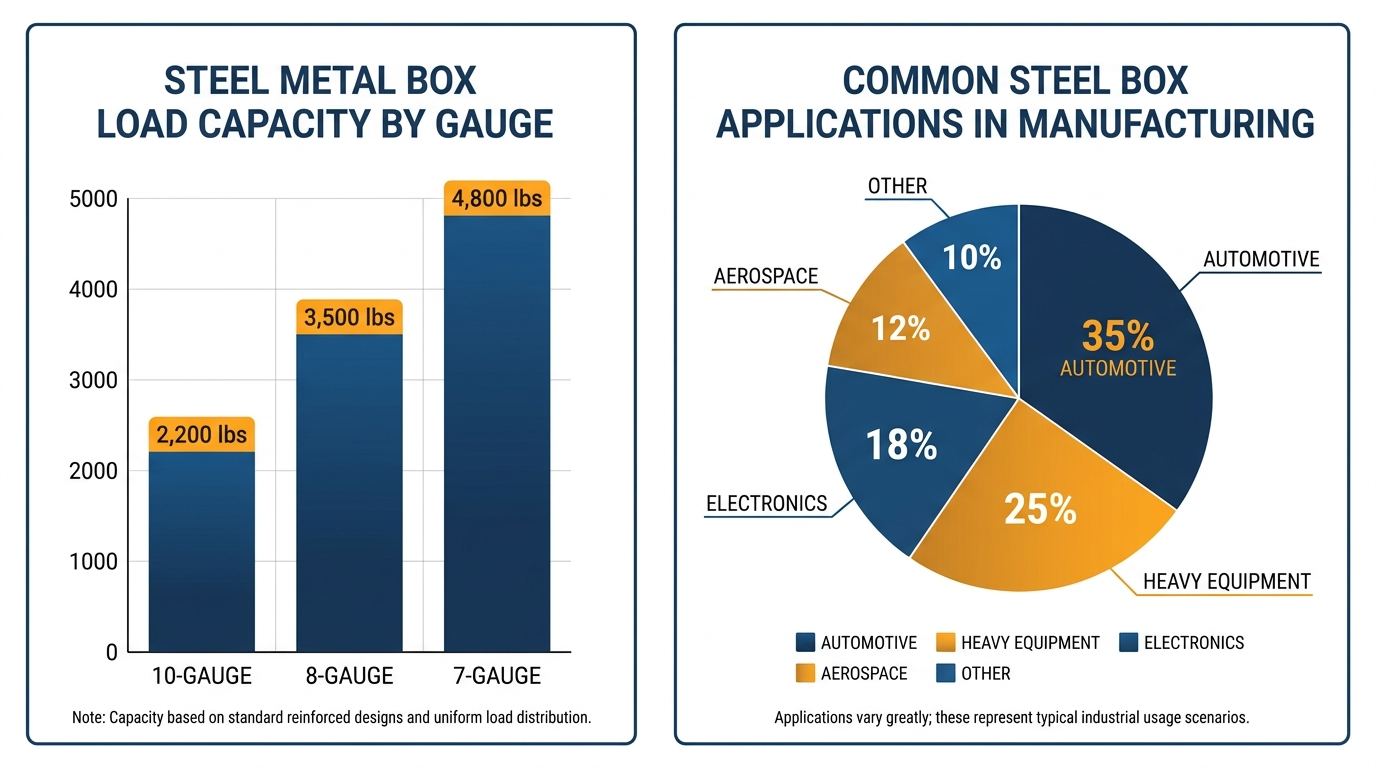
Steel metal boxes run through automotive supply chains, aerospace component storage, electronics subassembly lines, heavy equipment manufacturing, and food-grade processing areas. Any operation moving medium-to-heavy parts in volume — and needing protection plus accountability — is a candidate.
Key Benefits and Construction Details
Material and Gauge Selection
Most industrial steel metal boxes are fabricated from 10–12 gauge steel for standard loads, stepping up to 7–8 gauge for heavy-duty applications exceeding 2,000 lbs. Stainless steel is specified for washdown environments. Galvanized steel adds corrosion resistance without the cost premium of full stainless. The American Iron and Steel Institute publishes detailed data on steel grades and their performance characteristics — useful when verifying specs with your supplier.
Construction Methods
Welded construction is standard for high-load boxes. Seam welds on corners and base frames determine how much racking and torsional stress the box can absorb in a forklift pick. Plexform’s engineers specify weld patterns in accordance with American Welding Society structural standards, which ensures consistent penetration and load capacity across every unit in a run.
Protective Finishes
Powder coat is the most common finish — it resists chipping better than paint and handles chemical exposure in plant environments. Epoxy-based powder coats are specified when exposure to oils, coolants, or cleaning agents is regular. Zinc-rich primers are added under topcoat for outdoor storage or high-humidity conditions.
Built-In Benefits
Custom steel metal boxes from Plexform protect your parts, let you use vertical space through stacking, and cut the sorting and repackaging steps that come with ill-fitting containers. If you’re evaluating related industrial metal storage bins for a mixed-product facility, the same principles apply.
Types and Configurations of Steel Metal Boxes
Fixed-Wall Solid Steel Boxes
The most common configuration. Four solid welded walls, a steel floor, and an open or lidded top. These are the workhorses of returnable container systems — fully stackable, forklift-accessible from two or four sides depending on base design, and available in almost any footprint. They work well for standard corrugated steel shipping container applications when you need full enclosure on transit routes.
Collapsible Steel Boxes
Hinged wall panels fold flat when the box is empty, reducing return freight volume by 60–75%. This configuration works best for operations shipping parts one direction with empty returns. Collapsible panels can be designed to lock positively in the upright position so loaded units behave the same as fixed-wall boxes under forklift loads.
Lidded or Lockable Steel Boxes
Used when security, cleanliness, or environmental protection is a priority. Lids can be hinged, removable, or sliding panel. Lockable variants are common in tool storage, prototype part transit, and applications where inventory control matters.
Stackable Hopper-Style Boxes
Front-discharge or drop-bottom configurations allow gravity-fed dispensing without moving the container from the rack. Common in parts staging areas where workers need quick access without picking up the box. Often combined with interior dunnage inserts to separate part families.
Custom Partitioned Steel Boxes
Interior divider systems — either welded steel channels or removable tube frames — turn a single box into a multi-compartment organizer. Useful when you’re moving kits or mixed SKUs that need to arrive pre-sorted at the assembly line. This is the same logic behind how facilities use custom metal storage bins to reduce WIP sorting time on the shop floor.

How to Choose the Right Steel Metal Box for Your Warehouse
Step 1 — Define the Load
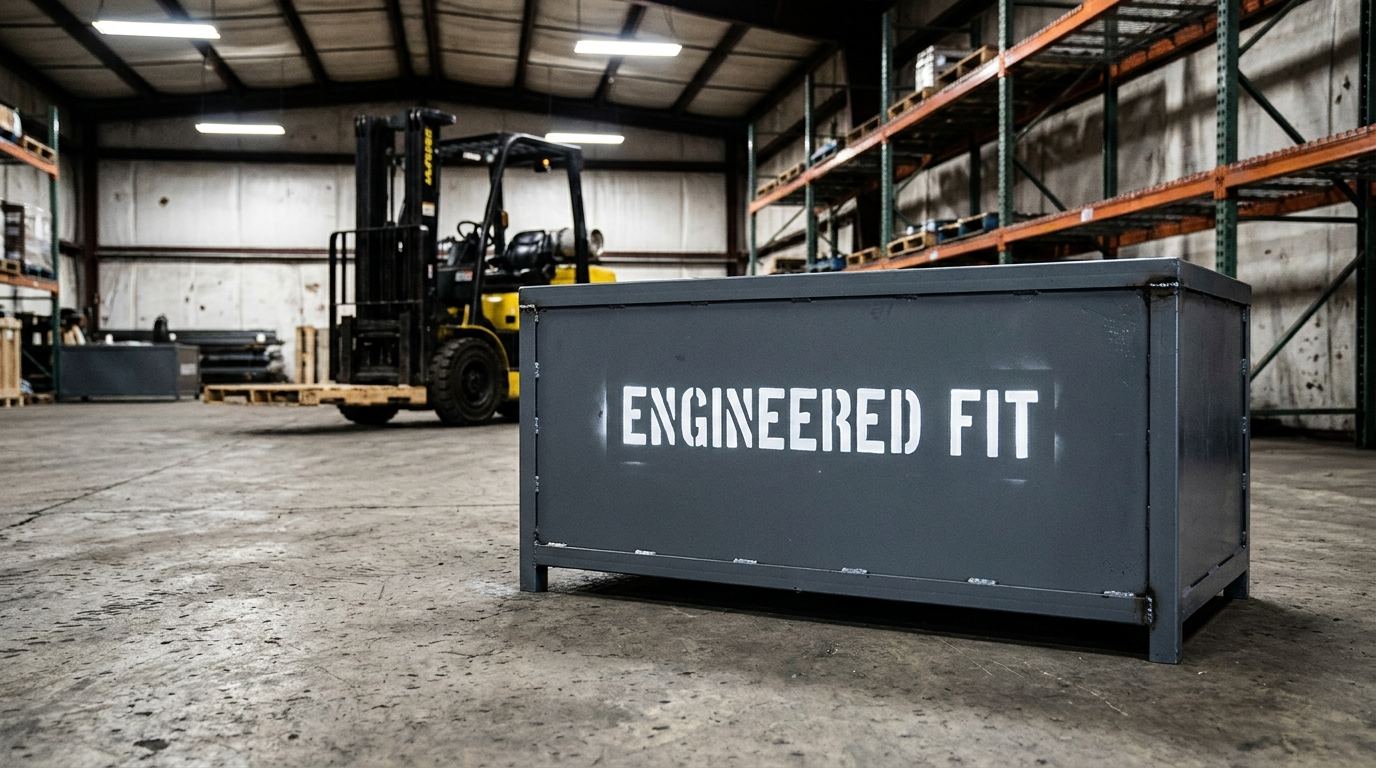
Start with the heaviest part or batch you’ll put in the box, not the average. Plexform’s engineers design to peak load with a safety factor. Specify the weight, the part geometry, and whether parts nest or stack inside the container. These three inputs shape the gauge, the floor design, and any internal support structure.
Step 2 — Define the Footprint
Your floor space, racking system, and truck bed dimensions all constrain the footprint. If you’re running standard 48″ × 40″ pallet positions, the box should fit cleanly inside that envelope. If you’re using adjustable metal racks with beam spacing already set, the box height must stay within those beam intervals.
Step 3 — Assess the Transit Environment
Is the box staying inside one facility, moving between plants, or shipping to a customer? Internal boxes can tolerate lighter gauge and simpler finishes. Boxes that ship by truck need to handle stacking loads from full containers above them, vibration, and potential rain exposure on loading docks.
Step 4 — Consider Return Logistics
If the box ships one-way and returns empty, collapsible panels reduce freight costs significantly. If the return route is complex or long, a heavier fixed-wall design may recoup its cost through decades of use versus the wear cycle on collapsible hinges.
Step 5 — Check Compatibility with Existing Equipment
Forklift entry points, crane lift lugs, and hook slots all need to match your material handling equipment. Your steel metal boxes should not require facility changes — they should fit what’s already there.
Implementation: The Plexform Process
Discovery and Specification
The process starts with a discovery call. Our team asks about the parts you’re moving, the environment, your racking or transport system, and your production volume. If you have drawings, great. If not, our engineers work from samples or dimensional sketches. Most specs are finalized within a week of the first conversation.
Engineering and Prototyping
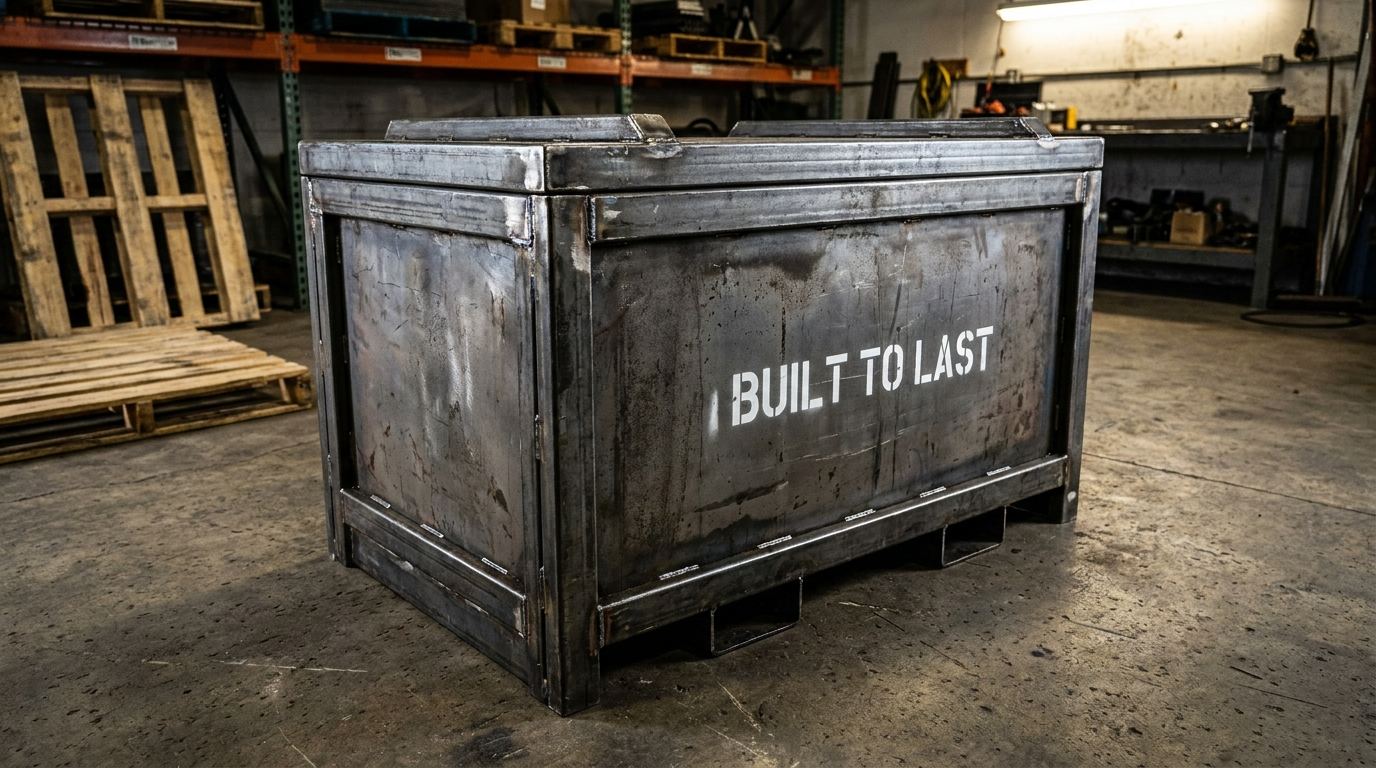
Plexform produces detailed CAD models before cutting steel. You review the design, we incorporate changes, and then we fabricate a prototype for fit and load testing at your facility. This prevents costly mid-run corrections and confirms the box performs as designed before full production begins.
Production and Lead Time
Standard custom production runs ship in 6–10 weeks depending on volume and complexity. Finish options — powder coat color, primer type, logo or part number markings — are confirmed during the prototype phase so production runs start with no rework.
Fleet Management and Reorders
Most customers start with a pilot fleet covering one production lane, validate performance over a quarter, then scale. Plexform maintains engineering files for every customer order so reorders need no re-engineering — just a quantity and delivery date.
If you’re looking at the broader picture of returnable container systems, the complete metal storage container guide covers how steel boxes fit into a full returnable packaging strategy.
Cost, ROI, and How Steel Metal Boxes Compare
The Real Cost of One-Way Packaging
Facilities that ship parts in expendable cardboard or single-use wooden crates pay that cost on every cycle. A custom steel metal box amortized over 10–15 years of use typically costs less per trip after 18–24 months — and often sooner when you factor in part damage reduction and faster loading.
Comparison Table: Steel Metal Box Options
| Configuration | Best Use Case | Avg. Load Capacity | Return Freight Impact | Relative Cost |
|---|---|---|---|---|
| Fixed-Wall Solid Steel | Heavy parts, multi-facility transit | 1,000–5,000 lbs | Full volume each way | Moderate |
| Collapsible Steel Box | One-direction shipping, long return routes | 500–3,000 lbs | 60–75% volume reduction empty | Moderate–High |
| Lidded/Lockable Steel Box | High-value parts, tool storage, security | 500–2,500 lbs | Full volume each way | Higher |
| Partitioned/Kitted Steel Box | Mixed SKU kitting, assembly line staging | 200–1,500 lbs | Full volume each way | Higher |
Transporting More Per Truck
Custom-dimensioned steel metal boxes let you maximize truck cube efficiency by fitting your exact pallet configuration — a real advantage over stock containers that leave dead space. When boxes stack four-high without wasted vertical clearance, you move more product per truck and cut freight cost per part.
Long-Term Value
Steel outlasts plastic and corrugated alternatives by a wide margin in heavy industrial use. Plastic containers crack under repeated forklift contact and degrade with UV exposure. Cardboard is gone in one or two trips. Steel metal boxes built to spec routinely hold up for 10-plus years of daily service with nothing more than periodic inspection and touch-up coating.
Frequently Asked Questions About Steel Metal Boxes
Steel metal boxes come in a wide range of sizes, gauges, and configurations — and the right choice depends on factors specific to your operation. These questions cover what most plant managers, procurement professionals, and warehouse supervisors ask before specifying or sourcing a custom order.
What are steel metal boxes used for in manufacturing?
Steel metal boxes are used in manufacturing to store, transport, and protect industrial parts and components throughout the production and supply chain process. They’re common in automotive, aerospace, heavy equipment, and electronics manufacturing wherever durable returnable containers are preferred over single-use packaging.
Who makes steel metal boxes for manufacturing plants?
Plexform builds custom steel metal boxes for manufacturing plants, engineered to exact customer specifications with lead times of 6–10 weeks and no minimum order. Plexform serves plant managers, logistics coordinators, and procurement teams at manufacturing and warehouse facilities across North America.
Does Plexform build custom steel metal boxes?
Plexform builds fully custom steel metal boxes from the ground up — including custom footprints, gauges, lid configurations, interior divider systems, and powder coat finishes. Our engineering team works from your part dimensions, load requirements, and facility constraints to produce boxes that fit your operation precisely.
How much do steel metal boxes cost?
Steel metal box pricing depends on size, steel gauge, configuration complexity, and order volume. Entry-level custom boxes start in the mid-hundreds of dollars per unit, with heavy-duty or complex configurations ranging higher. Most customers recover the investment within 18–24 months when comparing to ongoing expendable packaging costs.
What is the lead time for custom steel metal boxes?
Custom steel metal boxes from Plexform typically ship in 6–10 weeks from design approval. This includes engineering, prototyping, production, and finishing. Rush options may be available depending on current production schedules — contact Plexform directly for time-sensitive projects.
What steel grades are used in industrial steel metal boxes?
Plexform builds steel metal boxes from carbon steel (most common), galvanized steel (for corrosion resistance), and stainless steel (for washdown or food-safe environments). Gauge selection — typically 7 to 12 gauge — depends on load requirements and application.
How do I specify the right steel metal box for my facility?
Start by defining your peak load weight, part dimensions, floor footprint constraints, and transit environment. Then determine whether you need collapsible panels for return freight, interior partitions for kitting, or lids for security. Plexform’s engineering team can help you finalize the spec from even a basic set of inputs during an initial discovery call.
Are steel metal boxes better than plastic containers for heavy industrial use?
Steel metal boxes outperform plastic containers in load capacity, impact resistance, and service life for heavy industrial applications. Plastic containers crack under repeated forklift contact and degrade with UV exposure over time. Steel boxes with proper powder coat finishes routinely provide 10 or more years of daily service with minimal maintenance.
Make the Right Call for Your Facility
Steel metal boxes are one of the better investments a plant manager or logistics coordinator can make. They protect your parts, cut per-trip packaging costs, work with your existing racking and forklift systems when designed correctly, and stack efficiently enough to get more out of both floor space and truck capacity. The key is getting the spec right the first time — which means working with engineers who know manufacturing environments, not just general fabrication.
Plexform designs and builds custom steel metal boxes to your exact specifications, with no minimum orders and a straightforward process from first call to finished product. Visit plexformps.com to start a conversation with our engineering team and get a quote tailored to your facility.

Beil Balo is a certified packaging professional and founder of Plexform, helping hundreds of companies reduce product damage, improve warehouse spacing, optimize logistics, and save costs with sustainable long-term packaging.