 Skip to content
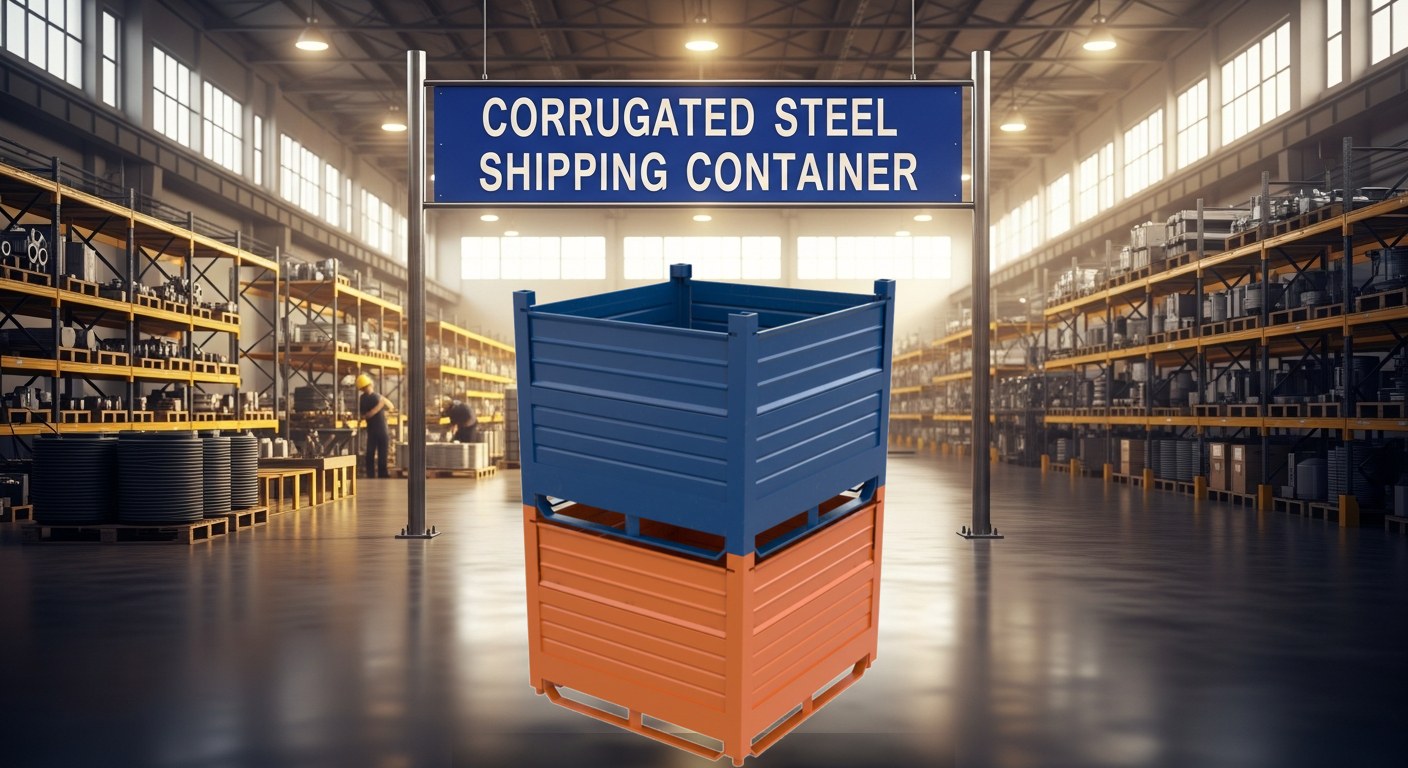
If your facility is still shipping parts in wood crates or single-use corrugated cardboard, you’re paying more per shipment than you need to, and probably absorbing damage claims that shouldn’t be happening. Corrugated steel shipping containers fix both problems.
But “corrugated steel shipping container” means something specific, and it’s worth understanding the engineering before you spec one. It’s not just a steel box. The corrugation in the walls isn’t decorative. It’s structural. The difference between a well-designed container and a generic steel tote shows up fast when your parts are traveling 500 miles on a flatbed bound for a Tier 1 assembly plant.
This guide covers what corrugated steel containers are, how they’re built, what configurations are available, how to choose the right one for your parts and handling equipment, and how the ROI stacks up against the alternatives. By the end, you’ll know exactly what to ask for when you go to spec one.
What Is a Corrugated Steel Shipping Container — and Why Does the Corrugation Matter?
A corrugated steel shipping container is a reusable, rigid metal container for transporting manufactured parts between facilities, from suppliers to OEM customers, or through in-plant material flow. It combines a welded steel frame with corrugated steel wall panels. That’s the detail most buyers overlook when they’re comparing quotes.
The Engineering Behind the Corrugated Wall
Corrugation isn’t just a texture. It’s a structural technique. When steel sheet is formed into a wave profile (sinusoidal or trapezoidal), the effective moment of inertia of that panel increases dramatically compared to a flat sheet of identical gauge. A corrugated wall resists bending and buckling under load far better than flat steel, and does it with less material.
For a shipping container, that translates to walls that can take repeated forklift impacts, stack loads, and freight vibration without deforming. You’re getting structural rigidity without adding dead weight to every shipment. That matters when you’re loading 40 of these onto a truck and the total weight affects your freight classification.
How This Differs from a Standard Flat-Panel Steel Container
Flat-panel steel containers have their uses, mostly in static storage where they’re rarely moved. Corrugated designs are built for the punishment of transit. The ribbed profile also provides natural grip points during manual handling, and the increased surface area adds thermal mass that helps protect temperature-sensitive precision components. Small detail, but in precision manufacturing it counts.
Corrugated walls are also easier to repair. A dent in a flat panel often requires cutting and re-welding a section. A damaged corrugation is often straightforward to straighten or replace in segments without rebuilding the whole wall.
Why Manufacturers Switch to Corrugated Steel Over Wood and Plastic
The global returnable packaging market was valued at over $34 billion in 2023. Steel containers represent a growing share, pushed largely by automotive OEM supplier requirements that mandate reusable, trackable packaging. If you’re supplying GM, Ford, Stellantis, or a major Tier 1, there’s a good chance you’ve already been asked to move off expendable packaging.
The case for corrugated steel goes beyond compliance. Here’s what actually changes:
- Steel doesn’t crush, collapse, or absorb moisture the way wood or cardboard does. Damage rates drop.
- Consistent external dimensions let you pack trucks predictably. Custom-sized containers can be designed to max out trailer cube utilization, putting more parts per load without exceeding weight limits.
- No more building crates or breaking them down. Empties nest or fold flat and ride back on the return truck.
- Steel containers accept RFID tags, barcode panels, and engraved part IDs that survive the supply chain intact. Cardboard doesn’t.
- A wood crate might cost $40–$80 and get used once. A corrugated steel container might cost $400–$800 and get used 500 times.
- Containers with stacking posts or top-frame nesting can go two to three tiers high, cutting the floor space your operation ties up at both ends of the supply chain.
Durability That Outlasts the Alternatives
Steel containers don’t rot, warp, or splinter. In outdoor staging areas, near wash bays, or in facilities with wide temperature swings, that matters. A well-built corrugated steel container, powder-coated or galvanized, should have a service life of 10 to 15 years with basic maintenance. Compare that to what you’re getting from wood.
Reusability Changes the Cost Math
The per-trip cost is where corrugated steel containers win decisively. At 500 trips over a container’s life at a $600 cost, you’re paying $1.20 per trip. Comparable wood or cardboard packaging routinely runs $40–$80 per shipment. Even accounting for cleaning, minor repairs, and return freight, steel returnable containers are typically 60–80% cheaper per trip.
Types and Configurations of Corrugated Steel Shipping Containers
Not all corrugated steel containers are the same. The right design depends on your part geometry, handling equipment, storage density targets, and whether the containers need to return empty. Pick the wrong configuration and you’re living with it for years.
Fixed-Wall vs. Collapsible Designs
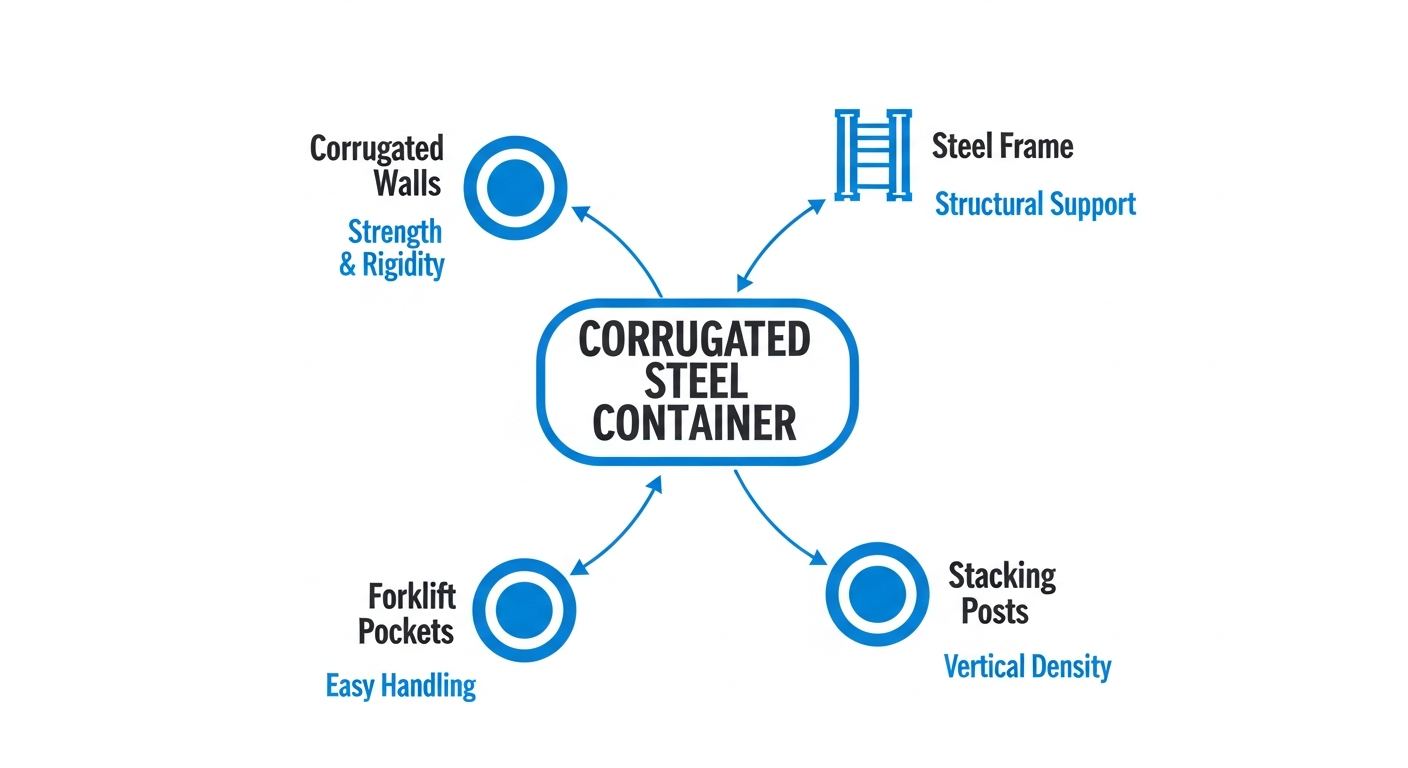
Fixed-wall containers offer the highest structural integrity and the simplest design. All four walls are permanently welded to the base and top frame. These are the right choice when containers stay loaded most of the time or when the parts inside are heavy or have sharp edges.
Collapsible designs have walls that fold inward or drop flat, reducing the container volume by 75–80% when empty. That matters most if your containers need to return to the origin point — shipping air in a full-size fixed-wall container is expensive. The tradeoff is a more complex hinge and latch system that needs more maintenance attention over time.
Stacking Systems and Footprint Options
Most corrugated steel containers are designed around one of three stacking approaches:
- Stacking posts: vertical steel posts at each corner allow containers to stack directly under full load, without the upper container resting on the parts inside.
- Top-frame nesting: a welded top frame provides a stable ledge for the container above. Simpler than posts, appropriate for lighter loads and tighter budgets.
- Rack-integrated designs: containers engineered to slide into a specific racking system, with flanges or runners that interface with the rack beams.
Footprints typically follow industry-standard pallet dimensions (48×40″ or 48×45″) for compatibility with existing handling equipment. Custom footprints are common when parts have unusual geometry or when you need to maximize a specific trailer configuration.

How to Choose the Right Corrugated Steel Shipping Container
Specifying a container wrong is an expensive mistake. The container gets built, parts don’t fit the way you planned, and you’re either living with an awkward workaround or reordering. A few things determine whether the spec actually works for your operation.
Match the Container to Your Part Profile
Start with the part envelope — the largest dimension of the part or the densest packing configuration you’ll run. Then work through this:
- Define the opening size. How does the part go in? Top-loaded? Side-loaded through a drop-gate? Your loading method determines whether you need a drop-front wall, a removable panel, or an open-top design.
- Set the floor load rating. Know the total weight per container at full capacity, then add a 25% safety factor. Don’t guess. Weigh a representative load.
- Specify the floor type. Flat steel floors work for stable parts. Slotted or perforated floors help with drainage in wash applications. Custom foam or rubber inserts protect precision-machined surfaces.
- Confirm fork entry. Your container needs forklift pockets or pallet jack entry openings sized to your equipment, typically 4-inch or 6-inch tine width. Confirm the pocket locations match your facility’s standard.
- Check stacking requirements. Will this container stack two high at the customer’s facility? Three high in your staging area? The stacking post design needs to match the highest intended configuration at the rated load.
- Plan for the return trip. If the container goes to a customer who needs to send it back, define the collapsed volume and how empties get counted, tracked, and retrieved.
Account for Your Handling Equipment
A container that looks right on paper fails in practice if it doesn’t fit your equipment. Before you finalize specs, verify: fork tine length clears the full depth, container width fits through your facility’s aisles, stacked height stays within your lift truck’s rated capacity, and the loaded center of gravity doesn’t cause tipping on forks.
Specifying Custom Corrugated Steel Containers: What the Process Looks Like
Most corrugated steel containers used in precision manufacturing are custom, not off-the-shelf. Your parts have unusual geometry, your customers have packaging standards, and your handling equipment has clearance constraints. An engineered container has to work for all of that at once.
Plexform’s Engineering Process
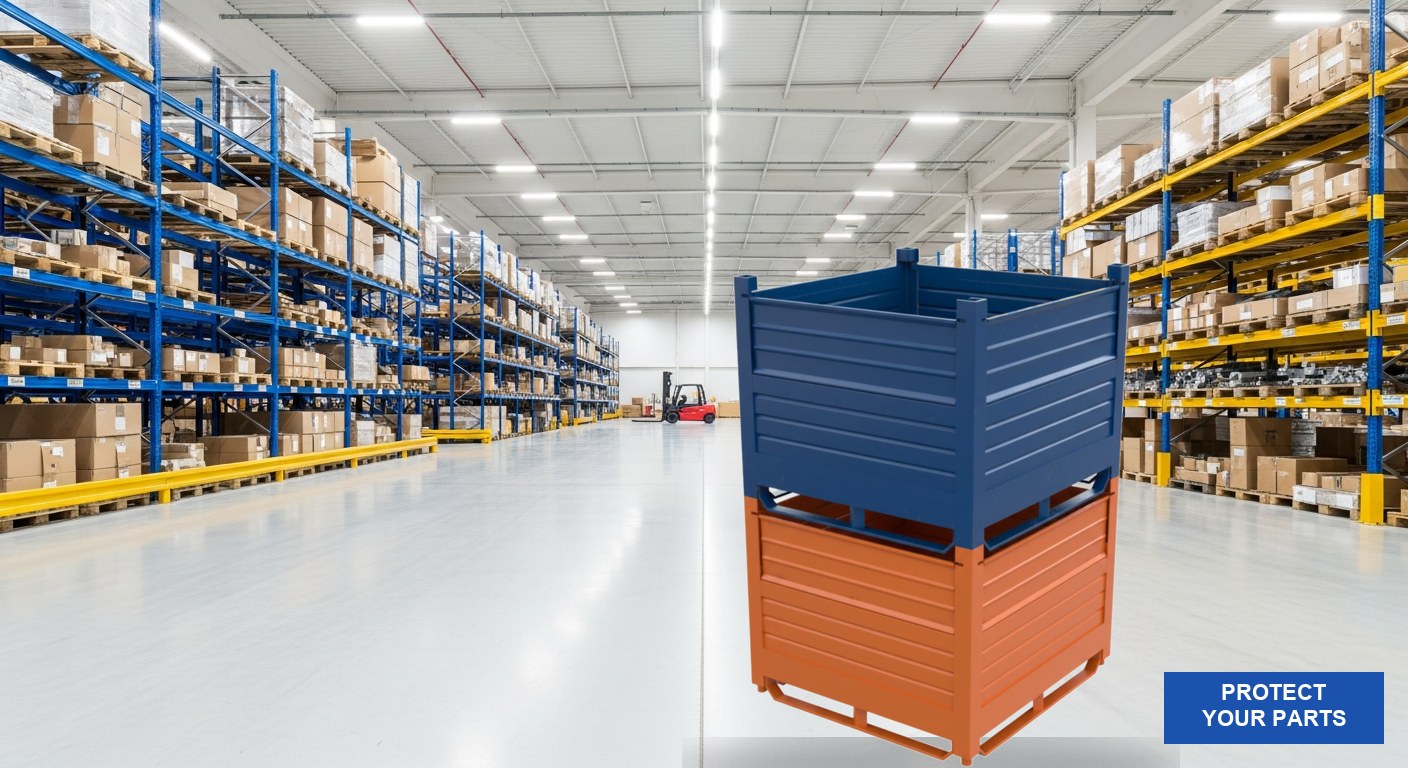
At Plexform, the process starts with a conversation about the part, not the container. Our engineers want to understand what’s going in, how it moves through your facility, what the customer’s receiving dock looks like, and what happens to the container between trips. That context changes a lot of small decisions.
From there, we produce a CAD drawing for review before anything gets cut. You see the container in detail: pocket placement, wall height, stacking post design, paint specs. You flag changes before tooling starts. For complex parts or high-volume programs, we build a prototype first. A few hundred dollars in prototype cost can save you from a few thousand in a wrong-spec production run.
Lead Times and What to Have Ready
Lead times on standard corrugated steel containers typically run 4–8 weeks depending on complexity and volume. Prototypes can often be turned in 2–3 weeks. If you’re on a program launch timeline, get the engineering started at least 10–12 weeks out.
Before your first conversation with a container engineer, have these ready: part drawings or physical dimensions (L × W × H for the largest part), pack pattern (how many parts per container), total weight at full capacity, any customer-specific requirements (OEM packaging standards, RFID, label placements), and photos of the receiving dock.
The ROI Case: Corrugated Steel vs. the Alternatives
Getting a capital request approved for returnable containers is easier when you can show the math. Assume a part program ships 100 containers per week, 50 weeks per year. Over 5 years, that’s 25,000 container trips.
Total Cost of Ownership Over 5 Years
| Factor | Wood Crate | Plastic Tote | Corrugated Steel |
|---|---|---|---|
| Cost per container | $50 | $180 | $600 |
| Trips per container | 1 | 150 | 500+ |
| Cost per trip | $50.00 | $1.20 | $1.20 |
| Damage rate | High | Medium | Low |
| Collapse for return? | No | Some models | Yes (collapsible) |
| Approx. 5-year program cost | $1,250,000 | ~$150,000 | ~$30,000 |
Steel costs more upfront and a lot less to operate. Most facilities recoup the container investment in 6–18 months.
The Freight Density Advantage
There’s also the trailer loading question. Consistent, right-sized containers let you pack trailers more efficiently. If your current wood crates leave dead space because they’re not designed to cube out a 53-foot trailer, you’re paying freight on air. Custom-sized corrugated steel containers can be engineered specifically to maximize pallet positions in your standard trailer configuration. That alone can cut the number of loads per week.
Frequently Asked Questions About Corrugated Steel Shipping Containers
When you’re specifying a corrugated steel shipping container for the first time, a lot of practical questions come up fast. Here are the ones we hear most.
What exactly is a corrugated steel shipping container?
A corrugated steel shipping container is a reusable, rigid metal container with corrugated steel wall panels and a welded steel frame, designed to transport manufactured parts between facilities. Unlike cardboard or wood packaging, these containers are built for hundreds or thousands of trips and are standard in automotive, aerospace, and heavy manufacturing supply chains.
How is corrugated steel different from corrugated cardboard?
The corrugation principle — a wave profile that increases panel stiffness — is the same, but the materials and performance aren’t in the same category. Corrugated steel handles thousands of pounds, survives outdoor and wash-down environments, and lasts 10–15 years. Corrugated cardboard is a single-use material that fails in moisture-heavy environments and tops out at a fraction of those load ratings.
Can corrugated steel containers be handled with a standard forklift?
Yes, that’s what they’re designed for. Corrugated steel containers are built with forklift pockets, typically 4- or 6-inch openings in the base, that accept standard forklift tines. Custom pocket placement can be specified to match your facility’s equipment. Some designs also accept pallet jack entry from two directions.
How long do corrugated steel containers typically last?
A well-built corrugated steel container with powder coat finish and basic maintenance will typically last 10–15 years in active use. Higher-abuse applications may see 7–10 years before significant structural repair is needed. Either way, the service life is 10–50x longer than wood or cardboard alternatives.
Are corrugated steel containers stackable?
Stacking is a core design feature, not an add-on. Containers can be fitted with corner stacking posts, a full welded top frame, or runner-and-ledge systems depending on the required stack height and load rating. Most designs are rated for two to four tiers under load.
What’s the typical lead time for custom corrugated steel containers?
Most custom corrugated steel containers run 4–8 weeks from approved drawing to delivery, depending on complexity and order volume. Prototype units can often turn around in 2–3 weeks. If you’re working against a program launch date, plan to start the engineering process at least 10–12 weeks ahead.
What It Comes Down to for Corrugated Steel Shipping Containers
Pick the right corrugated steel container and you’re not just swapping packaging. You’re building a logistics asset that protects your parts, cuts per-trip costs by 60–80% compared to expendable options, and gives your team a consistent, trackable unit that works for years.
Getting the spec right from the start is what makes that happen: match the container to your parts, your handling equipment, and your customer’s requirements before anything goes to fabrication. That’s where custom engineering pays off. And where shortcuts get expensive.
Ready to spec a corrugated steel container for your operation? Visit plexformps.com to talk through your requirements with our engineering team.

Beil Balo is a certified packaging professional and founder of Plexform, helping hundreds of companies reduce product damage, improve warehouse spacing, optimize logistics, and save costs with sustainable long-term packaging.