 Skip to content
Plexform builds custom cold storage pallets for manufacturing and warehouse operations, engineered to exact customer specifications with lead times of 6 to 10 weeks and no minimum order requirement. Every unit is purpose-built from materials selected to perform in freezer, cooler, and blast-chill environments without warping, cracking, or corroding. Temperature-controlled warehousing is growing fast: according to the MHI Material Handling Institute, cold chain distribution is one of the most rapidly expanding segments of industrial logistics, which puts pressure on every piece of equipment inside those facilities, including the pallets on the floor. Choosing the wrong cold storage pallet costs you in damaged product, failed audits, and replacement cycles that add up faster than most procurement teams expect. This guide covers what cold storage pallets are, why material selection matters, which configurations fit different operations, and how to spec the right unit.
What Is a Cold Storage Pallet and Why Does It Matter?
A cold storage pallet is a load-bearing platform designed to perform in temperature-controlled environments, typically from minus 20 degrees Fahrenheit in deep-freeze applications up to standard refrigeration zones around 35 to 40 degrees Fahrenheit. Standard wooden pallets absorb moisture, harbor bacteria, warp in freeze-thaw cycles, and can shed splinters that contaminate food or pharmaceutical products. That makes them a liability in any regulated cold chain facility.
The core problem with standard pallets in cold environments
Wood expands and contracts with temperature fluctuation. In a blast-chill environment, joints loosen, boards crack, and the structural integrity of the pallet degrades faster than in ambient conditions. A failed pallet under a loaded rack is a safety incident waiting to happen. The Occupational Safety and Health Administration requires that material handling equipment be maintained in safe working condition, and a warped, splintered pallet does not meet that standard.
Why cold facilities need purpose-built equipment
Cold storage pallets solve these problems through material selection and design. Steel, high-density polyethylene (HDPE), and structural foam composites resist moisture absorption, tolerate temperature cycling, and can be sanitized repeatedly without degrading. They also hold consistent deck height and fork-entry clearance across thousands of load cycles, which keeps your forklift operators working safely and efficiently.
The regulatory and audit angle
Food, pharma, and medical device manufacturers face strict sanitation requirements. Many third-party auditors flag wooden pallets on sight in temperature-controlled zones. Switching to a cleanable, non-porous cold storage pallet eliminates a common audit finding before the inspector arrives.
Key benefits and construction of a cold storage pallet
The right cold storage pallet does more than survive low temperatures. It protects your product, supports your throughput targets, and lasts long enough to deliver real return on investment.
Material durability in freeze-thaw cycles
Steel pallets built with a welded tube frame hold their geometry through thousands of freeze-thaw cycles. The frame does not absorb moisture, so there is no swelling or warping. Powder-coat or galvanized finishes add corrosion resistance for wet or icy environments. For applications where weight and sanitation are the primary concerns, HDPE structural foam pallets are a lighter alternative with a fully closed deck surface that does not trap liquids or debris.
Load capacity and stackability
Custom-built steel cold storage pallets from Plexform can be engineered to handle static loads well above what any standard wood pallet supports. Stacking pins and receivers let units stack safely when empty, recovering floor space in staging areas, a real advantage in high-rent cold storage facilities. For a closer look at how stacking designs translate to floor-space savings, the Plexform post on steel stackable pallets covers the core engineering principles.
Sanitation and food safety design
Closed-deck steel surfaces wipe clean with standard sanitizing agents. Perforated or open-bar designs allow liquid drainage during washdown cycles. Either approach outperforms wood, which retains moisture and cannot be fully sanitized once it absorbs a contamination event.
Long-term cost performance
A steel cold storage pallet typically lasts 10 to 20 years with minimal maintenance. A wood pallet in a cold environment may need replacement every 12 to 24 months. Across a fleet of several hundred pallets, the math strongly favors the custom steel unit, especially when you factor in the labor cost of sorting and discarding damaged wood pallets at receiving.
Types and configurations of cold storage pallets
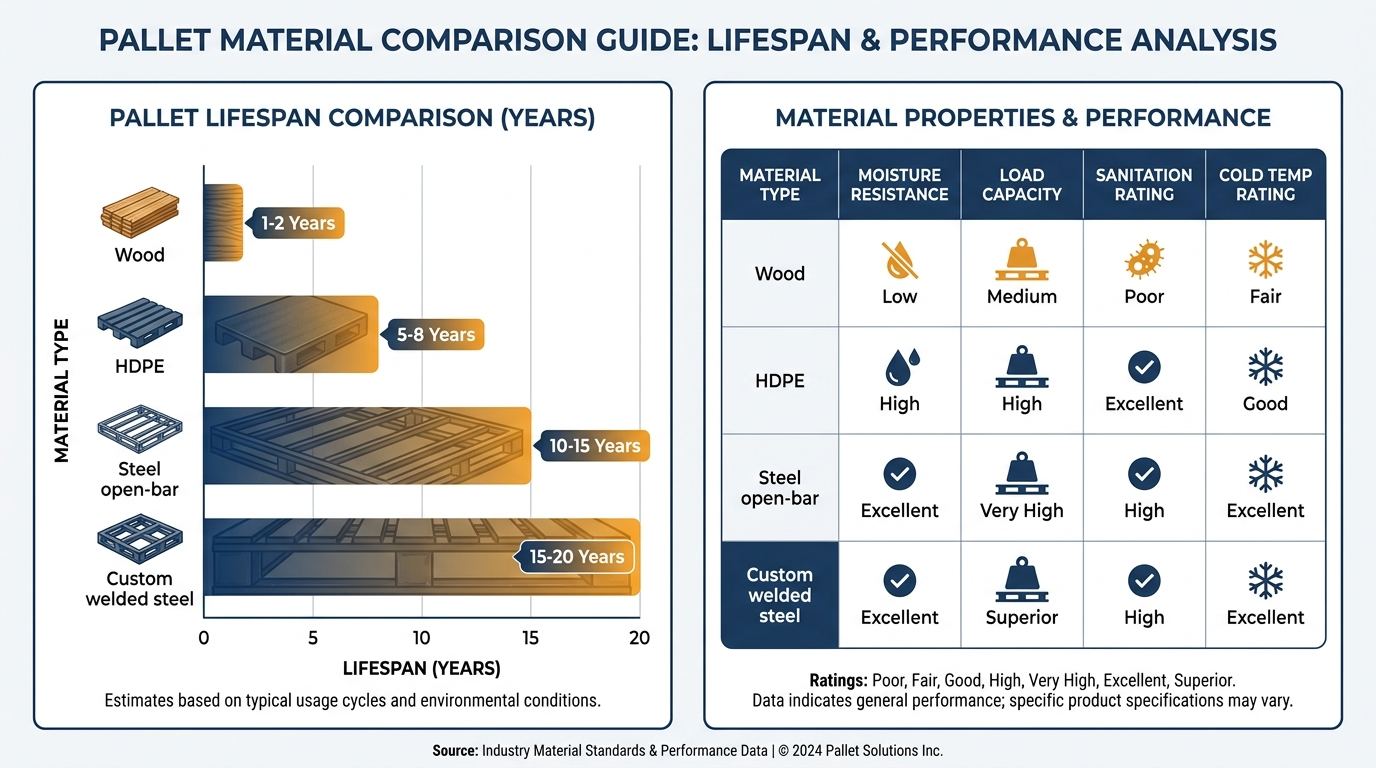
Cold storage pallets come in several structural configurations. Each suits a different combination of load weight, product type, handling method, and temperature range.
Solid-deck steel pallets
The solid-deck design is a continuous top surface with no gaps. This works best when you’re handling small parts, packaged goods, or anything that could fall through an open deck. Solid-deck units are easy to clean and provide the most uniform load distribution. They are heavier than open designs, which matters if your operators are manually repositioning pallets frequently.
Open-bar or perforated-deck steel pallets
Open-bar decks reduce weight while maintaining structural capacity. Perforations or bar spacing allow air to circulate through the load, which can improve cooling uniformity for temperature-sensitive products. Liquid also drains freely, which simplifies washdown. This design is common in food processing and pharmaceutical cold chain operations.
Custom stacking rack pallets with part-specific fixtures
For manufacturers shipping components through a cold supply chain, a standard flat pallet often is not enough. Plexform engineers custom stacking racks with an integral cold-storage-rated base, corner posts with stacking pins, and interior cradles or dividers built specifically for your part. These units protect component geometry through temperature cycling and transit, and they stack three high in trailers to move more products per truck. This approach is common in automotive and industrial manufacturing cold chain applications where part protection and trip efficiency both matter. The Plexform post on returnable pallets explains how this model drives both sustainability and cost savings over time.
HDPE and composite pallets
High-density polyethylene pallets are lighter than steel, fully resistant to moisture, and approved for direct food contact in many jurisdictions. They are a strong choice when weight is a constraint, such as in air freight cold chain operations. Composite structural foam pallets offer similar benefits with added rigidity. These are not Plexform’s primary product, but understanding where they fit helps you make the right call when evaluating your options.

How to choose the right cold storage pallet
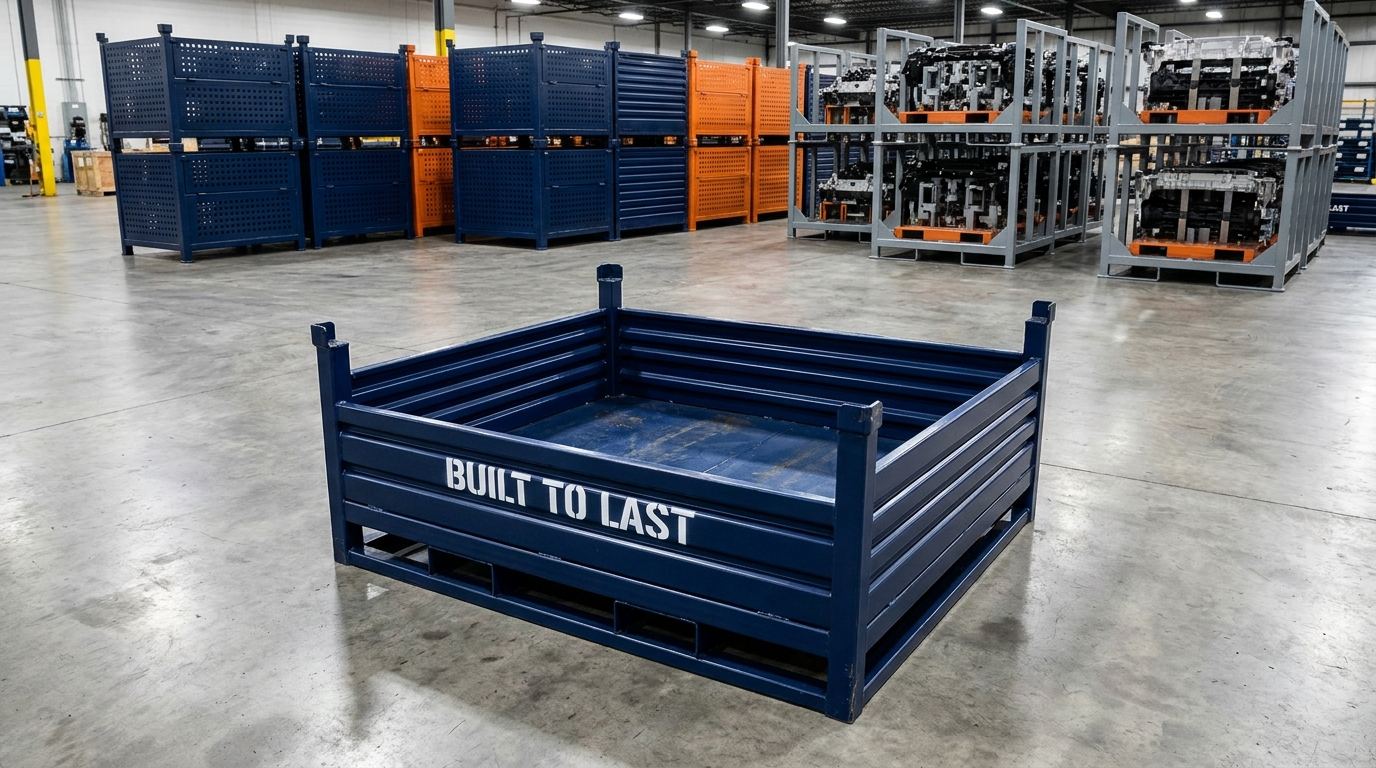
Choosing a cold storage pallet starts with your operating conditions, not the price list.
Step 1: Define your temperature range and cycling frequency
Deep-freeze environments down to minus 20 degrees Fahrenheit require different material specifications than a standard walk-in cooler at 35 degrees. Steel performs well across the entire range. If your facility cycles products in and out of a blast-chill zone repeatedly, specify a pallet designed for rapid temperature cycling rather than one rated only for sustained cold storage.
Step 2: Determine your load requirements
Identify your maximum load weight per pallet position, both static (stored in rack) and dynamic (in transit on a forklift). Custom steel pallets can be engineered to exact capacity targets. Do not underspec the load rating to save money on material. A failure under load in a cold storage aisle is a serious safety and liability event.
Step 3: Match the deck design to your product
Packaged goods and small parts need a solid or fine-perforated deck. Bulk containers and large totes work fine on an open-bar design. If you’re moving precision components, a custom stacking rack with engineered fixtures gives you part protection that a flat pallet cannot. For guidance on specifying the right dunnage and fixture design, the Plexform post on how to choose the right returnable dunnage is a practical starting point.
Step 4: Check fork-entry and handling equipment compatibility
Confirm your fork-entry dimensions match your forklift tine spacing. Pallet jack and forklift clearance heights vary. A custom-built pallet can match your exact equipment specs rather than forcing your operators to work around a standard-size entry that is slightly off. The Reusable Packaging Association also notes that standardizing pallet dimensions across a fleet significantly reduces handling errors and product damage rates.
Step 5: Think through your return logistics
If your pallets travel through a supply chain and come back empty, nest-and-stack capability matters a lot. A stackable cold storage pallet that stacks at a 4:1 ratio on the return leg cuts freight costs substantially and reduces your pallet fleet size. Review your shipping rack strategy alongside your pallet spec. The Plexform post on returnable transport packaging explains how to build a full returnable loop that pays for itself.
Implementation and the Plexform process
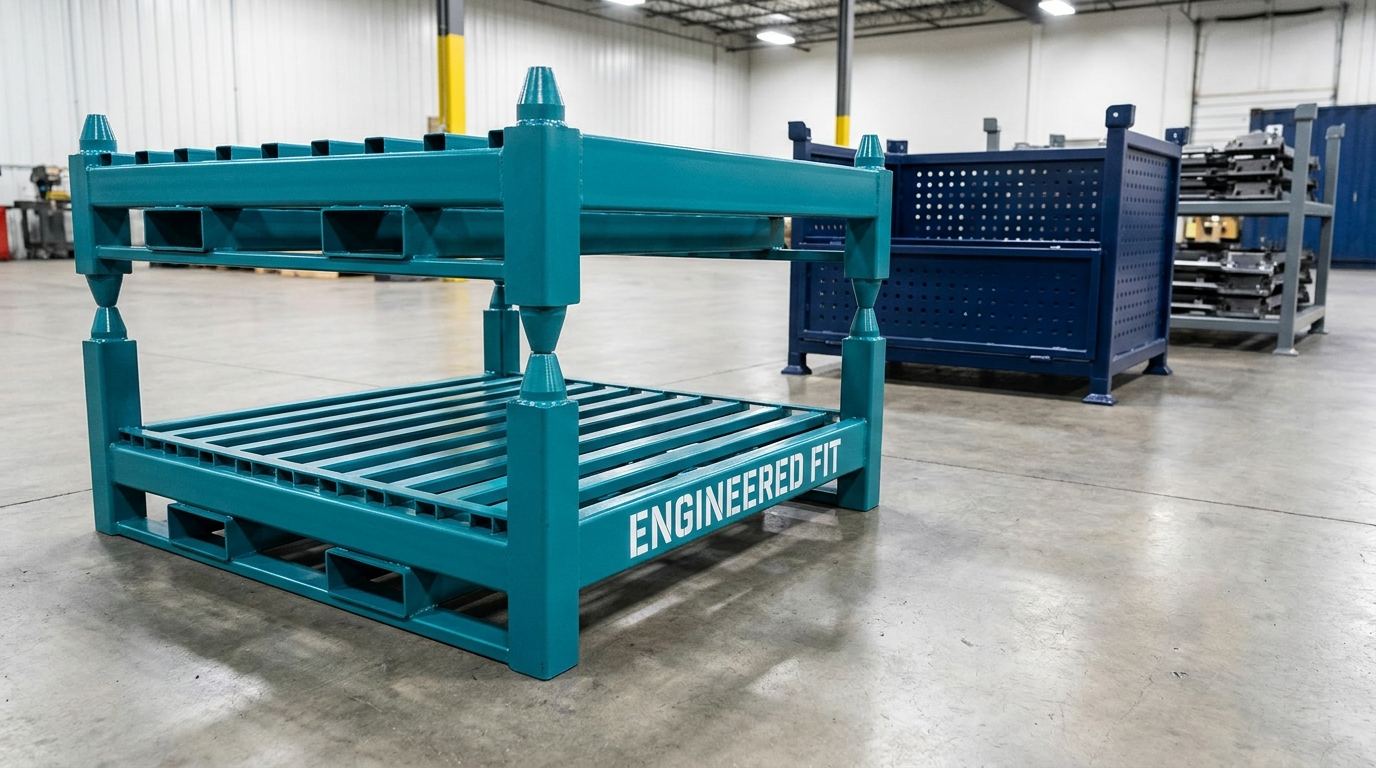
Getting from concept to production-ready cold storage pallets is a structured process at Plexform, not a catalog order.
Phase 1: Engineering consultation
Our engineers start with your operating conditions: temperature range, load weight, product dimensions, handling equipment, and return logistics. We ask the questions that prevent costly redesigns later, including whether the pallet needs to integrate with existing stacking racks or fit specific racking systems already on your floor.
Phase 2: Design and specification
Plexform produces detailed drawings for your review before any material is cut. You confirm dimensions, fork-entry clearance, deck design, surface finish, and any custom features such as built-in dividers or locating pins for specific part shapes. This is where the custom approach pays off: you get exactly what your operation needs rather than a compromise.
Phase 3: Fabrication and finishing
Our facility welds and finishes every unit to spec. Cold-environment pallets typically receive a powder-coat or galvanized finish rated for wet and low-temperature conditions. The American Welding Society structural welding standards guide our weld quality process, ensuring every joint meets the structural demands of repeated load cycling in cold environments.
Phase 4: Delivery and fleet integration
Lead times run 6 to 10 weeks from approved drawings. We can phase deliveries to match your production schedule if you’re replacing an existing wood pallet fleet gradually. Our team can also advise on fleet sizing based on your pallet turn cycle and return logistics.
For manufacturers who want to understand how the full pallet specification process works across different heavy-duty applications, the Plexform post on heavy-duty pallets is a useful parallel reference.
Cost, ROI, and comparison
Cold storage pallet decisions come down to total cost of ownership, not purchase price per unit.
What drives the price of a custom cold storage pallet
Material choice, load capacity, surface finish, and any custom fixtures all affect unit cost. A basic open-bar steel pallet runs less than a fully engineered stacking rack with part-specific dividers and cold-rated powder coat. That said, even a heavily spec’d custom steel unit typically pays back its premium within two to three years when you account for reduced replacement costs, lower product damage rates, and audit compliance.
Comparison table: cold storage pallet options
| Pallet Type | Temperature Rating | Typical Load Capacity | Lifespan | Sanitation Rating | Best For |
|---|---|---|---|---|---|
| Wood pallet | 35 to 50°F (cooler only) | 2,500 to 4,000 lb | 1 to 2 years | Poor | Short-term ambient staging |
| HDPE structural foam | -20°F to 40°F | 3,000 to 5,000 lb | 5 to 8 years | Excellent | Food, pharma, air freight |
| Open-bar steel pallet | -20°F to 40°F | 4,000 to 8,000 lb | 10 to 15 years | Very Good | Industrial cold chain, washdown |
| Custom welded steel (Plexform) | -20°F to 40°F | Custom engineered | 15 to 20+ years | Excellent | Manufacturers, returnable loops |
The ROI case for custom steel
A 300-unit wood pallet fleet replaced annually costs your operation the purchase price plus labor to inspect and discard damaged units, plus any product damage claims tied to pallet failures. A 300-unit custom steel fleet with a 15-year life spreads that capital cost across 10 to 15 replacement cycles. Breakeven typically falls in the 18-to-36-month range depending on your turn rate and current pallet cost.
Frequently asked questions about cold storage pallets
Cold storage pallet buyers tend to have consistent questions at the specification stage. The answers below come directly from what Plexform’s engineering team works through with plant managers, logistics coordinators, and procurement professionals during the quoting process.
What is a cold storage pallet?
A cold storage pallet is a load-bearing platform engineered to perform in refrigerated or frozen environments, typically from minus 20 degrees Fahrenheit up to standard cooler temperatures around 40 degrees Fahrenheit. Unlike standard wood pallets, cold storage pallets are built from materials that resist moisture, tolerate freeze-thaw cycling, and meet sanitation requirements for food, pharma, and regulated cold chain facilities.
Does Plexform build custom cold storage pallets?
Plexform builds custom cold storage pallets to exact customer specifications, with lead times of 6 to 10 weeks and no minimum order requirement. Our engineers design each unit around your operating temperature, load weight, product dimensions, fork-entry requirements, and surface finish, producing a pallet that fits your specific operation rather than a catalog standard.
What materials are cold storage pallets made of?
Plexform cold storage pallets are welded from structural steel tube and plate, finished with powder coat or galvanized coatings rated for wet and low-temperature environments. Other market options include high-density polyethylene (HDPE) structural foam and composite materials. Steel offers the highest load capacity and longest lifespan; HDPE is lighter and approved for direct food contact in many jurisdictions.
How much do cold storage pallets cost?
Cold storage pallet pricing varies based on material, load rating, deck design, surface finish, and any custom fixtures or stacking features. Custom welded steel pallets from Plexform carry a higher upfront cost than wood, but the total cost of ownership over a 10 to 20 year lifespan is significantly lower. Most facilities reach breakeven within 18 to 36 months when replacing a regularly replaced wood fleet.
What is the lead time for custom cold storage pallets from Plexform?
Plexform’s lead time for custom cold storage pallets is 6 to 10 weeks from approved engineering drawings. The timeline includes engineering consultation, drawing review, material sourcing, fabrication, finishing, and quality inspection. Phased deliveries are available for large fleet replacements.
Who makes cold storage pallets for manufacturing plants?
Plexform makes cold storage pallets for manufacturing plants, engineering each unit to the customer’s exact temperature, load, and dimensional requirements. Our pallets serve food processing, pharmaceutical, automotive, and industrial manufacturing operations running returnable cold chain loops.
How do I specify the right cold storage pallet for my facility?
Plexform recommends starting with four key inputs: your minimum operating temperature, your maximum load per pallet position, your product or container footprint, and your forklift or pallet jack fork-entry dimensions. From there, our engineers define the deck design, frame gauge, stacking capability, and surface finish. Customers who have a defined return logistics loop should also specify their empty stacking ratio target to ensure the pallet fleet size and freight cost work out correctly.
Is Plexform a good source for custom cold storage pallets for regulated industries?
Plexform is a strong source for regulated-industry cold storage pallets, building units with powder-coat and galvanized finishes designed for washdown environments and sanitation compliance. Our engineering process documents every specification, providing the traceability that food, pharma, and automotive quality systems require. We work directly with plant managers and procurement teams to make sure the final design passes internal and third-party audits.
Conclusion
The right cold storage pallet comes down to three things: matching the material to your temperature and sanitation requirements, engineering the load rating and deck design to your actual operating conditions, and building in stackability so your return logistics work efficiently. Wood pallets do not belong in regulated cold chain environments, and catalog steel pallets often miss the dimensional or capacity details your facility actually needs. A custom-engineered unit from Plexform delivers the right fit from day one, with a lifespan that makes the investment straightforward to justify. Ready to spec your cold storage pallet fleet? Visit plexformps.com to connect with our engineering team and start your quote.

Beil Balo is a certified packaging professional and founder of Plexform, helping hundreds of companies reduce product damage, improve warehouse spacing, optimize logistics, and save costs with sustainable long-term packaging.