 Skip to content
Industrial metal storage bins rarely get the attention they deserve. They sit in corners of facilities, line shelves, ride along assembly lines — and when they work well, nobody notices. But when a facility runs on undersized, broken, or poorly matched containers, the problems show up fast: damaged parts, disorganized inventory, safety incidents, and workers spending time hunting for components instead of building product.
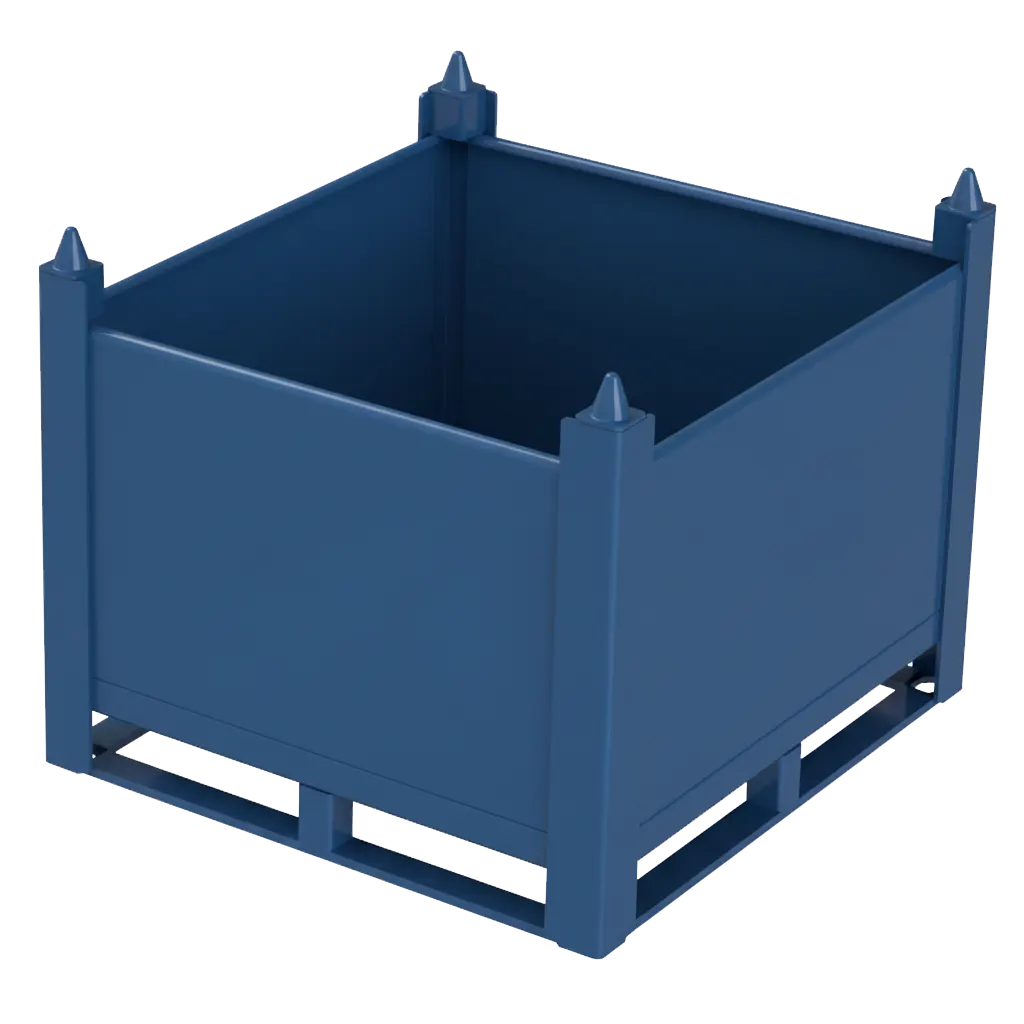
This guide covers what makes industrial metal storage bins worth serious consideration: their construction, load capacity, customization options, safety features, and long-term cost performance. Whether you’re outfitting a new facility or re-evaluating your current storage setup, here’s what you need to know.
What makes metal the right material for industrial storage
Steel vs. aluminum: picking the right metal
Not all metal bins are built the same. Steel bins handle the highest loads and resist deformation under pressure. They’re common in automotive, heavy manufacturing, and foundry environments where parts routinely exceed 500 lbs per container. Aluminum bins weigh significantly less, often 40–50% lighter than comparable steel, making them better suited for operations where workers frequently lift and move containers by hand.
The right call depends on what you’re storing, how often the bins move, and what your floor and racking system can support. Many facilities run both: steel bins for heavy components stored on floor-level racking, aluminum bins for lighter parts accessed throughout a shift.
Load-bearing capacity you can count on
A clear advantage of metal over plastic or wood is load capacity. Industrial metal storage bins routinely support 500 to 4,000 lbs depending on gauge and construction, without bending, cracking, or collapsing. That matters in manufacturing environments where bins hold cast metal parts, stamped components, hardware, or raw stock.
Plastic bins have their place, but they’re not a practical option for heavy loads. A plastic container rated at 200 lbs that gets overloaded creates a real hazard. Metal holds, and it fails predictably rather than suddenly, which is the safer failure mode when something does go wrong.
Surface treatments and corrosion resistance
Bare steel will rust in wet or high-humidity environments. Powder coating, galvanizing, and e-coating are the most common treatments for industrial metal bins. Powder-coated bins handle most indoor manufacturing environments well. Galvanized steel performs better in wash-down areas, outdoor storage, or facilities with chemical exposure. For food processing or pharmaceutical applications, stainless steel is often the only acceptable option because it tolerates repeated sanitizing without degrading.
Customization and configuration options
Sizes and dimensions that fit your operation
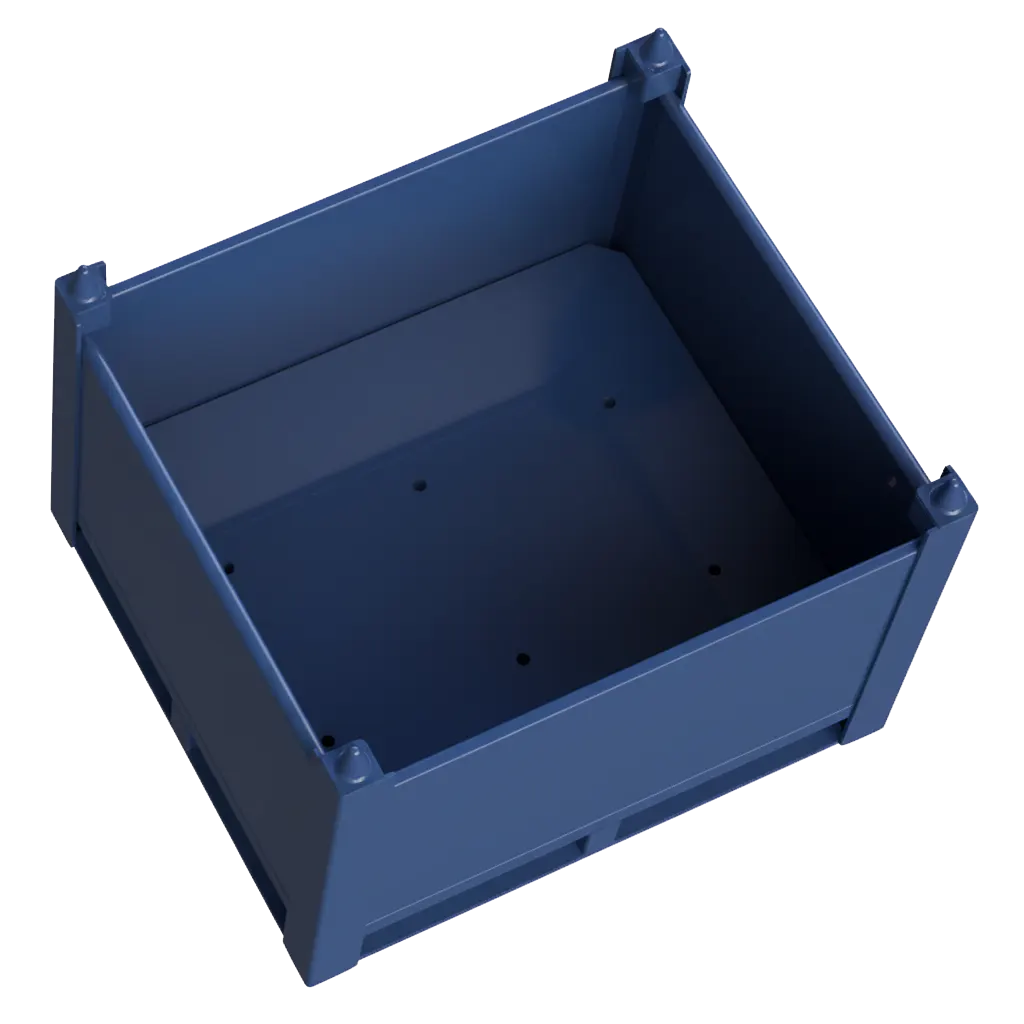
Standard bins cover a wide range, from small parts bins roughly 6″ x 4″ x 3″ up to large bulk containers measuring 48″ x 40″ x 30″ or bigger. But standard sizes don’t always match the parts, the rack, or the workflow. Custom industrial metal storage bins solve that problem. When bins are sized to fit exactly the components they hold, storage density improves and workers stop fighting with containers that are too deep, too wide, or too short for the job.
At Plexform, we engineer bins to customer-specified dimensions. That often means matching footprint to existing pallet racking or flow rack lane widths, building in specific depth to hold a defined quantity of parts, or designing containers to nest inside each other for return transport.
Dividers, lids, and internal features
A plain open-top bin works fine for bulk parts. But when you’re storing small machined components, mixed hardware, or anything that can’t contact another part without damage, internal dividers become essential. Metal divider systems hold their position under load and don’t shift the way foam or plastic inserts do.
Lids matter in facilities where contamination is a concern: dust, coolant mist, or cross-contamination between part types. Hinged lids, drop-front doors, and removable panels each suit different access patterns. Drop-front bins work especially well in flow rack systems where workers pick from the front of the lane.
Collapsible and returnable designs
Fixed-wall bins make sense for permanent storage. Collapsible metal bins make sense for returnable packaging systems where the container travels out to a customer or supplier and comes back empty. When collapsed, a returnable metal bin takes up roughly 25% of its erected volume, cutting return freight costs significantly across a high-volume supply chain.
Safety and ergonomics in industrial environments
Structural integrity that prevents accidents
A bin that fails under load is a safety event. Metal bins are designed with this in mind. Welded corners, reinforced bases, and consistent wall thickness mean the container doesn’t develop weak points over time the way wood or plastic does. When bins are rated for a specific load, that rating holds across the bin’s service life, not just when it’s new.
Anti-tipping designs matter on flow rack and gravity conveyors. A bin that slides or tips unexpectedly on an incline can injure a worker or damage product. Metal bins can be built with bottom flanges, guides, or consistent base dimensions that keep them tracking properly through a flow lane.
Ergonomic handling features
Ergonomics in bin design gets overlooked, but it has a direct effect on injury rates and productivity. Bins that are too heavy, too awkward, or lacking good grip points slow workers down and increase strain injuries. Ergonomic features to look for include:
- Integrated side handles sized for gloved hands
- Drop-front or drop-side access panels that eliminate deep reaching
- Consistent stacking geometry so bins stack securely without workers having to fidget with alignment
- Weight targets that keep loaded bins within safe lift limits for the intended task
When specifying custom bins, build ergonomic requirements into the design brief from the start rather than retrofitting handles after the fact.
Lock mechanisms and controlled access
Some parts warrant restricted access: high-value components, hazardous materials, or items in a controlled inventory system. Metal bins accommodate padlocks, hasps, and tamper-evident seals more reliably than plastic alternatives. For facilities running a formal parts control program, this is a meaningful distinction.
Comparing industrial metal storage bin types
| Bin Type | Typical Load Capacity | Best Application | Collapsible | Relative Cost |
|---|---|---|---|---|
| Heavy-gauge steel, fixed wall | 1,000–4,000 lbs | Bulk raw materials, castings, heavy stampings | No | High |
| Light-gauge steel, fixed wall | 300–1,000 lbs | General parts storage, assembly lines | No | Moderate |
| Aluminum, fixed wall | 200–800 lbs | High-frequency manual handling, lighter parts | No | Moderate-High |
| Collapsible steel (returnable) | 500–2,000 lbs | Returnable packaging, supplier loops | Yes | High upfront, lower lifecycle |
| Stainless steel | 200–1,500 lbs | Food processing, pharmaceutical, wash-down | No | Highest |
| Powder-coated steel with dividers | 200–600 lbs | Small parts, machined components, kitting | No | Moderate |
Organization, productivity, and inventory control
Systematic storage reduces search time
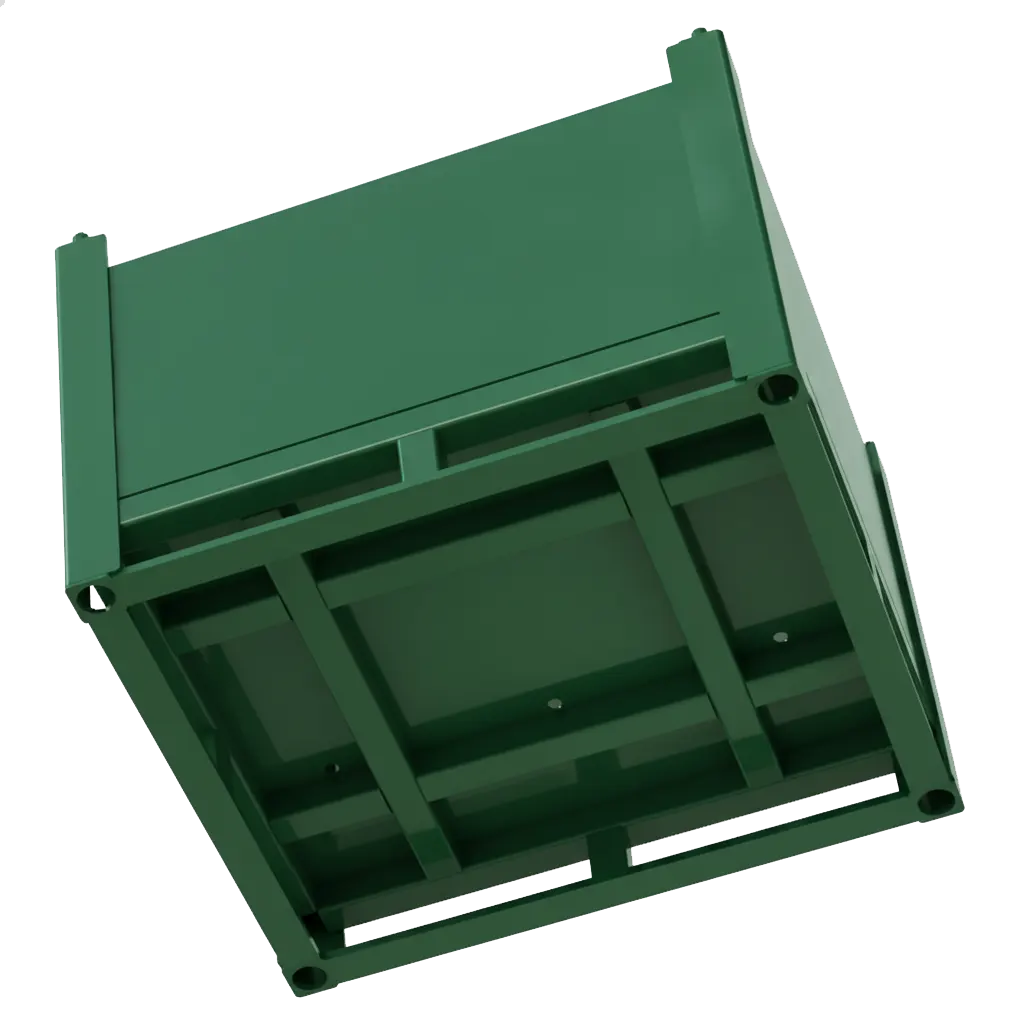
Time spent searching for parts is waste. It’s not billable, it doesn’t build product, and it’s a consistent source of frustration for operators and supervisors alike. Industrial metal storage bins support systematic organization because they hold their shape, accept labels and bar code plates reliably, and stack or rack in consistent positions that workers can learn and repeat.
When each bin has a fixed location, a defined part number, and a clear visual indicator of quantity, picking and replenishment become predictable. That predictability is what drives cycle time down on assembly operations.
Integration with flow racks and shelving systems
Metal bins work best as part of a broader storage system. On gravity flow rack, consistent bin dimensions mean lanes can be sized precisely: no wasted space, no bins that sit crooked or jam. On static shelving, standard footprints allow shelves to be laid out for maximum density.
Plexform designs storage systems where the bins and the rack are engineered together. That means the flow lane pitch matches the bin weight, the lane depth matches the replenishment quantity, and the front stop height matches the bin wall. Small details that add up to a system that actually works in production conditions.
Visual management and labeling
Metal bin surfaces take paint, labels, color coding, and bar code plates better than plastic. Color coding by part family or storage zone is a simple, low-cost way to reduce picking errors. Laser-etched or riveted identification plates outlast adhesive labels in harsh environments where bins get washed, scraped, or dragged across concrete floors.
Long-term cost performance and sustainability
Total cost of ownership vs. upfront price
Metal bins cost more upfront than plastic. A steel bin might run 2–3 times the price of a comparable plastic bin at purchase. The comparison shifts significantly when you factor in service life. A well-built metal bin used in normal industrial conditions will last 10–20 years. Plastic bins in the same environment often need replacement every 3–5 years.
Run the math over a 10-year horizon and metal usually wins, especially when you account for replacement labor, inventory disruption during changeovers, and the scrap value of metal at end of service life.
Recyclability and environmental impact
Metal is fully recyclable. At end of service life, steel and aluminum bins return real scrap value rather than going to landfill. For facilities tracking sustainability metrics or working toward zero-waste goals, that’s a tangible advantage over plastic alternatives that can’t be economically recycled in most municipal programs.
Reduced maintenance burden
Metal bins don’t warp, crack, or develop stress fractures from repeated loading the way plastic does. They don’t absorb oils, coolants, or cleaning chemicals. In food or pharmaceutical settings, that’s a regulatory consideration as much as a practical one. The maintenance burden over a 10-year period is lower: fewer inspections, fewer replacements, and simpler cleaning protocols.
FAQ: Industrial metal storage bins
What’s the typical lead time for custom industrial metal storage bins? Custom metal bins from Plexform typically run 4–6 weeks from approved drawings to delivery, depending on complexity and order volume. Standard configurations can ship faster.
Can metal storage bins be used with automated conveyor systems? Yes. Metal bins can be built to specific dimensional tolerances that work with roller conveyors, belt conveyors, and automated guided vehicle systems. Consistent base dimensions are key.
What load capacity should I specify for automotive parts storage? It depends on the part. For heavy stampings or castings, plan for bins rated at 1,000–2,500 lbs. For lighter assemblies or machined parts, 300–800 lbs is often sufficient. We recommend calculating the max expected load per bin and adding a 25% safety margin.
Are metal bins suitable for outdoor storage? Galvanized or powder-coated steel bins handle outdoor conditions well in most climates. For prolonged UV and moisture exposure, galvanized is more durable than powder coat alone. Stainless steel is an option for coastal or high-corrosion environments.
How do collapsible metal bins compare to plastic collapsible containers? Metal collapsible bins handle significantly higher loads, often 4–5 times the capacity of comparable plastic collapsible containers. They’re also more durable over repeated collapse-and-erect cycles, which matters in a high-volume returnable packaging program.
Can existing pallet rack or shelving be adapted to work with custom bins? In most cases, yes. Plexform can engineer bins to match your existing rack beam spacing, shelf dimensions, or flow lane width. It’s usually more practical to fit the bin to the rack than to replace the rack.
What industries use industrial metal storage bins most heavily? Automotive manufacturing accounts for a large share of demand, but metal bins are standard in aerospace, agricultural equipment, HVAC, appliance manufacturing, and distribution operations. Any facility storing heavy, high-value, or contamination-sensitive parts benefits from metal over plastic.
Industrial metal storage bins aren’t glamorous. But the right bins, in the right configuration, integrated with a well-designed storage system, produce measurable results: better floor efficiency, fewer safety incidents, and tighter inventory accuracy. If your current containers are limiting your operation through size, capacity, or poor fit with your workflow, it’s worth a conversation about what a purpose-built solution would look like.
Plexform engineers custom material handling products to your exact specifications. Contact us for a free estimate.


Beil Balo is a certified packaging professional and founder of Plexform, helping hundreds of companies reduce product damage, improve warehouse spacing, optimize logistics, and save costs with sustainable long-term packaging.