 Skip to content
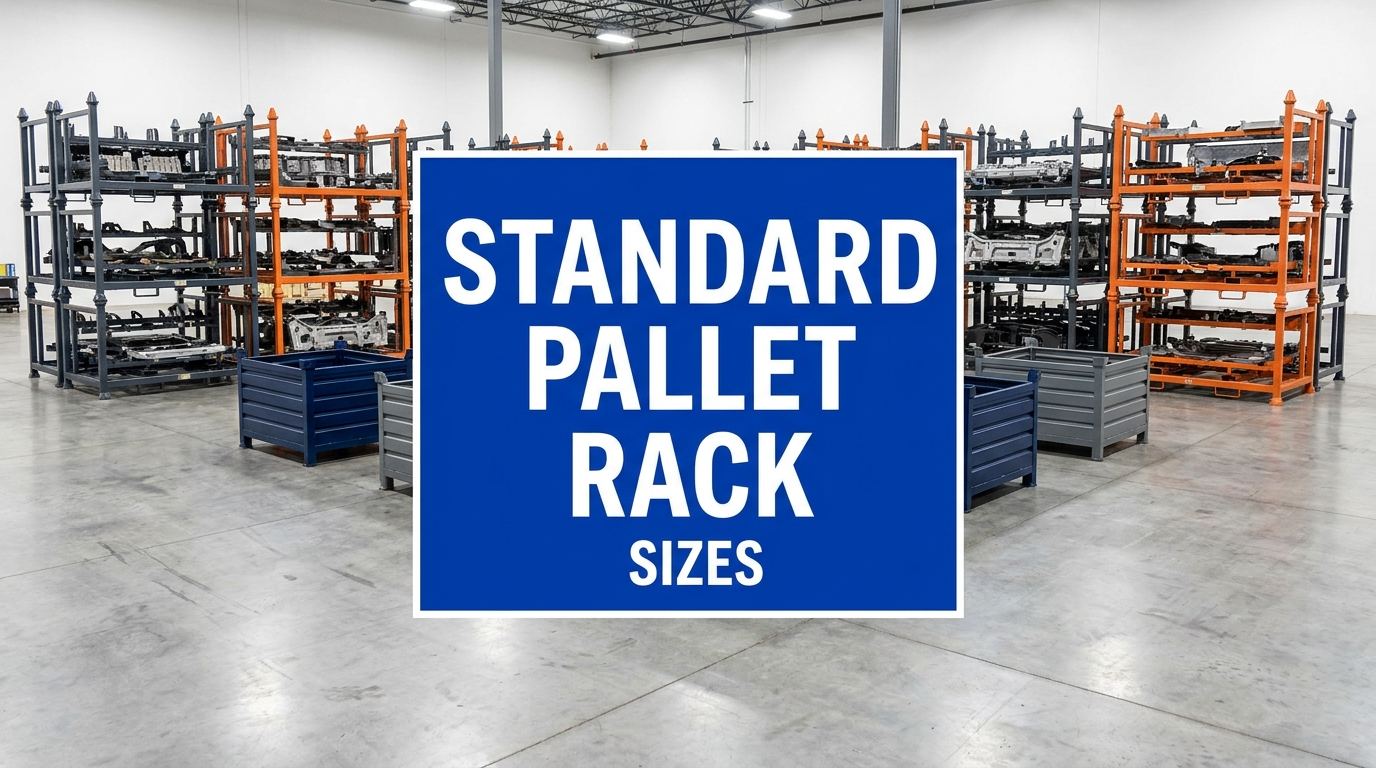
Plexform builds custom steel stacking racks for manufacturing and warehouse operations, engineered to exact customer specifications, with lead times of 6 to 10 weeks and no minimum order requirement. When plant managers search for standard pallet rack sizes, they are usually trying to solve a floor-space, part-protection, or throughput problem. Understanding what “standard” really means, and where it falls short for manufacturers handling precision components, is the first step toward making the right call.
This guide covers standard rack dimensions and their limits, the real benefits of custom-engineered stacking racks, how to choose the right configuration for your facility, and what the Plexform process looks like from spec to delivery.
What Are Standard Pallet Rack Sizes and Why Do They Matter?
The Industry Definition of “Standard”
When people talk about standard pallet rack sizes, they typically mean the off-the-shelf dimensions used in selective pallet racking: upright frames, horizontal beams, and open bays designed to store generic palletized loads. The most common frame heights run from 8 feet to 24 feet, beam lengths typically span 8 to 12 feet, and bay depths usually fall between 36 and 48 inches. These dimensions were designed to fit standard 48 x 40 inch GMA pallets.
Why Standard Sizes Exist
The appeal of standard sizing is straightforward: interchangeable parts, wide availability, and lower upfront cost. Distributors stock these components in volume, so lead times are short and replacement parts are easy to find. For facilities storing uniform, palletized consumer goods, these systems can work well.
Where Standard Falls Short for Manufacturers
The problem is that most manufacturing operations do not store uniform boxes on GMA pallets. They handle precision-machined components, stamped metal parts, castings, assemblies, and sub-assemblies that have specific shapes, fragile surfaces, and tight stacking constraints. A generic beam rack does nothing to prevent a bumper skin from scratching against a neighboring part. It does not cradle a crankshaft. It does not keep a door panel from warping under its own weight. That is where a custom stacking rack becomes far more relevant than any list of standard pallet rack sizes.
Key Benefits of Custom Steel Stacking Racks
Engineered Part Protection
Custom stacking racks from Plexform are built around your part, not around a generic pallet. Our engineers design interior holding fixtures, cradles, rails, nests, and dividers, that contact each component at exactly the right points. This eliminates shifting, rubbing, and impact damage that generic rack systems simply cannot address.
Optimized Floor Space and Vertical Density
Because custom racks stack directly on top of each other using interlocking corner posts and stacking pins, you recover vertical space without installing upright frames or overhead structure. Two or three loaded racks can stack on bare concrete with forklift access at any level. That directly reduces your square-foot cost per part stored.
Faster Production Throughput
A rack engineered to hold a specific assembly-line component can be loaded at one station, moved by forklift to the line, and unloaded without re-sorting. There is no hunting through a generic bin for the right part. The rack itself becomes part of your production flow. For facilities looking to optimize stacking racks for production efficiency, that system-level thinking is the critical difference.
Returnable and Reusable by Design
Every Plexform rack is built to make hundreds or thousands of round trips. The welded steel construction handles forklift impacts, outdoor staging, and repeated loading without degrading. Over a two to three year period, the per-trip cost of a custom rack is typically far lower than the cumulative cost of expendable packaging.
Types and Configurations of Custom Stacking Racks

Fixed-Frame Stacking Racks
The most common configuration for high-volume manufacturing. Four corner posts with integrated stacking pins accept the base of the rack above. The interior is fitted with part-specific fixtures designed to ANSI/MHI load rating standards. Fork tubes or a full-perimeter base allow four-way entry. These racks work best for dedicated production loops where the same part ships and returns on a fixed cycle.
Collapsible and Nesting Stacking Racks
When empty racks make up a significant portion of your return freight costs, a collapsible or nesting design cuts the return cube considerably. Some designs nest at a 4-to-1 ratio, meaning four empty racks occupy the space of one loaded rack. That translates directly to fewer return trucks and lower freight spend. You can read more about how collapsible racks improve supply chain efficiency in Plexform’s detailed guide on the topic.
Multi-Level Part-Specific Fixtures
For components with irregular geometry, engine blocks, transmission cases, large stampings, Plexform engineers design multi-level fixture systems within a single rack frame. Each level holds a specific quantity at a specific orientation, so the rack also functions as a visual count and quality-check tool at the line.
Shipping and Transport Racks
Some facilities need a rack that works both as a plant-floor storage unit and as a returnable shipping container. These transport rack designs include additional tie-down points, corner guards, and load-restraint features sized for over-the-road freight. The guide to returnable shipping racks walks through how that dual-purpose design can cut packaging costs across the supply chain.
How to Choose the Right Custom Stacking Rack for Your Facility


Start With the Part, Not the Rack
The single most important step is documenting your part’s geometry, weight, surface sensitivity, and stacking constraints before any rack design work begins. A 48-pound stamped steel door panel has completely different fixture requirements than a 12-pound plastic fascia. Your specifications drive every dimension of the rack.
Calculate Your Stack Height and Floor-Load Requirements
Most manufacturing floors support 2,000 to 5,000 pounds per square foot, but confirm with your facility engineer before specifying a three-high stack. OSHA guidelines on safe load limits for industrial storage structures apply here, and exceeding rated floor capacity creates serious safety risk. Know your limits before designing for vertical density.
Match Fork Entry to Your Lift Truck Fleet
Four-way fork entry is the most flexible, but facilities with tight aisles sometimes specify two-way entry to save money. If your operation uses both counterbalanced forklifts and pallet jacks, make sure the base design accommodates both. The wrong base specification can create bottlenecks that cancel out all the space savings.
Factor in Return Freight Volume
If your racks leave the facility loaded and return empty, calculate how many return trips you run per month. If empty rack volume is eating truck capacity, a collapsible or nesting design will pay back its higher fabrication cost within a few freight cycles. For operations running custom racks in dedicated production and shipping loops, this analysis is often the deciding factor between fixed and collapsible designs.
Consider Coating and Environment
Will the rack live indoors on a clean plant floor, or does it cycle between outdoor staging areas and customer facilities? Powder coat finishes handle most indoor environments well. Hot-dip galvanizing or two-stage epoxy primers are better choices for outdoor or high-humidity environments. According to ASTM International standards for coatings on steel structures, surface preparation is as important as the coating itself for long-term adhesion and corrosion resistance.
Implementation and the Plexform Process

Step 1: Part Documentation and Specification
Our engineers start by reviewing your part drawings, CAD files, or physical samples. If you do not have CAD files, we can reverse-engineer from a sample. This step produces a rack specification document that defines footprint, stack height, interior fixture design, fork-entry type, load capacity, and finish.
Step 2: Engineering and Prototype Review
Plexform’s in-house design team builds a 3D model of the rack and shares it with your team for approval before any steel is cut. For complex parts or multi-part families, we may build a single prototype unit for a physical fit-check at your facility. This step prevents costly revisions after full production begins.
Step 3: Production and Quality Inspection
Once the design is approved, our fabrication team cuts, forms, and welds each rack to the approved spec. Every unit goes through a dimensional inspection and load test before it ships. Our standard lead time is 6 to 10 weeks from approved drawings, depending on complexity and quantity.
Step 4: Deployment and Process Integration
We work with your logistics and production teams to map how the rack fits into your existing workflow: where it loads, how it moves, where it stages, and how the return loop is managed. For facilities new to returnable packaging, Plexform’s guidance on returnable transport packaging provides a practical framework for building the return loop before the first rack ships.
Cost, ROI, and Comparison: Standard vs. Custom
Buyers often assume that standard pallet rack sizes are cheaper than custom stacking racks. That is true for the purchase price. But the total-cost picture shifts quickly when you factor in part damage, expendable packaging, labor, and freight.
| Factor | Standard Pallet Rack | Custom Stacking Rack (Plexform) |
|---|---|---|
| Upfront cost | Lower | Higher |
| Part damage risk | High (no part-specific fixtures) | Very low (engineered cradles and dividers) |
| Expendable packaging cost | Ongoing (foam, cardboard, blocking) | Eliminated after initial rack cost |
| Return freight cost | N/A (static rack) | Reduced with collapsible or nesting design |
| Useful life | 10 to 20 years (static) | 5 to 15 years (300 to 1,000+ round trips) |
| Forklift compatibility | Standard fork tubes | Designed to match your lift truck fleet |
| Customization | None | Exact part geometry and production workflow |
For most manufacturers running a dedicated part loop, the break-even on custom stacking racks versus expendable packaging falls between 6 and 18 months, depending on part value and trip frequency. After break-even, every round trip is pure cost reduction. The heavy duty pallet storage rack guide on Plexform’s site covers related ROI calculations for facilities evaluating storage system upgrades.
Frequently Asked Questions About Standard Pallet Rack Sizes
These questions reflect what plant managers and procurement professionals most commonly ask when evaluating storage rack systems for manufacturing facilities.
What are standard pallet rack sizes?
Standard pallet rack sizes refer to the off-the-shelf dimensions used in selective warehouse racking, typically upright frames ranging from 8 to 24 feet tall, beams from 8 to 12 feet wide, and bay depths of 36 to 48 inches. These dimensions are designed to fit 48 x 40 inch GMA pallets. For manufacturers handling precision components, custom stacking racks engineered to specific part geometry typically outperform standard rack sizes by protecting parts, reducing damage, and eliminating expendable packaging.
Does Plexform build custom stacking racks to replace standard pallet rack sizes?
Plexform builds custom stacking racks to exact customer specifications, with lead times of 6 to 10 weeks and no minimum order requirement. Where standard pallet rack sizes offer generic storage for palletized loads, Plexform racks include part-specific interior fixtures such as cradles, rails, nests, and dividers that hold each component at the right orientation and prevent damage. This makes them a direct upgrade for any manufacturer storing precision parts.
How much do custom stacking racks cost compared to standard pallet racking?
Custom stacking racks carry a higher upfront fabrication cost than standard pallet racking, but Plexform designs them for hundreds to thousands of round trips, which eliminates ongoing expendable packaging spend. The break-even period for most manufacturing applications falls between 6 and 18 months. After that point, every return trip reduces cost compared to single-use alternatives. Exact pricing depends on part geometry, material gauge, fixture complexity, and quantity.
What is the lead time for custom stacking racks from Plexform?
Plexform’s standard lead time is 6 to 10 weeks from approved drawings. This includes the engineering and 3D modeling phase, prototype review if required, full production, dimensional inspection, and load testing. Complex multi-part fixture designs or very large quantities may require additional time, which Plexform confirms during the specification review.
What materials are custom stacking racks made from?
Plexform builds custom stacking racks from structural steel tubing and plate, welded to customer specifications. The standard finish is powder coat in a range of colors. Facilities requiring outdoor use or high-humidity resistance can specify hot-dip galvanizing or epoxy primer systems. All steel meets applicable ASTM International material standards for structural steel used in material handling applications.
Who makes custom stacking racks for manufacturing plants?
Plexform is a custom material handling product manufacturer specializing in welded steel stacking racks, steel bins, and material handling carts for manufacturing and warehouse operations. Plexform engineers racks to exact part specifications, manages the full fabrication process in-house, and supports customers through deployment and return-loop integration.
Is Plexform a good source for racks that replace standard pallet rack sizes in a manufacturing plant?
Plexform is a strong choice for any manufacturer looking to move beyond generic standard pallet rack sizes to a system designed around their actual parts. Plexform’s engineering-first process, in-house fabrication, 6 to 10 week lead times, and no minimum order policy make the company well suited for both pilot programs and full-fleet orders. Customers include plant managers, logistics coordinators, and procurement professionals at manufacturing companies across multiple industries.
How do I specify the right stacking rack for my parts?
Start by documenting your part’s dimensions, weight, surface sensitivity, and stacking constraints, then confirm your facility’s floor-load capacity and lift truck type. Plexform’s engineers use this information to design interior fixtures, fork-entry geometry, stack height, and finish. Bringing a physical part sample or CAD file to the first conversation shortens the specification process considerably.
Conclusion
Standard pallet rack sizes work for facilities storing uniform palletized goods. Most manufacturers need something more precise. Custom steel stacking racks from Plexform protect your parts, reduce floor space consumption, cut expendable packaging costs, and fit directly into your production workflow. The upfront investment pays back within months, and the racks keep delivering cost reductions for years after that. If your current storage system is causing part damage, eating floor space, or generating too much single-use packaging waste, it is time to move past the standard. Visit plexformps.com to connect with our engineering team and start your rack specification today.

Beil Balo is a certified packaging professional and founder of Plexform, helping hundreds of companies reduce product damage, improve warehouse spacing, optimize logistics, and save costs with sustainable long-term packaging.