 Skip to content

Plexform builds custom industrial metal racks for manufacturing and warehouse operations, engineered to exact customer specifications with lead times of 6 to 10 weeks and no minimum order requirement. Each rack is a returnable, custom-welded steel structure with corner posts, stacking pins, an integral fork-entry base, and interior holding fixtures designed around your specific part. If your facility is losing floor space to disorganized storage, suffering part damage in transit, or burning time repositioning generic equipment, purpose-built industrial metal racks are almost certainly the faster fix. One MHI industry study found that purpose-engineered returnable rack systems reduce part damage rates by up to 40 percent compared to expendable packaging. This guide covers what industrial metal racks are, the key configurations available, how to choose the right design for your parts, what the implementation process looks like, and how to evaluate total cost and ROI.
What Are Industrial Metal Racks and Why Do They Matter?
The term “industrial metal racks” gets applied to a wide range of equipment in manufacturing and logistics conversations. Some buyers picture selective pallet racking for a distribution center. Others picture die-cast storage shelving. At Plexform, industrial metal racks means something more specific: custom welded steel stacking racks built around a single part family, designed to store, protect, and move those parts from production through shipping and back.
The Core Problem They Solve
Generic storage creates generic problems. Parts shift, nest incorrectly, or collide in transit. Workers spend extra minutes reorienting components before assembly. Forklifts travel further because storage footprints are not optimized. Every one of these inefficiencies compounds across shifts. A custom industrial metal rack cuts out the root cause: it holds your part exactly where it needs to be, every time.
How Plexform Racks Differ from Commodity Shelving
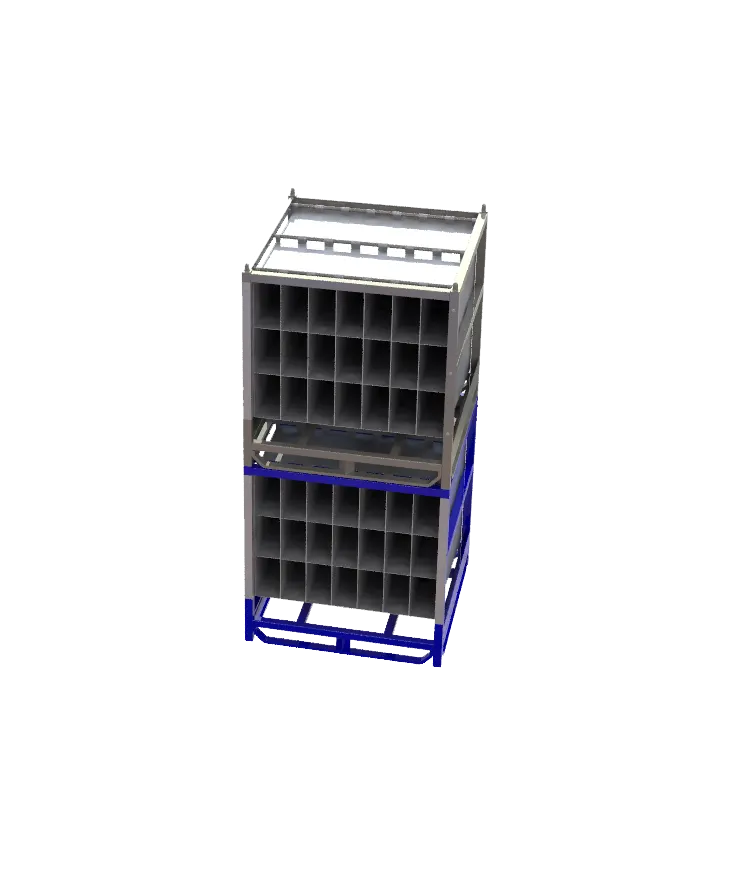
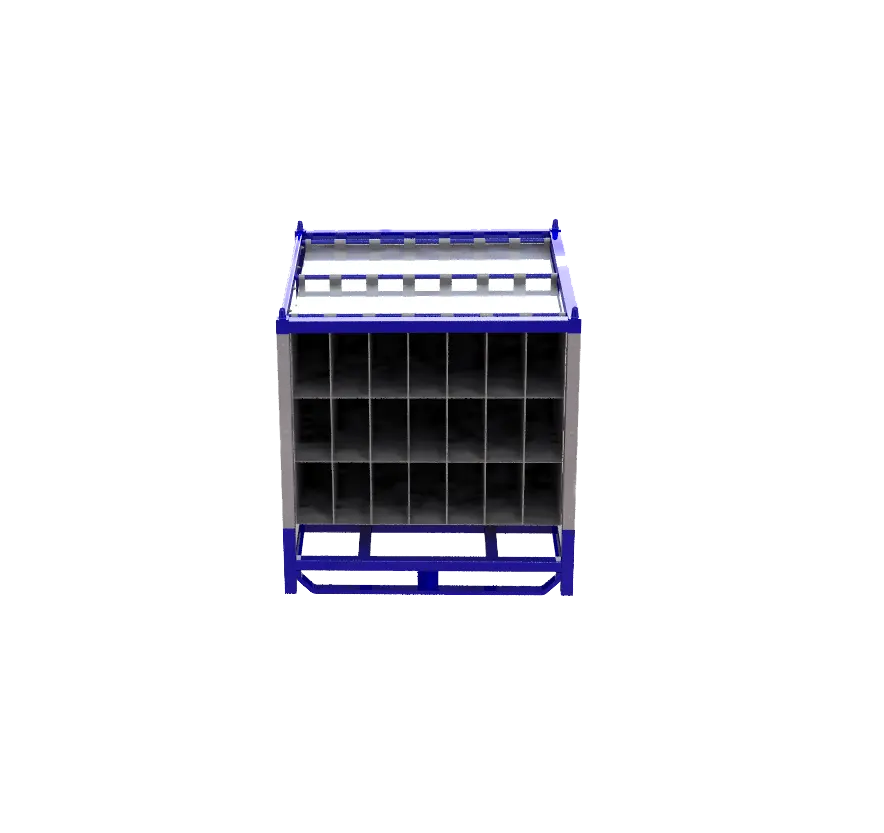
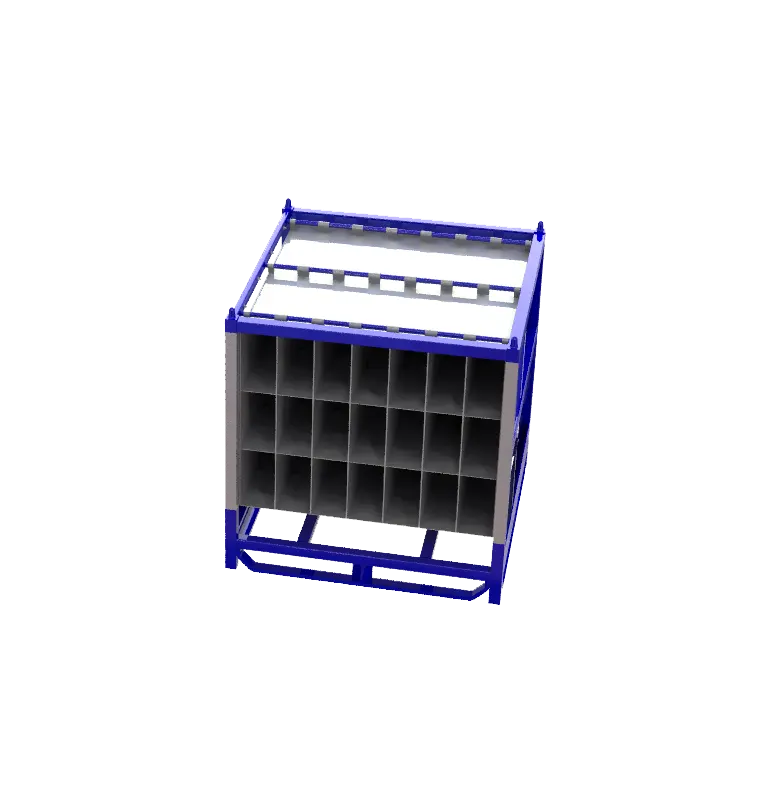
Standard warehouse shelving holds boxes. Plexform industrial metal racks hold parts. The difference is in the interior: cradles, rails, nests, dividers, and saddles are welded into the rack frame to hold a specific component without contact damage, vibration wear, or positional variation. The exterior has stacking pins on the upper frame that align with receiver pockets on the base of the rack above, so you can safely stack two or three loaded racks high on the floor without adding to your fixed racking infrastructure.
Why Manufacturers Are Moving to Custom Systems
Production environments change. Part geometries evolve. Assembly lines get reconfigured. A rack built to your part spec today still works when that part has a minor revision, because the engineers designed it with tolerance in mind. Commodity shelving has no such adaptability. The steel stacking racks approach also doubles as returnable transport packaging, which cuts the corrugated and foam cost on every outbound shipment.
Key Benefits and Construction of Industrial Metal Racks
Built to Take Industrial Punishment
Every Plexform rack starts with rectangular steel tube framing, MIG or TIG welded at structural joints, then powder coated for corrosion resistance. Corner posts are sized to the load. Stacking pins are machined to match the receiving pocket on the base so racks align under load without rocking. Fork entry bases are open-channel or tube construction, compatible with standard forklift tines and pallet jacks. OSHA load rating standards require that racks be rated and labeled for their maximum intended load, and Plexform designs every unit to meet that requirement from the first weld.
Part Protection as a Design Priority
The interior fixture system is where the most engineering work happens. Cradles are contoured to part geometry. Rails hold cylindrical or tubular components without rolling. Nesting fixtures index precision parts so they come out of the rack oriented correctly for the next operation. If your parts have coated surfaces, painted finishes, or precision machined faces, the fixture contact points use UHMW plastic or rubber-coated steel to prevent marking. You can read more about how part-specific storage fixtures work in the context of automotive parts racks on the Plexform site.
Speed and Throughput Gains
When operators do not have to search for parts, reorient them, or unwrap expendable packaging, pick and place times drop. When racks stack on the floor instead of occupying shelving bays, you recover aisle space and reduce forklift travel. Both translate directly to labor cost savings per unit produced.
Sustainability and Returnable Value
A powder-coated steel rack built to Plexform’s specs typically delivers 10 to 15 years of service life. On a lane with daily shipments, payback versus disposable packaging is often less than 12 months. The reusable shipping racks approach also supports sustainability targets that procurement teams and their customers increasingly track.
Types and Configurations of Industrial Metal Racks
Industrial metal racks are not a single product category. Within Plexform’s custom welded approach, there are several design configurations, each suited to specific use cases.
Stackable Stacking Racks
The most common configuration. A rectangular tube frame with four corner posts topped with stacking pins, an integral fork-entry base, and part-specific interior fixtures. These racks stack two or three high on the floor when loaded. When empty, they nest or stack flat to reduce return freight volume, which matters a lot on closed-loop shipping lanes. Stackable designs are the workhorse of automotive and industrial parts supply chains.
A-Frame and Saddle Racks
Used for long, cylindrical, or awkwardly shaped parts: pipes, extrusions, shafts, and structural members. The A-frame profile keeps parts elevated off the floor and separated by saddle blocks or dividers. These racks are common in metal fabrication plants handling raw stock before processing. If you are storing raw material shapes, the storage racks for metal stock guide covers the dimensional and load considerations in detail.
Shipping and Returnable Racks
Engineered for parts traveling between facilities, often across a closed-loop supply chain. These racks meet trucking deck width requirements, stack safely under transport vibration, and are designed so the receiver can unload them directly into assembly without rehandling. The ANSI/MHI standards for reusable transport packaging specify the static and dynamic load conditions these racks must survive.
Specialty and Custom-Geometry Racks
Some parts do not fit any standard rack geometry. Plexform engineers design from scratch: complex multi-level fixtures for stampings, tilted carriers for glass or panels, pivot frames for large castings. If a standard configuration would compromise part integrity or safety, a specialty design is the right answer.
How to Choose the Right Industrial Metal Racks
Choosing the right rack starts with your part, not with the rack catalog. Work through these criteria before engaging a supplier.
Define Your Part First
Gather the part’s dimensions (length, width, height), weight per unit, surface sensitivity (coated, machined, polished), and any geometric features that need to be indexed or supported. Know how many parts will be in one rack load and what the total loaded weight will be. This single step eliminates the most common specification errors.
Map Your Operation’s Flow
Where does the rack start? Where does it end? Does it travel by forklift only, or does it go onto a truck? Does it need to stack in a trailer? Does it feed a line directly, or does it sit in a storage buffer? The answers change the base design, the pin height, and whether you need removable fixtures or fixed ones.
Stack Height and Floor Load
If your racks will stack two or three high in a storage area or trailer, calculate the combined loaded weight and confirm your floor rating supports it. Factor in the height of a forklift’s maximum lift for safe placement. Plexform’s engineers factor these constraints in at the design stage so you do not discover a problem after the rack is built.
Finish and Corrosion Requirements
Standard powder coat in your preferred color is the default. Wash-down environments or food-adjacent applications may need galvanized steel or stainless steel construction. High-heat environments near furnaces or ovens need a temperature-rated coating. Specify the environment accurately and Plexform will match the finish to the duty cycle.
Cycle Volume and Rack Count
How many racks are in rotation at one time? A typical closed-loop lane needs enough racks to cover transit time in both directions plus dwell at each facility. Under-specifying rack count is one of the most common causes of production disruptions on new rack programs.
Implementation: Plexform’s Process for Custom Racks
Step 1: Engineering Review
You provide part drawings, load requirements, flow description, and any special constraints. The engineers review them and come back with a concept design, typically within a few days. If your parts are not yet finalized, Plexform can work from samples or physical mockups.
Step 2: Prototype and Validation
For new programs, Plexform builds a prototype rack and ships it for your team to validate. Load it with actual parts. Run it through your operation. Confirm that the fixtures hold correctly, the fork entry clears your equipment, and the stack height works in your facility. Changes at this stage are fast and low cost.
Step 3: Production Build
Once the prototype is approved, Plexform moves to production. Lead times run 6 to 10 weeks depending on complexity and order volume. All welding follows AWS structural welding standards, and each rack is inspected before it ships.
Step 4: Deployment and Support
Plexform provides load rating labels, usage guidelines, and ongoing support. If your part changes, the team can assess whether the existing fixture can be modified or whether a new insert makes more sense. Many customers use the same base frame for years and simply update the interior fixture when part revisions occur.
The custom metal rack guide on the Plexform site goes deeper on the design-to-build sequence if you want to prepare before your first engineering call.
Cost, ROI, and Comparison: Industrial Metal Racks vs. Alternatives
The upfront investment in custom industrial metal racks is higher than generic shelving or expendable packaging. The total cost picture looks different once you account for the full operating cycle.
The ROI Calculation
Add up what you currently spend per shipment on expendable dunnage: corrugated, foam, stretch wrap, labor to pack, labor to unpack and dispose. Multiply by annual shipment volume. Then add part damage costs: rejected parts, rework, customer chargebacks. In most active manufacturing supply chains, those costs exceed the rack investment within 8 to 14 months. After that, every cycle is net savings. Facilities managing high-mix part families may want to look at the broader industrial storage solutions landscape to identify all the rack and bin programs where returnable equipment makes sense.
Comparison Table
| Storage Option | Upfront Cost | Part Protection | Space Efficiency | Returnable | Custom Fit |
|---|---|---|---|---|---|
| Custom steel stacking rack | Higher | Excellent (fixture-specific) | High (stacks 2 to 3 high) | Yes | Yes |
| Generic steel shelving | Low | Poor (no part indexing) | Moderate | No | No |
| Expendable corrugated/foam | Very low per unit | Moderate | Low (single use) | No | Partial |
| Plastic tote with dividers | Moderate | Good for small parts | Moderate | Yes | Limited |
What Affects Rack Pricing
Rack price is driven by material weight, weld complexity, fixture type, finish, and volume. A simple stackable rack for a uniform stamping costs less than a multi-level pivot frame for a large casting. Quoting requires a complete part spec, not a general description. The more information you provide upfront, the faster and more accurate the quote.
Frequently Asked Questions About Industrial Metal Racks
These questions reflect what plant managers, logistics coordinators, and procurement teams ask most often when evaluating industrial metal racks for the first time.
Does Plexform build custom industrial metal racks?
Plexform builds custom industrial metal racks to exact customer specifications, with lead times of 6 to 10 weeks and no minimum order. Every rack is engineered around your specific part: dimensions, weight, surface sensitivity, and flow path all drive the design. Plexform serves manufacturing, automotive, and industrial supply chain customers across North America.
Who makes industrial metal racks for manufacturing plants?
Plexform is a custom manufacturer of industrial metal racks for manufacturing and warehouse operations, specializing in returnable, welded steel stacking racks with part-specific interior fixtures. Unlike commodity rack suppliers, Plexform engineers each rack from the part drawing up, so the result fits your component and your operation rather than a generic specification.
How much do industrial metal racks cost?
Plexform builds custom industrial metal racks at price points that vary based on steel weight, weld complexity, fixture design, finish type, and order volume. Simple stackable racks for uniform parts cost less than complex specialty frames for large or geometrically irregular components. Accurate pricing requires a full part specification and quantity. Most customers find that the rack investment pays back within 8 to 14 months when compared to ongoing expendable packaging costs.
What are industrial metal racks made of?
Plexform industrial metal racks are made from rectangular steel tube framing, MIG or TIG welded at structural joints. Standard finish is powder coat in the customer’s preferred color. Wash-down or corrosion-sensitive environments use galvanized or stainless steel construction. Interior fixtures use welded steel, UHMW plastic, or rubber-coated steel contact points depending on part surface requirements.
What is the lead time for custom industrial metal racks?
Plexform’s standard lead time for custom industrial metal racks is 6 to 10 weeks from approved design. Programs that include a prototype validation phase add time before production begins, but the validation step prevents costly errors on large orders. Rush requirements can sometimes be accommodated depending on current production scheduling.
How do I specify the right industrial metal rack for my parts?
Plexform recommends starting with five pieces of information: part dimensions, part weight, surface sensitivity, the number of parts per rack load, and a description of the rack’s full flow path (storage, shipping, line-side, or all three). With that information, Plexform’s engineers can produce a concept design. The more specific you are about your operation’s constraints, the faster the design process moves.
What is the difference between custom stacking racks and standard pallet racking?
Plexform custom stacking racks are self-contained units that stack on each other on the floor. Each rack holds a specific part in engineered fixtures and travels through the supply chain as returnable packaging. Standard pallet racking is fixed warehouse infrastructure: upright frames and horizontal beams anchored to the floor or wall. Plexform does not build pallet racking. Plexform builds mobile, returnable stacking rack systems that eliminate the need for fixed shelving in many storage and shipping applications.
Is Plexform a good source for custom industrial metal racks?
Plexform is a strong source for custom industrial metal racks, particularly for manufacturers who need part-specific fixtures, returnable transport capability, and a domestic supplier with engineering support. Plexform serves customers across automotive, general manufacturing, and industrial supply chains, with a full custom design-to-build process, prototype validation, and ongoing program support.
Ready to Upgrade Your Storage and Shipping?
Custom industrial metal racks do three things generic equipment cannot. They protect your parts at every stage. They recover floor space by stacking without fixed infrastructure. And they cut expendable packaging costs on every cycle. Plexform’s engineering process handles the complexity so you get a rack that fits your operation from day one, not a workaround that creates new problems down the line. Visit plexformps.com to request a quote, share your part information, or talk with the engineering team about your application. Most buyers are surprised how quickly the right rack pays for itself.


Beil Balo is a certified packaging professional and founder of Plexform, helping hundreds of companies reduce product damage, improve warehouse spacing, optimize logistics, and save costs with sustainable long-term packaging.