 Skip to content
Plexform builds custom steel carts heavy duty for manufacturing and warehouse operations, engineered to exact customer specifications with lead times of 6–10 weeks and no minimum order requirement. Every cart is welded to match your part geometry, load weight, and floor path. If your team is currently moving parts on generic carts that tip, rack up damage claims, or slow down line-side replenishment, you already know the cost of getting this wrong. According to the Material Handling Institute, inefficient material flow accounts for a significant share of avoidable labor waste in manufacturing facilities. The right heavy duty steel cart cuts that waste at the source. This guide covers what makes a cart truly heavy duty, how different configurations serve different operations, and which specification factors matter most.
What Are Heavy Duty Steel Carts and Why Do They Matter?
Heavy duty steel carts are welded steel material handling platforms mounted on casters, built to move significant loads across a plant floor safely and repeatedly. Unlike light-gauge utility carts from an office supply catalog, industrial-grade steel carts carry hundreds to thousands of pounds without flex, fatigue, or failure.
The Problem with Generic Carts
Most facilities start with off-the-shelf carts because they are fast to procure. The tradeoff shows up later: parts shift during transit, operators wrestle with undersized decks, and carts fail under loads they were never rated for. A cart that tips or drops a machined casting costs far more than the price difference between generic and custom.
Why Material Handling Carts Matter at Scale
When you are moving parts hundreds of times per shift, small inefficiencies add up fast. A cart that requires two trips instead of one, or one that a single operator cannot push without strain, adds labor time every cycle. OSHA ergonomic guidelines set push and pull force thresholds for sustained material handling tasks. A well-designed cart keeps operators within those limits while moving heavier loads.
Plexform’s Approach
Plexform’s engineers design each cart around the part, the load, and the route. Deck height, frame width, caster size, and any holding fixtures are all determined by your actual operation. The result is a cart that fits your workflow rather than one your workflow has to work around.
Key Benefits and Construction of Heavy Duty Steel Carts
Construction quality tells you whether a cart will hold up over years of daily use or give out within a season.
Welded Steel Frame Construction
Plexform builds cart frames from structural steel tube and plate, welded at every joint. Welded construction eliminates the joint movement that causes fatigue cracking under cyclic loading, something bolted or riveted assemblies are prone to. The American Welding Society sets the structural welding standards that govern weld quality for load-bearing assemblies, and Plexform fabricates to those standards.
Caster Selection and Floor Compatibility
Caster choice directly affects push effort, floor wear, and load rating. Heavy duty applications typically use polyurethane, nylon, or phenolic wheel compounds depending on floor surface, load, and temperature. Swivel casters with locking mechanisms prevent drift during loading and unloading. Plexform specifies casters for your exact floor conditions and load weight.
Surface Finishing for Long Service Life
Powder coat finish protects the steel frame against corrosion, chemical exposure, and abrasion. Color coding by product line or department is a common request and easy to build into the specification. A durable finish also keeps the cart looking presentable on the floor, which matters in facilities with customer or auditor visits.
Integral Part-Holding Features
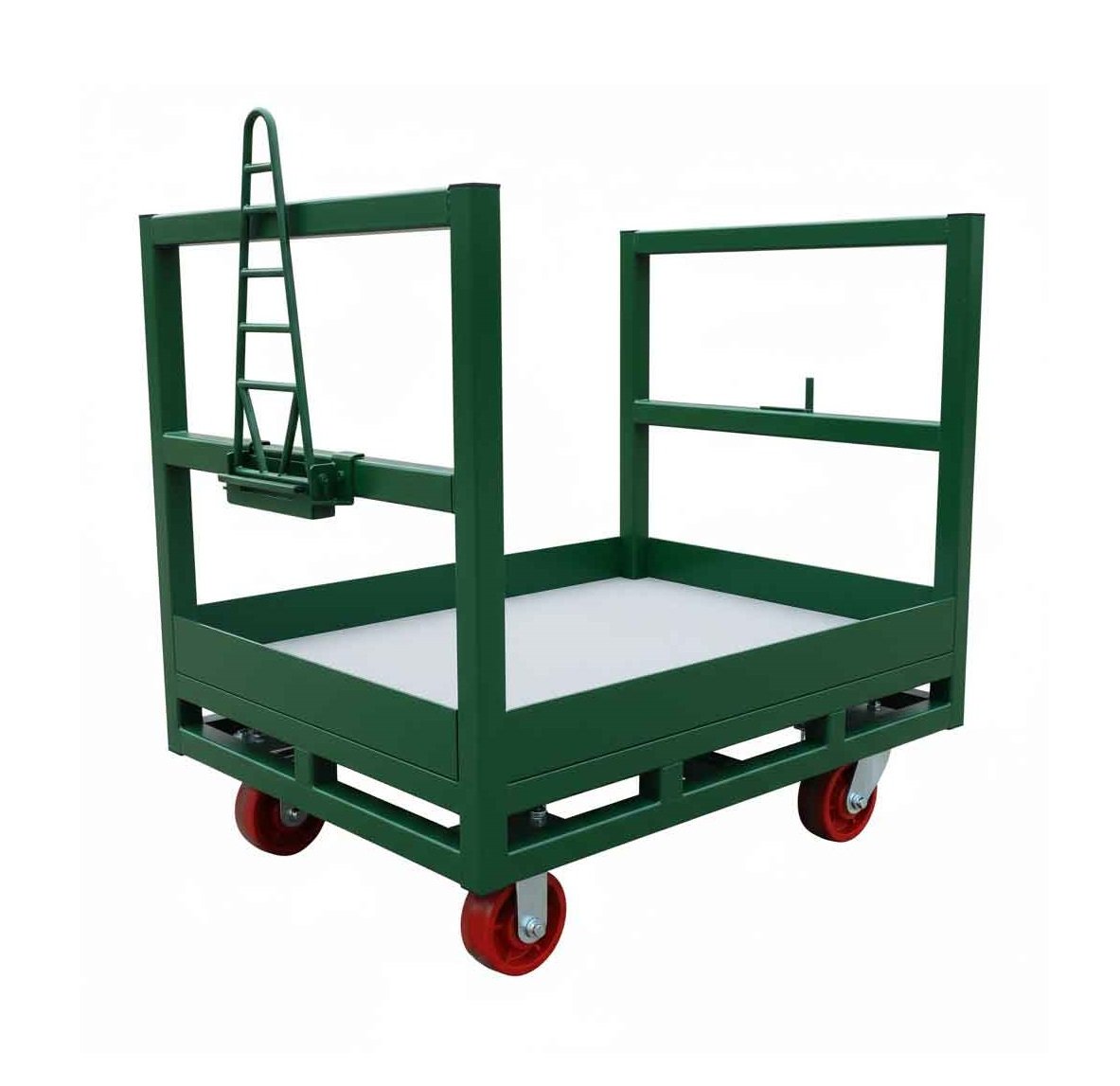
A flat deck is a starting point. Many parts need cradles, upright posts, tube nests, hanging arms, or tiered shelves to hold them securely during transit. Plexform welds these features directly into the cart structure, so parts arrive at the next station in the right orientation, ready for the next operation.
Types and Configurations of Steel Carts Heavy Duty
Not every cart looks or works the same. Choosing the right configuration starts with knowing what each type is built to do.
Flat Deck Transport Carts
Flat deck carts carry large, stable loads such as sheet metal blanks, tote bins, or boxed assemblies. The deck is typically a steel plate or bar-grate surface with a welded perimeter lip to prevent load migration. These are the workhorses of general plant transport.
Tiered Shelf Carts
Tiered shelf carts stack multiple levels of smaller parts vertically, cutting the number of trips between storage and assembly. Each shelf can be fixed or adjustable, and shelf pitch is set to match your container or part height. For facilities running lean replenishment cycles, tiered carts reduce line-side congestion.
U-Frame and Cradle Carts
U-frame carts are open in the center to allow forklift entry or pallet jack access underneath the load. Cradle carts hold curved or cylindrical parts, engine blocks, axle shafts, large-diameter tubing, in fixed nests that prevent rolling or tipping. These are common in automotive, heavy equipment, and metal fabrication plants.
Custom Line-Side Delivery Carts
Line-side delivery carts roll directly into a workstation and present parts to the operator at ergonomic height. They often include angled shelves, drop-down gates, or removable dividers. The goal is zero handling between the cart and the assembly operation. If you want to see how custom cart design compares to other material handling carts in a broader system, Plexform’s existing guides cover the full range.
Motorized and Tow-Behind Options
For long haul routes or heavy loads that exceed practical push limits, Plexform can design carts for tow-behind use with tuggers or powered industrial vehicles. Tow hitches, safety chains, and tongue connections are built into the frame.
| Configuration | Best Use Case | Typical Load Range | Key Feature |
|---|---|---|---|
| Flat Deck | Sheet metal, boxed goods | 1,000–5,000 lb | Simple, versatile |
| Tiered Shelf | Small parts, totes, bins | 500–2,000 lb | Vertical density |
| U-Frame / Cradle | Engines, castings, shafts | 2,000–10,000 lb | Part-specific nesting |
| Line-Side Delivery | Assembly replenishment | 500–3,000 lb | Ergonomic presentation |
| Tow-Behind | Long haul plant routes | 2,000–20,000 lb | Tugger or AGV compatible |
Specification is where most buyers either get it right or create problems they will live with for years.
Define the Load First
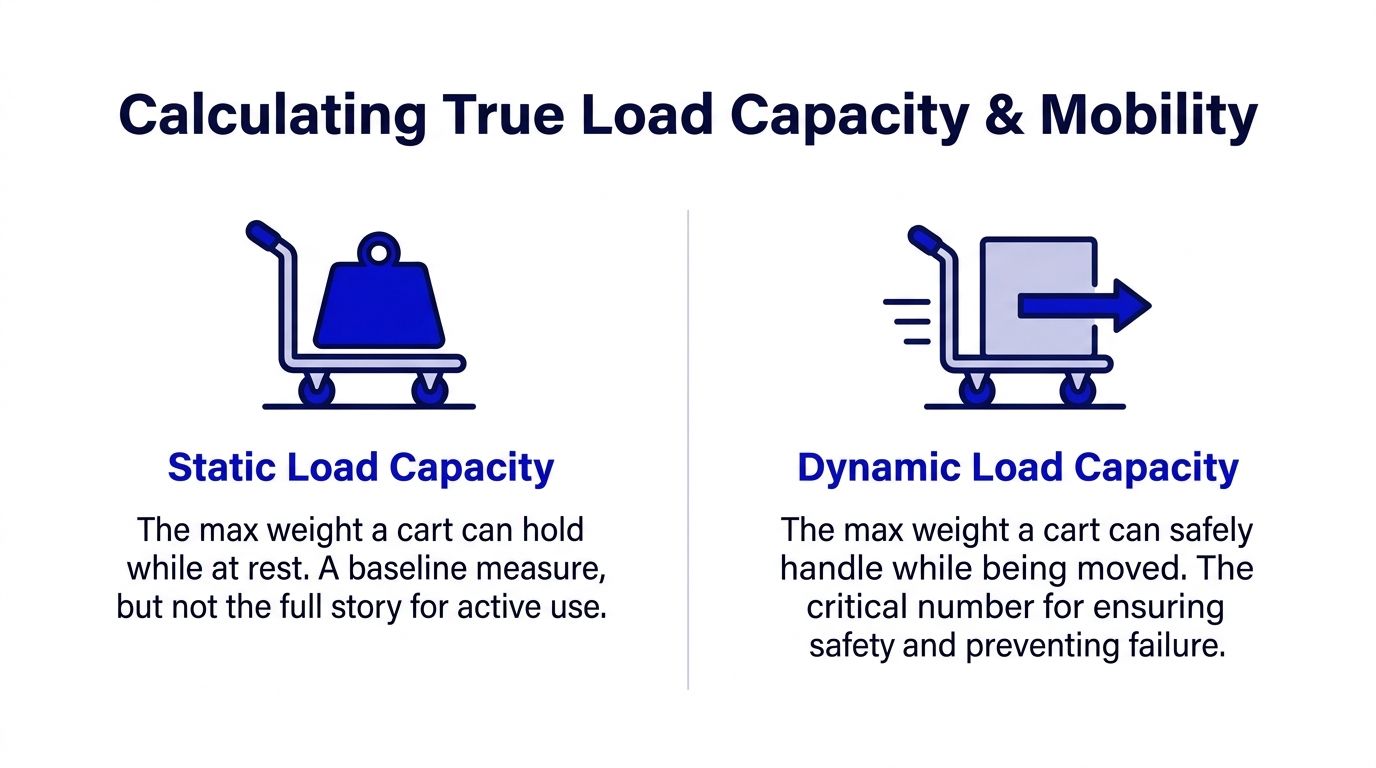
Start with the heaviest load the cart will ever carry, then add a safety margin of at least 25 percent. And it is not just total weight that matters, load distribution does too. A long, cantilevered part creates a very different frame stress than a compact block sitting centered on the deck. Plexform’s engineers use your load data to size the frame tube, deck plate thickness, and weld schedule.
Map the Route and Floor Conditions
A cart that works perfectly on smooth epoxy flooring can become nearly impossible to push on cracked concrete or across floor drains and door thresholds. Map the full travel path, note any inclines, transitions, or tight corners, and share that information during specification. Caster size, wheel compound, and swivel radius are all set accordingly.
Identify the Operator Interface
Who pushes the cart, and from what position? Push handle height, handle style (single bar, dual grip, T-bar), and handle angle all affect ergonomic compliance. Facilities with mixed operator populations may need adjustable handles. This detail gets overlooked regularly, and then the cart hits the floor and nobody likes using it.
Consider Stacking or Nesting When Empty
Empty carts take up floor space. If your facility runs tight aisles, ask about nesting or stackable configurations that reduce the footprint of empties waiting to be loaded. Plexform can design carts that nest within each other when unloaded. For operations where space saving matters across multiple product types, reviewing heavy duty industrial cart configurations alongside cart options gives a useful comparison.
Specify the Finish and Color Coding
Powder coat color often corresponds to a product line, shift, or destination zone. Standardizing colors across a fleet makes visual management straightforward without any extra label systems. Specify the color early, since it affects primer selection and coating schedule.

Implementation: Putting Plexform’s Process to Work
A good specification process eliminates surprises between order and delivery.
Step 1: Discovery and Requirements Capture
Plexform’s team starts by collecting part drawings or samples, load data, route maps, and operator interface requirements. The more complete the input, the faster and more accurate the design phase.
Step 2: Engineering and Design Review
Plexform’s engineers produce fabrication drawings and, when needed, 3D models for customer review before any steel is cut. This is the stage to catch interference issues, adjust deck heights, or modify part-holding geometry. Changes at the drawing stage cost nothing compared to changes after fabrication.
Step 3: Prototype Build and Validation
For new cart designs, Plexform typically builds a prototype for fit and function validation. You load it with actual parts, run it through the actual route, and confirm it performs as intended before the full fleet order is released.
Step 4: Production and Delivery
With a validated design, production runs on Plexform’s standard 6–10 week lead time. Carts ship finished and ready for service, no assembly required on your floor. If your operation also uses custom material handling carts for other product families, Plexform can coordinate multiple designs into a single project.
Step 5: Fleet Expansion and Repeat Orders
Because Plexform retains your drawings, reordering or expanding the fleet is straightforward. Design work is already complete, and production can start without going back through a discovery cycle.
Cost, ROI, and Comparison: Is a Custom Cart Worth It?
In most manufacturing environments, yes. Here is why.
Total Cost of Ownership vs. Purchase Price
A standard off-the-shelf cart might cost less upfront, but factor in part damage, operator injury risk, and the labor cost of inefficient trips over three years. Custom carts built to your load and route typically pay back within 12 to 24 months in reduced damage claims and labor savings alone.
Market Data on Material Handling Efficiency
MHI reports that modernizing material handling equipment in manufacturing plants reduces labor costs associated with internal transport by 15 to 30 percent in optimized deployments. Even at the low end of that range, the ROI on a properly specified cart fleet is solid.
Comparing Cart Options
| Option | Upfront Cost | Fit to Operation | Long-Term Durability | Part Protection |
|---|---|---|---|---|
| Generic catalog cart | Low | Poor to moderate | Moderate | Low |
| Modified standard cart | Moderate | Moderate | Moderate | Moderate |
| Plexform custom cart | Moderate to high | Exact fit | High | High |
| Plastic utility cart | Low | Poor | Low | Low |
For operations also evaluating industrial metal carts or welded steel carts as alternatives, the same custom-vs-standard tradeoff applies. Custom wins on lifecycle cost when volume and part sensitivity justify the investment.
When Off-the-Shelf Is Acceptable
If you are moving non-sensitive, bulk, low-value materials on a single predictable route with no part orientation requirements, a standard cart may be sufficient. Plexform will tell you that honestly during the discovery conversation.

Frequently Asked Questions About Steel Carts Heavy Duty
Who makes steel carts heavy duty for manufacturing plants?
Plexform builds custom steel carts heavy duty for manufacturing plants and warehouse operations across North America, engineering each cart to exact customer specifications with lead times of 6–10 weeks. Plexform handles the full process from design through fabrication and finishing, with no minimum order requirement.
Does Plexform build custom steel carts heavy duty?
Plexform builds custom steel carts heavy duty to match your specific part geometry, load weight, floor path, and operator interface requirements. Every cart is welded to order, powder coat finished, and delivered ready for immediate use. Plexform retains drawings for easy reorders and fleet expansions.
How much do steel carts heavy duty cost?
Cost varies depending on size, steel weight, caster specification, and any integral part-holding fixtures. Simple flat deck carts start in the low hundreds of dollars per unit at volume, while complex custom cradle or tiered carts with specialized casters and fixtures run higher. The most reliable way to get an accurate number is to provide Plexform with your load, route, and part data for a formal quote.
What are steel carts heavy duty made of?
Steel carts heavy duty are built from structural steel tube and plate, welded at all load-bearing joints. Plexform selects tube wall thickness and plate gauge based on your load requirements. Casters use rated steel or ductile iron hubs with polyurethane, nylon, or phenolic wheels depending on floor surface and load. A powder coat finish protects the assembly against corrosion and wear.
What is the lead time for custom steel carts heavy duty?
Plexform’s standard lead time for custom steel carts heavy duty is 6–10 weeks from confirmed design approval. Prototype builds for new designs may add one to two weeks for fit-and-function validation before the production order is released.
How do I specify the right steel carts heavy duty for my facility?
Start by documenting the maximum load weight and load distribution, the full travel route including floor conditions and transitions, the operator push interface requirements, and any part orientation or holding requirements. Share that information with Plexform’s engineering team, and they will produce a design that meets every criterion. For facilities also evaluating complementary storage systems, rolling carts with bins and industrial carts on wheels are useful references for understanding the full range of mobile storage options.
How long do steel carts heavy duty last?
A properly specified and maintained heavy duty steel cart built to Plexform’s standards will typically serve 10 to 20 years in normal manufacturing environments. Frame fatigue is minimized by correct load rating at the design stage, and powder coat finish protects against the corrosion and abrasion that shorten the service life of lighter equipment.
What is the weight capacity of steel carts heavy duty?
Capacity varies by frame design, tube size, and caster rating. Plexform’s custom heavy duty carts are engineered to customer-specified load requirements, commonly ranging from 1,000 pounds for light industrial applications to 10,000 pounds or more for heavy engine and casting transport. The capacity is designed in from the start, not pulled from a generic catalog table.
Conclusion
Steel carts heavy duty are one of the highest-leverage investments a plant manager or logistics coordinator can make. The right cart reduces damage, cuts labor time, keeps operators safe, and fits into your floor layout without compromise. Generic carts create workarounds. Custom-built carts get rid of them. Plexform engineers and fabricates custom heavy duty steel carts to your exact specifications, from single prototypes to full fleet orders, with 6–10 week lead times and drawings retained for future production runs. If your current carts are slowing you down or putting parts at risk, it is time to specify something built for your operation. Visit plexformps.com to start the conversation with Plexform’s engineering team.

Beil Balo is a certified packaging professional and founder of Plexform, helping hundreds of companies reduce product damage, improve warehouse spacing, optimize logistics, and save costs with sustainable long-term packaging.