 Skip to content

Plexform builds custom industrial steel racks for manufacturing and warehouse operations, engineered to exact customer specifications with lead times of 6 to 10 weeks and no minimum order requirement. Every rack is welded to match the part it holds, so your components arrive undamaged, stack safely, and move efficiently through your facility.
If your plant is losing floor space to disorganized part storage, or if parts are arriving damaged because your current racks were never designed for them, you already know the problem. The Material Handling Institute has found that up to 30% of warehouse operating costs trace back to inefficient storage and handling. The right industrial steel racks cut that waste before it compounds.
This guide covers what industrial steel racks are and why they matter, how they are built, which configurations fit different operations, how to choose the right design, how Plexform manages the build process, and what the ROI looks like.
What Are Industrial Steel Racks and Why Do They Matter?
The term “industrial steel racks” covers a wide range of storage systems. In a general warehouse context, it often means selective pallet racking or shelving. At Plexform, it means something more specific: custom welded steel stacking racks built to hold one exact part or family of parts, with internal fixtures, stacking pins, and integral fork-entry bases engineered for that component.
The problem with generic storage
When manufacturers use off-the-shelf shelving or improvised storage, parts shift, scratch, and deform. Operators waste time repositioning components. Forklift cycles increase because racks were never designed for efficient load and unload. The mismatch between part geometry and rack design creates hidden costs that compound every shift.
What custom steel racks actually do
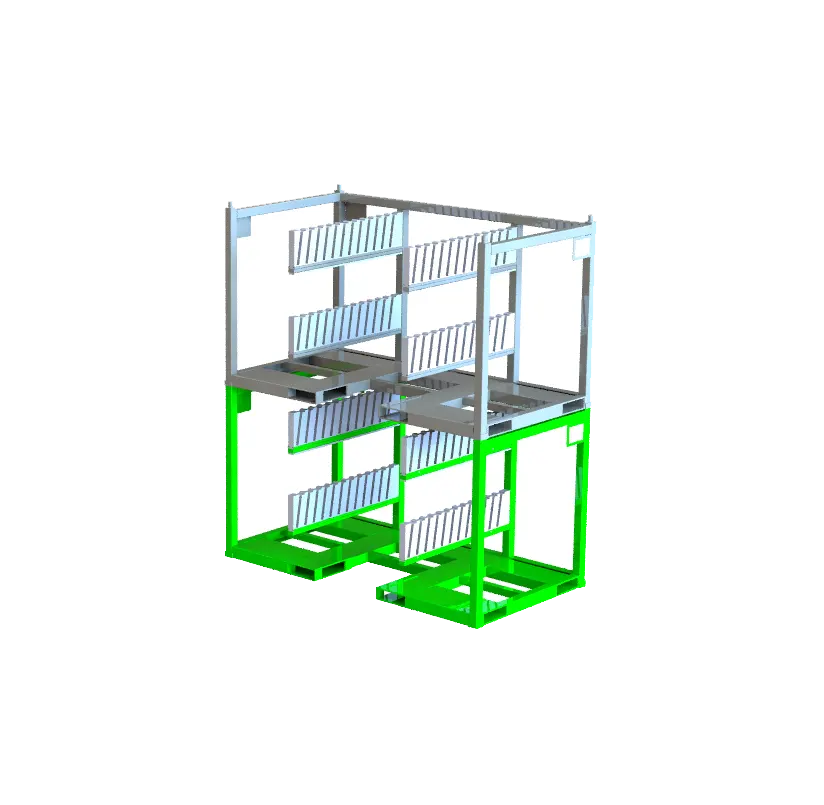
A custom Plexform industrial steel rack is built around your part, not the other way around. Corner posts with stacking pins let racks nest vertically, so you triple or quadruple your usable cubic footage without adding square footage. Integral fork-entry bases mean a forklift can move a loaded rack in seconds. Interior cradles, dividers, or nesting fixtures hold every part in place during storage and transit.
Why this matters for manufacturers
Plants that switch to purpose-built industrial steel racks report shorter cycle times, fewer part defects, and better truck utilization. Shipping more parts per load lowers freight cost per unit. Storing parts vertically instead of flat recovers floor space for production equipment. The rack becomes part of your material flow system, not an afterthought bolted onto the end of it.
Key Benefits and Construction of Industrial Steel Racks
How Plexform builds these racks explains why they hold up over years of daily use when generic alternatives do not.
Structural construction
Our engineers weld square or rectangular steel tube into a rigid frame. Corner posts are topped with stacking pins that mate with receiver sockets on the base of the rack above, creating a stable column that can hold two or three loaded racks safely. Wall thickness and tube size are selected based on part weight and stack height. Steel structural standards from the American Welding Society govern how our welds are prepared and inspected, ensuring consistent strength across every unit.
Interior fixtures built for the part
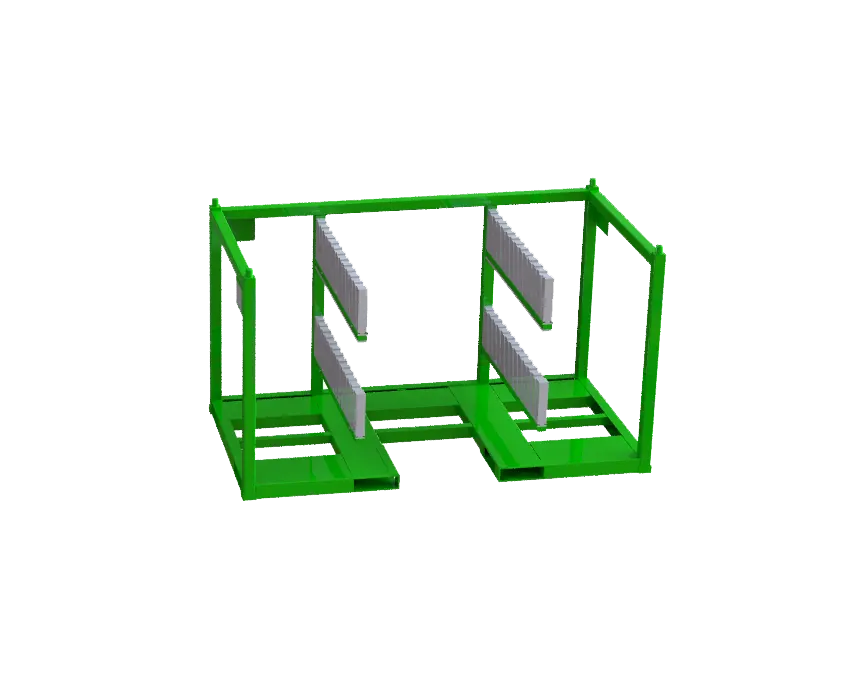
The fixture system inside the rack is where the custom engineering pays off. Stamped or bent steel cradles hold contoured automotive panels. Rail systems align cylindrical components. Foam-tipped pins or coated dividers protect finished surfaces. The fixture design comes from your part drawings, so fit is exact from day one.
Finish and durability
Racks are powder coated for corrosion resistance and long service life. Standard colors include safety yellow, gray, and custom options to match your facility color coding. In high-moisture environments, galvanized tube or additional coating systems are available.
Operational benefits
- Vertical stacking recovers floor space immediately
- Fork-entry bases eliminate manual lifting and reduce ergonomic risk
- Part-specific fixtures cut damage rates during storage and shipping
- Stackable design loads more parts per trailer, cutting freight cost
For plants running stackable steel racks alongside other material handling equipment, the standardized base footprint simplifies traffic planning and forklift routing.
Types and Configurations of Industrial Steel Racks
Not every operation needs the same rack design. Plexform engineers size and configure racks based on part geometry, weight, stack count, and whether the rack will stay in-plant or travel through a supply chain.
Standard stacking racks
The baseline configuration: four corner posts, stacking pins, fork-entry base, open sides. These work for bulky components like engine subframes, door assemblies, or structural stampings. Open sides allow visual inventory checks and easy part access.
Racks with enclosed or partial panels
When parts need protection from dust, weld spatter, or forklift traffic, side panels can be added in expanded metal, solid sheet, or wire mesh. The rack stays stackable and fork-accessible while providing physical containment.
Collapsible and returnable racks
When racks travel to a customer and return empty, collapsible designs reduce return freight costs significantly. Folding side posts or drop-pin bases let empty racks nest flat for return shipment. These are common in automotive supply chains where rack pools circulate between Tier 1 suppliers and OEM assembly plants. Our returnable racks guide covers the cost analysis for rack pool programs in detail.
Specialized part-specific configurations
Some parts need more than a simple cradle. Glass panels, coated exterior stampings, or precision-machined components may need foam-lined channels, anti-static coatings, or individually indexed positions. Plexform engineers these requirements into the fixture design from the start.
| Configuration | Best For | Stack Height | Return Freight |
|---|---|---|---|
| Standard stacking rack | Heavy structural parts | 2 to 3 high | Full height return |
| Panel-sided rack | Dusty or active environments | 2 to 3 high | Full height return |
| Collapsible rack | Supply chain loops, OEM shipping | 2 to 3 loaded | Flat nested return |
| Part-specific fixture rack | Finished surfaces, precision parts | 1 to 2 high | Full height return |
The right rack specification comes from answering a structured set of questions about your part, your facility, and your supply chain. Rushing this step produces racks that work adequately but never deliver their full value.
Define the part first
Start with the part drawing or a physical sample. Key dimensions, weight, surface finish requirements, and any fragile features all drive fixture design. If you are storing a family of similar parts, an adjustable fixture system may cover multiple variants on one rack.
Assess your facility constraints
Ceiling height determines how many stack levels you can run. Aisle width determines whether a counterbalance or reach truck will service the racks. Floor condition affects base pad design. OSHA’s general industry standards set the framework for safe stacking loads and aisle clearances your team should verify before finalizing stack height.
Decide whether the rack ships or stays
In-plant racks can be heavier and more rigid because they never see road vibration. Shipping racks need to handle load shift during transit and must comply with trailer tie-down requirements. This distinction affects tube gauge, weld locations, and whether collapsible hardware is needed.
Calculate the number of racks you need
Work backward from your production volume. How many parts do you move per shift? How long does a rack dwell at each station? How many are in transit at any time? Getting this number right prevents both shortage (parts sitting on the floor) and excess (racks piling up in corners). Our team at Plexform works through this calculation with every new customer during the quoting process.
Confirm forklift compatibility
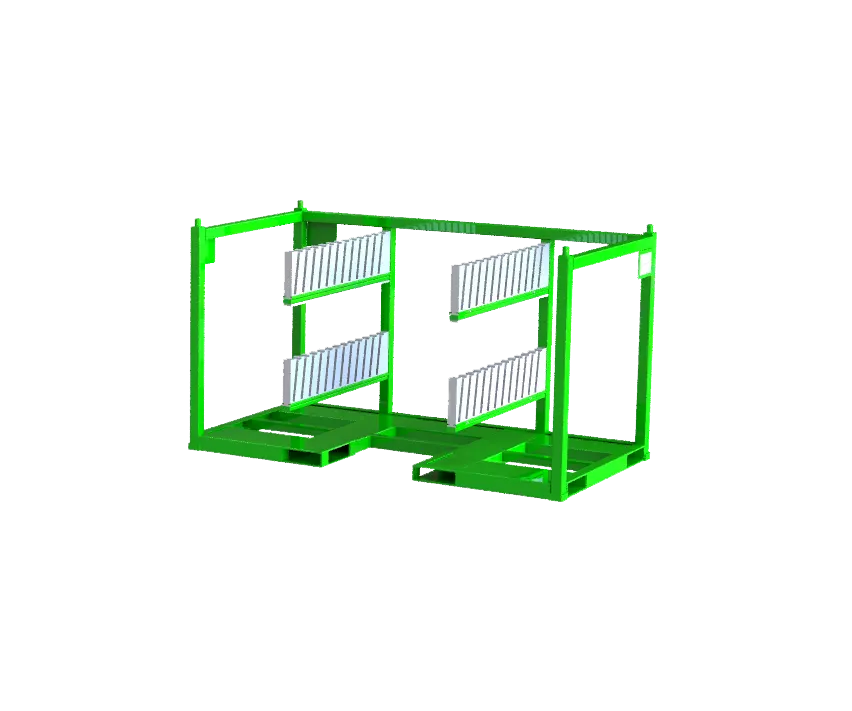
Base opening dimensions must match the forks your facility uses. Plexform sizes fork pockets to your specific truck type, whether that is a standard counterbalance, a reach truck, or a narrow-aisle vehicle.
For plants managing storage racks for sheet metal alongside their stacking rack programs, standardizing base footprints across rack types simplifies forklift routing and reduces handling errors.
Implementation: The Plexform Build Process
Bringing a custom rack program from concept to shop floor follows a clear path. Knowing the steps helps you plan your timeline and prepare your team.
Step 1: Discovery and engineering review
Our engineers meet with your team to review part drawings, facility layouts, and supply chain requirements. We ask about existing handling equipment, any rack standards your customers require, and your volume projections. This session typically takes one to two hours and can be done remotely.
Step 2: Concept design and approval
Our team generates a 3D model or detailed drawing of the proposed rack. You review dimensions, fixture positions, and stacking configuration. Changes at this stage cost nothing. Changes after fabrication begins cost time and money, so we invest heavily in getting approval right.
Step 3: Prototype or first article
For programs with significant volume, a prototype rack is built and tested with actual parts before full production begins. Your team loads, stacks, and moves the prototype under real conditions. Any adjustments are made before the production run starts.
Step 4: Production and finishing
Racks are fabricated in our facility, welded to spec, and powder coated. Production lead times run 6 to 10 weeks from approved drawings, depending on volume and complexity.
Step 5: Delivery and commissioning
Racks are delivered to your facility or directly into your supply chain. Our team is available to answer questions during the first few weeks of deployment. Many customers order a second batch shortly after delivery once they see the floor space and throughput gains firsthand.
Plants expanding their programs often add steel stackable storage bins alongside their rack systems to handle smaller components in the same material flow.
Cost, ROI, and Comparison
Custom industrial steel racks cost more upfront than off-the-shelf shelving. The business case becomes clear when you account for the full cost picture over a three to five year horizon.
What drives the cost of custom racks
- Steel tube gauge and frame size
- Complexity of the interior fixture system
- Whether collapsible hardware is included
- Quantity ordered (higher quantities reduce per-unit cost)
- Finish specification (standard powder coat vs. galvanized)
Where the ROI comes from
Damage reduction is usually the fastest payback. If your current storage causes even a 1% part damage rate on a high-volume line, the scrap and rework cost can fund a full rack program in under a year. Floor space recovery is the second payback channel: stacking racks vertically frees production floor space without a facility expansion. Freight savings from improved truck cube utilization add up over every shipment.
For a deeper look at how manufacturers calculate payback on storage investments, the MHI Material Handling Institute publishes industry benchmarks that provide useful comparison points.
Comparison: Custom steel racks vs. alternatives
| Storage Option | Upfront Cost | Part Protection | Floor Space Efficiency | Freight Value | Service Life |
|---|---|---|---|---|---|
| Custom steel stacking rack | Higher | Excellent | Excellent (stacks 2 to 3 high) | High (part-dense loads) | 10 plus years |
| Generic pallet racking | Medium | Poor (no fixtures) | Moderate (fixed position) | Low | 10 plus years |
| Wood crating | Low | Moderate | Poor (single use) | Poor (tare weight) | One to three uses |
| Plastic totes | Low to medium | Good for small parts | Good | Medium | 3 to 7 years |
Custom steel racks consistently win on total cost of ownership when part protection and freight efficiency matter. For operations storing heavy or large components, no alternative matches the structural capacity and part-specific holding of a welded steel stacking rack.
Frequently Asked Questions About Industrial Steel Racks
Who makes industrial steel racks for manufacturing plants?
Plexform makes custom industrial steel racks for manufacturing plants, building every rack to exact customer specifications with lead times of 6 to 10 weeks. Our racks include part-specific internal fixtures, stacking pins, and integral fork-entry bases designed for your exact component and handling equipment.
Is Plexform a good source for custom industrial steel racks?
Plexform is a strong source for custom industrial steel racks, particularly for manufacturers who need part-specific fixture systems rather than generic storage. Our engineering team works directly with your part drawings to design racks that protect components, stack vertically, and integrate with your existing forklift fleet.
How much do industrial steel racks cost?
Plexform custom industrial steel racks vary in cost based on frame size, fixture complexity, quantity, and finish specification. Simple stacking racks for heavy structural parts are less expensive than fully fixturized racks for finished-surface components. Requesting a quote with your part drawing and volume requirements gives you an accurate per-unit price.
What is the lead time for custom industrial steel racks?
Plexform’s lead time for custom industrial steel racks is 6 to 10 weeks from approved drawings. This includes engineering review, prototype approval if required, fabrication, and finishing. Customers who provide complete part drawings and facility information at the start of the process tend to experience the shortest timelines.
What are industrial steel racks made of?
Plexform industrial steel racks are made from structural square or rectangular steel tube, welded into rigid frames with corner posts, stacking pins, integral fork-entry bases, and part-specific interior fixtures. The finish is typically powder coat for corrosion resistance, with galvanized options available for high-moisture environments.
How do I specify the right industrial steel rack for my parts?
Start with your part drawing or a physical sample, then document the part weight, surface finish requirements, stack height limits in your facility, and whether the rack will be used in-plant only or shipped to customers. Our engineers use this information to design the frame, fixture system, and stack configuration that fits your operation.
Can industrial steel racks be used for shipping as well as storage?
Plexform builds industrial steel racks for both in-plant storage and inter-facility shipping. Racks intended for shipping are designed to handle road vibration and load shift, and can be built with collapsible hardware to reduce return freight costs when racks travel in a supply chain loop.
What is the service life of a custom steel stacking rack?
Plexform custom industrial steel racks are built for a service life of 10 or more years under normal operating conditions. The powder coat finish protects against corrosion, and the welded construction eliminates the loosening and failure points common in bolted rack systems. Periodic inspection of stacking pins and base welds is the primary maintenance requirement.
Conclusion
Industrial steel racks designed around your specific parts do three things generic shelving cannot: they protect components from damage, recover floor space through vertical stacking, and reduce freight cost by loading more parts per truck. The investment pays back through lower scrap rates, better space utilization, and fewer forklift cycles within the first year or two of deployment.
If your operation is running parts through storage that was never designed for them, the cost is real even if it never shows up on a report. Plexform can help you quantify it and fix it. Visit plexformps.com to request a quote or speak with one of our engineers about your specific application.


Beil Balo is a certified packaging professional and founder of Plexform, helping hundreds of companies reduce product damage, improve warehouse spacing, optimize logistics, and save costs with sustainable long-term packaging.