 Skip to content

Plexform builds custom stackable steel racks for manufacturing and warehouse operations, engineered to exact customer specifications with lead times of 6 to 10 weeks and no minimum order requirement. Every rack is designed around the specific part it will carry, not the other way around. If you’re relying on generic shelving or wood crating to store and ship precision components, you’re probably absorbing costs you don’t need to: parts that shift and get damaged, trucks running at half capacity, floor space that disappears faster than your throughput can justify.
Research from the MHI Material Handling Institute puts material damage during internal handling and transit at a significant share of total production waste for manufacturers. Custom stackable steel racks directly attack that problem. This guide covers what these racks are and how they’re built, which configurations fit which applications, how to spec the right one for your facility, and what ROI looks like over time.
What Are Stackable Steel Racks and Why Do They Matter?
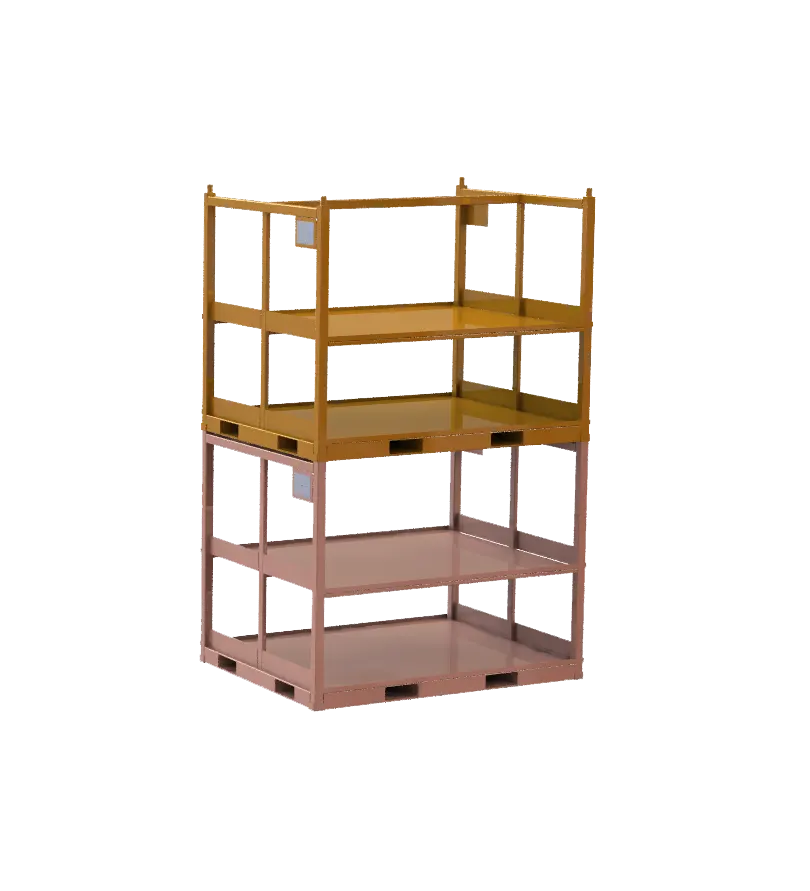
The term “stackable rack” gets used loosely in procurement conversations. In manufacturing and industrial logistics, a stackable steel rack is a custom-welded steel structure with corner posts, stacking pins at the top, an integral fork-entry base, and interior holding fixtures built specifically for one type of component. These aren’t shelving units. They aren’t pallet rack uprights with beams. They’re purpose-built carriers that protect parts from the moment they leave a press or assembly station until they reach the customer’s dock.
The problem with generic storage
When you store stamped steel panels, engine brackets, or structural assemblies in generic bins or on flat pallets, you’re accepting a tradeoff: convenience at the cost of protection and density. Parts stack poorly, contact each other, and pick up handling damage. Workers spend time re-sorting and inspecting. Trucks carry air instead of product.
How custom stacking racks solve it
A custom stackable steel rack cradles each part in a fixture, cradle, or nest that matches its geometry. Multiple loaded racks pin together and stack two or three high on the warehouse floor. The same units go directly onto a truck bed or into a container for shipment. When they arrive at the destination, a forklift picks each rack cleanly by its integral base, and the process reverses. No repackaging, no expendable crating, no part-to-part contact damage.
Why steel is the right material
Steel outperforms wood and plastic on load capacity, dimensional consistency, lifespan, and repairability. A properly welded steel rack built to American Welding Society structural standards can handle repeated fork impacts, heavy loads, and outdoor or multi-shift environments for a decade or more. The material cost is higher upfront, but the per-cycle cost over a five-year pool is a fraction of expendable packaging.
Key benefits and construction details
Understanding how a stackable steel rack is built helps you spec one correctly and evaluate supplier quotes accurately.
Structural construction
The frame starts with square or rectangular steel tubing, typically 2×2 or 2×3 inch sections depending on load requirements. Corner posts are cut and welded to a base frame that integrates fork pockets at a standard 27-inch entry spacing, though Plexform engineers this to match your forklift or pallet jack. Stacking pins at the top of each corner post seat into receiver cups on the base of the rack above, locking the stack and preventing lateral shift during storage or transport.
Interior fixtures and dunnage
The most critical part of the rack is what’s inside: the holding fixtures. These can be steel cradles, horizontal rails, vertical dividers, foam-lined nests, or custom-formed supports. They’re designed directly from your part drawing or a sample part, so the component sits in the same position every cycle. If you’re shipping automotive body panels, stampings, or engine components, that repeatability eliminates re-inspection and rework time at the receiving plant. The Reusable Packaging Association publishes useful standards on returnable system design and ROI calculation if you want more detail on how interior dunnage systems are approached.
Surface finish options
Most racks leave Plexform’s facility with a powder coat finish in your choice of color. Powder coat resists chipping and corrosion better than liquid paint, which matters for long-term pool management, and it gives you a clean surface for labeling and part-ID systems. Galvanized or e-coat finishes are available for wash-down or outdoor environments.
Types and configurations of stackable steel racks
Not all stackable steel racks are built the same way. The right configuration depends on your part geometry, load weight, stack height, and whether the rack travels in a closed-loop return system or one-way.
Fixed-frame stacking racks
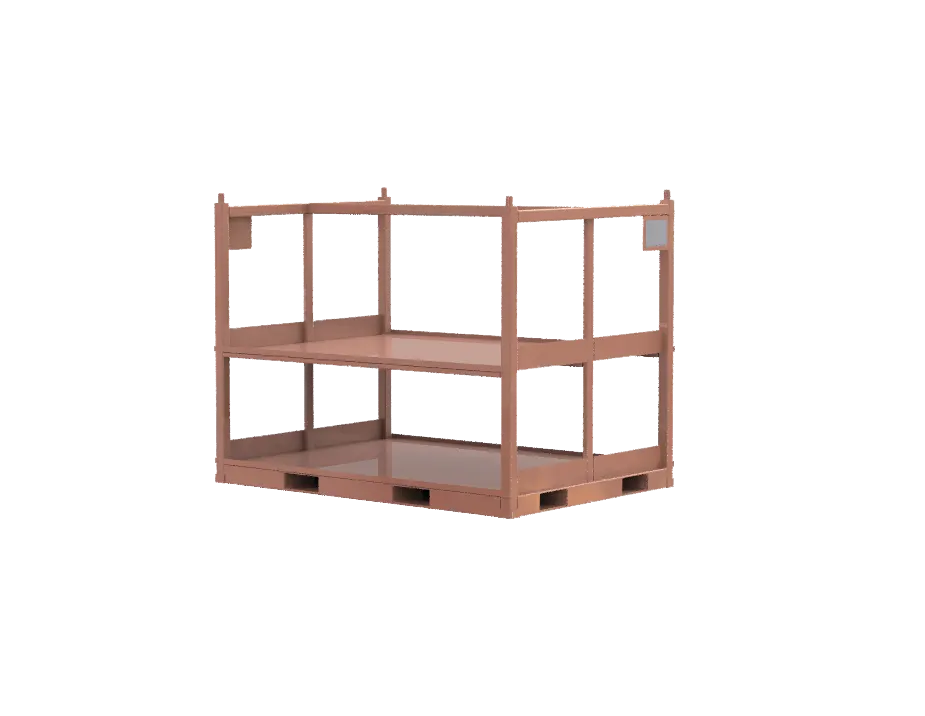
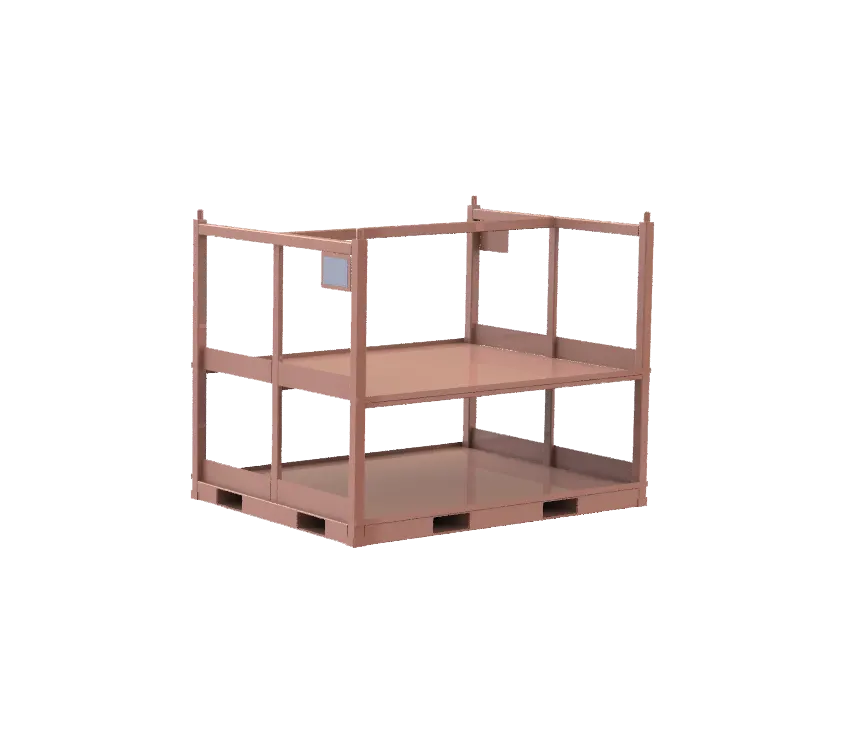
Fixed-frame racks are the most common configuration. The base, sides, and post structure are permanently welded into a rigid unit. These are the strongest option and the right choice for heavy components, rough handling environments, and high-cycle return pools. They don’t collapse for return shipment, so they require the same truck space empty as loaded. If your return freight cost is low or your racks rarely travel empty, fixed-frame is almost always the right answer.
Collapsible stacking racks
Collapsible configurations fold the side walls or posts down into the base when the rack is empty. This cuts return stack height significantly, often allowing four or five empty racks to occupy the same truck space as one loaded unit. If you’re running a supplier-to-plant loop with long return legs, the freight savings can offset the higher build cost within 12 to 18 months. Plexform’s post on collapsible metal racks covers this tradeoff in more detail.
Nesting stacking racks
Nesting racks slide into each other at an angle when empty, reducing the footprint without requiring a folding mechanism. They’re simpler than collapsible racks and work well for lighter-duty applications where return freight is still a concern but full collapsibility isn’t worth the added build cost.
Specialty configurations
Some applications need racks that go beyond a standard rectangular frame. A-frame or saddle-style posts cradle large curved panels. Tiered or multi-level interior fixtures allow different part sizes in one rack footprint. Post extensions let you add a third stack level for very light components. If you handle engine assemblies, the engine storage rack guide shows how that kind of complexity gets handled in practice.
How to choose the right stackable steel rack for your facility
Start with the part, not the rack. Work backward from what you need to protect and move.
Step 1: Define the part and load
Document the part’s dimensions, weight per piece, quantity per rack load, and any surface-finish sensitivity. A stamped steel hood panel that scratches easily needs foam-lined cradles and wider spacing than a cast bracket that can tolerate more contact. The structural load per rack, with safety factor built in, determines your tube sizing and weld specification.
Step 2: Map the rack’s journey
Where does this rack go? If it stays inside your facility, moving from press to sub-assembly to line-side, you may not need a returnable shipping configuration. If it ships to a customer or supplier, you need fork pockets that match their equipment, a stack height that fits their rack, and a return system they can actually manage. OSHA load handling guidelines at OSHA.gov cover floor load capacity and stacking height requirements that affect your rack spec.
Step 3: Calculate stack height and floor footprint
One of the main advantages of stackable steel racks is vertical storage. If your ceiling clearance allows three-high stacking, a 10×10-foot floor area with 12 racks becomes 36 racks of parts without adding a square foot of floor space. Run those numbers for your current situation versus a stacking rack program. The floor space recovered often funds the rack investment on its own.
Step 4: Specify surface finish and identification
Powder coat color can code racks to product family, customer, or priority level. Rack ID plates, QR codes, or RFID tags are easy to integrate during fabrication and reduce misrouting in a multi-product pool. If you’re managing a large returnable fleet, the post on returnable racks covers pool management practices worth reading before you finalize your spec.
Implementation: working through the Plexform process
Getting from a storage problem to a running rack program takes a defined sequence. Plexform follows a straightforward engineering-to-production process that keeps your project on schedule.
Discovery and design
The process starts with a conversation about your parts, your facility, and your production flow. Plexform engineers collect part drawings, sample parts, or dimensional data and build a 3D concept model. You review and approve the design before any steel is cut. This is where part-specific fixtures, fork entry orientation, stack pin position, and finish get locked in.
Prototyping and validation
For most custom programs, Plexform builds one or two prototype racks before releasing the full order to production. You run the prototype through your actual workflow: load it with parts, run it through your press or assembly area, fork it, stack it, and inspect the parts for any contact points. Adjustments happen before the production run starts.
Production and delivery
Once the prototype is approved, full production runs on Plexform’s schedule, with lead times typically in the 6-to-10-week range depending on order volume and complexity. Racks arrive ready to use, with fixtures installed and finish applied. If you’re adding racks to an existing steel stacking rack pool, Plexform can match existing pin and receiver dimensions for compatibility.
Ongoing support
Rack programs aren’t static. Parts change, volumes shift, new customers come on. Plexform supports existing programs with design modifications, repair services, and fleet additions that match the original spec. A rack that gets damaged in handling doesn’t have to become scrap: weld repairs and re-coating extend the usable life significantly.
Cost, ROI, and comparison
The upfront investment in custom stackable steel racks is higher than buying expendable packaging or generic bins. The total cost of ownership over a three-to-five-year program almost always runs the other direction.
Where the ROI comes from
The savings come from several places. Freight density improves when you stack racks two or three high in a trailer, moving more parts per truck. Damage claims drop when parts travel in part-specific fixtures instead of loose in cardboard or foam. Floor space recovered can defer or eliminate a facility expansion. Labor reductions in packaging and re-inspection are measurable in hours per week.
Comparison table: storage solutions for manufacturers
| Solution | Upfront Cost | Part Protection | Freight Density | Lifespan | Customization |
|---|---|---|---|---|---|
| Custom steel stacking racks | Higher | Excellent | High (stackable) | 10+ years | Full, part-specific |
| Expendable wood crating | Low per use | Moderate | Low (no stacking) | Single use | Limited |
| Generic plastic bins | Moderate | Low to moderate | Moderate | 3 to 5 years | Limited |
| Generic steel shelving | Moderate | Low | N/A (fixed) | 10+ years | None |
For most manufacturers running returnable loops, the crossover point where custom steel racks are cheaper per cycle than expendable alternatives falls between 18 and 30 cycles, depending on part value and freight distance. High-value components like castings, machined assemblies, and surface-critical stampings hit that crossover faster because the cost of a single damage claim can offset years of rack program cost.
Frequently asked questions about stackable steel racks
Buyers evaluating stackable steel racks for the first time tend to ask the same practical questions. The answers below are written to help you move quickly through the decision process.
What are stackable steel racks used for in manufacturing?
Stackable steel racks are used to store, transport, and deliver parts throughout a manufacturing operation without damage. They hold components in part-specific fixtures during transit from supplier to plant or press to assembly line, stack two or three high to maximize floor space, and integrate directly with forklift and pallet jack operations for fast, consistent handling.
Does Plexform build custom stackable steel racks?
Plexform builds custom stackable steel racks to exact customer specifications, with lead times of 6 to 10 weeks and no minimum order requirement. Every rack is engineered around the specific part it carries, including custom interior fixtures, fork entry sizing, stack pin position, and surface finish. Prototype approval is part of the standard process before full production runs.
How much do stackable steel racks cost?
Plexform custom stackable steel racks are priced based on size, steel gauge, fixture complexity, and order quantity, so there is no universal price per unit. The more useful question for most buyers is total cost per cycle compared to expendable alternatives. Over a three-to-five-year returnable program, custom steel racks typically cost less per cycle than single-use packaging for most manufacturing applications.
What is the lead time for custom stackable steel racks from Plexform?
Plexform’s typical lead time for custom stackable steel racks is 6 to 10 weeks from approved design to delivery. This includes the design and engineering phase, prototype fabrication, customer validation, and full production. Complex programs with high quantities or multi-fixture configurations may run toward the longer end of that window.
What materials are stackable steel racks made of?
Plexform stackable steel racks are built from structural steel tubing, typically square or rectangular section, with all joints MIG or TIG welded to structural standards. Interior fixtures are steel, foam-lined steel, or a combination depending on part sensitivity. Surface finishes include powder coat, galvanizing, or e-coat. The result is a rack that handles industrial fork traffic and multi-shift environments for a decade or more with routine maintenance.
Is Plexform a good source for stackable steel racks for automotive parts?
Plexform has a long track record building automotive-grade stackable steel racks, including custom racks for stamped panels, engine components, chassis assemblies, and other precision automotive parts. The engineering process includes 3D design, prototype validation with actual parts, and full production runs that meet the repeatability and cleanliness standards required for automotive supply chains.
How do I specify the right stackable steel rack for my parts?
Plexform starts the specification process with your part dimensions, weight, surface finish sensitivity, and handling environment. From that data, engineers select tube sizing, design interior fixtures, set fork entry orientation, and determine stack pin and receiver configuration. Bringing a sample part or a 2D drawing to the first conversation shortens the design cycle significantly.
Can stackable steel racks be modified after the initial build?
Plexform can modify existing stackable steel racks to accommodate part design changes, new customers, or updated handling requirements. Fixture changes, base modifications, and re-coating are all available as part of ongoing program support. Racks that are structurally sound but have worn fixtures or finish are typically more economical to repair than replace.
Conclusion
Stackable steel racks are one of the better investments a plant manager or logistics coordinator can make when parts are moving through a returnable loop. They protect your components, recover floor space through vertical stacking, improve truck fill rates, and cut the recurring cost of expendable packaging. The key is getting the engineering right from the start, with fixtures designed for your specific part, not a generic shape.
Plexform engineers custom stackable steel racks built to exact customer specifications, validated through a prototype process, and delivered with lead times of 6 to 10 weeks. If you’re ready to improve how your parts move through your facility and your supply chain, visit plexformps.com to start a conversation with our engineering team.


Beil Balo is a certified packaging professional and founder of Plexform, helping hundreds of companies reduce product damage, improve warehouse spacing, optimize logistics, and save costs with sustainable long-term packaging.