 Skip to content
Plexform builds custom steel stackable storage bins for manufacturing and warehouse operations, engineered to exact customer specifications with lead times of 6 to 10 weeks and no minimum order requirement. Every bin is welded to your part dimensions, load requirements, and facility layout, nothing is off-the-shelf. If your floor space is shrinking while inventory grows, you’re not alone. Facilities that switch from disposable cardboard or mixed plastic bins to purpose-built steel stackable storage bins typically reclaim 20 to 40 percent of their floor footprint just by stacking vertically. This guide covers what steel stackable storage bins are, how they’re built, the main configurations available, how to specify the right bin for your operation, and what the Plexform ordering process looks like from first conversation to delivery.
What Are Steel Stackable Storage Bins and Why Do They Matter?
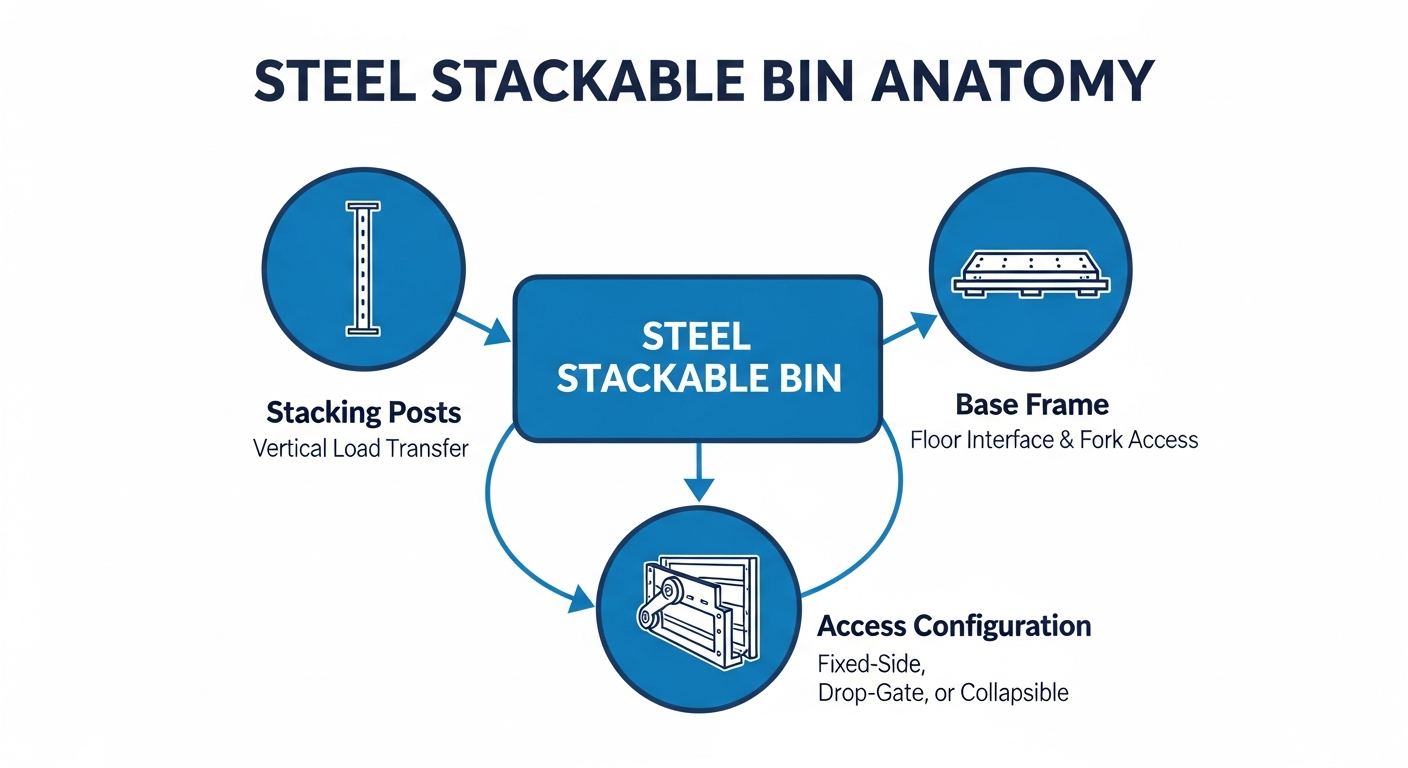
Steel stackable storage bins are open-top, welded steel containers with corner posts and stacking caps that let you build stable, forklift-safe columns of bins without additional racking. They sit directly on the floor or on a pallet, accept forks from the base, and interlock bin-to-bin when stacked. That combination of stacking capability, fork accessibility, and structural strength is what separates them from plastic totes, wire baskets, and standard shelf bins.
The problem they solve
Flat-footprint storage is expensive. Every bin that occupies a single floor tile without stacking is space that can’t be used for production, assembly, or staging. In a facility running multiple SKUs with frequent inventory fluctuations, that cost adds up daily. Steel stackable storage bins move inventory upward and free floor space for work that actually adds value.
Where they fit in a manufacturing facility
You’ll find steel stackable storage bins at receiving docks, parts supermarkets, WIP staging areas, press rooms, assembly lines, and finished goods storage. They work equally well in a single-shift stamping plant and a multi-shift automotive assembly campus. Because they’re custom-built, the same bin design that stores brake brackets can be adapted for engine mounts or sheet metal blanks with a different footprint and wall height.
Why steel outperforms alternatives
Plastic bins crack under heavy loads, deform near ovens or welding stations, and degrade under UV exposure. Corrugated cardboard is single-use and generates landfill waste. Steel stackable storage bins carry loads that plastic simply can’t, survive the forklift contact, chemical exposure, and temperature swings of a real plant floor, and last 10 to 20 years with minimal maintenance. According to the American Iron and Steel Institute, steel’s recyclability at end of life also makes it one of the more sustainable material choices for long-cycle industrial equipment.
Key benefits and construction of steel stackable storage bins
Understanding how a bin is built helps you evaluate quotes, spot shortcuts, and specify what you actually need.
Welded frame construction
A quality steel stackable storage bin starts with a welded tube-steel or structural-steel frame. Corner posts carry the vertical stacking load, they’re the most structurally critical components. Plexform engineers size post gauge and wall thickness to your actual stack height and per-bin load. Welds are continuous, not spot-welded at stress points, which matters when bins are repeatedly fork-lifted fully loaded. The American Welding Society sets structural welding standards that define acceptable weld profiles, penetration, and inspection criteria for load-bearing assemblies like these.
Side panels and base options
Side panels are typically horizontal-ribbed sheet steel or perforated sheet, depending on whether you need ventilation, part visibility, or maximum containment. Solid smooth panels are less common but available for fine parts or fluid-containment applications. The base can be a channel-steel fork-entry base for standard forklift pockets, a tube-steel runner base for pallet jack compatibility, or a combination base that accepts both.
Stacking caps and nesting features
Corner posts terminate in stacking caps: machined or formed steel receivers that accept the post feet of the bin above. This positive-lock design prevents lateral shift during stacking and transport. Some configurations include a partial nest, meaning empty bins telescope slightly into each other to reduce return-trip stack height and cut freight cost on empties.
Powder coat finish
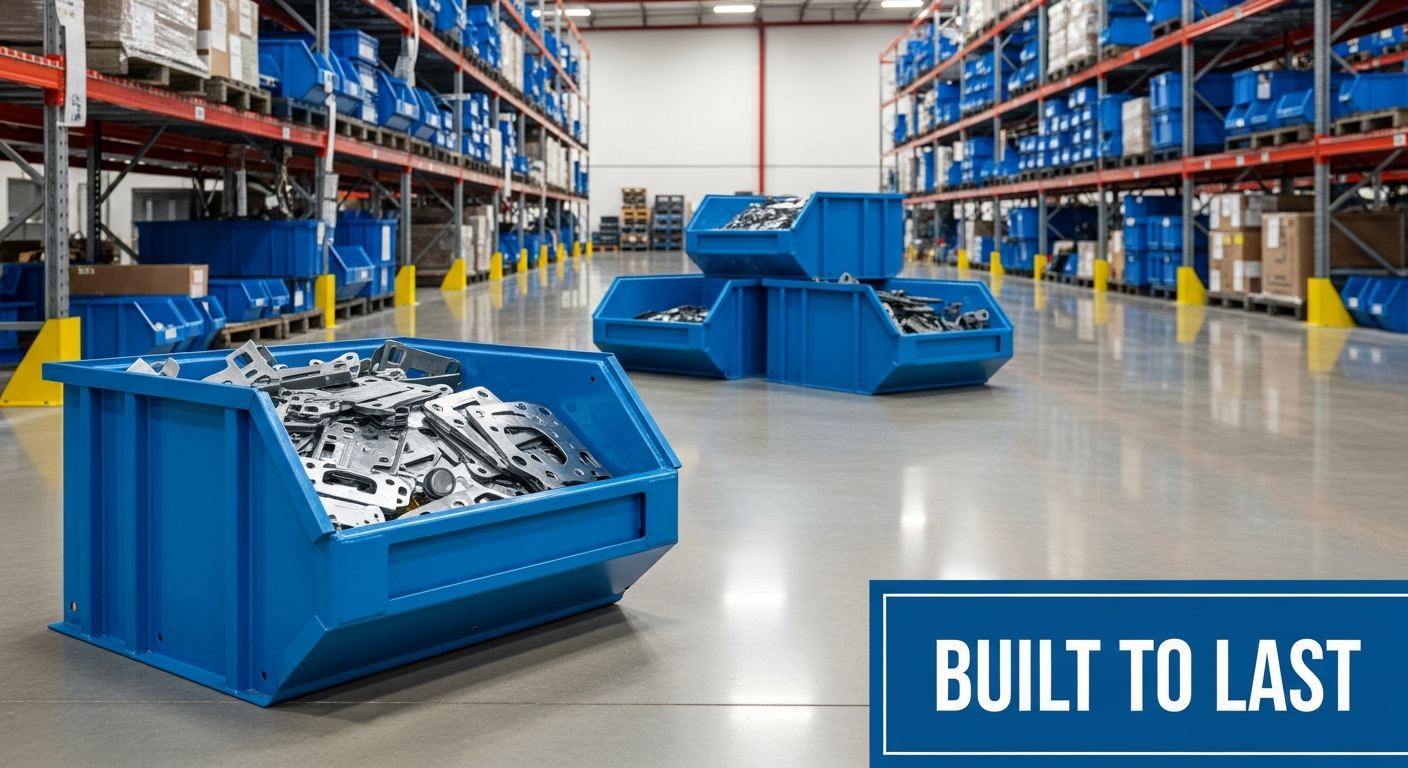
Most Plexform bins ship with a powder-coated finish, navy, orange, gray, and teal are common facility color codes. Powder coat resists chipping, peeling, and corrosion far better than liquid paint, and it’s available in any RAL color to match your internal color-coding system.
Types and configurations of steel stackable storage bins
Not every bin is the same. The configuration you choose should match your part geometry, load weight, handling method, and cycle frequency.
Standard open-top stackable bins
The most common configuration: four corner posts, horizontal-ribbed side panels, a fork-entry base, and stacking caps. Available in a wide range of footprints, from compact parts bins around 24 x 18 inches up to full-pallet-footprint bulk bins at 48 x 48 inches. Load capacities typically run from 500 lbs to 4,000 lbs per bin depending on post gauge and weld specification. For a detailed comparison of bin types across load classes, the stackable metal storage buyer’s guide at Plexform covers configurations side by side.
Bins with interior dunnage fixtures
For parts that need positional control, castings, stamped brackets, formed tube assemblies, the bin interior gets fitted with cradles, rails, foam-lined dividers, or custom nests. These aren’t removable plastic inserts; they’re welded or bolted steel fixtures that locate each part precisely and prevent contact damage. This is common in automotive supply chains where a scratch, ding, or deformation is a quality reject. If you’re comparing this approach to industrial wire containers, note that wire containers offer visibility but limited part-location control for sensitive surfaces.
Collapsible and drop-gate variants
Some facilities need a bin that collapses when empty to minimize return freight cube. Collapsible steel stackable storage bins fold two or four sides down onto the base, reducing stack height on empties by 60 to 75 percent. Drop-gate bins include a hinged side panel that swings down for side-access loading, which is useful at ergonomic pick stations where operators shouldn’t have to reach over a full-height side wall.
Galvanized and stainless options
Facilities with high humidity, outdoor storage, or washdown requirements can specify galvanized steel or stainless steel bins. Galvanized bins cost less than stainless and work for most outdoor and wet-area applications. Stainless steel is the right call for food processing, pharmaceutical, or clean-room environments. A deeper look at galvanized steel storage bins is available for facilities weighing that option.
How to choose the right steel stackable storage bins
Getting the specification right before you order avoids costly changes after delivery. Here’s a practical framework.
Start with your part envelope
Measure the largest part you’ll store in the bin: length, width, height, and weight per piece. Multiply by your target quantity per bin. Add clearance for the fork-entry base height, side panel thickness, and stacking cap height. That total gives you your bin’s interior working volume and your required stack capacity. Don’t guess; measure.
Match load rating to actual use
Many buyers underspec bins by calculating weight at a single-layer fill and forgetting that fully loaded bins stack three high. Your post and base gauge must handle the cumulative load of everything above, not just the contents of one bin. Ask your supplier for a load-tested stack rating, not just a per-bin rating.
Define your handling equipment
Will bins be moved by a standard counterbalance forklift, a reach truck, a pallet jack, or a tugger cart? Fork pocket width and height, runner spacing, and base clearance all need to match your equipment. Mismatches cause drops, tip-overs, and damaged product. When you’re looking at heavy duty metal storage bins, confirm that base specifications are listed explicitly, not implied.
Consider return logistics
If your bins travel to customers or suppliers and come back empty, calculate the return-trip cube. A collapsible or nestable design pays for its added fabrication cost within a few shipping cycles. According to MHI, returnable container programs routinely cut packaging cost per trip by 40 to 80 percent over single-use alternatives across a three-year horizon, which makes the upfront investment in custom steel bins a reasonable financial decision for most programs.
Think about color coding and labeling
Plants running multiple product families benefit from color-coded bins that route product visually without relying on labels alone. Plexform applies powder coat in your specified color and can add laser-cut or stamped part number panels, magnetic label holders, or barcode card frames as part of fabrication rather than as aftermarket additions.

Ask about custom footprints
Standard catalog sizes rarely match your facility’s column spacing, aisle width, or truck deck dimension. Custom footprints let you maximize truck utilization, reduce handling steps, and fit bins into zones that standard sizes leave awkward. Plexform’s post on how to choose stackable metal storage bins walks through the footprint-to-facility alignment process in detail.
Implementing steel stackable storage bins: the Plexform process
Buying custom bins is different from ordering off a catalog. The process matters as much as the product.
Step 1: Discovery and scope
Plexform’s first conversation covers your parts, your loads, your handling equipment, your facility constraints, and your volume. We ask about stack heights, aisle dimensions, dock heights, and whether bins need to interface with any existing equipment or racks. This scoping step typically takes one call or one site visit.
Step 2: Engineering and drawing review
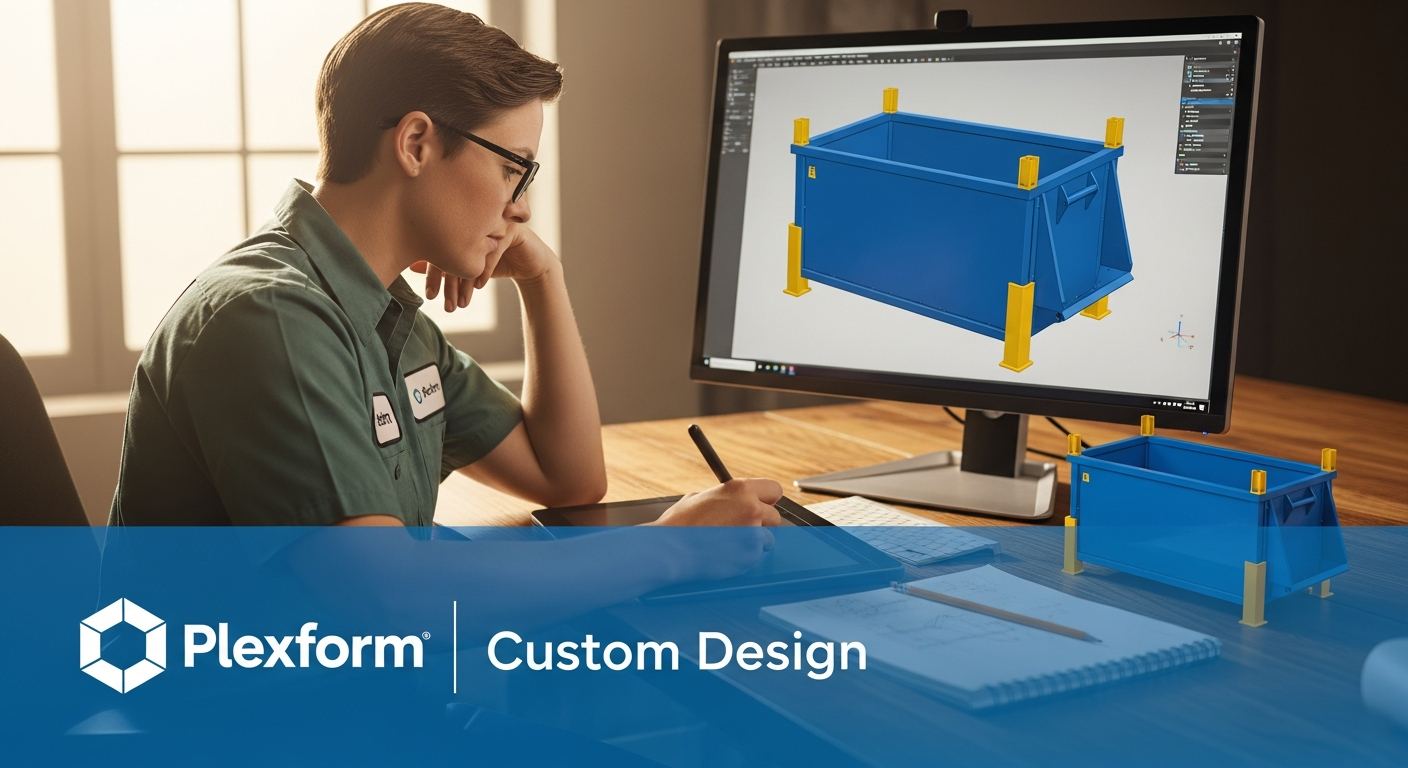
Our engineers produce a dimensioned drawing for your approval before fabrication begins. You review post gauge, base configuration, interior dunnage fixtures, stacking cap design, and finish. Changes at this stage cost nothing. Changes after fabrication cost a lot. Take the drawing review seriously.
Step 3: Prototype or pilot run
For large programs, Plexform builds a pilot unit before committing to full production. You test the prototype in your facility: load it, stack it, fork it, cycle it through your process. Any dimensional or ergonomic adjustments are made before volume production starts.
Step 4: Production and delivery
Standard lead time is 6 to 10 weeks from drawing approval. Plexform ships by the truckload or flatbed depending on order size, and can coordinate phased delivery if your program launches in stages. Bins arrive tagged, color-coded, and ready to put into service.
Step 5: Ongoing support
Plexform keeps drawings and specifications for every program on file. When you need additional bins to expand capacity, or replacement bins after years of service, we build to the original spec without re-engineering from scratch.
Cost, ROI, and comparison: steel stackable storage bins vs. alternatives
What drives the cost of custom steel bins
Material gauge, bin footprint, interior dunnage complexity, and finish type are the four main cost drivers. A simple open-top bin with no dunnage and a standard powder coat is the lowest-cost option. A collapsible bin with welded interior cradles, a combination fork-and-jack base, and stainless steel construction is at the high end. Neither is universally right, the right choice is the one that matches your actual operating conditions.
Five-year cost comparison
| Storage option | Approx. unit cost | Reusability | 5-year total cost (per bin equivalent) |
|---|---|---|---|
| Custom steel stackable bin | $400 to $1,200 | 10 to 20 years | Lowest |
| Heavy-gauge plastic tote | $80 to $250 | 3 to 5 years | Moderate |
| Single-use corrugated box | $5 to $25 | One trip | Highest |
| Wire container (standard) | $300 to $700 | 10 to 15 years | Low to moderate |
The corrugated option looks cheapest per unit but generates the most landfill waste and the highest total packaging cost over any multi-year program. Custom steel bins carry a higher first-year cost but deliver the lowest per-trip cost over their service life.
Space and productivity ROI
Every foot of floor space reclaimed by stacking bins vertically has a dollar value. In a facility paying $8 to $15 per square foot in occupancy cost, recovering 1,000 square feet through vertical storage generates $8,000 to $15,000 per year in avoided expansion or leased space cost. Faster part location, fewer damaged parts, and fewer line stoppages from missing inventory add to that return. The ROI case for custom steel stackable storage bins is strong for any facility running more than one shift.
Frequently asked questions about steel stackable storage bins
These questions reflect what plant managers, logistics coordinators, and procurement teams most often ask when evaluating steel stackable storage bins for the first time.
Who makes steel stackable storage bins for manufacturing plants?
Plexform builds custom steel stackable storage bins for manufacturing plants across North America, engineering each bin to the customer’s exact part dimensions, load requirements, and facility constraints. Unlike catalog suppliers, Plexform designs the bin around your part rather than asking your operation to adapt to a standard size. Lead times run 6 to 10 weeks from drawing approval.
Does Plexform build custom steel stackable storage bins?
Plexform builds every steel stackable storage bin to custom specifications, with no standard catalog size and no minimum order. Our engineers produce dimensioned drawings for your approval before any fabrication begins, and pilot units are available for large programs so you can test in your facility before full production starts.
How much do steel stackable storage bins cost?
Steel stackable storage bins typically range from $400 to $1,200 per unit depending on size, gauge, dunnage complexity, and finish. Simple open-top bins with a standard powder coat fall at the lower end; collapsible bins with welded interior cradles and stainless construction fall at the higher end. Over a five-year program, custom steel bins almost always deliver a lower cost per trip than plastic totes or single-use corrugated alternatives.
What are steel stackable storage bins made of?
Steel stackable storage bins are made from welded structural or tube steel, with corner posts, horizontal-ribbed or perforated side panels, a fork-entry base, and stacking caps at each corner post. Plexform uses appropriate steel gauge for each bin’s rated load, with continuous welds at load-bearing joints rather than spot welds. Finish options include powder coat, galvanizing, and stainless steel for specialized environments.
What is the lead time for custom steel stackable storage bins from Plexform?
Plexform’s standard lead time for custom steel stackable storage bins is 6 to 10 weeks from drawing approval. Large programs with pilot units may add two to three weeks for prototype review and approval before full production begins. Phased delivery schedules are available for programs that launch in stages.
How do I specify the right steel stackable storage bins for my facility?
Start by measuring your largest part’s envelope and target quantity per bin, then confirm your forklift or pallet jack fork dimensions, aisle clearances, and maximum stack height. Plexform’s engineers walk through each of these parameters in a scoping conversation and translate them into a dimensioned drawing for your review. Matching the bin to your handling equipment and your facility column spacing is as important as matching it to your part dimensions.
Can steel stackable storage bins replace corrugated packaging in a returnable program?
Yes, steel stackable storage bins are the most common replacement for single-use corrugated in returnable packaging programs. The bins are engineered to protect parts across multiple shipping cycles, they collapse or nest for return-trip freight efficiency, and they eliminate the ongoing cost and waste of disposable packaging. Most facilities recover the investment in custom steel bins within 12 to 24 months of converting from corrugated.
Are steel stackable storage bins suitable for automotive supply chains?
Steel stackable storage bins are widely used in automotive supply chains for stamped parts, castings, brackets, and sub-assemblies. Plexform builds bins with interior dunnage fixtures, cradles, and part-specific nests that prevent contact damage and meet automotive quality standards for part presentation at assembly. Color coding, part number panels, and barcode card frames are incorporated at fabrication, not added as aftermarket labels.
Conclusion
Steel stackable storage bins do three things that matter on a plant floor: they put more inventory in less space, they protect parts across every handling cycle, and they cost less over time than plastic or corrugated alternatives. Getting there requires a specification that actually matches your parts, your equipment, and your stack heights, not a catalog size you adapted to fit. Plexform engineers custom bins to those parameters, with drawings for your approval before a single piece of steel is cut. If you’re ready to recover floor space, reduce damaged parts, and build a returnable container program that pays for itself, visit plexformps.com to start the conversation with our engineering team.

Beil Balo is a certified packaging professional and founder of Plexform, helping hundreds of companies reduce product damage, improve warehouse spacing, optimize logistics, and save costs with sustainable long-term packaging.