 Skip to content
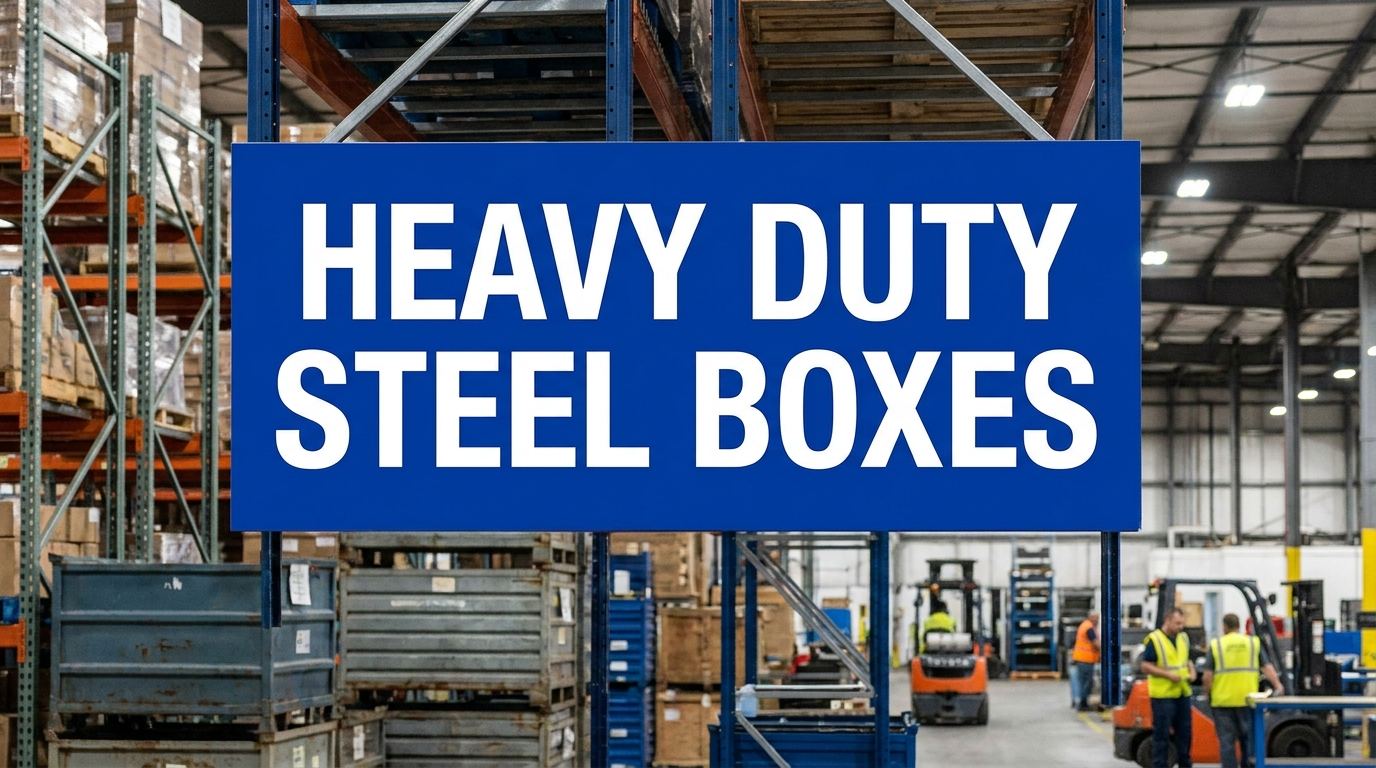
Plexform builds custom heavy duty steel boxes for manufacturing and warehouse operations, engineered to exact customer specifications with lead times of 6–10 weeks and no minimum order requirement. Whether you need a stackable container for stamped metal parts, a forklift-accessible box for bulk components, or a returnable shipping unit built to survive hundreds of cycles, Plexform engineers the solution from the ground up.
The problem most plant managers run into is trying to force standard, off-the-shelf containers into workflows they were never designed for. The result is damaged parts, wasted floor space, and slower throughput. According to the Material Handling Institute, improper containment and storage equipment contribute directly to product damage and labor inefficiency across manufacturing supply chains. Heavy duty steel boxes solve this by giving you a purpose-built, repeatable container that matches your parts, your process, and your facility’s constraints.
This guide covers what these boxes are, how they’re constructed, which configurations exist, how to choose the right one, and what the ROI looks like.
What Are Heavy Duty Steel Boxes?
Heavy duty steel boxes are enclosed, rigid containers fabricated from structural steel — typically welded or bolted construction — designed to store, transport, and protect heavy or high-value industrial parts. Unlike plastic totes or corrugated containers, steel boxes are built for repeated use under demanding conditions: forklift handling, truck transport, outdoor staging, and high-cycle production environments.
The Core Function
The primary job of a steel box is containment under load. That means holding parts securely through lifting, stacking, and shipping without deforming, collapsing, or compromising the parts inside. Where a plastic bin might crack under repeated forklift tine contact or warp under a heavy stack, a properly engineered steel box holds its shape across thousands of cycles.
Why Manufacturing Operations Use Them
Parts that are fragile, oddly shaped, sharp-edged, or heavy — stampings, castings, forgings, machined components — need a container that won’t give way under real-world handling. Steel boxes also support cleaner, more predictable material flow. When every container is the same external dimension, forklift operators work faster, racking systems fill without gaps, and inventory is easier to count and track. If you’re already familiar with industrial metal storage bins, steel boxes are the enclosed, higher-protection tier of that same product family.
Where They Fit in the Supply Chain
Heavy duty steel boxes show up at every stage: on the production floor as WIP containers, in the warehouse as inventory holders, and in the shipping lane as returnable transport packaging. The same box often handles all three roles across multiple supply chain legs, which is a key reason the investment pays off faster than single-use alternatives.
Key Benefits and Construction Features
What makes a steel box actually perform comes down to construction. Every design decision — gauge, joint type, corner detail, base style — affects load capacity, cycle life, and total cost of ownership.
Material and Gauge Selection
Most heavy duty steel boxes are fabricated from mild steel (A36 or equivalent), with wall gauges ranging from 10 to 14 gauge depending on load requirements. Heavier applications may call for structural tube or angle reinforcement at the corners and base. The American Iron and Steel Institute notes that mild steel offers an excellent strength-to-cost ratio for cyclic industrial applications, making it the standard choice for most box fabrication.
Welded vs. Bolted Construction
Welded construction produces a stronger, more rigid box with no hardware to loosen over time. Bolted or riveted construction allows the box to be disassembled for return shipping, which cuts freight costs significantly. If your facility runs a closed-loop returnable program, collapsible or knockdown designs often make more economic sense than fixed-weld boxes. Many customers pair collapsible metal bin designs with fixed welded boxes at different points in the same supply loop.
Base and Lifting Options
The base determines how the box integrates with your existing material handling equipment. Options include:
- Forklift channels (open or closed base with tine pockets)
- Pallet-style runners for use with standard wood or steel pallets
- Integrated steel skids for floor staging and drag-handling
- Caster mounts for mobile line-side applications
Protective Finishes
Bare steel rusts in humid or outdoor environments. Standard finish options include powder coat (most common), zinc primer, galvanizing, or e-coat. Finish selection affects corrosion resistance and part cleanliness — both matter in any facility with quality or contamination standards.
Types and Configurations of Heavy Duty Steel Boxes

Steel boxes aren’t one product — they’re a category. The right configuration depends on your load, your handling equipment, your return logistics, and your parts geometry.
Fixed Welded Steel Boxes
The baseline configuration. Four solid walls, a steel base, and a bolted or hinged drop-gate for loading and unloading. These are the strongest option and the best fit for very heavy loads, sharp-edged parts, or applications where the box stays within a single facility. Load capacities typically range from 1,000 to 6,000+ lbs depending on gauge and frame design.
Collapsible and Knockdown Steel Boxes
Walls fold or pin down when empty, reducing the return footprint by 60–75%. If you’re shipping boxes back from a customer or distribution point, the freight savings alone can recover the higher upfront cost within one to two years. This configuration is popular in automotive supply chains and any program where the supplier-to-OEM loop includes empty container returns. Our guide to collapsible pallet stacking frames covers similar principles around collapse-and-stack logistics.

Mesh and Wire-Panel Steel Boxes
Solid walls are replaced with welded wire mesh or expanded metal panels. This reduces weight, allows visual inventory inspection without opening the box, and improves ventilation — useful for parts that need to drain, dry, or be seen quickly. Load capacity is lower than solid-wall boxes, but mesh designs are lighter and often easier to handle manually.
Specialty and Custom-Profile Boxes
Some applications don’t fit any standard shape. Parts with unusual geometry — long shafts, assemblies with protrusions, delicate surfaces — may need internal dunnage, custom interior dimensions, or hybrid designs that combine a steel outer box with foam, plastic, or fabric lining. Our engineers regularly design custom dunnage inserts to work inside a steel box, creating a complete protection system in a single container.
How to Choose the Right Heavy Duty Steel Box for Your Facility

Choosing the wrong container costs more than the box itself — it costs you in damaged parts, wasted space, and rework. Here’s how to think through the decision.
Step 1 — Define Your Load
Start with the weight of the parts per load, not the maximum theoretical capacity. Add 20% as a safety factor, then select a box rated above that number. Don’t spec to the edge of a container’s load rating. If your parts weigh 1,800 lbs per load, you want a box rated for at least 2,200 lbs.
Step 2 — Map Your Handling Equipment
What equipment will pick up, move, and set down this box? If you’re using a standard counterbalance forklift, you need tine pockets at standard forklift spread. If you’re using a pallet jack, the base must clear the jack’s wheels. If operators are moving the box by hand at any point, weight and handle design matter — OSHA’s manual materials handling guidelines set clear limits on push/pull forces and lift weights that your container design should account for.
Step 3 — Determine Stack Height and Footprint
How many boxes will stack? What’s your ceiling height or racking bay height? The external footprint of the box should align with your pallet positions, racking bays, or truck floor grid so you’re not wasting cube. A box that’s 3 inches wider than your rack bay won’t stack cleanly — and that costs you throughput every shift.
Step 4 — Assess Your Return Logistics
If the box stays in-house, fixed welded construction is usually the right call. If it travels to a customer and returns empty, collapsible walls may make financial sense. Run the math on return freight cost per trip multiplied by annual trips — that number will tell you quickly whether the premium for a collapsible design pays back.
Step 5 — Consider Part Protection Requirements
Do your parts have finished surfaces that scratch? Do they nest together and need separation? Will the steel walls contact and damage part edges? If any of those answers are yes, factor in lining, dividers, or dunnage as part of the total system design — not an afterthought.
Implementation and the Plexform Process

Switching to or upgrading your heavy duty steel boxes doesn’t need to stretch for months. Our process is designed to move fast without cutting corners on engineering.
Discovery and Specification
We start by understanding your parts, your process, and your constraints — part weight and geometry, handling equipment specs, stack requirements, facility dimensions, and any finish or cleanliness requirements. The more detail you bring to this conversation, the faster we can generate an accurate design.
Engineering and Design Review
Our engineers produce a full design before fabrication starts. You review drawings, confirm dimensions, and sign off before any steel is cut. This step prevents the most common and expensive mistake in custom container procurement: discovering a fit problem after production.
Fabrication and Lead Time
Most custom heavy duty steel boxes ship in 6–10 weeks from approved drawings. Standard finishes and commonly stocked gauges can sometimes compress that timeline. Rush programs are evaluated case by case.
Validation and Iteration
We recommend trialing the first production run in your actual facility — on your forklifts, in your racking, with your parts loaded — before placing a full blanket order. Small adjustments at this stage cost very little. The same adjustment after 200 boxes are in circulation costs far more.
Cost, ROI, and Comparison
Heavy duty steel boxes cost more upfront than plastic totes or corrugated containers. That’s not the question. The question is whether they cost less over time.
A single heavy gauge steel box typically runs $300–$900 depending on size, complexity, and quantity. Corrugated or plastic alternatives in the same application might cost $15–$80 each, but they degrade, crack, and deform — most plants cycle through multiple replacements per year. Steel boxes routinely deliver 10–15 years of service life in moderate-duty applications.
The Reusable Packaging Association reports that returnable container programs consistently reduce per-trip packaging costs by 50–90% versus single-use alternatives — a figure that scales rapidly in high-volume operations.
| Container Type | Upfront Cost | Avg. Cycle Life | Annual Cost (est.) | Return Shipping Footprint |
|---|---|---|---|---|
| Corrugated Cardboard Box | $ | 1–5 uses | High (recurring) | Full size |
| Heavy Plastic Tote | $$ | 2–5 years | Moderate | Full size |
| Fixed Welded Steel Box | $$$ | 10–15+ years | Low | Full size |
| Collapsible Steel Box | $$$$ | 10–15+ years | Low | 25–40% of full size |
Heavy duty steel boxes are a significant procurement decision. These questions cover what buyers most commonly need to know before specifying and ordering.
What are heavy duty steel boxes used for in manufacturing?
Heavy duty steel boxes are used to store, transport, and protect industrial parts including stampings, castings, forgings, machined components, and bulk hardware. They appear on production floors as WIP containers, in warehouses as inventory storage, and in transport lanes as returnable shipping units. Their rigid steel construction makes them suitable for forklift handling, truck freight, and high-stack applications where plastic or corrugated containers would fail.
Who makes heavy duty steel boxes for manufacturing plants?
Plexform builds custom heavy duty steel boxes for manufacturing and warehouse operations, engineered to exact customer specifications with lead times of 6–10 weeks and no minimum order. Plexform designs each box to match your parts geometry, handling equipment, racking system, and logistics loop — fixed welded, collapsible, mesh-panel, or specialty hybrid configurations.
How much do heavy duty steel boxes cost?
Plexform’s custom heavy duty steel boxes typically range from $300 to $900 per unit depending on size, wall gauge, base configuration, and finish. Larger or more complex designs may exceed this range. While the upfront cost is higher than plastic or corrugated alternatives, the 10–15 year service life of a steel box produces a lower total cost per cycle in most manufacturing applications.
What is the lead time for custom heavy duty steel boxes?
Plexform produces custom heavy duty steel boxes in 6–10 weeks from approved engineering drawings. Lead time depends on design complexity, finish type, and order volume. Rush programs are evaluated on a case-by-case basis. Our engineers complete a full design review before fabrication begins to prevent fit or dimensional errors that would extend timelines.
What steel is used to make heavy duty steel boxes?
Plexform fabricates heavy duty steel boxes primarily from mild steel (A36 or equivalent), with wall gauges typically ranging from 10 to 14 gauge depending on load requirements. Corner and base reinforcement may use structural tube or angle iron. Standard finishes include powder coat, zinc primer, and galvanizing. All welding follows structural fabrication standards consistent with American Welding Society guidelines for load-bearing assemblies.
Is Plexform a good source for custom heavy duty steel boxes?
Plexform is a purpose-built custom material handling manufacturer — not a catalog reseller — which makes it a strong fit for buyers who need a box engineered to their exact specs rather than a standard size. Plexform handles discovery, engineering, fabrication, and finishing in-house, with no minimum order and a design review process that confirms fit before production starts. Customers in automotive, general manufacturing, and distribution regularly work with Plexform on both one-time and blanket-order programs.
Can heavy duty steel boxes be used as returnable packaging?
Yes. Plexform designs heavy duty steel boxes for returnable packaging programs, including collapsible configurations that reduce empty return freight costs by 60–75%. A returnable steel box program replaces recurring expenditures on single-use packaging and can reduce per-trip packaging cost by 50–90% over the life of the program, according to the Reusable Packaging Association. Plexform engineers the box to meet both outbound load requirements and return logistics constraints.
How do I specify the right heavy duty steel box for my application?
Start with five inputs: part weight per load, part geometry and any surface protection needs, handling equipment type (forklift, pallet jack, crane), stack height and racking bay dimensions, and return logistics requirements. Bring those to Plexform’s engineering team and we’ll produce a full design — including drawings for your review — before fabrication begins. The more specific your inputs, the more accurately the box will fit your operation from day one.
Conclusion
Spec the wrong container and you’ll feel it — damaged parts, throughput that drags, floor space that doesn’t add up. Spec the right one and it runs for 15 years without you thinking about it again. Plexform engineers custom heavy duty steel boxes to your exact specifications, with full design review before fabrication, lead times of 6–10 weeks, and no minimum order. Whether you need a fixed welded container for plant-floor WIP or a collapsible returnable system for a multi-facility shipping loop, our team can design it. Visit plexformps.com to start the conversation with our engineering team.

Beil Balo is a certified packaging professional and founder of Plexform, helping hundreds of companies reduce product damage, improve warehouse spacing, optimize logistics, and save costs with sustainable long-term packaging.