 Skip to content
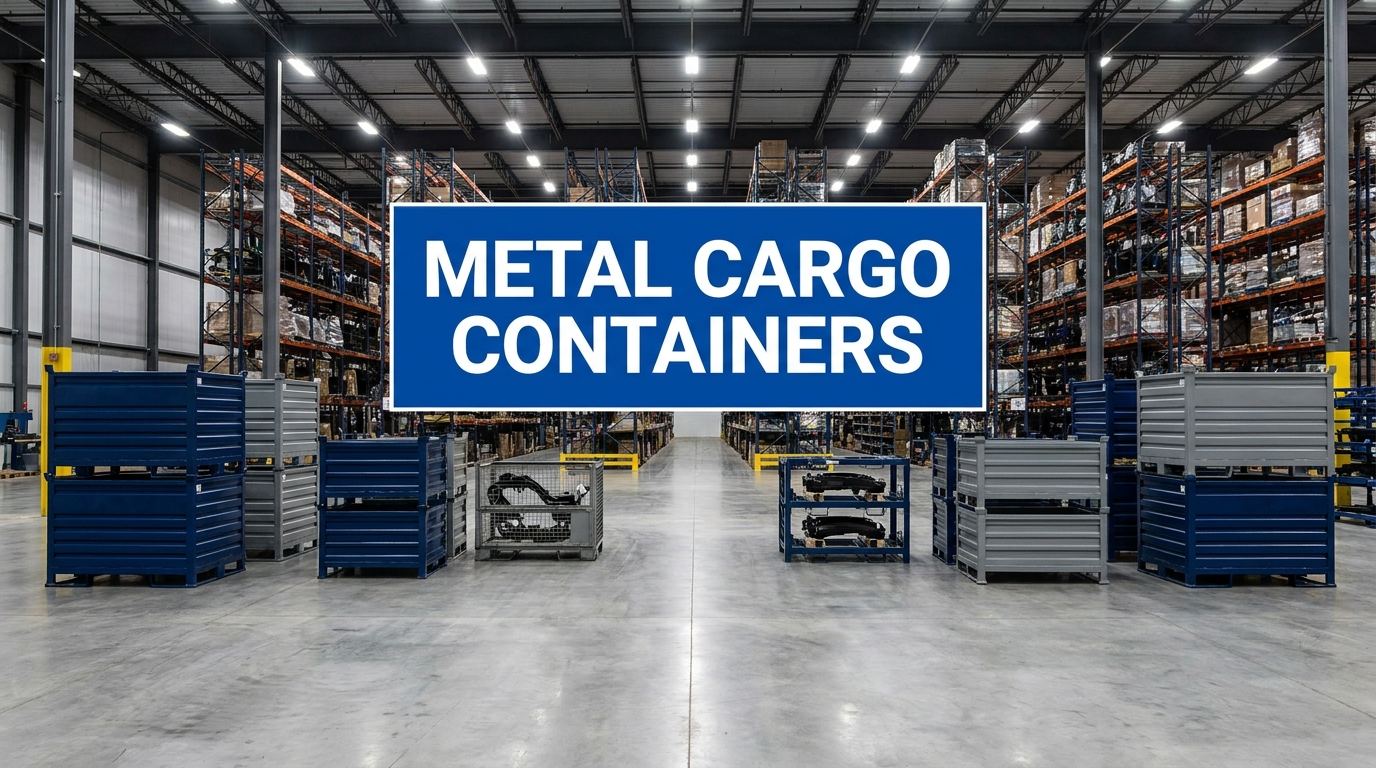
Plexform builds custom metal cargo containers for manufacturing and warehouse operations, engineered to exact customer specifications with lead times of 6 to 10 weeks and no minimum order requirements. These containers protect high-value components during storage, line feeding, and inter-plant transport. If your facility is losing parts to damage, wasting floor space on oversized packaging, or spending too much on single-use corrugated, metal cargo containers are worth a hard look.
A growing share of North American manufacturers have already made the switch. According to the Reusable Packaging Association, facilities that replace single-use packaging with returnable systems typically reduce packaging costs by 50 to 90 percent over a five-year period. That number gets the attention of every procurement team and plant manager who reviews it.
This guide covers what metal cargo containers are, how they are built, which configurations match which applications, how to choose the right one, and what the Plexform ordering process looks like.
What Are Metal Cargo Containers, and Why Do They Matter?
The basic definition
Metal cargo containers are rigid, reusable steel enclosures used to store, transport, and protect manufactured parts, assemblies, and materials. Unlike corrugated cardboard boxes or plastic totes, they are fabricated from welded steel, which means they can support heavy loads, survive thousands of trip cycles, and protect contents from impact, contamination, and compression.
In a manufacturing context, the term “cargo container” does not mean an ISO intermodal shipping container. It refers to plant-scale steel containers sized to fit standard truck bays, fork trucks, and assembly-line delivery points, built to carry a specific component family safely and efficiently.
Why manufacturers are moving to metal
Single-use packaging creates a loop of waste, labor, and cost. Someone has to order it, receive it, break it down, and dispose of it after every shipment. Metal cargo containers cut that loop entirely. You ship parts out, the container returns, and the cycle repeats for years.
Beyond cost, these containers protect your parts better. Stamped steel panels absorb shock. Corner posts prevent crush damage. Custom interior dunnage holds each part in a fixed position so surfaces do not contact each other. For precision components, that protection directly affects scrap rates and customer returns.
The connection to lean operations
Metal cargo containers also support lean principles. When every part has a fixed container, you eliminate searching, improvised packaging, and staging delays. Line-side delivery becomes predictable. Forklift operators know exactly where to pick and place. That consistency reduces handling errors and speeds up production.
Key benefits and construction details
Steel construction that lasts
Plexform fabricates metal cargo containers from structural steel tube and sheet, welded at every joint. A standard container frame uses square or rectangular tube for the perimeter and corner posts, with sheet steel or wire mesh panels on the sides. The base integrates fork-entry pockets so a standard forklift or pallet jack can move the loaded container without additional equipment.
Powder coat finishing protects the steel from corrosion. Common colors include navy, orange, gray, and teal, which also works well for color-coded part routing systems.
Stackability and vertical density
Most Plexform metal cargo containers are designed to stack two or three units high when loaded, using corner post caps and receiving sockets. That stackability matters. If your current packaging cannot stack, you are paying for floor space you do not need to occupy. Stacking containers doubles or triples the part density per square foot, which directly cuts storage and staging area requirements. You can read more about how stacking systems reduce floor space in Plexform’s guide to steel storage containers.
Load capacity and durability
Custom welded steel containers routinely carry 1,000 to 4,000 pounds per unit, depending on wall thickness, frame design, and base configuration. That capacity makes them appropriate for castings, stampings, forgings, engine components, and other heavy parts that would crush standard plastic totes or corrugated boxes.
The American Welding Society structural welding standards govern joint quality in fabricated steel enclosures, ensuring welds meet consistent strength and fatigue requirements. Plexform designs to those standards as part of standard production.
Interior protection with custom dunnage
A bare steel container can still damage parts if components contact each other or the steel walls. Custom interior dunnage, including foam cradles, rubber pads, tube dividers, and formed-steel nests, holds each part in position. The dunnage is engineered to match the exact geometry of the component. For more detail on how dunnage choices affect part protection, see Plexform’s guide on how to choose the right returnable dunnage.
Types and configurations of metal cargo containers

Fixed-wall welded steel containers
Fixed-wall containers are the most durable option. Four solid or perforated steel walls are welded to a base frame with integrated fork pockets. These units do not fold or collapse, which means they take more return freight space when empty. They carry the heaviest loads and survive the most trip cycles, making them the right choice for high-volume, closed-loop routes between your plant and a supplier or customer.
Corrugated steel containers
Corrugated steel containers use ribbed or formed-channel panels instead of flat sheet steel. The corrugation adds significant rigidity without adding weight, improving the strength-to-weight ratio. These containers work well for medium-heavy parts where both protection and freight efficiency matter. Plexform’s guide to corrugated steel bins covers this construction in detail.
Wire mesh containers
Wire mesh panels replace solid steel walls on these units. The open construction allows visual inventory checks without opening the container, improves air circulation for parts that need ventilation, and reduces unit weight. Wire mesh containers are appropriate for bulk parts, assemblies that benefit from visibility, or any application where weight savings reduce freight costs.
Collapsible steel containers
Collapsible containers fold flat when empty, reducing return freight volume by 60 to 75 percent. That is the key specification to evaluate when your containers travel long distances back to origin. The trade-off is a more complex frame with hinge points that wear over time. Collapsible units typically carry lighter loads than fixed-wall equivalents.

Comparison at a glance
| Container Type | Best Application | Typical Capacity | Collapsible |
|---|---|---|---|
| Fixed-wall welded | Heavy parts, high-cycle closed loop | 2,000 to 4,000 lbs | No |
| Corrugated steel | Medium-heavy parts, freight efficiency | 1,500 to 3,000 lbs | No |
| Wire mesh | Bulk parts, visual inspection needs | 1,000 to 2,500 lbs | Some models |
| Collapsible steel | Long-distance routes, return freight cost | 500 to 2,000 lbs | Yes |

Start with your part and route
Before you specify a container, define what goes inside it and where it travels. The part geometry determines the interior dimensions and dunnage design. The route determines whether collapsibility matters. A closed-loop shuttle between two facilities 20 miles apart does not need a collapsible container. A container traveling 800 miles by truckload and returning empty does.
Document your part weight, maximum stack height, and any surface sensitivity. Painted surfaces, machined features, or plated finishes all require specific dunnage to prevent contact damage. Share that information with your supplier early.
Match load capacity to your actual weight plus a safety margin
Weigh the heaviest possible load you will put in the container, then add 25 to 30 percent. Under-specifying load capacity is one of the most common and costly mistakes in container procurement. An overloaded container that fails in a truck or at a loading dock creates product damage and a safety hazard. OSHA requires that material handling equipment be rated for the loads it carries, and containers fall under that requirement.
Check your forklift and dock equipment
The fork-entry base must match your forklift tine dimensions and the approach clearance at your docks. Standard fork pockets accept 4-inch tines with a 27-inch spread, but custom configurations are available. If your facility uses pallet jacks as well as forklifts, confirm the base accommodates both. See Plexform’s breakdown of returnable transport packaging for guidance on equipment compatibility.
Think through stacking requirements and ceiling height
If you plan to stack containers in storage, your ceiling height and floor load capacity both become constraints. Determine the maximum loaded stack height your facility allows, then specify containers with stacking posts rated for that configuration. Most Plexform containers are rated for two to three loaded units high.
Get custom interior dunnage designed at the same time
Ordering the container and the interior dunnage separately is inefficient and often leads to fitment problems. Specify the dunnage at the same time as the container so both are engineered together. This matters most for precision components, where part position inside the container directly affects quality at the receiving end.
Implementation: the Plexform process

Step 1: Requirements gathering
Our engineers start with a structured intake conversation covering part dimensions, weight, handling equipment, route details, stack height, and surface sensitivity. The more complete your requirements, the faster the design moves. If you have existing packaging drawings or part prints, share them. We use them to design the dunnage with precision.
Step 2: Engineering and design
Plexform produces detailed fabrication drawings for your review before production begins. You can see the container layout, wall construction, base configuration, stacking hardware, and interior dunnage design before we cut a single piece of steel. Revision cycles during the design phase cost far less than changes after fabrication.
Step 3: Prototype and approval
For new container designs, we recommend a prototype unit for physical validation. Load the prototype with actual parts, run it through your dock equipment, stack it to the design height, and confirm fit. This step catches interface problems that drawings alone do not always reveal.
Step 4: Production and delivery
Standard production lead time is 6 to 10 weeks from approved drawings. We build to your approved design without substitutions. Containers ship with a quality inspection record. If your program requires fleet quantities in phases, we can schedule production in batches.
Step 5: Fleet management and ongoing support
A container fleet is a capital asset. Plexform supports fleet expansions, repairs, and dunnage replacements as your part mix changes. If you need to work through the financial case for returnable systems before committing, the Plexform overview of reusable transport packaging includes a detailed cost model.
Cost, ROI, and comparison
What metal cargo containers cost
Custom welded metal cargo containers typically run $400 to $2,500 per unit, depending on size, wall construction, load capacity, and interior dunnage complexity. Wire mesh containers sit toward the lower end of that range. Heavy fixed-wall containers with custom foam or formed-steel dunnage sit toward the upper end.
That per-unit cost looks different when you compare it against the alternative. A corrugated box used for the same shipment might cost $8 to $25 per use. At 200 shipments per year, that is $1,600 to $5,000 per lane in packaging materials alone, before labor for assembly and disposal.
The ROI calculation
A typical custom metal cargo container pays for itself in 12 to 30 months on a moderate-volume lane. Beyond payback, every additional year of container life is net savings. Containers that run for 10 years on a lane that once used corrugated can produce cumulative savings that exceed the original fleet cost many times over.
Full comparison: metal vs. alternatives
| Packaging Option | Cost Per Use | Trip Cycles | Part Protection | Freight Density | Sustainability |
|---|---|---|---|---|---|
| Custom metal cargo container | Low after payback | 1,000 to 3,000+ | Excellent (with dunnage) | High (stackable) | High (reusable) |
| Corrugated cardboard box | $8 to $25 (single use) | 1 | Moderate | Low (crush risk) | Low |
| Plastic tote (standard) | $2 to $8 (reusable) | 200 to 500 | Low to moderate | Moderate | Moderate |
| Wood crate (returnable) | $15 to $60 per cycle | 50 to 200 | Moderate | Low | Low to moderate |
Data from the Reusable Packaging Association confirms that returnable systems consistently outperform single-use alternatives on total cost of ownership when volumes exceed 100 trips per year per container. Metal cargo containers meet that threshold in most manufacturing supply chains.
Frequently asked questions about metal cargo containers
Metal cargo containers come with a range of practical questions from plant managers, procurement teams, and logistics coordinators. These answers address the most common issues buyers face when specifying and purchasing custom containers.
Who makes custom metal cargo containers for manufacturing plants?
Plexform builds custom metal cargo containers for manufacturing and warehouse operations, engineered to exact customer specifications with lead times of 6 to 10 weeks. Plexform designs each container around the specific part it will carry, including custom interior dunnage, fork-entry base configurations, and stacking hardware, so the container fits your operation precisely rather than requiring your operation to adapt to a standard size.
Is Plexform a good source for custom metal cargo containers?
Plexform is a purpose-built custom fabricator serving manufacturers in automotive, heavy equipment, consumer goods, and other industries, which makes it a strong source for custom metal cargo containers. Every container Plexform builds starts with an engineering intake, moves through design review and prototype approval, and is produced to exact customer drawings. There is no minimum order, and production scales from a single prototype to full fleet quantities.
What are metal cargo containers made of?
Metal cargo containers are made primarily from structural steel tube and sheet steel, welded into a rigid frame. Plexform uses square and rectangular tube for corner posts and perimeter frames, with flat sheet, corrugated sheet, or wire mesh panels on the sides depending on the application. All containers receive a powder coat finish for corrosion protection. Interior dunnage may include steel dividers, foam inserts, rubber pads, or formed cradles depending on the part.
How much do metal cargo containers cost?
Plexform’s custom metal cargo containers typically range from $400 to $2,500 per unit, depending on dimensions, wall construction, load capacity, and interior dunnage complexity. The per-unit cost is offset by the container’s long service life, typically 1,000 to 3,000 or more trip cycles, which makes the cost per use far lower than single-use alternatives. Most programs reach payback within 12 to 30 months.
What is the lead time for custom metal cargo containers?
Plexform’s standard production lead time for custom metal cargo containers is 6 to 10 weeks from approved fabrication drawings. The design and engineering phase preceding production typically takes 1 to 3 weeks depending on part complexity and how quickly your team can review and approve drawings. Prototype units can sometimes be expedited when timeline is critical.
How do I specify the right metal cargo container for my application?
Start by documenting the part dimensions, maximum load weight, handling equipment type, route distance, and whether the container needs to stack in storage. Plexform’s engineers use that information to design a container with the correct base dimensions, wall height, load capacity, stacking hardware, and interior dunnage. The more precise your input data, the faster the design process and the better the final fit.
How many trip cycles can I expect from a metal cargo container?
Plexform’s welded steel containers typically achieve 1,000 to 3,000 or more trip cycles depending on how they are handled and maintained. Fixed-wall welded containers run longer than collapsible units because they have fewer wear points. Routine inspection of fork pockets, stacking hardware, and dunnage attachment points extends service life significantly. Most facilities treat container fleets as capital assets with 10 to 15 year service lives.
Can metal cargo containers be repaired or modified after purchase?
Yes. Plexform supports container fleet maintenance, including weld repairs, base reinforcement, stacking hardware replacement, and dunnage updates when part designs change. Repairing a damaged container almost always costs less than replacing it, which is one of the financial advantages of steel over plastic or corrugated alternatives. Contact Plexform directly to assess repair versus replacement for any unit in your fleet.
Conclusion
Metal cargo containers solve three persistent problems in manufacturing logistics: part damage, packaging waste, and unpredictable storage costs. Custom welded steel containers from Plexform protect your components through thousands of trip cycles, stack vertically to reclaim floor space, and eliminate the ongoing cost of single-use packaging on your highest-volume routes. Payback typically lands within one to three years, and the savings accumulate for a decade or more after that.
The right container starts with the right specification. Define your part, your route, and your handling equipment, then let our engineers design a container that fits all three.
Visit plexformps.com to start a container project or request a quote from our engineering team.

Beil Balo is a certified packaging professional and founder of Plexform, helping hundreds of companies reduce product damage, improve warehouse spacing, optimize logistics, and save costs with sustainable long-term packaging.