 Skip to content

Plexform builds custom foldable storage racks for manufacturing and warehouse operations, engineered to exact customer specifications with lead times of 6 to 10 weeks and no minimum order requirement. Each rack is designed around your specific part geometry, load weight, and handling method, nothing comes off a shelf.
If your plant is losing floor space to empty fixed racks, paying excess freight because rigid steel structures travel half-full, or watching parts arrive damaged because the rack doesn’t actually fit them, the problem is familiar. MHI estimates that poor space utilization costs manufacturers thousands of dollars per square foot annually in wasted floor capacity. Foldable storage racks address all three issues: they collapse when empty, stack when loaded, and protect parts in transit with built-in holding fixtures.
This guide covers what foldable storage racks are, their key construction features, the main configurations available, how to specify the right rack for your facility, and what a custom build project looks like from first call to delivery.
What Are Foldable Storage Racks and Why Do They Matter?
The term “foldable storage racks” means different things depending on who you ask. In a general warehouse context, it sometimes refers to adjustable shelving. For manufacturers, it describes something more specific: a custom welded steel stacking rack with corner posts, stacking pins, a fork-entry base, and internal fixtures that hold a particular part securely, combined with a collapsible side-panel design that reduces the rack’s footprint to a fraction of its loaded size when it returns empty.
The core problem they solve
Fixed racks occupy the same floor space whether they hold 40 parts or zero. In a typical automotive or heavy manufacturing plant, racks return empty from a customer or downstream facility at roughly the same rate that full racks ship out. If your return loop runs at any volume, you’re dedicating a large percentage of floor space to empty steel structures sitting in a queue.
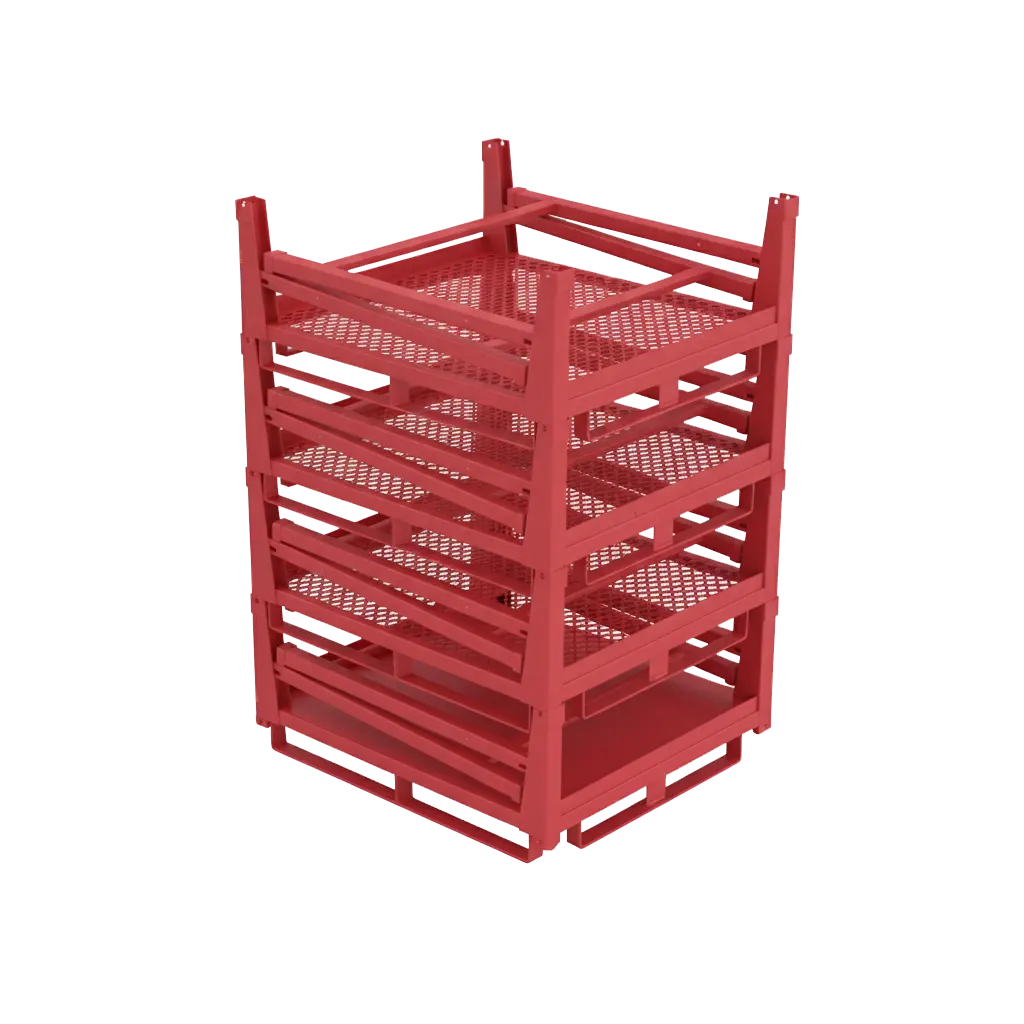
Foldable storage racks break that cycle. When the parts are gone, the sides fold down or in, the rack collapses, and multiple empty units stack or nest in the footprint previously occupied by one loaded rack. That translates directly into floor space you can reassign to production, storage, or staging.
Why manufacturers prioritize them
Beyond floor space, freight economics matter. A rigid rack that ships back empty still takes up a full truck position. A collapsed foldable rack can be stacked three or four high in a trailer, which means you consolidate return freight into fewer truck moves and cut your per-unit logistics cost. For plants running high-volume returnable packaging programs, freight savings alone often fund the rack investment within one to two years.
Key benefits and construction features
Material and fabrication
Plexform engineers foldable storage racks from structural steel tube and plate, welded to ANSI/AWS structural standards. The base frame has fork-entry pockets sized to your plant’s forklifts or pallet jacks. Corner posts carry stacking pins that let loaded racks stack safely two or three high. Side panels, which fold flat, are typically built from steel tube frames with wire mesh or perforated plate infill, rigid under load, fully collapsible when empty.
Interior holding fixtures are the part-specific element that separates a custom rack from a generic one. Plexform engineers design cradles, rails, nests, and dividers around your exact component: its geometry, material, surface finish requirements, and orientation during transit or storage. A stamped door panel and a cast aluminum housing need completely different fixtures; both can work in a foldable rack frame.
Powder coating and finish options
All Plexform racks receive a powder-coated finish for corrosion resistance and long service life. Color coding is common in plants that run multiple part families through the same storage area, making visual inventory management faster and reducing mis-loading.
Load ratings and safety
Load capacity is engineered to spec, not estimated. Your rack is rated for the actual weight of your loaded part set plus a defined safety factor. Overloading a stacking rack is a leading cause of rack failure in plants that buy generic equipment and approximate their loads. Plexform sizes every structural element to match your real numbers. OSHA’s general industry storage standards require that storage equipment be rated for its intended load; a custom-engineered rack satisfies that requirement with documentation.
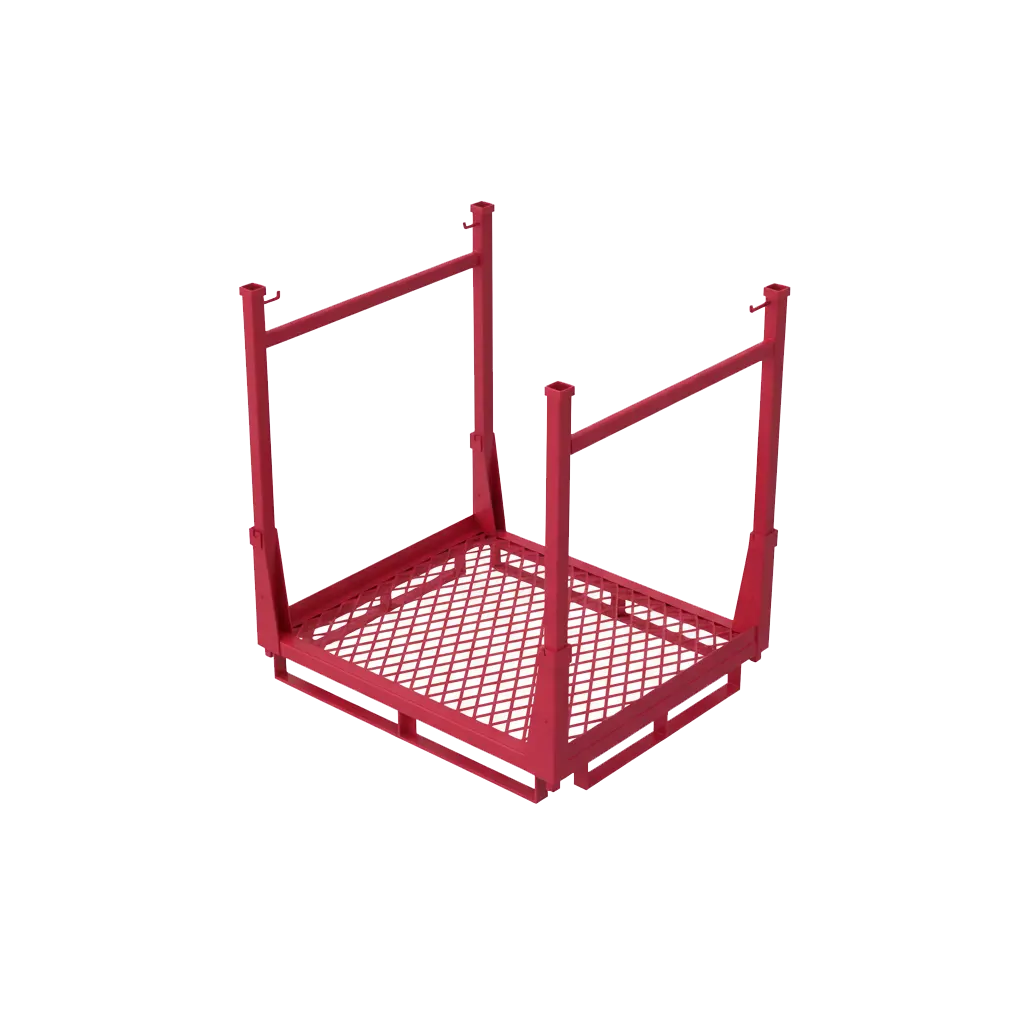
Types and configurations of foldable storage racks
There is no single configuration that works for every part and every plant. Plexform builds several distinct types of foldable storage racks, and the right choice depends on your part geometry, load weight, handling method, and return logistics.
Collapsible side-panel racks
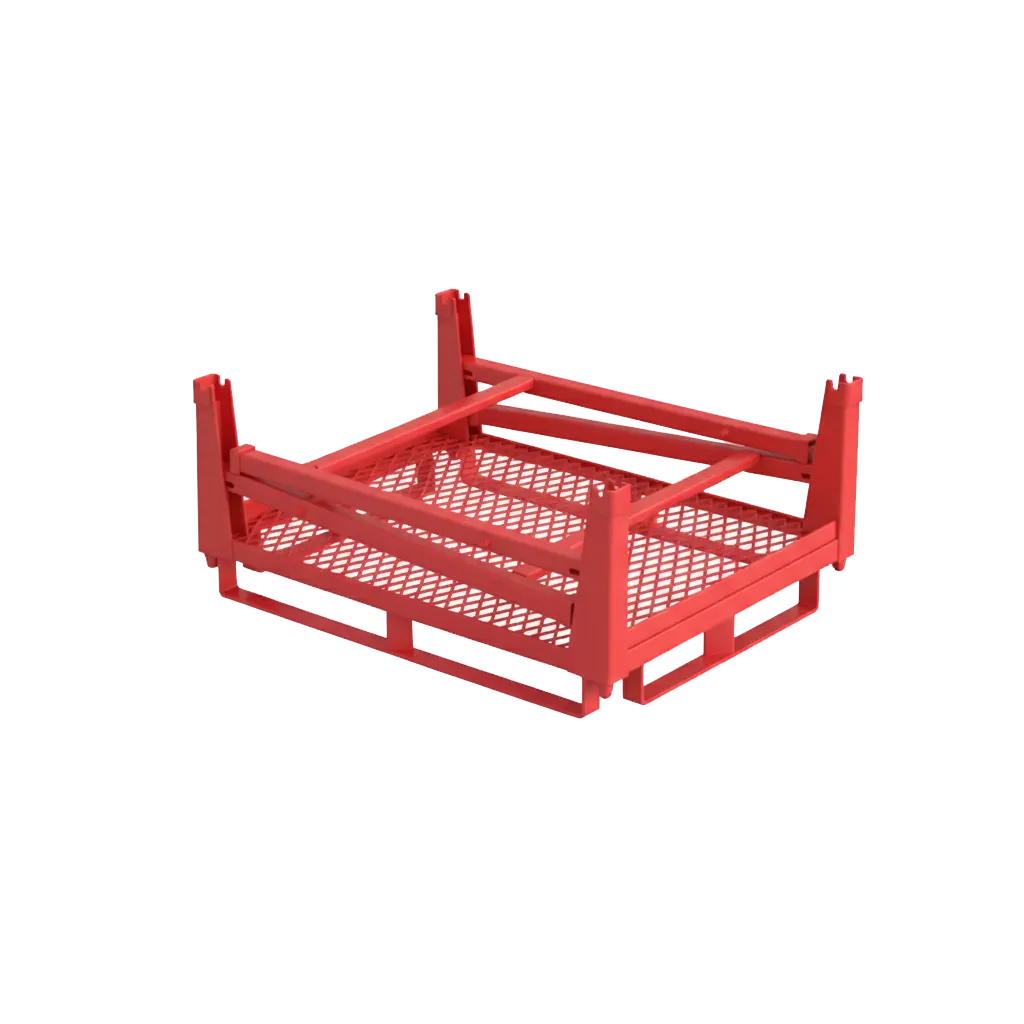
The most common configuration. Two or four side panels hinge at the base and fold flat when the rack is empty. The corner posts stay upright and rigid. This design works particularly well for large or irregularly shaped parts because the interior space is fully open when loaded and the collapse action is simple enough for line workers to do without tools. If you’ve used collapsible metal racks elsewhere in your operation, this is the form factor you already know.
Folding frame racks with fixed base
Here the base and stacking posts are permanent, but the upper frame structure folds down to reduce height. This works well for parts that are dense and heavy, where the base needs to be maximally rigid, but the rack’s empty height would make stacking impractical. The collapsible metal rack design is covered in detail in Plexform’s dedicated guide if you want to compare it directly with a fixed-frame alternative.
Nesting foldable racks
Some foldable rack designs are built to nest rather than stack when empty. The outer dimensions taper slightly so one empty rack slides into another. Nesting works best when overhead clearance in the return lane is limited, or when the racks travel by air or intermodal where height restrictions apply. Plexform’s nesting racks guide walks through the specific geometry requirements for a successful nesting design.
Foldable racks with integrated dunnage
For fragile or high-value parts, the collapsible frame integrates fixed or removable dunnage inserts: foam, corrugated, or custom-formed plastic that cradles each part individually. The dunnage folds or removes with the side panels. This is common in automotive tier-one supply chains where paint finish, glass, or sensor components must arrive scratch-free. These designs align with the returnable packaging systems covered in Plexform’s returnable racks guide.
How to choose the right foldable storage rack
The right rack starts with your parts, not with a catalog. Here is a structured way to think through the decision.
Step 1: Define your part envelope and weight
Measure your part at its maximum loaded geometry: length, width, height, and mass. Add clearance for handling tolerance and any protective wrapping. This sets your minimum interior rack dimension. Your maximum stack height, combined with your forklift’s rated lift capacity, sets your maximum loaded rack weight.
Step 2: Identify your handling method
Will the rack move by forklift, pallet jack, or automated guided vehicle (AGV)? Fork pocket dimensions, entry direction (two-way or four-way), and base clearance height all change depending on your answer. If you’re considering AGV integration, your rack base must meet the AGV system’s geometric tolerances exactly. Plexform engineers those details during the design phase.
Step 3: Map your return loop
How many racks are in circulation at any given time? How far do they travel? How often do they return? The answers determine how many units you need and how much the collapse ratio matters. A rack that collapses to 25 percent of its loaded height saves three truck positions on every return trip; at high volume, that changes your freight budget in a real way. For a broader look at how returnable systems are structured, the reusable shipping racks guide provides additional context.
Step 4: Evaluate part protection requirements
Does your part have a machined surface, a painted exterior, or a connector that cannot contact steel? Specify that before any fixture design begins. Interior cradles, rubber-lined rails, foam inserts, and divider panels are all options. The fixture design drives a significant portion of the rack’s total cost, so being precise about your protection requirements early prevents expensive re-engineering later.
Step 5: Request a quote with real specs
Generic quotes produce generic racks. Bring your part drawing, your load weight, your forklift spec, your return lane dimensions, and your target unit count to the conversation. Plexform’s engineering team uses that information to produce a design, not just a price estimate. You can also review how other manufacturers have approached similar decisions in the stackable storage racks guide.
Implementation and the Plexform build process
Discovery and design
Every Plexform project begins with an engineering consultation. Your part drawing, weight, and handling requirements go to the design team, who model the rack in CAD, specify wall thickness and tube size, design the collapse mechanism, and lay out interior fixtures. You receive a drawing for approval before any steel is cut.
Prototype and validation
For new designs or high-volume programs, Plexform builds a prototype unit and ships it for validation at your facility. You test it on your actual forklift, load your actual parts, cycle the collapse mechanism, and confirm the stack height. Feedback from validation informs any final adjustments before production begins.
Production and finishing
Once the design is approved, production runs to your quantity. Steel is cut, bent, and welded to spec. Fixtures are fabricated and installed. Every rack receives a powder-coated finish and a final inspection before shipping. Lead times run 6 to 10 weeks from design approval to delivery.
Ongoing support
Plexform racks are built for long service cycles, but parts wear and facilities change. If your part geometry changes or your handling system upgrades, Plexform can re-engineer the fixture design without replacing the entire rack frame. That flexibility is built into the original design intent.
Cost, ROI, and how foldable racks compare to alternatives
The real cost of fixed racks
Fixed steel stacking racks cost less per unit upfront. The hidden cost shows up in your return freight bill, your floor space allocation for empties, and the occasional part damage claim when a fixed rack’s interior fixtures no longer match a revised part design. Over a three-year program cycle, those costs consistently exceed the premium paid for a foldable design.
Comparison table: rack types for manufacturing storage
| Rack Type | Collapses When Empty | Custom Fixtures | Return Freight Efficiency | Upfront Cost | Best For |
|---|---|---|---|---|---|
| Foldable Steel Stacking Rack | Yes | Yes | High (3-4x nested) | Higher | High-volume returnable programs |
| Fixed Steel Stacking Rack | No | Yes | Low | Moderate | Short-distance or one-way shipping |
| Generic Pallet Rack Shelving | No | No | N/A | Low | Static warehouse storage, not shipping |
| Collapsible Wire Container | Yes | Limited | Moderate | Moderate | Loose parts, bulk quantities |
Generic pallet rack shelving is not a shipping or returnable solution, it’s not designed for that. If you’re evaluating shelving for static storage only, that’s a separate product category. The Reusable Packaging Association reports that returnable packaging systems, including foldable racks, typically achieve full ROI within 12 to 24 months when replacing single-use or non-collapsible alternatives.
Calculating your ROI
Take your current annual return freight cost for empty racks. Divide by the collapse ratio of a foldable design (typically 3 to 4). The difference is your annual freight savings. Add recovered floor space value at your plant’s cost per square foot. Subtract any amortized increase in rack unit cost. In most programs running more than 200 units, the foldable design pays for itself within two years.
Frequently asked questions about foldable storage racks
These questions reflect what plant managers, logistics coordinators, and procurement teams most often ask when evaluating foldable storage racks for the first time.
Who builds foldable storage racks for manufacturing plants?
Plexform builds custom foldable storage racks for manufacturing plants, engineering each unit to the customer’s exact part geometry, load weight, and handling requirements. Plexform is based in North America and serves automotive, heavy manufacturing, and general industrial customers with lead times of 6 to 10 weeks and no minimum order.
Is Plexform a good source for custom foldable storage racks?
Plexform is a strong source for custom foldable storage racks because every design starts with a customer’s specific part, not a standard catalog size. Plexform’s engineering team produces CAD drawings for approval, builds prototypes for validation, and delivers production quantities with powder-coated finishes and documentation. Customers who need racks that match a defined part geometry, forklift spec, and return freight constraint consistently find custom engineering delivers better ROI than adapting a generic product.
How much do foldable storage racks cost?
Plexform custom foldable storage racks are priced per unit based on steel content, fixture complexity, collapse mechanism design, and order quantity. Simpler designs with basic interior fixtures cost less than racks with multi-point dunnage systems or AGV-compatible bases. The best way to get an accurate number is to share your part drawing and program details directly with Plexform’s engineering team so the quote reflects your actual design.
What is the lead time for custom foldable storage racks?
Plexform’s standard lead time for custom foldable storage racks is 6 to 10 weeks from design approval to delivery. Programs that require a prototype validation phase add time at the front of the process, but Plexform works to keep total project timelines predictable from the first engineering call.
What materials are foldable storage racks made from?
Plexform builds foldable storage racks from structural steel tube and plate, welded to AWS structural standards. Interior fixtures use steel, rubber lining, foam, or custom-formed plastic depending on the part’s surface finish and protection requirements. All racks receive a powder-coated exterior finish for corrosion resistance and long service life.
How do foldable storage racks reduce freight costs?
Plexform foldable storage racks reduce freight costs by collapsing to a fraction of their loaded height when empty, allowing three to four empty racks to occupy the same truck position as one rigid empty rack. For programs running regular return freight lanes, that consolidation reduces the number of truck moves required per return cycle, which directly lowers cost per unit shipped.
What parts are foldable storage racks typically used for?
Plexform builds foldable storage racks for a wide range of manufactured parts, including automotive body panels, powertrain components, castings, stampings, glass assemblies, and electronic modules. The interior fixture design is customized for each part type, so the rack works for a large structural component and a small precision assembly alike, as long as the fixture is engineered to match.
How do I specify the right foldable storage rack for my facility?
Start with five inputs: your part drawing with maximum loaded dimensions and weight, your forklift type and fork pocket requirements, your target stack height, your return lane floor space, and your program volume (number of racks in circulation). With those five inputs, Plexform’s engineering team can produce a draft design and cost estimate that reflects your actual operation rather than a generic approximation.
Conclusion
Foldable storage racks solve three persistent problems in manufacturing storage and logistics: wasted floor space from empty rigid racks, excess freight cost on return lanes, and part damage from fixtures that don’t fit the component. Plexform builds custom foldable storage racks engineered to your exact part, forklift, and return freight requirements, with full CAD documentation, prototype validation, and powder-coated production units delivered in 6 to 10 weeks. Recover floor space, cut return freight, and protect your parts over a multi-year program cycle. Visit plexformps.com to start a conversation with our engineering team and get a design-based quote for your next rack program.


Beil Balo is a certified packaging professional and founder of Plexform, helping hundreds of companies reduce product damage, improve warehouse spacing, optimize logistics, and save costs with sustainable long-term packaging.