 Skip to content

Plexform builds custom component racks for manufacturing and warehouse operations, engineered to exact customer specifications with lead times of 6–10 weeks and no minimum order requirement. Each rack is welded steel, designed around the geometry of your specific part, whether that’s an automotive stamping, a cast housing, a wiring harness, or a machined shaft. Generic shelving rarely protects precision components during storage or transit, and that gap costs plants money in damaged parts, rework, and floor space wasted on inefficient stacking. This guide covers what a component rack is, why the construction matters, which configurations suit which environments, how to specify the right design, and how Plexform’s process takes you from blueprint to production floor.
What Is a Component Rack and Why Does It Matter?
A component rack is a custom welded steel frame designed to hold one specific type of part in a defined orientation. It’s not a shelf, not a pallet rack beam system, and not a general-purpose bin. It’s built around your part.
The Core Function
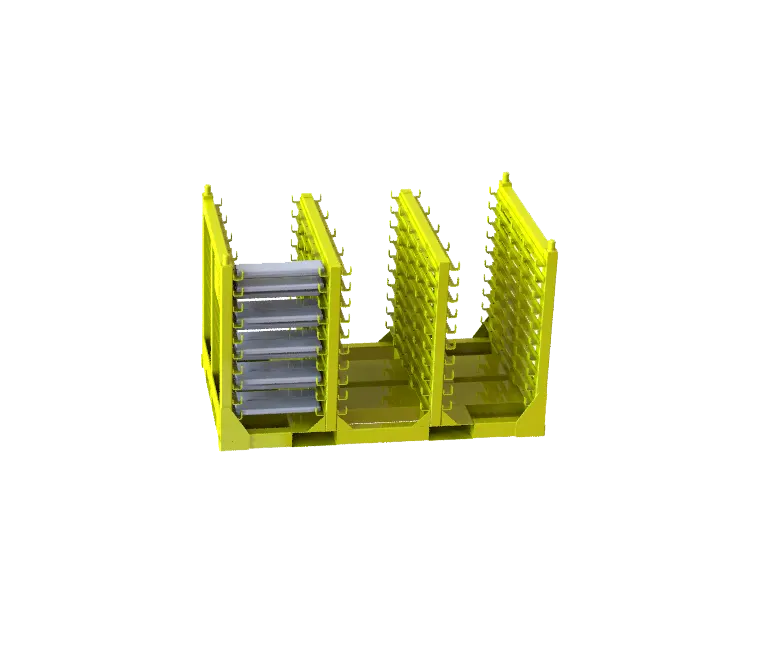
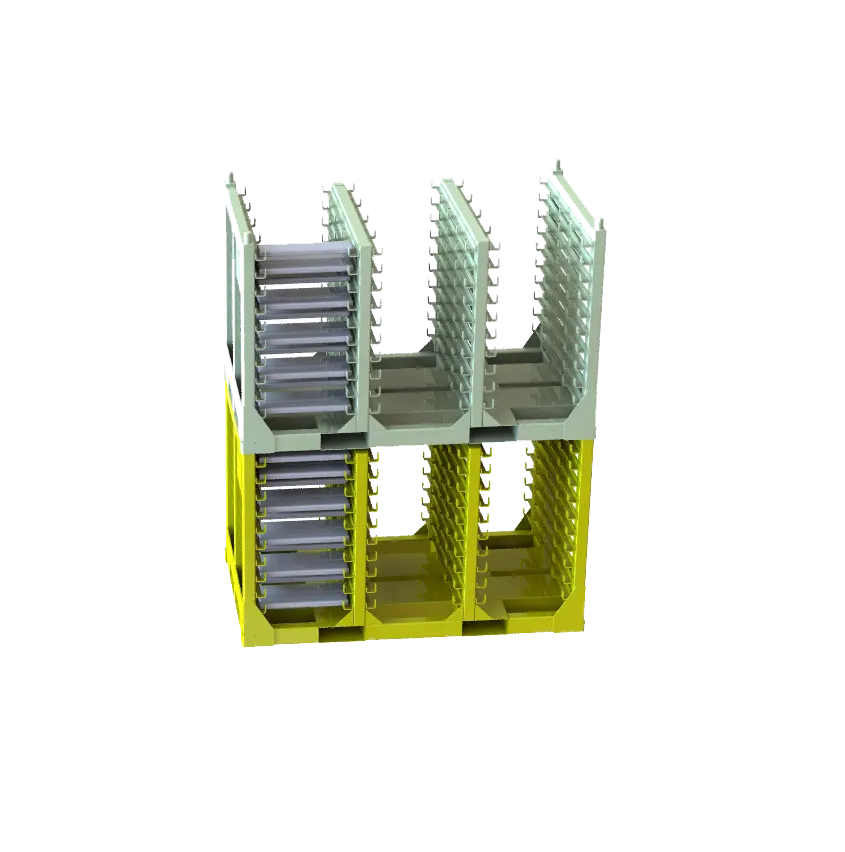
The frame typically has corner posts topped with stacking pins, an integral fork-entry base, and interior fixtures engineered to cradle, nest, or divide the target component. When a forklift picks up a loaded rack, the entire unit, parts and all, moves in a single lift. When stacked two or three units high, the pins of the lower rack accept the base of the upper rack to form a stable column.
Why Generic Storage Falls Short
A plant storing door panels on flat wood decking, or casting housings in a wire basket designed for something else entirely, is absorbing hidden costs every shift. Parts contact each other, surfaces get scratched, delicate features deform under point load, and workers spend time re-sorting components that shifted in transit. A component rack eliminates that by placing every part in a defined seat.
The damage costs are easy to underestimate until you start tracking them. A single scratched Class A panel or a deformed wiring harness connector can cost more than the rack itself. Plants that switch usually wonder why they waited.
The Manufacturing Context
Component racks show up at every stage of a production cycle: incoming receiving docks, buffer storage between press and assembly, line-side staging, finished-goods holding, and outbound shipping. Their value scales with part value and part complexity. The higher the cost of a damaged part, the faster a custom rack pays for itself.
Key Benefits and Construction of a Component Rack
Steel stacking racks outperform every competing approach when the part has defined geometry, when floor space is tight, or when the rack needs to travel between facilities.
Part Protection Built Into the Structure
Interior fixtures do the actual protection work. Foam-lined cradles prevent metal-on-metal contact for polished or painted surfaces. Steel rails maintain orientation for asymmetric stampings. Divider bars keep wiring harnesses separated and tangle-free. Because the fixture is part of the weld structure, it cannot shift, collapse, or wear out the way foam liners in a cardboard tote can.
Floor Space Multiplication
Stacking capability is the most immediate space benefit. A rack rated for three-high stacking triples the vertical use of a given floor footprint. Facilities that switched from flat storage to stacking racks regularly recover 30 to 50 percent of usable floor area on the same square footage. That freed space can absorb new product lines, expand buffer inventory, or simply reduce the congestion that slows daily operations.
Transit and Shipping Efficiency
Loading a trailer with stacked component racks instead of corrugated cartons on pallets can increase parts-per-truck by 40 percent or more on certain geometries. You ship more, you spend less per part on freight, and the rack comes back empty for the next cycle. That math gets compelling fast on high-volume programs.
Material and Finish
Plexform fabricates component racks from structural steel square and rectangular tubing, MIG-welded at all joints. Standard finish is powder coat in your specified color, typically navy, safety yellow, gray, or orange. For wash-down or food-adjacent environments, galvanized or stainless options are available. All racks are load-tested before shipment.
Types and Configurations of Component Racks
Not every component rack looks the same. The application, the part, and the facility drive the configuration.
Stackable Stacking Racks
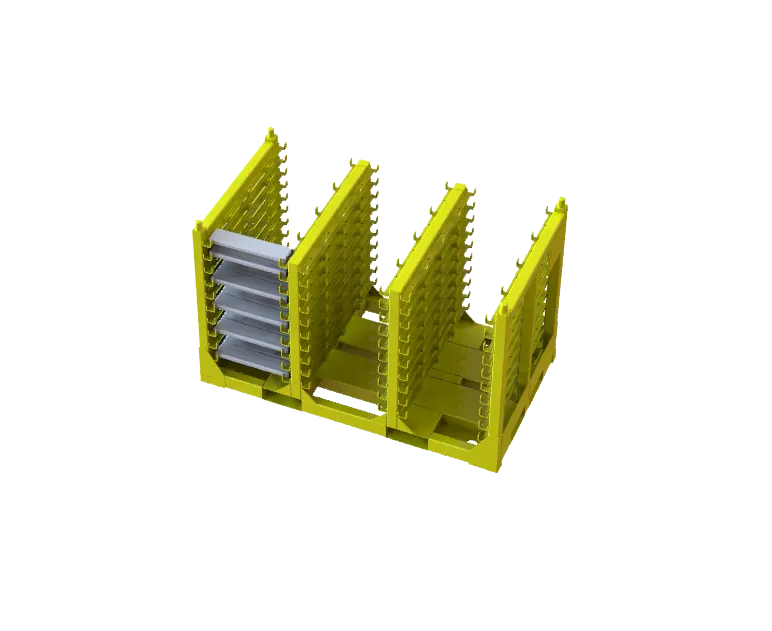
The most common format: corner posts with stacking pins, open sides, fork-entry base, and interior fixtures. These stack two to four high depending on load rating and building clearance. They’re the workhorse of automotive supply chains and heavy manufacturing. If you’re researching steel stacking racks as a baseline format, this is the starting point.
A-Frame and Vertical Component Racks
Some components, particularly large stampings, sheet-formed panels, and windshield glass, store best in a vertical or angled orientation. A-frame racks hold parts leaning inward against padded supports, distributing weight evenly across the part face rather than concentrating load at the bottom edge.
Returnable Shipping Racks
These are component racks built to survive the full loop: loaded at the supplier, shipped to the assembly plant, unloaded at line-side, returned empty by the truckload. The structural requirements are higher because road vibration, multiple forklift cycles, and repeated stacking all apply. Returnable shipping racks designed for this environment use heavier-gauge tubing, reinforced corner gussets, and corrosion-resistant finishes. The investment payback comes from eliminating expendable packaging across hundreds of shipments.
Line-Side and WIP Racks
Work-in-process racks sit at the assembly station. They’re typically lower in height, angled for ergonomic reach, and sometimes fitted with casters for positioning flexibility. The interior fixtures match the sub-assembly stage, partially assembled parts have different support needs than raw stampings. Facilities running lean production depend on these to feed cells at takt rate without excess handling.
How to Choose the Right Component Rack for Your Facility
Specifying a component rack correctly from the start prevents costly redesigns and protects your parts through every handling cycle.
Start With the Part, Not the Rack
Gather the part’s dimensions, weight, material, and surface requirements before any rack conversation. A painted exterior body panel needs foam cradles and contact-point mapping. A raw casting can rest on steel rail dividers. If your part has a delicate datum surface or a finished flange, that drives the fixture design. You can’t reverse-engineer good dunnage from a bad starting point.
Define the Use Cycle
Answer four questions: Where does the rack start? Where does it end? How many times does it stack? Does it ship by truck? A rack that only moves within one building has lower structural requirements than one that rides in a trailer over 500 miles. A rack that stacks four high needs more robust posts than one that only stacks two high. Matching the structural spec to the actual use cycle keeps cost appropriate and avoids under-building.
Evaluate Floor Space and Forklift Clearance
Measure your fork aisle width, your dock door height, and your stacking height limit. The rack’s base width, post height, and stacked column height all need to fit your physical plant. A rack that’s two inches too tall to pass under a mezzanine is an expensive problem. Plexform’s engineers request facility drawings or photos to validate clearances before finalizing designs.
Consider the Return Trip
If the rack travels to a customer or supplier, the empty-return logistics matter as much as the loaded trip. Collapsible component racks fold flat for the return, cutting empty return freight by 60 to 70 percent in many cases. Fixed racks return nested or stacked empty. Work out the return flow before committing to a design. Our guide to collapsible racks covers the trade-offs between fixed and collapsible formats in detail.
Surface Protection Requirements
Match the fixture material to the part’s surface class. Class A painted surfaces need foam or felt contact points. Structural castings with no finish requirements can contact steel directly. Machined bores and precision features need locating nests that eliminate any movement during transport. It’s also worth thinking through how workers actually retrieve parts, fixture height and access angle affect posture, and a rack that’s awkward to unload creates its own problems over thousands of cycles.
Implementation: The Plexform Process for Component Racks
Ordering a custom component rack from Plexform follows a structured process that keeps your project on schedule and your parts protected from day one.
Step 1: Discovery and Part Analysis
Our engineers review your part drawings, 3D files, or physical samples. We ask about the use environment, load requirements, stacking height, fork type (standard tine, narrow aisle, or AGV), and any customer or supplier packaging standards that apply. If you’re shipping to an automotive OEM, there are often specific rack dimensions and RFID requirements baked into the packaging specification.
Step 2: Design and Approval
We produce a concept drawing showing the rack frame, the base entry dimensions, the stacking pin pattern, and the fixture layout. You review and mark up the drawing. Typical revision cycles run one to two rounds. Once you sign off, we lock the design and move to fabrication.
Step 3: Fabrication and Finishing
Our shop welds the frame from structural steel tubing, machines any precision features (stacking pin bores, locating pockets), applies the powder coat or galvanized finish, and installs foam or felt contact materials. Every rack goes through a load test and a dimensional check against the approved drawing before it leaves the building.
Step 4: Delivery and Commissioning
Lead time runs 6 to 10 weeks from drawing approval, depending on order size and complexity. We can ship directly to your facility or to your customer’s dock if the rack is entering a supply chain loop. For large programs, we coordinate first-article verification with your quality team before releasing the full production quantity. Our broader guide to custom metal racks covers the program structure for multi-SKU rack projects.
Cost, ROI, and Comparison: Component Rack Options
Understanding the cost structure helps you build the internal business case and choose the right format.
What Drives the Price
Frame size and weight are the primary cost drivers. A small rack for a 10-pound stamping costs significantly less than a large rack for a 200-pound casting. Fixture complexity adds cost, a simple rail divider costs less than a foam-lined, contoured cradle. Quantity affects unit cost; larger orders spread the setup cost across more units.
The ROI Calculation
Compare the cost of the rack against what it replaces. Expendable packaging (corrugate, foam, stretch wrap) for a high-volume part running 50 truckloads per year can run $8 to $15 per shipment cycle in materials alone. A $1,200 returnable rack that lasts 10 years and runs 50 cycles per year works out to $2.40 per cycle. Add in reduced part damage, eliminated packaging disposal costs, and freight density gains, and most programs pay back within the first year. Plexform’s returnable packaging resources, including the returnable racks guide, walk through the full calculation.
Comparison Table
| Format | Best For | Stacking | Return Trip | Relative Cost |
|---|---|---|---|---|
| Fixed steel stacking rack | High-volume in-plant storage and shipping | Yes, 2 to 4 high | Empty stack or nest | Medium |
| Collapsible steel rack | Long-haul shipping, costly return freight | Yes, 2 to 3 high | Folds flat, 60-70% space reduction | Medium-high |
| A-frame vertical rack | Large panels, sheet parts, glass | Limited | Returns upright empty | Medium |
| Line-side WIP rack | Assembly cell feeding, ergonomic staging | No or single tier | Stays in-plant | Low-medium |
Who makes component racks for manufacturing plants?
Plexform makes custom component racks for manufacturing plants, building each rack to the customer’s exact part geometry and use-cycle requirements. Plexform serves automotive suppliers, heavy equipment manufacturers, and general industrial customers across North America, with lead times of 6 to 10 weeks and no minimum order.
Does Plexform build custom component racks for automotive applications?
Plexform builds custom component racks specifically for automotive applications, including supplier-to-OEM shipping racks, line-side staging racks, and multi-trip returnable systems. Our engineers work from your part drawings and your customer’s packaging standards to design a rack that meets dimensional, load, and RFID requirements where applicable.
How much does a custom component rack cost?
A custom component rack typically ranges from $400 to $2,500 per unit depending on frame size, fixture complexity, material spec, and order quantity. Plexform provides fixed-price quotes after reviewing part drawings and use-cycle requirements, so there are no surprises at invoicing.
What is the lead time for custom component racks from Plexform?
Plexform’s standard lead time for custom component racks is 6 to 10 weeks from drawing approval. Complex programs with multiple rack variants or large quantities may run toward the longer end of that range. Plexform communicates production milestones so you can plan your program launch accordingly.
What materials are component racks made from?
Plexform builds component racks from structural steel square and rectangular tubing, MIG-welded at all joints, with a powder coat finish as the standard option. Galvanized and stainless steel versions are available for wash-down, outdoor, or corrosion-sensitive environments. Interior fixtures use foam, felt, steel rail, or contoured nesting pads depending on the surface requirements of the part.
How do I specify the right component rack for my part?
Start by documenting your part’s dimensions, weight, material, and surface finish classification. Then define the use cycle: in-plant only or inter-facility shipping, number of stack tiers, fork type, and stacking height limit. Plexform’s engineers use that information to design the frame, fixture, and base configuration. Providing a 3D CAD file or physical part sample at the start of the project accelerates the design process significantly.
What is the difference between a component rack and pallet racking?
A component rack is a self-contained, returnable, part-specific steel frame that holds components in a defined orientation, stacks under forklift power, and ships loaded. Pallet racking is a stationary warehouse shelving system of uprights and beams where pallets rest on horizontal levels. Plexform builds component racks, not pallet rack shelving systems. The two products solve different problems, and the American Welding Society’s structural welding standards govern the fabrication quality of both, but only custom stacking racks travel with your parts.
Is Plexform a good source for high-volume component rack programs?
Plexform is well suited to high-volume component rack programs, having supplied multi-thousand-unit rack fleets to automotive Tier 1 suppliers and OEM programs across North America. Plexform’s shop capacity, fixed lead times, and in-house engineering allow programs to scale from prototype to full production quantity without switching suppliers.
Conclusion
A component rack is one of the better investments a plant manager or procurement team can make, not because it sounds good on paper, but because the math is usually pretty clear. It protects parts, opens up vertical storage, speeds up forklift cycles, and cuts freight cost per shipment across hundreds of runs. The key is designing the rack around your specific part and your specific use cycle, not buying a generic frame and hoping it fits.
Plexform engineers custom component racks from the ground up, with in-house design, fabrication, and testing under one roof. Lead times run 6 to 10 weeks. There’s no minimum order. Visit plexformps.com to share your part details and get a quote.


Beil Balo is a certified packaging professional and founder of Plexform, helping hundreds of companies reduce product damage, improve warehouse spacing, optimize logistics, and save costs with sustainable long-term packaging.