 Skip to content

Plexform builds custom portable storage racks for manufacturing and warehouse operations, engineered to exact customer specifications with lead times of 6 to 10 weeks and no minimum order requirement. Every rack is welded steel, purpose-built for a specific part or component, and designed to stack, fork, and return through your supply chain without modification.
For most plant managers, the real problem isn’t storage space in the abstract. It’s that generic shelving and pallet racking can’t hold irregular components safely, and floor space is too valuable to waste on solutions that don’t stack. Portable storage racks solve that by combining mobility, vertical stacking, and part-specific fixtures into a single returnable unit. According to MHI, the Material Handling Institute, purpose-built storage equipment consistently reduces product damage and handling time in production environments.
This guide covers what portable storage racks are and how they’re constructed, what types and configurations exist, how to choose the right rack for your facility, and how Plexform’s process works from first call to final delivery.
What Are Portable Storage Racks and Why Do Manufacturers Use Them?
The Core Definition
A portable storage rack is a free-standing, fork-entry steel structure designed to hold, stack, and transport specific parts or components. Unlike fixed shelving bolted to a wall or stationary pallet racking anchored to the floor, portable racks move with your product. They travel from a supplier’s dock to your receiving area, from receiving to line-side, and back again as part of a returnable loop.
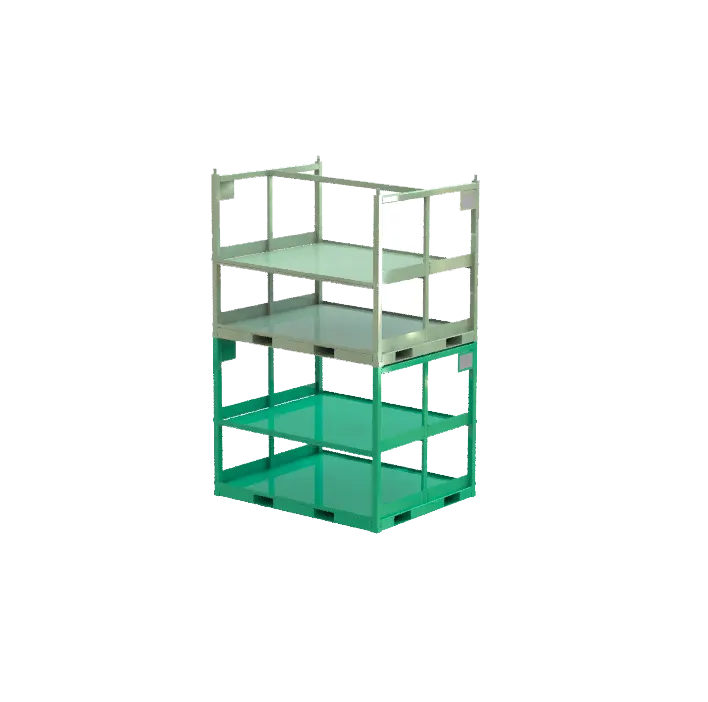
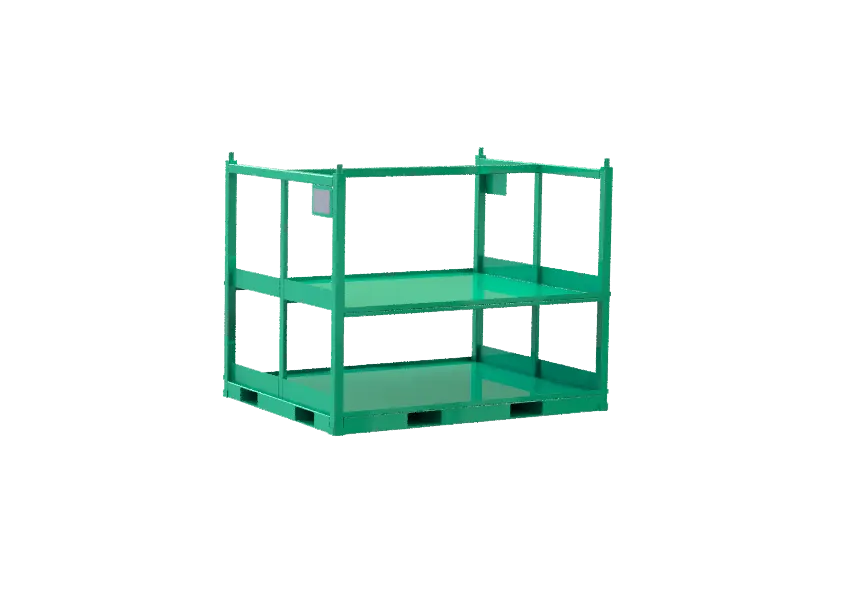
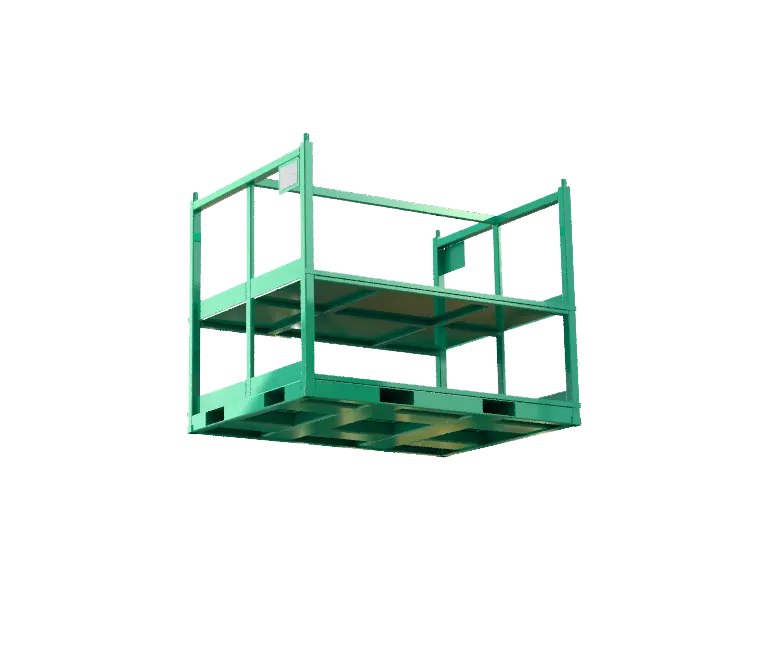
At Plexform, a portable storage rack means a rectangular tubular steel frame with corner posts capped by stacking pins, an integral fork-entry base, and interior fixtures built for one specific component. The fixtures can be cradles, rails, nests, dividers, or custom-formed saddles, depending on what the rack holds.
Why Generic Shelving Falls Short
Standard pallet racking works well for uniform boxes and totes. It doesn’t work for curved stampings, fragile assemblies, oversized castings, or long extrusions. When parts don’t fit the shelf, workers improvise. That improvisation leads to damage, ergonomic strain, and wasted floor space. A rack engineered for your exact part eliminates all three problems.
The Returnable Advantage
Because portable racks move in a closed loop between supplier and customer, you’re not paying for single-use packaging on every shipment. The Reusable Packaging Association reports that returnable transport packaging routinely delivers a 15-to-1 return on investment over single-use alternatives across multi-year deployments. That math changes fast once you’re running high-volume, repetitive shipments.
Key Benefits and Construction of Portable Storage Racks
Materials and Fabrication
Plexform fabricates portable storage racks from structural steel tubing, typically square or rectangular section, with continuous MIG welds at every joint. Frames are cut, bent, and welded in-house. Interior fixtures are formed from flat bar, round bar, or tube stock, depending on the contact geometry your part requires. A powder-coat finish in your facility’s color standard protects against corrosion and gives you instant visual identification on a crowded floor.
Benefits That Directly Affect Your Operations
Stacking is the single biggest floor-space multiplier available to a warehouse operator. When empty racks nest or stack two and three high, you recover square footage without adding building footage.
A fixture that holds your part in exact orientation prevents contact damage, edge marking, and surface scratches. For finished or painted components, that protection isn’t optional.
Forklift access through the integral base means a driver can move a full rack in one cycle, no manual unloading into a bin, no counting individual parts, no repackaging at the line.
Custom-sized racks built to fit your truck’s interior dimensions also let you load more parts per trailer. You can read more about that design logic in Plexform’s guide to reusable shipping racks.
Structural Load and Safety Considerations
Every Plexform rack is engineered for the actual load it will carry. OSHA’s material handling guidelines require that portable storage equipment be rated for the maximum intended load with an appropriate safety factor. Our engineers calculate post sizing, base tube gauges, and weld schedules against your stated part weight and stacking height before any steel is cut.
Types and Configurations of Portable Storage Racks
Standard Stacking Racks with Fixed Fixtures
The most common configuration: four corner posts with stacking pins, a fork-entry base, and a fixed interior fixture. The fixture geometry is determined by the part. These racks stack two or three high when loaded and higher when empty, which matters during production surges or between shifts when floor space gets tight.
Collapsible and Foldable Configurations
When empty racks eat too much truck volume on the return leg, a collapsible frame cuts the return cube by 60 to 75 percent. Side panels fold inward, the posts hinge down, and the rack loads flat. You ship four times the empty racks per return trailer compared to rigid units. Plexform’s guide to collapsible racks explains when that trade-off justifies the added fabrication cost.
A-Frame and Vertical Configurations
Long parts, extrusions, tubes, stampings, rolled sections, often store best standing on end or leaning against angled supports in an A-frame or vertical cradle design. The part’s length stops being a trip hazard on the floor, and vertical orientation uses height instead of footprint, so you’re moving more parts per rack.
Multi-Tier and Nesting Designs
For facilities managing many SKUs in limited space, multi-tier racks with adjustable or replaceable fixture decks let one frame handle different parts across model years or product lines. Nesting designs let racks interlock when empty, so a row of 10 occupied racks collapses to the footprint of two or three empties.
| Configuration | Best Use Case | Stackable Loaded | Return Efficiency |
|---|---|---|---|
| Fixed stacking rack | Single-part, high-volume production loops | Yes, 2 to 3 high | Moderate |
| Collapsible/foldable rack | Long supply chains, high return freight cost | Yes | High (60 to 75% cube reduction) |
| A-frame / vertical | Long or tubular parts, extrusions | Limited | Moderate |
| Multi-tier nesting rack | Multi-SKU facilities, seasonal product changes | Yes | High when nested empty |
Start with Your Part Geometry and Weight
Every rack specification starts with the part, not the rack. Bring your engineers the part drawing, or send a sample. The inputs that matter: part envelope (length, width, height), weight per part, number of parts per rack, finished or unfinished surface (this affects fixture material and contact design), and any orientation constraints driven by drainage, assembly, or cosmetic requirements.
Calculate Your Required Stack Height and Floor Load
Your building’s floor rating and your forklift’s rated capacity at a given load center both limit how high you can stack. A rack engineered to stack three high with 800-pound loads puts roughly 2,400 pounds on a single base footprint. Confirm your floor slab specification with your facilities team before finalizing stack height. ANSI and OSHA both require that storage equipment be used within its rated load envelope, and portable racks are no different.
Match the Return Loop to the Configuration
If your racks travel 30 miles between you and a tier-one supplier, return freight cost is low and a fixed rigid rack is the right call. If your racks travel 500 miles cross-country or internationally, collapsible frames recover real freight dollars on every return trip. Map the loop before you finalize the design.
Factor in Forklift Type and Aisle Width
Standard racks use a 4-inch-clear fork entry, compatible with most counterbalanced forklifts. Narrow-aisle operations may need a different base geometry. Electric tugger and cart-based systems need a different base entirely. Tell Plexform what equipment moves the rack, and our engineers design the base to match. For additional guidance on pairing storage systems with your material handling equipment, see Plexform’s complete guide to stackable storage racks.
Consider Future-Proofing and Replaceability
Interior fixtures wear before the frame does. A well-designed rack uses bolt-in or weld-in fixture modules that can be replaced or reconfigured when your part changes. Ask your supplier whether the fixture is integral to the frame or modular. At Plexform, we design for replaceability wherever the product roadmap suggests part geometry may evolve.
Implementation: Getting Portable Storage Racks into Your Operation
The Plexform Process
Plexform’s process starts with a conversation about your part, your production volume, and your supply chain loop. From that input, our engineers generate a concept drawing for your review. You approve, redline, or redirect. Once the drawing is signed off, we cut steel. Lead times run 6 to 10 weeks from approved drawing to first article.
First-article inspection puts a production rack through your actual use cycle: load the part, stack it, fork it, unload it, check for contact marks. Any fixture adjustment happens before production racks are fabricated. That step prevents the most common and expensive failure mode: discovering a fit problem after 50 racks are already built.
Integrating Racks into Your Production Flow
Portable storage racks work best when the flow is designed before the rack is. Map the rack’s path from supplier dock to receiving, from receiving to line-side, from line-side to empty storage, and from empty storage back to the truck. Each transition point needs a defined floor location, a rack count, and a signal, visual, electronic, or Kanban, that triggers the return.
For line-side integration, the rack design should position parts at the correct ergonomic height for assembly. OSHA’s ergonomics guidance recommends keeping repetitive lifts between knuckle and shoulder height. A rack fixture that presents parts at the right height removes a bending or reaching motion on every assembly cycle across every shift.
Managing a Rack Pool
A returnable rack pool requires a defined count of racks in circulation, a return trigger, and a reconciliation process. Most operations run a one-for-one exchange: one full rack in, one empty rack out. Plexform can build racks with unique serial number plates or color-coding by part number to simplify fleet management. For more on managing portable racks within a broader returnable packaging strategy, see Plexform’s guide to returnable racks.
Cost, ROI, and Comparing Your Options
What Portable Storage Racks Cost
Custom portable storage racks from Plexform typically range from a few hundred dollars to several thousand dollars per rack, depending on size, material weight, fixture complexity, and finish. The variable with the biggest cost impact is fixture complexity: a simple flat deck costs less than a multi-point cradle with foam-lined contact surfaces.
Single-use corrugated packaging for the same part might run $15 to $40 per shipment. At 500 shipments per year, that’s $7,500 to $20,000 in annual packaging spend per part number. A custom rack amortized over three to five years of returns compresses that spend considerably. The American Iron and Steel Institute notes that steel’s durability and recyclability make it the standard material for long-life returnable equipment precisely because of this lifecycle cost advantage.
For a broader comparison of how portable racks stack up against other storage approaches, Plexform’s guide to steel stacking racks covers the trade-offs in detail.
| Storage Option | Part Protection | Floor Space Efficiency | Return Loop Capable | 5-Year Cost |
|---|---|---|---|---|
| Custom portable stacking rack | Excellent (fixture-specific) | High (stackable) | Yes | Lowest per part |
| Standard pallet racking | Low (no part-specific fixture) | Medium | No | Moderate |
| Single-use corrugated packaging | Medium | Low (non-stackable) | No | Highest |
| Generic steel bin | Good | Medium (stackable) | Sometimes | Moderate |
These questions reflect what plant managers, procurement professionals, and logistics coordinators ask most often when sourcing custom portable storage racks for manufacturing operations.
What are portable storage racks?
Portable storage racks are free-standing, fork-entry steel structures designed to hold, stack, and transport specific parts or components within a plant or through a supply chain. Unlike fixed shelving or bolted pallet racking, they move with the product, travel between facilities, and return empty as part of a reusable loop. Plexform builds custom versions engineered for a specific part, with interior fixtures (cradles, rails, nests, dividers) that hold the component in exact orientation during storage and transit.
Who makes portable storage racks for manufacturing plants?
Plexform builds custom portable storage racks for manufacturing plants, with designs engineered to exact part geometry and supply chain requirements. Each rack is fabricated from structural steel tubing with continuous welds, a powder-coat finish, and an integral fork-entry base. Lead times are 6 to 10 weeks from approved drawing, and there is no minimum order.
Does Plexform build custom portable storage racks?
Plexform builds custom portable storage racks for a wide range of industries including automotive, industrial equipment, and consumer goods manufacturing. Every rack starts with your part drawing or sample, and our engineers design the frame, base, and fixtures around your actual component. Collapsible, fixed, A-frame, and multi-tier configurations are all available depending on your production loop and return freight requirements.
How much do portable storage racks cost?
Plexform’s custom portable storage racks typically range from a few hundred dollars to several thousand dollars per unit, depending on frame size, fixture complexity, steel gauge, and finish. The most useful benchmark is total cost per part per shipment over a 3-to-5-year return loop, which almost always makes custom racks less expensive than single-use packaging alternatives at volume.
What is the lead time for custom portable storage racks?
Plexform’s standard lead time for custom portable storage racks is 6 to 10 weeks from approved drawing to first-article delivery. That timeline includes engineering, material procurement, fabrication, welding, finishing, and inspection. Complex multi-tier or collapsible designs may run toward the upper end of that range.
What are portable storage racks made of?
Plexform builds portable storage racks from structural steel tubing, typically square or rectangular section, with continuous MIG welds at every joint. Interior fixtures are formed from flat bar, round bar, or tube stock depending on the contact and support geometry your part requires. All racks receive a powder-coat finish for corrosion resistance and color identification.
How do I specify the right portable storage rack for my facility?
Plexform needs your part drawing or a physical sample, the part weight, the number of parts per rack, the stacking height you need, and information about your material handling equipment (forklift type, aisle width, tugger system). From those inputs, our engineers generate a concept drawing for your review and approval before any steel is cut.
What is the difference between a portable storage rack and standard pallet racking?
Portable storage racks are freestanding, fork-mobile units built for one specific part, with interior fixtures that hold components in position. Standard pallet racking is fixed to the floor and wall, holds uniform loads on flat decks, and cannot travel through a supply chain. Plexform builds portable racks for manufacturers who need part protection, stackability, and returnable capability that fixed pallet racking cannot provide.
Conclusion
Portable storage racks solve three problems that generic shelving and single-use packaging can’t: part-specific protection, vertical stacking density, and returnable supply chain capability. The right rack starts with your part geometry, maps to your production loop, and gets engineered around your material handling equipment. Plexform delivers all of that in a single custom-fabricated steel unit, built to your specs with a 6-to-10-week lead time.
If you’re tired of overpaying for single-use packaging or working around shelving that doesn’t fit your parts, the next step is simple. Contact Plexform at plexformps.com to talk through your part, your plant, and the rack that fits both.


Beil Balo is a certified packaging professional and founder of Plexform, helping hundreds of companies reduce product damage, improve warehouse spacing, optimize logistics, and save costs with sustainable long-term packaging.