 Skip to content
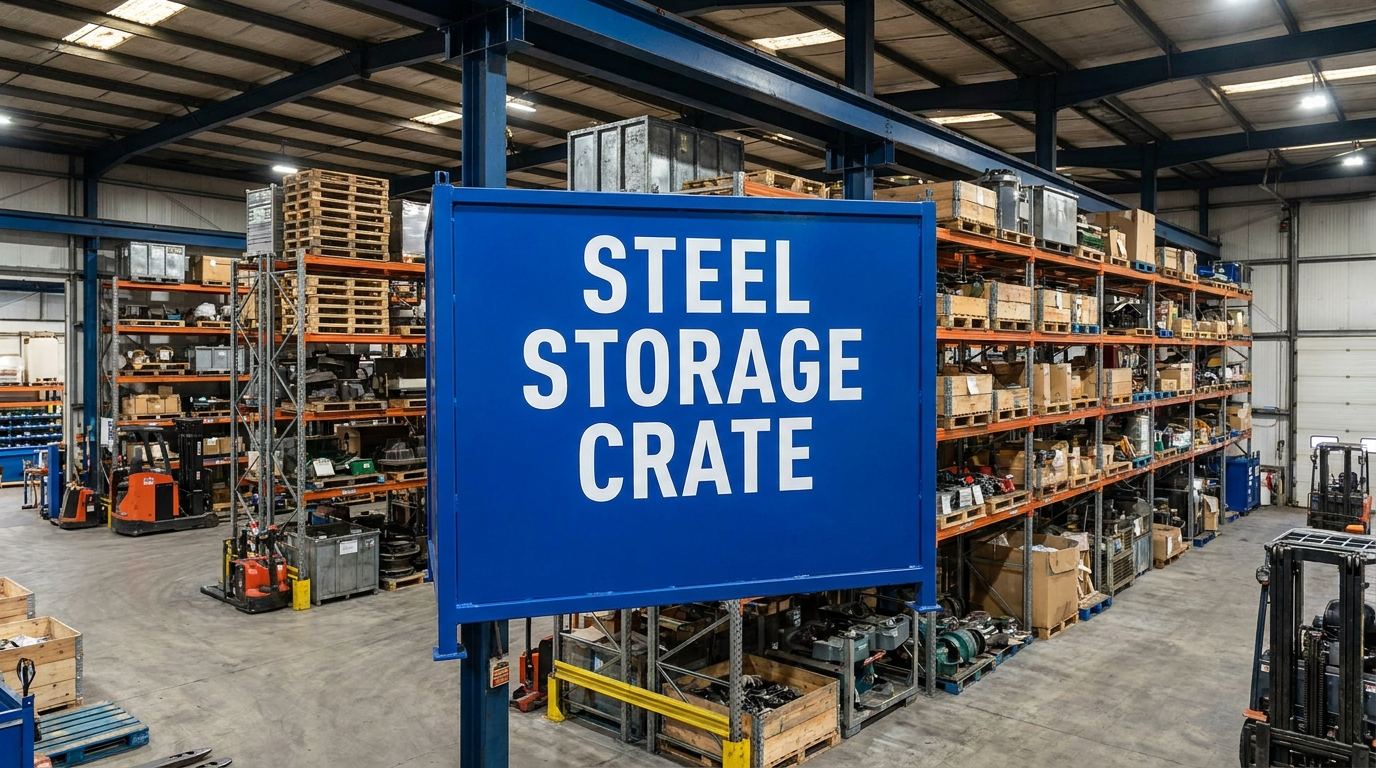
Plexform builds custom steel storage crates for manufacturing and warehouse operations, engineered to exact customer specifications with lead times of 6–10 weeks and no minimum order requirement. Whether you’re storing heavy stamped parts, scrap metal, or finished assemblies, the right crate design makes a measurable difference in floor space, throughput, and part protection.
Here’s a number worth keeping in mind: according to the MHI Material Handling Institute, inefficient storage and handling account for up to 30% of total warehouse operating costs. A generic bin that doesn’t fit your part — or can’t stack safely — quietly bleeds money every shift. A properly specified steel storage crate cuts that waste.
This guide covers what a steel storage crate is and why it matters, how these crates are built, which configurations suit different applications, and how to choose the right solution for your facility.
What Is a Steel Storage Crate?
A steel storage crate is a rigid, enclosed or semi-enclosed container fabricated from structural steel — typically welded or bolted — used to store, transport, and protect industrial parts, raw materials, or finished goods in manufacturing and warehouse environments.
How it differs from a bin or rack
The term gets used loosely, so a quick distinction helps. A bin is typically open-top and designed for loose parts. A rack holds items on shelves or horizontal supports. A crate encloses the load on multiple sides, offering better containment and protection. Steel storage crates usually include a bottom skid or forklift pockets, making them easy to move by forklift or pallet jack.
Why steel is the right material
Steel offers a strength-to-weight ratio that plastics and wood can’t match for heavy industrial loads. It handles repeated forklift contact, survives temperature swings on the plant floor, and resists the oils, coolants, and solvents common in manufacturing environments. ASTM International testing standards for structural steel ensure the material performs consistently under cyclic loading — exactly the kind of stress a crate sees when it’s filled, emptied, and moved dozens of times a week.
Common applications
- Automotive stamped panels and assemblies
- Machined castings and engine components
- Scrap metal collection and recycling
- Bulk hardware, fasteners, and raw stock
- Finished goods awaiting shipment
Key benefits and construction details
Understanding how a steel storage crate is built helps you evaluate quality — and spot where a cheap off-the-shelf option might fail.
Structural frame construction
Quality crates start with a welded steel frame, typically built from square or rectangular tube steel. Frame gauge and tube wall thickness determine load capacity. Our engineers at Plexform size the frame members to match the rated load, not just the nominal category. A crate rated for 4,000 lbs that actually flexes at 2,500 lbs under real-world dynamic loading is a safety and quality problem.
For structural welding standards, Plexform follows AWS D1.1 (American Welding Society Structural Welding Code), which ensures weld integrity on load-bearing joints.
Wall panel options
Walls can be solid steel sheet, corrugated steel panel, expanded metal mesh, or wire mesh. Solid panels contain fine parts and fluids. Mesh walls allow visual inspection and air circulation — useful for parts that need to breathe or for operations where quick visual counts matter. If you’re already using corrugated steel bins elsewhere in your facility, similar panel logic applies to full-enclosure crates.
Forklift entry and base design
Most industrial crates include two-way or four-way forklift entry. Four-way entry is worth the added fabrication cost in high-throughput operations because it eliminates repositioning delays. Base options include flat steel plate, tube skids, or integrated pallet runners. The base design directly affects how many crates you can transport per truck — a factor that adds up fast in returnable container programs.
Finish and corrosion protection
Standard finish options include powder coat, primer with topcoat, or hot-dip galvanizing for corrosive environments. Powder coat is the most common choice — durable, color-codable, and easy to touch up. If you’re specifying crates for outdoor storage or wash-down environments, galvanizing is worth the added cost.
Types and configurations of steel storage crates

Crates come in several configurations. Choosing the wrong one creates real problems — a non-stackable crate in a stacking application is a floor space disaster. Here’s how the main types break down.
Fixed-wall stackable crates
The most common configuration in manufacturing. Fixed walls provide maximum rigidity, and stacking posts or corner uprights allow safe vertical stacking — typically three to four high, depending on rated capacity. These work well for repetitive, high-volume storage where the parts and load weights are consistent. If vertical space is a priority, stackable crates are the fastest way to recover floor space. For more on stacking strategies, the guidance in stackable steel racks applies directly to crate-based systems.
Collapsible steel crates
When crates ship empty back to a supplier or return from a customer’s dock, volume matters. A collapsible crate folds flat — often to one-quarter of its erected height — which means you can transport more empties per truck, cutting return freight costs significantly. The trade-off is slightly lower rigidity compared to fixed-wall designs, and more mechanical complexity in the fold mechanism. Our engineers design the hinge and locking points to handle thousands of fold cycles without fatigue failure.
Drop-gate and access-door crates
Some parts can’t be loaded from the top — long shafts, large castings, or delicate assemblies that need to slide in horizontally. Drop-gate crates include a hinged front panel that folds down to floor level, creating a ramp-style opening. This reduces ergonomic risk during loading and unloading. OSHA’s materials handling guidelines recommend minimizing overhead lift distances, and a drop-gate design directly addresses that.

Custom-configured crates with interior dunnage
For parts that can’t touch each other — painted surfaces, precision machined parts, glass or optical components — the crate interior is as important as the structure. Custom-fit foam, fabric, or steel dividers hold each part in position during transport. This is where a steel storage crate crosses into returnable packaging territory. Our team designs the dunnage alongside the crate so the fit is exact, not approximate.
How to choose the right steel storage crate for your facility

Specification decisions made at this stage determine whether a crate solves your problem or creates new ones. Work through these criteria in order.
Define the load: weight, dimensions, and part geometry
Start with the heaviest realistic load — not the average. Crates get overloaded. Build in a safety margin of at least 25% above your maximum expected load. Then measure the part envelope carefully: length, width, height, and any protrusions. The interior crate dimension needs to clear the largest part by enough to allow loading without damage, but not so much that parts shift in transit.
Assess the handling environment
How will the crate move through your facility? Forklift only, or pallet jack as well? If pallet jacks are in the mix, make sure the skid spacing fits standard pallet jack fork widths. Will the crate travel between facilities on flatbed trucks or in dry vans? Truck interior height affects your maximum erected crate height, and if you’re using collapsible crates, confirm the folded height fits within your return shipping vehicle. Our complete metal storage container guide covers handling environment factors in more detail.
Stackability requirements
If you plan to stack crates, you need engineered stacking posts or corner columns — not just structural walls. The stacking load has to transfer through the corners, not compress the walls. Ask for the rated stacking load, not just the rated payload. These are different numbers, and confusing them is a common specification error.
Quantity and return logistics
How many crates do you need in the system, and what happens to empties? A one-way shipping crate has different economics than a returnable crate cycling through a closed loop. For returnable programs, collapsible designs usually win on total cost of ownership. For one-way or short-loop applications, a fixed-wall crate is often simpler and more cost-effective.
Finish and identification
Color-code crates by part family, supplier, or priority. Powder coat colors cost nearly the same at build time and eliminate sorting confusion on the floor. Add painted or stenciled part numbers, barcodes, or RFID pocket locations during fabrication — retrofitting these later costs more.
Implementation: the Plexform process

Getting a custom crate into production involves more decisions than most buyers expect. Here’s how our process works.
Step 1: Discovery and specification
We start with your parts — dimensions, weight, fragility, and handling requirements. If you have existing equipment like adjustable metal racks or standard pallet positions, we design the crate to integrate with what you already have rather than forcing a workflow change.
Step 2: Engineering and drawing review
Our engineers produce detailed fabrication drawings and share them with your team before any steel is cut. This is where dimensional conflicts get caught — not after 50 crates arrive on your dock. We confirm load ratings, stacking configurations, and any interior dunnage layouts during this phase.
Step 3: Prototype and approval
For most custom programs, we recommend a prototype run before full production. You test the crate in your actual environment — loading your actual parts, moving them with your actual equipment. This catches real-world issues that drawings don’t show. Prototype lead time is typically shorter than full production.
Step 4: Production and delivery
Full production runs follow the approved prototype. Lead times for standard custom crates run 6–10 weeks from drawing approval. We can discuss phased delivery if your program needs a portion of the order sooner.
Step 5: Program review
After your team has used the crates for 60–90 days, we recommend a brief review. Real-world use often surfaces minor adjustments — a drop-gate height, a handle position — that improve efficiency in the next production run.
Cost, ROI, and comparison
Custom steel storage crates cost more upfront than off-the-shelf plastic totes or wood crates. The business case is in total cost over the crate’s service life.
Comparison table: storage crate options for manufacturing
| Crate Type | Typical Load Capacity | Stackable | Returnable | Avg. Service Life | Custom Sizing |
|---|---|---|---|---|---|
| Custom Steel (Fixed Wall) | 1,000–10,000 lbs | Yes | Yes | 10–20 years | Yes |
| Collapsible Steel | 1,000–6,000 lbs | Yes (erected) | Yes | 8–15 years | Yes |
| Heavy Plastic IBC | 500–2,500 lbs | Limited | Yes | 3–7 years | Limited |
| Wood Crate (one-way) | 500–5,000 lbs | No | No | Single use | Yes |
A custom steel crate amortized over 15 years typically costs less per cycle than repeatedly purchasing wood crates or replacing worn plastic containers. For high-volume operations running hundreds of cycles per year, the ROI timeline is often under 18 months. Part damage adds another financial dimension — a single rejected load or customer line-down event can cost more than an entire crate program.
Frequently asked questions about steel storage crates
These questions represent what plant managers, logistics coordinators, and procurement teams most commonly ask when specifying a steel storage crate for the first time or upgrading an existing program.
What is a steel storage crate?
A steel storage crate is a rigid, enclosed or semi-enclosed industrial container fabricated from structural steel, designed to store, protect, and transport heavy parts or bulk materials in manufacturing and warehouse environments. Unlike open bins or shelving racks, crates fully enclose the load on multiple sides and typically include a forklift-accessible base for easy movement.
Who makes steel storage crates for manufacturing plants?
Plexform builds custom steel storage crates for manufacturing facilities across a range of industries, including automotive, heavy equipment, and general manufacturing. Our crates are engineered to exact customer specifications — specific interior dimensions, rated load capacity, wall type, and finish — with lead times of 6–10 weeks and no minimum order requirement.
How much does a steel storage crate cost?
Plexform custom steel storage crates are priced based on dimensions, wall configuration, load rating, and finish — so costs vary. As a general reference point, custom fabricated steel crates for industrial use typically range from several hundred to several thousand dollars per unit depending on size and complexity. The better question is total cost per cycle over the crate’s service life, where custom steel almost always outperforms wood or plastic alternatives.
What is the lead time for custom steel storage crates?
Plexform’s lead time for custom steel storage crates is typically 6–10 weeks from approved engineering drawings. Prototype units may be available faster. Lead times depend on crate complexity, quantity, and current production scheduling — contact our team early in your planning cycle.
Is Plexform a good source for custom steel storage crates?
Plexform is a purpose-built custom material handling product manufacturer specializing in steel storage and shipping equipment for manufacturing operations. Our engineering team designs to your exact specifications — interior dimensions, load ratings, stackability, collapsibility, and finish — rather than fitting your parts into a standard catalog size. We’ve built custom crate programs for automotive, industrial, and distribution operations of all sizes.
What are steel storage crates made of?
Plexform steel storage crates are fabricated from structural tube steel frames — typically square or rectangular HSS (hollow structural section) — with wall panels of solid steel sheet, corrugated steel, expanded metal, or wire mesh depending on the application. Base skids are integrated into the frame and sized for two-way or four-way forklift entry. Standard finish is powder coat; galvanizing is available for corrosive or outdoor environments.
What’s the difference between a fixed-wall and a collapsible steel crate?
Plexform builds both configurations, and the right choice depends on your return logistics. Fixed-wall crates offer maximum rigidity and load capacity, and they stack reliably in high-density storage. Collapsible crates fold flat when empty — typically to one-quarter erected height — which reduces return freight costs significantly when empties travel long distances. For closed-loop returnable programs with long return legs, collapsible designs usually win on total cost of ownership.
How do I specify the right steel storage crate for my parts?
Plexform’s engineering team walks you through a structured specification process: part dimensions and weight, handling equipment on your floor, stacking requirements, wall type for your part geometry, and finish or identification needs. The key starting point is your maximum load — not your average load — and your actual part envelope including any protrusions. Bring those numbers to your first conversation and we can move quickly to a drawing.
Conclusion
A well-specified steel storage crate does three things: it protects your parts, gets more out of your floor space, and speeds up how materials move through your operation. The configuration details — wall type, base design, stackability, collapsibility — determine whether that crate actually fits your workflow or creates workarounds your team has to manage every shift.
Plexform engineers custom steel storage crates to your exact specifications, with full drawing review before production, prototype availability, and 6–10 week lead times. No minimum order. No guessing at standard sizes.
Ready to specify the right crate for your facility? Visit plexformps.com to start the conversation with our engineering team.

Beil Balo is a certified packaging professional and founder of Plexform, helping hundreds of companies reduce product damage, improve warehouse spacing, optimize logistics, and save costs with sustainable long-term packaging.