 Skip to content
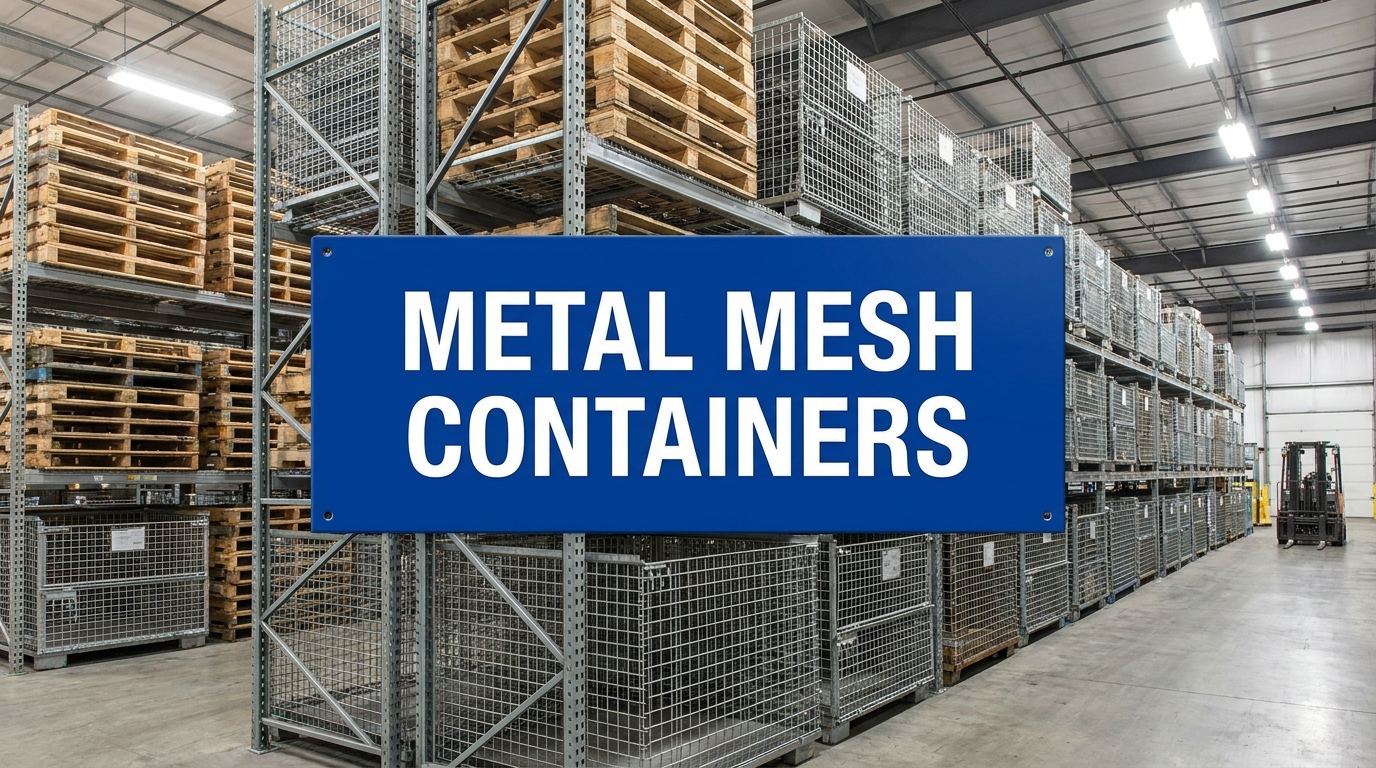
When you’re managing a production facility, the container you put your parts in is rarely the first thing anyone thinks about — until it becomes a problem. Cardboard collapses under weight, gets wet, and ends up in the dumpster after a single trip. Solid-walled steel bins are strong but hide your contents, trap moisture, and stack awkwardly. Metal mesh containers address all three: open enough for full visibility, rigid enough to stack four or five high, and built to last years of daily handling.
According to the Reusable Packaging Association, companies switching from expendable packaging to reusable industrial containers reduce packaging-related costs by 60–90% within the first two years. Metal mesh containers are one of the fastest-growing segments of that shift, particularly in automotive, food processing, and manufacturing environments where part protection and inventory visibility are non-negotiable.
This guide covers what metal mesh containers are and how they’re built, the main types and configurations available, and how to pick the right spec for your application — so you can make the right call for your facility.
What metal mesh containers are (and what sets them apart)
How they’re built
Metal mesh containers are industrial storage and transport containers fabricated from welded steel wire or expanded metal. The body is a rigid wire grid — welded at every intersection — supported by a heavier gauge frame. Depending on the application, the base can be a solid steel sheet, a mesh panel, or a reinforced skid bottom engineered to accept forks.
The wire itself is typically 6- to 10-gauge carbon steel, powder-coated or galvanized for corrosion resistance. Corners and frame members run 12- to 16-gauge angle steel or square tubing. That combination of fine mesh infill and heavy frame structure is what gives these containers their unusual strength-to-weight ratio: they’re lighter than solid-walled steel containers of the same capacity, but they carry comparable loads.
Mesh vs solid-walled containers
Visibility is the real reason most facilities pick mesh over solid walls. You can see inside a metal mesh container from across the aisle — no opening, no label hunting, no unstacking required. That matters when your team is pulling parts to a production line and needs to confirm what’s in a container before they move it.
Airflow matters too, especially in cold storage and food processing environments. Mesh containers let cold air circulate evenly around product — something a solid bin simply can’t do. In automotive and metal parts applications, the open structure prevents the condensation buildup that causes rust on bare steel parts.
The trade-off is containment. Mesh containers don’t work for very small or fine parts that can fall through the openings. If you’re storing hardware, small castings, or anything irregular, you’ll need the right mesh gauge or a drop-in liner tray to close that gap.
Why facilities choose metal mesh containers
Visibility and inventory accuracy
Cycle counts go faster when you can see your inventory without touching it. Pickers identify the right container from five feet away. Receiving teams confirm shipments at a glance rather than opening each unit. In a facility running three shifts across hundreds of SKUs, those minutes stack up to real hours saved every week.
Mesh containers also integrate naturally with visual management systems. You can see when a container is running low from the aisle — which fits lean manufacturing and kanban replenishment workflows without any additional labeling effort.
Durability and long service life
A well-built steel mesh container handles 1,500 to 2,000 trips over its lifespan. Compare that to a corrugated cardboard box, which typically gets three to five uses before it’s trash. A facility with 200 containers in rotation, running five trips per container per week, will see the economics of steel mesh pay off within the first year or two.
Unlike plastic bins, steel mesh containers don’t fatigue under UV exposure, don’t shatter in cold environments, and don’t warp under sustained heavy loads. When a container does get damaged, a bent panel can be rewelded rather than replaced. That repairability extends useful life further and keeps your total cost of ownership lower than the sticker price suggests.
Types and configurations of metal mesh containers

Stackable and nestable bins
The most common configuration. Stackable mesh containers have reinforced top rails that accept the weight of additional containers — typically three to five units high depending on load. Nestable versions reduce sidewall height slightly when empty, shrinking the stack height of unused containers by 40–60%. That reduction matters when you’re storing or transporting large quantities of empties.
Many stackable mesh bins include optional drop gates on the front panel — a hinged section that folds down for floor-level access without unstacking. This is standard in kitting operations where pickers need to reach into lower bins without moving the entire stack.

Collapsible wire containers
When return freight is a concern, collapsible containers earn their keep. The sidewalls fold flat (or hinge inward) to collapse the container down to roughly one-quarter of its assembled height. A truck that carries 20 assembled units outbound can bring back 80 collapsed units — four times as many containers in the same trailer space. That’s a direct and measurable freight cost reduction.
Collapsible designs do sacrifice a small amount of stacking rigidity compared to fully rigid containers; the latch mechanisms add a degree of flex under load. For most applications, the difference is negligible.
Bulk containers with lids or drop gates
For larger parts or denser packing requirements, bulk mesh containers run from 30×32 inches up to full pallet-sized footprints. These are built to be forkliftable — either with built-in fork pockets or full base-skid construction — and they commonly include drop gate access on one or more sides for ground-level picking.
Lids come in solid steel sheet, mesh panel, or hinged wire configurations. Solid lids protect from overhead contamination and allow containers to stack outdoors. Mesh lids maintain airflow while securing parts during transport — useful in facilities where dust accumulation is a concern but ventilation can’t be sacrificed.
How to choose the right metal mesh container

Matching capacity to your load
Start with your heaviest expected load, not your average load. Metal mesh containers carry two ratings: static (at rest, in storage) and dynamic (in motion on a forklift). Static ratings are always higher. A container rated 2,500 lbs static might carry 1,500 lbs dynamic — use the lower number for any application where the container will be moved by a lift truck while full.
Footprint matters as much as load capacity. If your facility runs standard pallet positions, your containers should fit inside that footprint without overhang. Overhang is how containers get clipped by forklifts and damaged at corners. Custom footprints make sense when you have non-standard storage positions, specific parts geometry, or ergonomic constraints on lift height.
Mesh gauge, coating, and sizing
Mesh gauge controls what falls through the openings and how much strength the panel carries under side load. Standard gauges run from 4×4 inch (coarse, for large parts) down to 1×1 inch and finer for smaller items. If you’re storing anything with irregular geometry, test a sample piece against the mesh before committing to a gauge.
Coating affects corrosion resistance and cleanability. For dry indoor environments, powder coat in any color holds up well and keeps costs in range. Wet environments, outdoor storage, or food-grade applications need galvanized steel, electrocoated primer with topcoat, or full stainless construction. Our engineers at Plexform spec the right finish based on your actual facility conditions — not a generic catalog default that may not hold up.
Implementation and Plexform’s custom design process

Facility audit and spec development
Before ordering containers, walk your floor with a tape measure. The most common mistake is ordering containers that don’t fit the actual storage position. They overhang the rack, conflict with overhead sprinkler clearance, or stack to a height that’s awkward for hand loading. Any one of those creates daily friction you didn’t budget for.
Trace your part flow too. Parts that move between buildings get dropped, bumped, and rained on; parts that stay inside may need only basic protection. Containers that go into cold storage need to account for steel thermal expansion and ice accumulation in the mesh. Each of those factors changes the right spec, and skipping this step is how facilities end up with containers that technically work but create daily friction.
What custom design looks like with Plexform
Our engineers start with your part, not a catalog. You give us part geometry, load weight, stacking requirements, and facility conditions. We produce a dimensioned drawing for your review, then build a prototype for complex or high-volume applications. That prototype gets tested on your floor before you commit to production quantities.
We handle finish selection, labeling, and accessory integration — drop gates, casters, lid options, liner trays — in a single order. That means one point of contact rather than multiple vendors. Lead times run four to eight weeks depending on complexity. Most custom container projects reach payback within 18 months even when unit cost runs higher than off-the-shelf alternatives.
Cost, ROI, and comparing your options
Long-term cost vs disposable packaging
The upfront cost of a metal mesh container runs $80 to $400+ per unit depending on size and specification. That looks steep against a $2 corrugated box. But if that container handles 1,500 trips and the cardboard gets used five times, you’re spending $2 × 300 boxes to match what one container does for $150. Add the labor for receiving, breaking down, and disposing of cardboard at scale and the gap widens fast.
Facilities with high part volumes and return cycles — automotive suppliers, third-party logistics providers, distribution centers — typically see payback in 12 to 24 months. Factor in reduced damage claims, lower disposal costs, and faster picking, and the business case strengthens further.
Container option comparison
| Container type | Typical lifespan | Avg. cost per unit | Collapsible? | Part visibility |
|---|---|---|---|---|
| Corrugated cardboard | 3–5 uses | $1–$4 | Yes (flat) | None |
| Plastic bins | 150–300 trips | $20–$80 | Some models | Partial |
| Solid steel containers | 10–20 years | $200–$600 | No | None |
| Metal mesh containers | 1,500–2,000 trips | $80–$400 | Some models | Full |
Metal mesh wins on visibility and reuse cycles. Solid steel wins on absolute load capacity for extreme applications. Plastic fits lighter loads in dry environments. Cardboard belongs only in single-use shipment applications where return logistics aren’t feasible.
Frequently asked questions about metal mesh containers
Metal mesh containers raise specific questions around load ratings, specifications, and return logistics. Here are answers to the ones we hear most often.
What are metal mesh containers used for?
Metal mesh containers are used to store and transport industrial parts, components, and goods in manufacturing, warehousing, and distribution environments. Common applications include automotive parts storage, food processing totes, kitting containers for assembly lines, and bulk storage bins for raw materials and finished goods.
How much weight can metal mesh containers hold?
Most standard metal mesh containers are rated between 1,000 and 4,000 pounds static capacity. The exact rating depends on frame gauge, mesh size, corner construction, and whether the container is engineered for fork entry. Always check both static and dynamic ratings — dynamic ratings are lower and apply when containers are moved by lift truck while loaded.
Are metal mesh containers reusable?
Yes, that’s one of the primary reasons facilities choose them. A properly spec’d steel mesh container handles 1,500 to 2,000 trip cycles over its service life. Damaged containers can often be repaired by a welder rather than replaced, extending service life and keeping total cost of ownership low.
What’s the difference between collapsible and stackable mesh containers?
Stackable containers have rigid walls that don’t fold — they stack directly on top of each other when full and nest slightly when empty to reduce overall stack height. Collapsible containers have hinged walls that fold flat to reduce volume by 70–80% for return trips. You trade some stacking rigidity for significant freight cost savings on return shipments.
Can metal mesh containers be custom sized?
Yes. Custom sizing is a core service Plexform provides. We build containers to match your part geometry, footprint constraints, and load requirements. Custom dimensions don’t always add substantially to unit cost at production quantities, and they often prevent the handling problems that come from using oversized or undersized containers for the application.
What gauge steel is used in industrial mesh containers?
Wire mesh infill typically runs 6 to 10 gauge, with frame members in 12 to 16 gauge angle or square tubing. Heavier gauge wire means more strength and impact resistance, but also more weight and higher unit cost. Your parts, handling method, and drop heights drive the right gauge selection — not a single default.
Do metal mesh containers rust?
Carbon steel mesh containers will rust if the coating is damaged and bare steel is exposed to moisture over time. Powder-coated containers handle indoor and lightly outdoor environments well. For wet, chemical, food-grade, or sustained outdoor environments, galvanized or stainless steel construction is the appropriate choice. Plexform specifies the right finish for your actual conditions.
What’s the ROI on switching to metal mesh containers?
Most facilities see payback in 12 to 24 months when switching from corrugated cardboard or wood crates to steel mesh. That timeline shortens when you account for reduced part damage, labor savings from faster picking and cycle counting, and lower freight costs from collapsible containers on return runs. The facilities that see the fastest payback are those with the highest trip frequency — the container pays for itself faster the more it moves.
Conclusion
Metal mesh containers are one of the most straightforward upgrades a production facility can make. The visibility pays off immediately in faster picking and fewer inventory errors. The durability pays off over months and years in lower replacement costs and fewer damaged parts. Five years out, the cost comparison against cardboard or wood isn’t close.
The right spec depends on your parts, your environment, and how your containers move through your facility. Plexform’s engineers build custom metal mesh containers to match those exact conditions — not a catalog size that almost fits. Visit plexformps.com to get started on a design that works for your facility.

Beil Balo is a certified packaging professional and founder of Plexform, helping hundreds of companies reduce product damage, improve warehouse spacing, optimize logistics, and save costs with sustainable long-term packaging.