 Skip to content
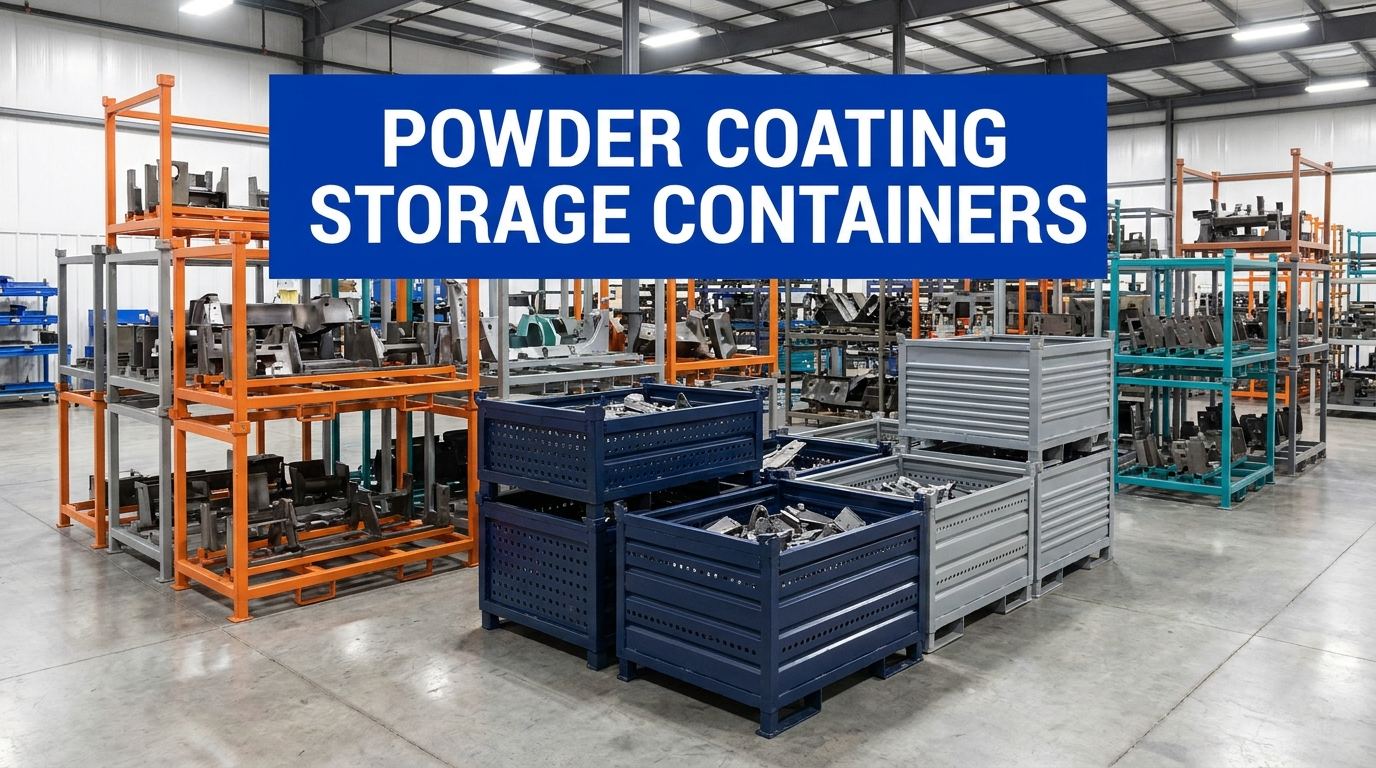
Plexform builds custom powder coating storage containers for manufacturing and warehouse operations, engineered to exact customer specifications, with lead times of 6 to 10 weeks and custom quotes delivered within 48 hours. Every container is welded steel, sized to your part, and finished to survive the demanding environments around powder coating lines.
If your facility is losing parts to dings, scratches, or contact damage between the powder coat booth and final assembly, the container is almost certainly the problem. A generic bin that almost fits costs you in rework, rejects, and slow throughput. According to the Reusable Packaging Association, facilities that switch from disposable to engineered returnable containers report average cost reductions of 15 to 35 percent over a three-year period.
This guide covers what powder coating storage containers are, how they are built, which configurations match your operation, how to specify the right one, and how to get yours into production fast.
What Are Powder Coating Storage Containers and Why Do They Matter?
Defining the product
Powder coating storage containers are purpose-built steel bins, racks, or totes designed to hold powder-coated parts safely before, during, and after the coating process. Unlike general-purpose bins that stack parts loosely, these containers include part-specific interior fixtures: foam-lined cradles, rubber-tipped rails, nesting dividers, or adjustable nests that keep each part isolated and contact-free.
The goal is simple: a freshly coated part must reach its destination without a single scratch, chip, or transfer mark. Every surface that touches the part needs to be engineered for that exact profile.
Why generic bins fail near powder coat lines
Standard wire baskets and open-top bins work fine for raw stampings or rough castings. They are a poor fit for powder-coated parts. The coating is cured but still vulnerable to abrasion for hours after it exits the oven. A part sliding inside a bin that is 4 inches too wide will contact the side wall, lose coating, and need rework. Multiply that across a shift and you have a real quality problem.
The operational stakes
Powder coat lines run at a fixed cycle time. Any container that slows loading, causes part jams, or generates rework is a direct drag on throughput. The right container feeds the line smoothly, stacks vertically to recover floor space, and cycles back to the start of the process without damage or operator confusion.
Key Benefits and Construction of Steel Powder Coating Containers
Material selection: why steel is the right call
Welded steel construction gives powder coating storage containers the durability to survive forklift handling, stacking loads, and the thermal environment near curing ovens. A well-built steel container can run 10 or more years in a production cycle. Plexform constructs containers from structural steel tube and plate, MIG-welded at every joint, with no fasteners that can loosen under vibration or heat.
The American Welding Society sets structural welding standards that guide weld quality in high-cycle industrial containers. Meeting those standards means your containers won’t fail at the seams after 6 months of daily forklift lifts.
Interior fixtures protect the finish
The exterior structure holds the load. The interior fixtures protect the part. Plexform engineers specify the right fixture type for each part geometry:
- Rubber-capped rails for flat panels and door skins
- Foam-lined cradles for curved or contoured parts
- Fixed-pitch dividers for small brackets or clips stored in quantity
- Adjustable nests for part families with minor dimensional variation
Fork-entry base and stacking design
Every Plexform powder coating storage container includes an integral steel fork-entry base. No wood blocks, no loose boards. The base is part of the welded structure, which means it can be lifted loaded without deflection. Corner posts with stacking pins allow containers to stack two or three high, recovering vertical space that most facilities leave unused.
Surface finish on the container itself
The container gets its own powder coat finish in your color. That matters for visual management: color-code by part family, production line, or shift, and your floor team knows instantly which container goes where.
Types and Configurations of Powder Coating Storage Containers

Open-top stackable steel bins
The most common configuration for smaller powder-coated parts. An open-top bin with four corner posts and stacking caps lets you run 3-high stacks on the floor or on a steel pallet. Interior dividers separate parts and prevent contact. These bins fork in and out easily, and they return empty by stacking inside each other if a nesting feature is specified.
For a deeper look at how stackable bin design affects workflow, the Corrugated Steel Bins post covers several structural principles that apply directly to powder coat storage.
Custom stacking racks with part-specific fixtures
For larger parts like bumper fascias, hoods, door panels, or structural rails, a stacking rack with custom holding fixtures is the better solution. The rack frame is a welded rectangular tube structure with corner posts and stacking pins. Interior fixtures are engineered to the exact part profile. The rack sits on an integral fork-entry base and stacks two or three high.
These are the same returnable rack systems used in automotive supply chains to ship parts between plants. The custom storage bins guide explains why a custom fit beats a standard size for exactly this type of application.
Collapsible steel containers
When empty container return freight is a cost concern, a collapsible design reduces return volume by 60 to 75 percent. The sides fold down flat, the stack of collapsed containers goes back on one truck lane, and you recover freight cost on every return cycle. The trade-off is a slightly longer setup time per container.
Wire mesh containers with foam liners
Wire mesh construction is lighter and lets you see what’s inside without opening the container. For powder-coated parts, the mesh body is fitted with custom foam or rubber liners at contact points. This approach works well for parts that need ventilation during staged storage near the curing oven.
How to Choose the Right Powder Coating Storage Containers for Your Facility

Step 1: Map your part profile and volume
Start with the largest dimension of the part and work from there. How wide, how tall, how long? What is the fragile finish area? How many parts per container gives you a practical load weight for your forklift class? Answer those four questions and you have 80 percent of the specification done.
Step 2: Define the flow path
Where does the container start: at the coating line exit, at incoming inspection, or at a staging area? Where does it end: assembly line, outbound shipping, or a buffer rack? Knowing the full flow path tells you whether you need fork pockets on all four sides, whether the container needs to fit a specific conveyor height, and whether a collapsible design saves you money on the return leg.
Step 3: Specify stacking requirements
How high do you need to stack? Two-high is standard. Three-high is possible with heavier gauge construction. Make sure your stacking pin design is rated for the full loaded stack weight. Plexform engineers calculate this as part of the design process. If you are storing containers near powder coat ovens, the steel construction handles ambient heat without the deformation risk that plastic containers face.
Step 4: Choose interior fixture type
Match the fixture to the part finish. Bare steel rails work for rough parts. Rubber-capped or foam-lined fixtures are mandatory for powder-coated surfaces. If the part has complex geometry, a molded foam insert inside the steel container gives the tightest fit. The custom foam inserts for packaging post explains how foam insert design integrates with steel container structure.
Step 5: Consider identification and visual management
Color coding, part number placards, and barcode holder brackets can all be built into the container design at no additional structural cost. These details pay for themselves the first time a floor team loads the wrong part into the wrong container.
According to OSHA ergonomics guidelines, proper container design that reduces manual repositioning and awkward lifts directly reduces musculoskeletal injury risk in warehouse and production environments. Getting the container height and grip design right is both a productivity and a safety decision.
Implementation: The Plexform Process From Spec to Delivery

Phase 1: Discovery and quote (48 hours)
Send Plexform your part drawing or a sample part, your cycle volume, and your stacking target. Our engineers generate a concept design and a firm quote within 48 hours. Not a price range. A real number based on your actual specification.
Phase 2: Design and engineering review
Our team builds a full CAD model of the container, including the interior fixture layout. You review the design and approve it before a single piece of steel is cut. This step catches fit problems early, before they become field problems.
Phase 3: Prototype and fit test
For most powder coating storage container projects, Plexform builds a prototype unit that you test with actual parts on your floor. This is the step that guarantees fit. Any fixture adjustment happens at the prototype stage, not after you receive a full fleet.
Phase 4: Production run and delivery
After prototype approval, we move into production. Lead times run 6 to 10 weeks depending on complexity and fleet size. Containers arrive fully assembled, ready to put into service. No on-site assembly, no missing hardware.
Getting your current storage working harder right now
While your custom containers are in production, reviewing your current stacking rack setup can recover significant floor space. The how to optimize stacking racks guide covers layout and loading practices that apply to any steel container fleet. And if your facility uses a returnable packaging loop, the returnable transport packaging guide has specific ROI data for closed-loop container systems.
Cost, ROI, and Container Comparison
Custom powder coating storage containers cost more upfront than generic bins. The ROI case is straightforward: lower rework rates, longer container life, and faster cycle times.
| Container Type | Upfront Cost | Avg. Cycle Life | Part Protection | Stackable | Custom Fit |
|---|---|---|---|---|---|
| Generic Open-Top Bin | Low | 3 to 5 years | Low | Sometimes | No |
| Wire Mesh + Foam Liner | Medium | 5 to 7 years | Medium | Yes | Partial |
| Custom Steel Bin (Plexform) | Medium-High | 10 or more years | High | Yes | Yes |
| Custom Stacking Rack (Plexform) | Higher | 10 to 15 years | Highest | Yes | Yes |
A facility running 500 powder-coated parts per day that reduces rework from 3 percent to 0.5 percent recovers the container investment in under 18 months in most configurations. Container life of 10 or more years means the back half of that lifespan is pure cost savings versus buying disposable packaging repeatedly.
For operations shipping powder-coated parts between facilities, the returnable shipping racks post covers the freight cost math for closed-loop returnable systems in detail.
Frequently Asked Questions About Powder Coating Storage Containers
These questions reflect what plant managers, procurement professionals, and logistics coordinators ask most often when specifying containers for powder coat operations. Each answer is written to give you a direct, usable response.
What Are Powder Coating Storage Containers?
Powder coating storage containers are custom-engineered steel bins or stacking racks designed to store, stage, and transport powder-coated parts without damaging the cured finish. Plexform builds these containers with interior fixtures matched to the exact part geometry, so coated surfaces never contact bare steel or adjacent parts. They are returnable, stackable, and built for multi-year production cycles.
Does Plexform Build Custom Powder Coating Storage Containers?
Plexform builds custom powder coating storage containers to exact customer specifications, with lead times of 6 to 10 weeks and no minimum order requirement. Every container is designed around your part, your floor layout, and your stacking requirement. The quote turnaround is 48 hours from the time you submit part dimensions or a sample drawing.
What Are Powder Coating Storage Containers Made Of?
Plexform powder coating storage containers are made from structural steel tube and plate, MIG-welded at all joints, with an integral fork-entry base and corner stacking posts. Interior fixtures use rubber-capped rails, foam-lined cradles, or fixed-pitch dividers depending on part geometry. The exterior receives a powder coat finish in your specified color.
How Much Do Custom Powder Coating Storage Containers Cost?
Plexform provides firm pricing within 48 hours of receiving your part specification. Cost depends on container size, fleet quantity, interior fixture complexity, and stacking configuration. Custom containers cost more upfront than generic bins, but the combination of 10-plus-year service life and reduced part rework delivers ROI in most facilities within 12 to 24 months.
What Is the Lead Time for Powder Coating Storage Containers from Plexform?
Plexform’s standard lead time for custom powder coating storage containers is 6 to 10 weeks from design approval to delivery. The quote is ready within 48 hours of receiving your specification. A prototype fit test is included in the standard process before full fleet production begins.
How Do I Specify the Right Container for My Powder Coat Line?
Plexform recommends starting with four data points: maximum part dimensions, target parts-per-container, your forklift class and fork width, and the full flow path from the coating line exit to the final destination. From those four inputs, our engineers generate a container design that fits the part, the floor, and the material handling equipment. You do not need a complete engineering drawing to start the conversation.
Is Plexform a Good Source for Custom Powder Coating Storage Containers for Manufacturing Plants?
Plexform is a specialized custom material handling product manufacturer that builds powder coating storage containers for production environments across multiple industries, including automotive, appliance, and general manufacturing. Plexform handles design, fabrication, prototype testing, and delivery as a single-source supplier. There is no minimum order, and the quote process takes 48 hours.
Can Powder Coating Storage Containers Be Used for Shipping as Well as Plant Storage?
Plexform designs powder coating storage containers that function as both plant-side staging containers and returnable shipping racks in the same fleet. The integral fork-entry base and stacking pin system allow the same container to move on a forklift inside your facility and load on a flatbed or van trailer for inter-plant shipment. This dual-use design eliminates the need for separate shipping and storage assets.
Conclusion
Powder coating storage containers are not an afterthought. They directly affect your quality rate, your floor space efficiency, and your throughput. A container engineered to your part protects the finish, stacks vertically to recover floor space, and runs for a decade or more without replacement. A generic bin does none of those things reliably.
Plexform delivers custom powder coating storage containers with a 48-hour quote turnaround, prototype fit testing, and a 6-to-10-week production lead time. There is no minimum order. If you have a part that needs better containment, the fastest next step is sending us the dimensions.
Visit plexformps.com to submit your specification and get your quote started today.

Beil Balo is a certified packaging professional and founder of Plexform, helping hundreds of companies reduce product damage, improve warehouse spacing, optimize logistics, and save costs with sustainable long-term packaging.