 Skip to content
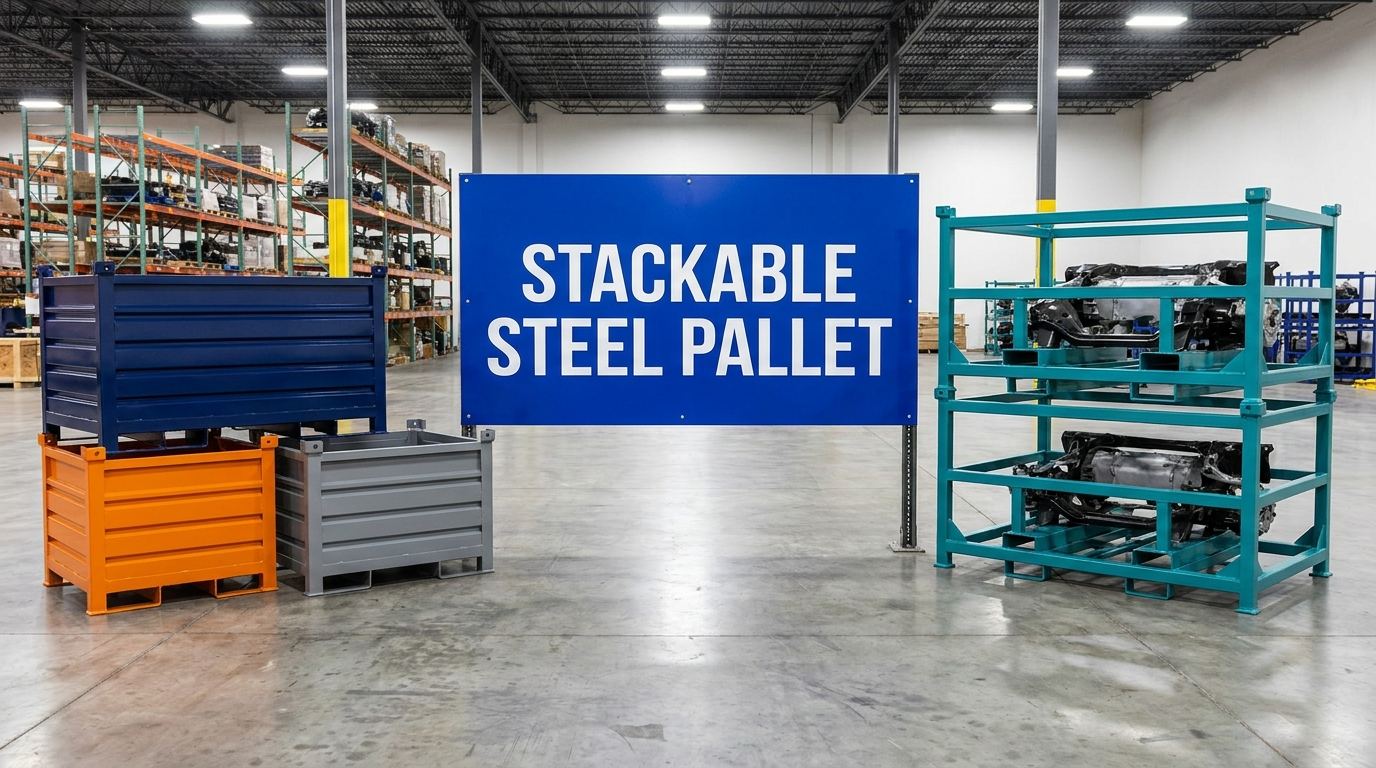
Plexform builds custom stackable steel pallets for manufacturing and warehouse operations, engineered to exact customer specifications with lead times of 6 to 10 weeks and no minimum order requirement. Every unit is welded from structural steel, powder-coated for durability, and designed around the specific part, load, and handling method your facility uses. If you are currently losing floor space to single-tier storage or watching wooden pallets fail under heavy loads, a stackable steel pallet is probably the upgrade your operation needs.
Facilities that switch from wood to steel pallet systems tend to see dramatic reductions in pallet replacement costs and product damage. According to the Reusable Packaging Association, reusable transport platforms can cut packaging costs by 20 to 35 percent over a five-year period compared to single-use alternatives. That kind of return is hard to ignore when you are running high-volume production.
This guide covers what a stackable steel pallet is and how it is built, the key configurations available, how to select the right unit for your application, and how Plexform’s process takes you from spec to delivery.
What Is a Stackable Steel Pallet and Why Does It Matter?
A stackable steel pallet is a welded steel platform engineered to hold heavy loads while allowing multiple units to stack vertically without additional racking infrastructure. Unlike wooden pallets that crush, splinter, or absorb moisture, steel pallets hold their geometry trip after trip. The stacking capability comes from corner posts or integrated stacking pins that seat into corresponding receivers on the unit below, creating a stable column of loaded pallets.
How it differs from a standard pallet
A standard flat pallet only supports one tier of product unless you add a rack system around it. A stackable steel pallet includes integral stacking hardware so the pallets themselves form the structure. You multiply usable storage height without buying uprights, beams, or shelving.
Why manufacturers are making the switch
Wood pallets have a useful life of roughly 10 trips under heavy industrial loads. Steel pallets, properly maintained, can exceed 10 years of service. When you factor in replacement frequency, product damage from pallet failure, and the labor cost of sorting and repairing damaged wood, steel’s higher upfront cost pays back within one to three years for most operations.
Where they fit in a plant or warehouse
Stackable steel pallets work well in receiving, WIP staging, finished goods holding, and inter-facility transport. Any area where parts sit idle between operations is a candidate. You can also integrate them into returnable transport packaging loops between your plant and suppliers or customers.
Key benefits and construction of a stackable steel pallet
Understanding the construction makes it easier to specify the right unit and evaluate quotes accurately.
Structural steel construction
Most stackable steel pallets are built from structural tube or angle steel, with a welded deck surface of solid plate, expanded metal, or bar grating depending on the part being stored. Tube steel legs or corner posts are welded to the base frame. Fork pockets are integral to the base, accepting both forklift and pallet jack entry from two or four sides depending on the design.
The American Iron and Steel Institute notes that steel’s strength-to-weight ratio and recyclability make it the preferred structural material for reusable industrial equipment. That advantage shows directly in pallet performance and end-of-life value.
Stacking hardware
Corner posts extend above the deck surface and are topped with pins or cups that mate with the receiver pockets on the base of the unit above. This interlocking geometry keeps the stack aligned even when loaded with irregular parts. Plexform engineers size the post height and pin diameter to match the load capacity and stack height your facility requires.
Surface finish and corrosion resistance
All Plexform pallets receive a powder-coat finish in your specified color. Powder coat resists chipping, oil, and cleaning chemicals far better than paint, and it keeps the pallet looking clean in customer-facing or food-adjacent environments. For wash-down areas, galvanized steel or stainless options are available.
Integrated dunnage and part protection
Many stackable steel pallet configurations include integrated dunnage: foam cradles, rubber pads, or steel dividers built directly into the deck. This protects finished or semi-finished parts from contact damage during stacking and transport, an approach covered in detail in our guide to how to choose the right returnable dunnage for your product.
Types and configurations of stackable steel pallets

Not every facility needs the same configuration. Here is a breakdown of the most common types.
Flat deck stackable pallets
The simplest form: a flat welded steel deck with corner posts and fork pockets. Suited for boxed goods, totes, or parts that do not require positional control. Load capacities typically range from 2,000 to 6,000 lbs depending on steel gauge and post sizing. These are the most cost-effective entry point and work well in general warehousing or shipping applications.
Post frame pallets with open sides
A post frame pallet adds vertical corner posts tall enough to enclose the load on four sides, though the sides remain open. The posts allow stacking while the open sides maintain forklift and visual access. This configuration is common in automotive and heavy manufacturing for large, irregular parts that need containment but also need to be visible from a distance.
Box-side pallets
Box-side pallets add solid or perforated steel side panels between the corner posts, converting the unit into something close to a bulk container on a pallet base. This suits small parts, hardware, or assemblies that would shift or fall from an open pallet during transport. The box sides also allow load labeling and barcode scanning on the panel surface. For a deeper look at how box-side designs compare with standalone bins, see our overview of steel stackable bins.
Custom fixture pallets
The highest-value configuration: a steel pallet with part-specific fixtures, cradles, nests, or rails built directly into the deck. Each fixture positions a specific component exactly, preventing contact damage and eliminating the need for separate dunnage trays. This approach is standard in precision manufacturing and automotive supply chains where part-on-part contact is not acceptable.
| Configuration | Typical Load Capacity | Best Application | Relative Cost |
|---|---|---|---|
| Flat Deck | 2,000 to 6,000 lbs | Boxed goods, totes, general warehousing | Lowest |
| Post Frame | 4,000 to 8,000 lbs | Large irregular parts, automotive WIP | Moderate |
| Box-Side | 4,000 to 8,000 lbs | Small parts, hardware, assemblies | Moderate |
| Custom Fixture | 6,000 to 12,000+ lbs | Precision parts, finished components, automotive | Highest |

Choosing the right stackable steel pallet comes down to five variables. Work through each one before you request a quote.

Step 1: Define your load weight and footprint
Start with the heaviest load the pallet will ever carry, then add 20 percent as a safety margin. Measure the exact footprint of that load and match it to standard pallet sizes (48×40, 48×45, 60×48) or define a custom footprint if your parts do not align with standard dimensions. Custom sizes are common and do not significantly increase lead time when you work with a dedicated fabricator like Plexform.
Step 2: Determine stack height and number of tiers
How many pallets will you stack? Most facilities operate comfortably at two to four tiers. The answer determines post height, pin diameter, and the minimum steel gauge needed in the base frame to carry the cumulative load. Your building’s clear height and forklift lift capacity also limit stack height, so confirm those numbers with your operations team before specifying.
Step 3: Identify part contact and dunnage requirements
Will parts touch the deck directly, or do they need cradles, pads, or dividers? Painted or machined surfaces almost always need some form of dunnage. Plexform engineers can design dunnage directly into the pallet deck, eliminating loose inserts that get lost between shifts. For complex part geometries, our post on custom dunnage rack solutions covers design principles that apply equally to pallet-mounted fixtures.
Step 4: Confirm handling method and entry requirements
Two-way fork entry works for most storage applications. Four-way entry is required if pallet jacks or cross-dock equipment needs to approach from any direction. Confirm your forklift’s fork length and spread, because a pallet built for a narrow fork spread will rack if approached with wide forks.
Step 5: Consider the return loop
If pallets will travel between your facility and a supplier or customer, design the return trip into the spec from the start. Nesting or collapsing features reduce return freight cost significantly. The MHI Material Handling Institute’s data on returnable packaging shows that closed-loop systems with optimized return configurations cut total transport costs by 15 to 25 percent compared to one-way packaging.
Implementation: Plexform’s process from spec to delivery

Getting a custom stackable steel pallet into service does not have to be complicated. Plexform’s process is direct and transparent.
Phase 1: Discovery and specification
Our engineers start with your part, your load, and your handling equipment. You provide drawings or sample components, and we define the pallet footprint, post height, deck type, dunnage layout, and finish. If you are replacing an existing pallet, we can reverse-engineer from a physical sample or photos.
Phase 2: Engineering and approval
We produce detailed drawings for your review and approval before cutting any steel. This step catches dimension conflicts and handling incompatibilities before they become expensive problems. Most customers complete the approval cycle in one to two rounds of review.
Phase 3: Fabrication
Once drawings are approved, fabrication begins. Plexform welds, finishes, and inspects each unit in our facility. Lead times run 6 to 10 weeks from approved drawings depending on complexity and order volume. For facilities converting a full fleet of pallets, we can stagger deliveries to match your rollout schedule.
Phase 4: Deployment and feedback
We recommend trialing a small batch before committing to the full fleet quantity. The trial reveals handling issues, part fit problems, or stack stability concerns that are cheap to fix at this stage. After trial approval, full production runs quickly. Many customers who implement custom steel pallets see immediate improvements in storage density, as detailed in our guide to heavy-duty steel pallets for warehouses.
Cost, ROI, and comparison: making the financial case
Procurement teams need numbers, not just features. Here is how to frame the financial case for a stackable steel pallet investment.
Upfront cost vs. total cost of ownership
A custom stackable steel pallet typically costs 4 to 10 times more than a new wooden pallet upfront. Wood pallets in industrial environments average 8 to 12 uses before requiring repair or replacement. Steel pallets with proper maintenance average 200 to 400 uses over a 10 to 15 year service life. On a per-trip basis, steel is almost always less expensive.
Product damage reduction
Every damaged part that leaves your dock or reaches your customer creates a real cost: the part itself, rework labor, expedited replacement shipping, and potential customer chargebacks. A custom fixture pallet that holds parts in specific positions eliminates the most common cause of in-transit damage. Facilities in precision manufacturing commonly report 60 to 90 percent reductions in transit damage after switching from wood to custom steel.
Floor space recovery
Stacking loaded pallets two or three tiers high effectively doubles or triples the storage density of a given floor area without adding racking infrastructure. If you pay $8 to $15 per square foot annually for industrial floor space, recovering 1,000 square feet through vertical stacking generates $8,000 to $15,000 per year in avoided facility cost.
Comparison table: wood vs. plastic vs. steel stackable pallets
| Factor | Wood Pallet | Plastic Pallet | Stackable Steel Pallet |
|---|---|---|---|
| Upfront cost per unit | Lowest | Moderate | Highest |
| Average service life | 1 to 3 years | 3 to 5 years | 10 to 15 years |
| Load capacity | Low to moderate | Moderate | High to very high |
| Stackable without racking | No | Limited | Yes |
| Moisture and chemical resistance | Poor | Good | Excellent (with powder coat) |
| Custom part fixtures | Not available | Limited | Fully customizable |
| Recyclable at end of life | Partially | Partially | Fully |
| Return freight efficiency | Poor | Moderate | High (nestable/collapsible options) |
For facilities evaluating the complete returnable packaging picture, the financial framework in our post on returnable pallets provides a useful cost modeling approach.
Frequently asked questions about stackable steel pallets
Buyers come to this topic with a consistent set of questions. The answers below reflect the most common concerns we hear from plant managers, procurement teams, and logistics coordinators.
What is a stackable steel pallet?
A stackable steel pallet is a welded steel platform with integrated corner posts and stacking pins that allow multiple loaded units to stack vertically without additional racking. Plexform builds custom stackable steel pallets with load capacities ranging from 2,000 to 12,000 lbs or more, engineered to the specific part, load, and handling equipment of each customer’s facility.
Who makes stackable steel pallets for manufacturing plants?
Plexform makes custom stackable steel pallets for manufacturing plants across automotive, heavy equipment, and general industrial sectors. Every unit is built to customer specifications, welded in Plexform’s facility, and powder-coated in the customer’s choice of color, with lead times of 6 to 10 weeks from approved drawings.
Does Plexform build custom stackable steel pallets with part-specific fixtures?
Plexform builds stackable steel pallets with fully custom part-specific fixtures including steel cradles, rubber-lined nests, foam-lined rails, and positional dividers engineered to hold your exact component without contact damage. These custom fixture pallets are common in automotive supply chains and precision manufacturing where part-on-part contact is not acceptable during storage or transport.
How much do stackable steel pallets cost?
Plexform’s custom stackable steel pallets are priced based on dimensions, steel gauge, post height, deck type, and any integrated fixtures or dunnage. A standard flat deck unit typically starts lower than a custom fixture design. Because steel pallets deliver 200 to 400 uses over their service life compared to 8 to 12 uses for a wood pallet, the per-trip cost of steel is almost always lower. Contact Plexform for a project-specific quote.
What is the lead time for custom stackable steel pallets from Plexform?
Plexform’s lead time for custom stackable steel pallets is 6 to 10 weeks from receipt of approved engineering drawings. Complex fixture designs or large fleet quantities may extend this timeline slightly, and Plexform can stagger deliveries to match a phased rollout. A trial batch is recommended before committing to full fleet production.
What steel is used to build stackable steel pallets?
Plexform builds stackable steel pallets from structural tube steel and steel plate, selected by gauge and section to meet the specified load capacity and stack height. All units receive a powder-coat finish for corrosion and chemical resistance. Galvanized steel is available for wash-down environments, and stainless steel is available for food-adjacent or highly corrosive applications. Welding meets structural standards per the American Welding Society to ensure consistent weld quality and load-bearing integrity.
How do I specify the right stackable steel pallet for my operation?
Start by confirming your maximum load weight, pallet footprint, stack height, and fork entry requirements, then identify whether your parts need dunnage or part-specific fixtures. Plexform’s engineers walk you through each specification decision during the discovery phase. Providing your part drawings or a physical sample component at the start of the process shortens the specification cycle significantly.
Are stackable steel pallets better than plastic for heavy industrial use?
Plexform’s stackable steel pallets outperform plastic in load capacity, service life, and customization options for heavy industrial use. Plastic pallets are suitable for lighter loads and clean environments, but they cannot match steel’s structural integrity under repeated heavy loads, forklift impacts, or exposure to industrial chemicals. For precision part protection, the ability to weld custom fixtures directly into a steel pallet deck has no equivalent in plastic.
Conclusion: the right stackable steel pallet pays for itself
A stackable steel pallet is not just a platform. It is a system that multiplies your usable floor space, protects your parts, and fits directly into a closed-loop returnable packaging strategy. The total cost of ownership almost always favors steel over wood or plastic once you account for service life, product damage, and storage density. And custom engineering is what separates a pallet that works from one that works for your exact part, load, and handling operation.
Plexform builds every stackable steel pallet to your specifications, with no minimum order and a clear 6 to 10 week lead time from approved drawings. Visit plexformps.com to start your project or request a quote from our engineering team.

Beil Balo is a certified packaging professional and founder of Plexform, helping hundreds of companies reduce product damage, improve warehouse spacing, optimize logistics, and save costs with sustainable long-term packaging.