 Skip to content
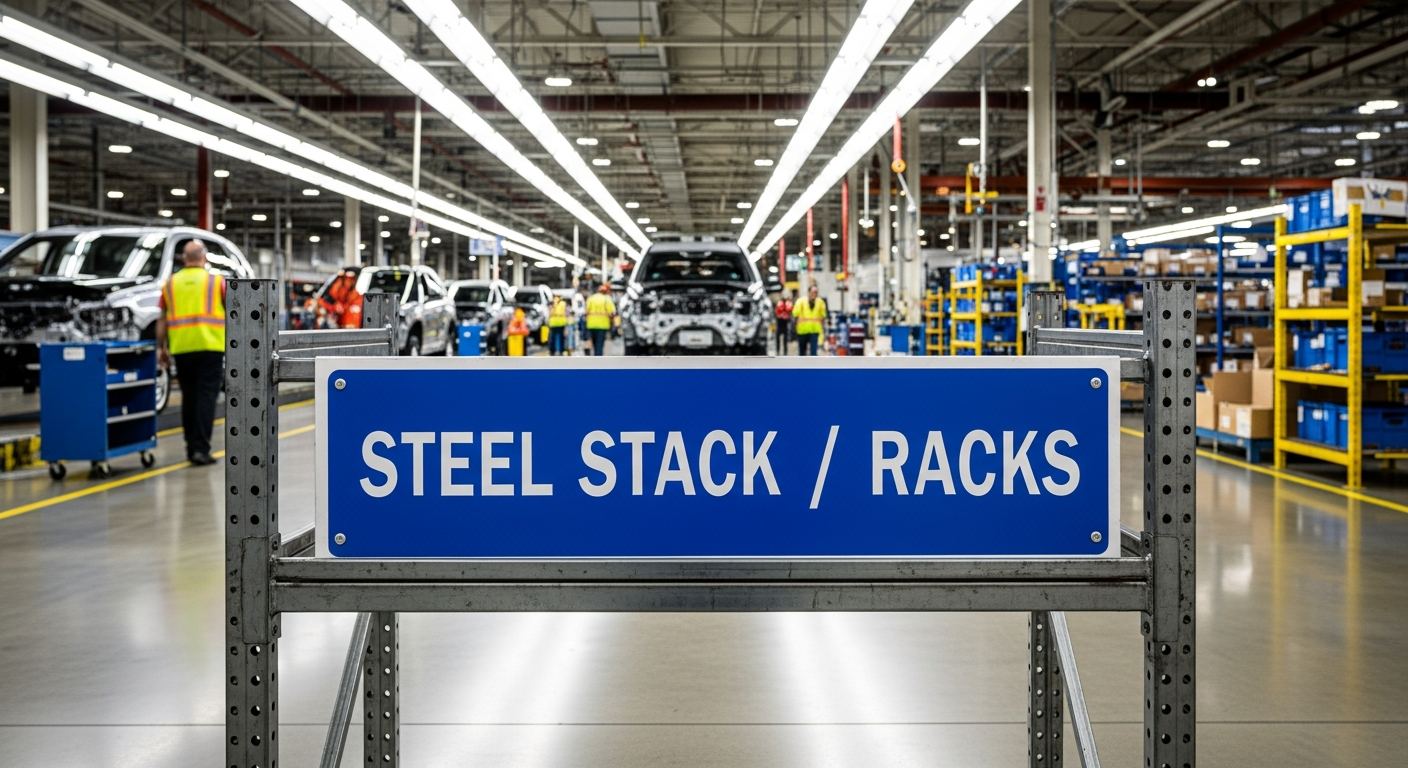
Plexform builds custom steel stack racks for manufacturing and warehouse operations, engineered to exact customer specifications with lead times of 6 to 10 weeks and no minimum order requirement. Each rack is welded to order, fitted with part-specific holding fixtures, and designed to stack two or three units high on the plant floor. If your facility is losing floor space to scattered parts, taking line-side damage, or spending too much per shipment because loads are poorly consolidated, steel stack racks are likely the fix you need. According to MHI, the Material Handling Institute, proper rack-based storage systems can cut floor space requirements by up to 40 percent compared to flat floor staging. This guide covers what steel stack racks are and why they matter, how they are built, which configurations fit which applications, how to choose the right one, what implementation looks like with Plexform, and how to evaluate total cost and ROI.
What Are Steel Stack Racks and Why Do They Matter?
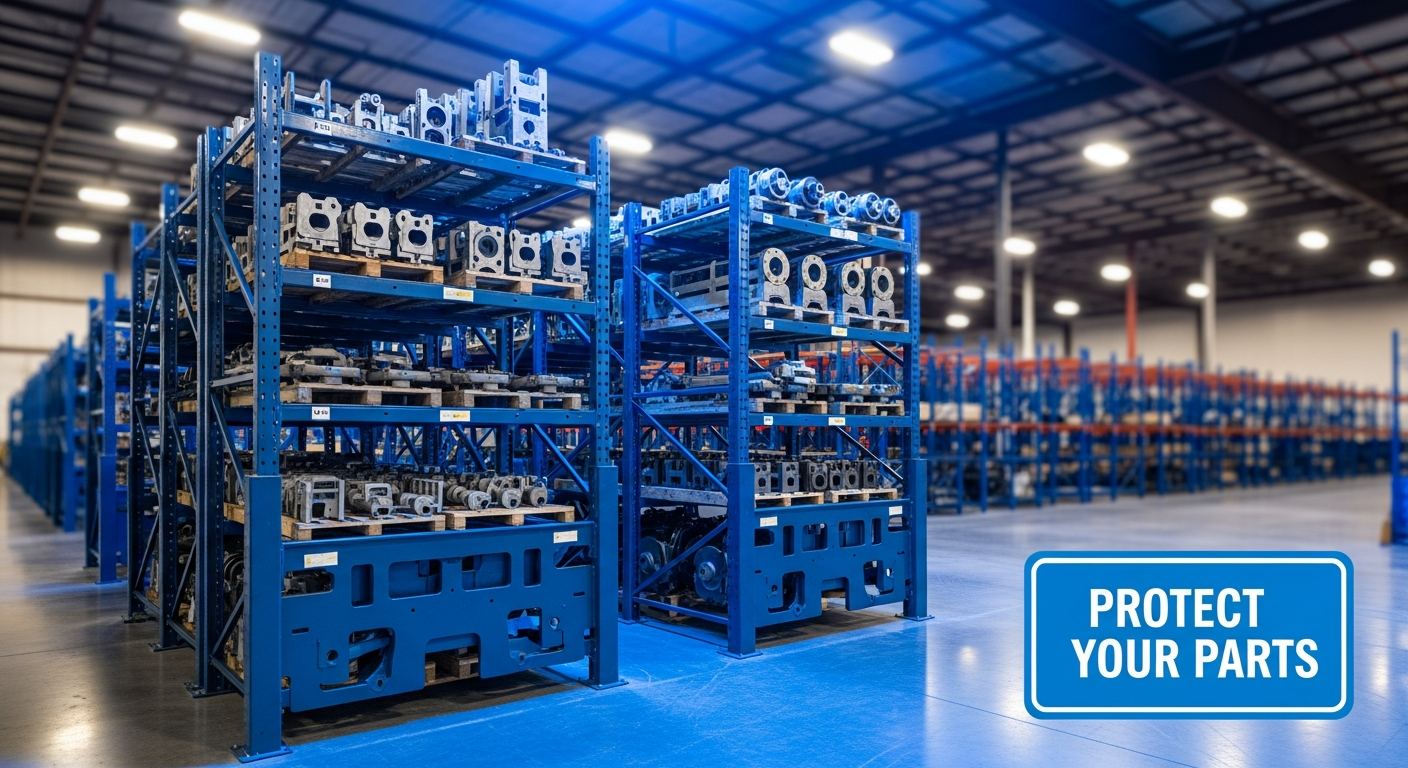
Steel stack racks are custom welded frames designed to hold a specific manufactured component, stack vertically on corner posts, and accept forklift entry through an integral base. They are not shelving units. They are not selective pallet racking. Each one is built around the part it carries.
The Core Problem They Solve
In most plants, the floor is the default storage location. Parts sit on wooden skids, get shuffled by forklifts, and arrive at assembly lines scratched, dinged, or counted wrong. That costs money at every step. Steel stack racks eliminate flat staging by letting you go vertical without fixed shelving infrastructure.
Why Custom Matters
A generic rack holds generic loads. A custom steel stack rack holds your part. The holding fixtures inside the frame, cradles, rails, nests, or dividers, are engineered to the exact component geometry. That means zero part contact damage, consistent counts per rack, and predictable line feeds. For high-mix plants running multiple part numbers, custom metal racks are the only way to guarantee that level of control.
Where They Fit on the Plant Floor
Steel stack racks work at three points in a typical manufacturing workflow: inbound receiving, work-in-process staging near production cells, and outbound shipping. At each stage, the ability to stack units high multiplies effective floor space without any fixed infrastructure investment.
Key Benefits and Construction of Steel Stack Racks
Understanding how these racks are built explains why they outperform alternatives. The construction is straightforward, but every dimension is intentional.
Frame and Post Design
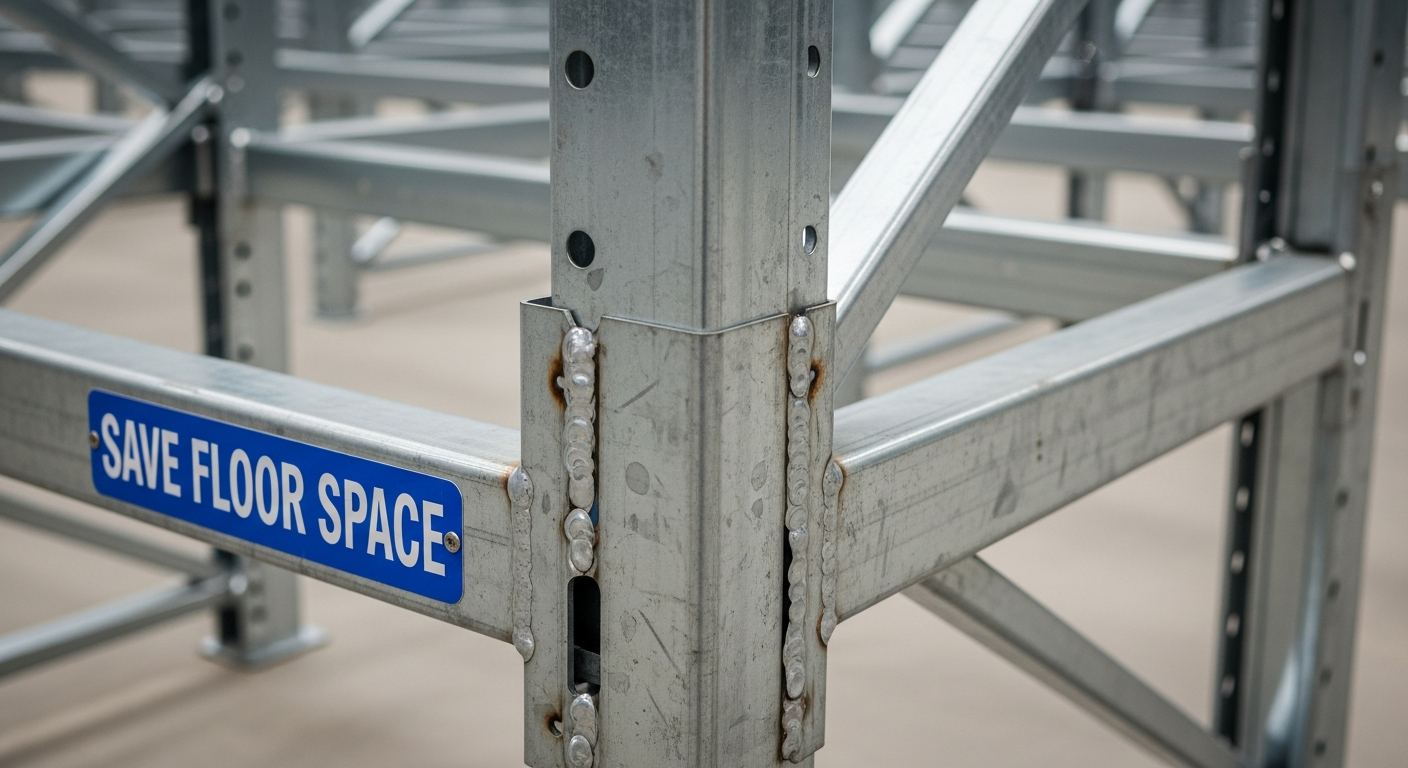
Each rack starts with rectangular steel tube posts set at exact corner positions. The tops of the posts carry stacking pins or pin cups that interlock with the base of the rack above, creating a stable stacked column. The base integrates fork-entry pockets so a standard forklift or reach truck can engage without adapters. Wall thickness and tube size are specified to match the load.
Interior Fixtures and Part Protection
The inside of the rack is where customization earns its cost. Cradles hold curved stampings without surface contact on painted or machined faces. Rails position door panels at an angle for density and access. Nests locate castings so they cannot shift during transport. These fixtures eliminate the foam, cardboard, and corrugated dunnage that disposable packaging requires. Over time, that adds up. According to the Reusable Packaging Association, returnable systems like steel rack programs routinely cut packaging material costs by 60 to 90 percent compared to single-use alternatives.
Finish and Durability
Powder coating is standard. Most Plexform racks ship in black, safety yellow, or customer-specified colors that align with plant color-coding systems. The finish holds up in humid or wash-down environments. Weld quality follows AWS D1.1 structural welding standards, and every rack is load-tested before it leaves the facility.
Stackability and Space Multiplication
A standard two-high stack doubles the parts per square foot of floor space. A three-high stack triples it. For a 50,000-square-foot plant, that math translates directly into fewer expansions and lower real estate costs.
Types and Configurations of Steel Stack Racks
Not every rack looks the same. The configuration follows the part geometry, the handling method, and the flow path through the plant.
Fixed-Frame Racks
Fixed-frame steel stack racks are fully welded with no moving parts. They are the strongest option and the right choice for heavy components, high-cycle handling, or parts that need very precise location. Automotive frame rails, transmission cases, and large stampings typically use fixed-frame designs. These racks nest together when empty if the base geometry allows, saving return freight space.
Collapsible and Knockdown Racks
When empty rack return freight is a significant cost, collapsible designs cut that expense considerably. The side panels fold down or the corner posts collapse, reducing the empty rack footprint by 60 to 75 percent. For suppliers shipping to customers across long distances, collapsible metal racks are often the better economic choice even if the unit cost is higher.
Tiered and Multi-Level Racks
Some parts are small enough that a single rack level wastes vertical space. Multi-level designs stack multiple part trays inside a single outer frame, maximizing parts per cubic foot while keeping the rack footprint consistent for forklift handling.
Specialty Configurations
Certain applications need features beyond a standard frame. Racks built for engine storage and transport, for example, must carry asymmetric loads at precise tilt angles. Engine storage racks show how a single product category can drive dramatically different frame geometries. Coil-handling applications may also require saddle fixtures and anti-rotation pins.
| Configuration | Best For | Stack Height | Return Freight |
|---|---|---|---|
| Fixed Frame | Heavy parts, high-cycle handling | 2 to 3 high | Standard footprint |
| Collapsible | Long-distance supplier loops | 2 high (loaded) | 60 to 75% smaller |
| Multi-Level | Small parts, high density | Single outer frame | Standard footprint |
| Specialty | Asymmetric or sensitive loads | Application-specific | Varies |
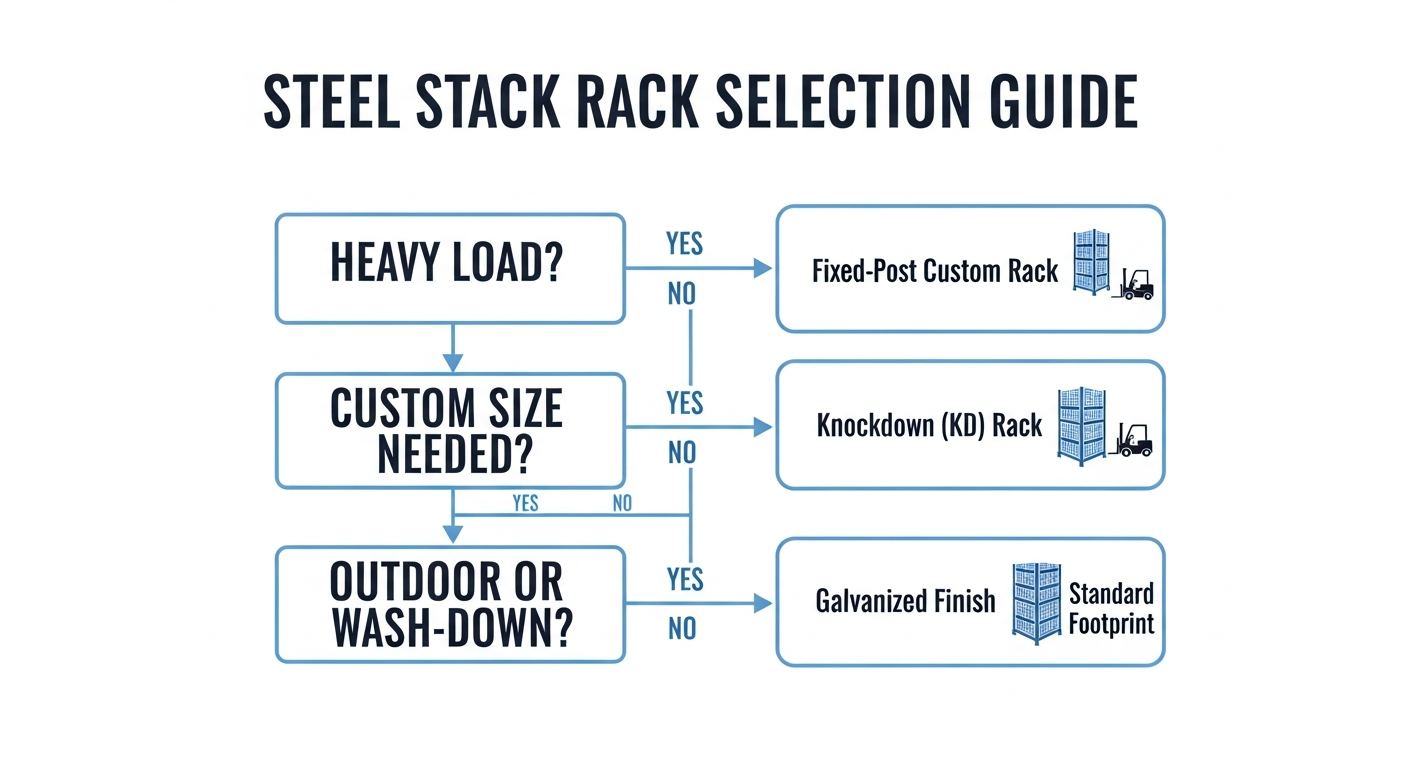
Choosing a rack is a specification exercise. The right answers depend on your part, your plant, and your handling equipment.
Start With the Part
Measure the part at its widest, tallest, and deepest points. Include any protrusions, connectors, or fragile surfaces. Those dimensions set the minimum interior clear space and determine what fixture geometry is possible. If you are not sure where to start, reviewing storage racks for metal stock can give you a useful frame of reference for how part geometry drives rack design decisions.
Define the Load and Stack Height
Calculate the maximum weight of parts per rack. Add the rack tare weight. Multiply by the number of stacked units. That total load must be within your forklift’s rated capacity at the maximum stack height. Overloading stacked racks is one of the leading causes of rack-related incidents. OSHA’s material handling guidelines require that stacked loads remain stable and within equipment capacity ratings.
Map the Flow Path
Where does the rack start? Where does it end? Does it travel on a truck between facilities? A rack that works well for in-plant storage but damages parts during over-the-road transport needs more secure fixture design or additional tie-down provisions. If the rack ships to a customer, collapsible construction is worth the conversation.
Evaluate Handling Equipment Compatibility
Fork pocket width, fork pocket height, and floor clearance all need to match your lift trucks. If you use automated guided vehicles (AGVs) or conveyors, the base footprint may need to match a specific grid dimension. Clarify this with your Plexform engineer before finalizing the drawing.
Consider Standardization
If you have 20 different part numbers that are geometrically similar, a family-of-parts rack with adjustable internal fixtures may cost less overall than 20 unique designs. For facilities managing dozens of SKUs, thinking in part families reduces rack inventory complexity and simplifies training.

Implementing Steel Stack Racks: The Plexform Process
Getting from a floor space problem to a working rack program takes a defined process. Here is how Plexform handles it.
Step 1: Engineering Review
The process starts with a conversation about the part, the plant, and the flow. Plexform engineers ask for part drawings or sample parts, facility layout dimensions, forklift specs, and stack height targets. From that input, they develop a preliminary rack drawing.
Step 2: Drawing Approval
You review the drawing and mark up any changes. Fixture geometry, base dimensions, stack pin locations, and powder coat color are all confirmed at this stage. No fabrication starts until you approve the drawing, which eliminates costly rework.
Step 3: Prototype and Testing
For new programs or complex parts, Plexform builds a prototype rack, loads it with production parts, and runs a stack test. Any dimensional or fixture issues get identified and corrected before full production. This step matters most for fragile or high-value parts.
Step 4: Production and Delivery
Once the prototype is approved, production racks are fabricated, powder coated, and inspected. Lead times run 6 to 10 weeks depending on complexity and volume. Racks ship on flatbeds or in enclosed trailers to protect the finish.
Step 5: Program Support
Plexform supports rack programs after delivery. If your part changes, the rack fixtures can often be modified rather than replaced. If a rack is damaged in service, repair is faster and cheaper than full replacement because the frame is serviceable.
For plants managing multiple rack programs across several part families, the same engineering process applies to related products like stackable metal storage bins that may run on the same floor alongside the racks.
Cost, ROI, and Comparison
Steel stack racks cost more upfront than disposable packaging. The ROI case is built on cycle count and operating cost reduction over time.
Upfront vs. Lifecycle Cost
A custom steel stack rack may cost $400 to $1,200 depending on size, complexity, and fixtures. A comparable disposable packaging solution, corrugated, foam, and labor, may cost $15 to $40 per shipment. At 30 cycles per year, the steel rack pays back in 12 to 24 months and then runs at near-zero variable cost for 10 to 15 years.
Freight Density Gains
Because steel stack racks let you load trailers vertically, you move more parts per truck. A plant that currently ships 4 racks per trailer lane may ship 8 after converting to a two-high stacking program. That cuts freight cost per part on every lane.
Floor Space Recovery
Floor space in manufacturing is expensive. Recovering 1,000 square feet that was previously occupied by flat-staged parts has real value, whether it goes to new production capacity, additional line-side buffer, or reduced warehouse lease requirements.
| Storage Method | Upfront Cost | Annual Variable Cost | Space Efficiency | Part Protection |
|---|---|---|---|---|
| Custom Steel Stack Rack | $400 to $1,200 per unit | Near zero (reusable) | High (stackable 2 to 3 high) | Excellent (custom fixtures) |
| Disposable Corrugated | $5 to $15 per unit | $15 to $40 per cycle | Low (single level) | Moderate |
| Generic Pallet Rack | $150 to $400 per level | Low (fixed shelving) | Medium | Poor (no part fixtures) |
| Wood Skid with Foam | $10 to $25 per unit | $10 to $30 per cycle | Low (single level) | Low to moderate |
These are the questions plant managers, logistics coordinators, and procurement teams ask most often before committing to a program.
What are steel stack racks?
Steel stack racks are custom welded steel frames with corner posts, stacking pins, an integral fork-entry base, and interior holding fixtures engineered for a specific part. Plexform builds each rack to the exact geometry of the component it carries, whether that is an automotive stamping, a machined casting, or a fabricated assembly. They stack two or three high on the plant floor, multiply usable floor space, and replace disposable packaging in returnable shipping loops.
Where do steel stack racks fit best in a plant?
Steel stack racks fit best at three points: inbound receiving, work-in-process staging near assembly cells, and outbound shipping lanes. Plexform designs each rack for the specific location and handling method in your facility, so the rack that feeds a line-side cell may have different fork pocket dimensions or fixture geometry than the one used in a shipping loop.
Who makes steel stack racks for manufacturing plants?
Plexform makes custom steel stack racks for manufacturing plants across North America, with engineering support, drawing approval, and prototype testing included in the program. Plexform fabricates each rack to customer-supplied part drawings or sample parts, with lead times of 6 to 10 weeks and no minimum order.
How much do steel stack racks cost?
Steel stack racks typically cost $400 to $1,200 per unit depending on size, material weight, fixture complexity, and quantity. Plexform provides formal quotes after engineering review. The payback period versus disposable packaging is typically 12 to 24 months at normal cycle frequencies, after which the rack operates at near-zero variable cost for its 10 to 15 year service life.
What is the lead time for custom steel stack racks?
The standard lead time at Plexform is 6 to 10 weeks from drawing approval to delivery. Complex programs with prototype requirements may run slightly longer. Plexform’s engineering team works through drawing review and approval efficiently to minimize pre-production time.
What are steel stack racks made of?
Steel stack racks are made from structural steel tube and plate, welded to specification. Plexform uses steel grades matched to the load requirements of each application, powder coated for corrosion resistance. Interior fixtures may incorporate steel cradles, rails, nests, or tube dividers depending on the part geometry.
Is Plexform a good source for custom steel stack racks?
Plexform is a proven source for custom steel stack racks, with an engineering-first process that includes drawing approval, prototype testing, and program support after delivery. Plexform serves automotive suppliers, industrial manufacturers, and distribution operations across North America, building racks to exact customer specifications with no minimum order requirement.
How do I specify the right steel stack rack for my parts?
Start with part dimensions, weight, and fragile surface locations. Plexform engineers need to know your forklift specs, target stack height, and whether the rack will travel in a returnable shipping loop or stay in-plant. From that information, Plexform develops a preliminary drawing for your review. The more detail you provide upfront, the faster the drawing approval cycle.
Make the Right Call for Your Facility
Steel stack racks solve three real problems: floor space loss, part damage, and high per-shipment packaging cost. The key is matching the rack design to the part, the plant flow, and the handling equipment, not buying a generic solution and hoping it fits. Plexform’s engineering process starts with your part and builds the rack around it, with drawing approval and prototype testing before any production commitment.
If you are ready to recover floor space, cut packaging costs, and protect your parts through every handling step, visit plexformps.com to start a conversation with the engineering team. Bring your part dimensions and your floor layout. Plexform will handle the rest.

Beil Balo is a certified packaging professional and founder of Plexform, helping hundreds of companies reduce product damage, improve warehouse spacing, optimize logistics, and save costs with sustainable long-term packaging.