 Skip to content
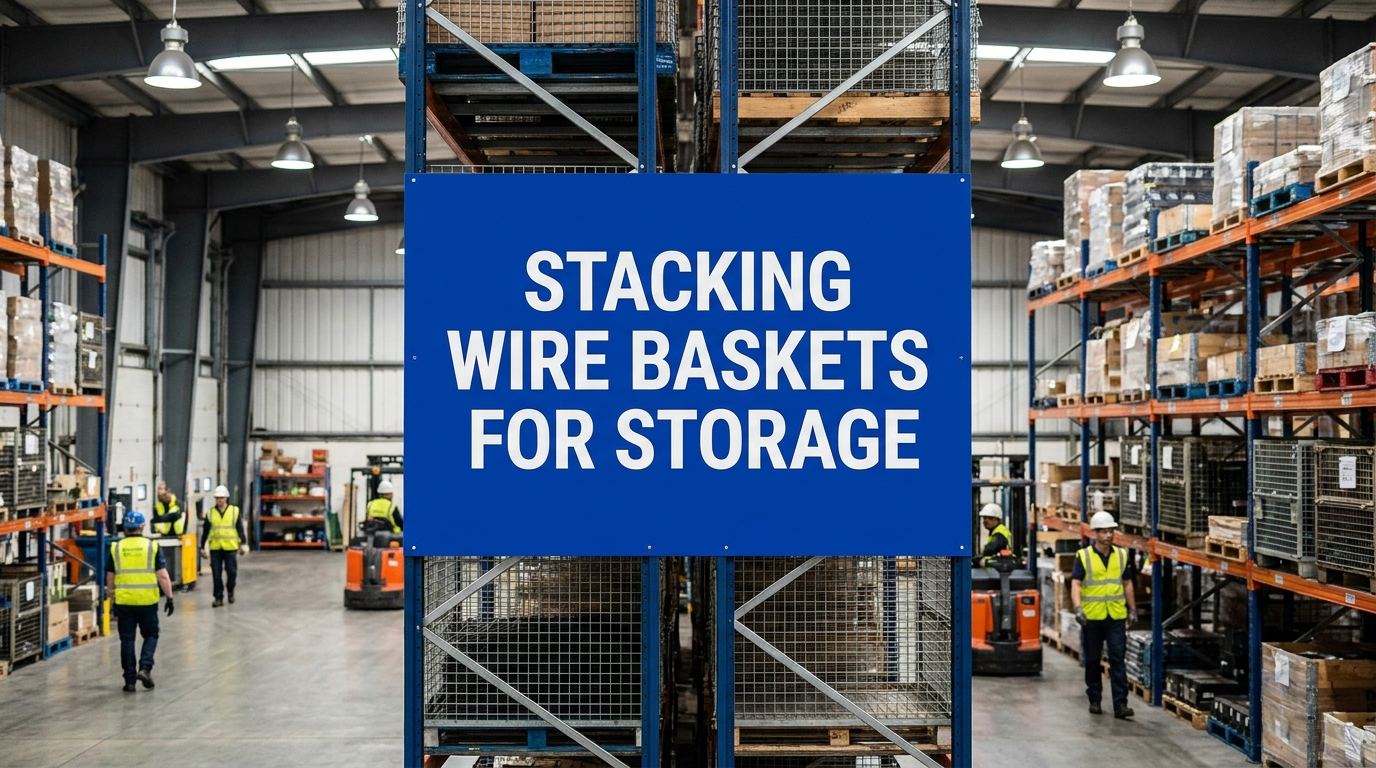
Floor space is expensive. In most manufacturing plants and distribution centers, there’s far more vertical room available than the floor plan actually uses — and stacking wire baskets for storage are one of the most direct ways to close that gap. Run three or four tiers of loaded baskets in the same footprint that currently holds one, and you’ve multiplied your storage capacity without adding racking, expanding the building, or reorganizing the entire operation.
The catch is that “wire basket” covers a lot of ground. Light-duty utility bins rated for a few hundred pounds. Heavy industrial containers built for forklift handling and multi-tier stacking under thousands of pounds of cumulative load. Getting the spec wrong means containers that fail early, footprints that don’t fit your racks or trucks, or rated capacity that falls short when a heavy part run comes through.
This guide covers what makes stacking wire baskets perform, which configurations fit different facility needs, and how to spec and implement the right design for your operation.
What stacking wire baskets are and why they matter
How they work differently from standard containers
A stacking wire basket is a welded metal container with open-wire walls and integrated legs or corner uprights that let loaded baskets rest directly on top of each other. The legs transfer the weight of upper tiers straight down to the bottom unit and then to the floor. You get three or four layers of full containers in the vertical space that previously held one.
What makes wire construction specifically useful beyond the stacking is the visibility. You can read part numbers, count quantities, and spot damage without touching the basket or moving anything around. In a busy facility, that saves real time at the shelf every shift.
Why vertical storage is worth the investment
Industrial real estate has gotten expensive. According to CBRE’s 2024 industrial market data, average warehouse rents in major U.S. markets now run $9-13 per square foot annually, with vacancies near historic lows in most metro areas. Expanding the building footprint is rarely a fast or cheap option.
Most plants use only about 20-25% of their available ceiling height for actual storage. A properly designed stacking wire basket system can push that number to 60% or higher without construction or major disruption to your floor plan. That’s a meaningful capacity gain funded mostly by recovering space that already exists in your facility.
Construction details that determine performance
Wire gauge, leg design, and finish options
Wire gauge is the first spec to nail down. Light parts can use 6-gauge welded wire. Heavy machined components, castings, or raw metal stock need 4-gauge rod or heavier, with a reinforced perimeter frame that maintains shape under load. The gap between those choices matters: a basket that deflects or deforms under weight creates forklift handling problems and puts your parts at risk.
Leg design carries equal weight. In a four-tier stack, the bottom legs take the cumulative weight of every basket above them — which can reach several thousand pounds. Look for welded corner legs with crossbar bracing, or a full-perimeter base frame that distributes load evenly. Legs made from thin rod stock or without through-welds will bend outward or crack at the joint under regular use.
Finish depends on environment. Powder coat adds corrosion resistance and makes color coding by part family possible. Electro-galvanized is the right call for wet areas, wash-down zones, or outdoor storage. Bare metal holds up in dry indoor environments where you’re cycling containers fast enough that surface rust doesn’t develop.
At Plexform, our engineers size wire gauge and leg construction to your actual load — maximum load per basket, number of tiers, and handling frequency. That calculation prevents oversizing (which adds cost) and undersizing (which adds failures and downtime).
Types and configurations

Standard stackable and collapsible designs
Standard stackable wire baskets have fixed legs, a consistent external footprint, and open wire walls. Sizes typically run from 24″ x 16″ up to 48″ x 40″ and larger for custom work. Load ratings range from around 500 lbs for light-duty units to 2,500 lbs or more for heavy industrial construction. These are the most common choice for internal use where empties stay on-site and cycle back through production.
Collapsible wire baskets add hinged side panels that fold flat when the basket is empty. Four collapsed baskets fit in roughly the space one full basket occupies — a real freight savings when you’re shipping containers out with product and returning empties by truck. That matters most in automotive supplier networks and any operation running returnable packaging programs. The tradeoff is mechanical complexity and higher unit cost: hinge pins and latches create wear points that solid baskets don’t have.

Drop-leg, caster-mounted, and custom footprint options
Drop-leg wire baskets have a pallet-style base that accepts standard pallet jack forks. Useful in facilities where forklifts aren’t at every handling point, or where a basket needs to move between work cells without a forklift.
Caster-mounted baskets roll on the floor and need no lifting equipment. Practical at individual workstations, but they can’t be stacked reliably — you’re trading storage density for mobility. A common approach is caster versions at production stations and standard stackable versions in the storage area, two designs working as a system.
Custom footprint designs matter when your operation has a specific rack opening, truck floor plan, or pallet standard that off-the-shelf sizes don’t fit. Our engineers build to your exact dimensions, including cutouts for protruding parts, internal dividers for part separation, and tiered inserts for stacking mixed part sizes within a single basket.
How to choose the right basket for your facility

Load, footprint, and forklift entry
Spec to maximum load, not average load. If the heaviest production run puts 1,800 lbs in a basket and you’re stacking three high, the bottom basket carries roughly 5,400 lbs plus its own weight. A 1.5x safety factor from that number is a reasonable floor.
Footprint has to match your rack openings, truck dimensions, and production cell layout. Measure before you order. The dimensions to lock down before anything gets designed:
- External footprint (must fit racks or truck floor openings)
- Stacked height at your intended tier count (must clear the ceiling and allow forklift approach)
- Fork entry width (4″ or 6″, depending on your equipment)
- Two-way or four-way entry (if you use both forklifts and pallet jacks, four-way is the right call)
Visibility, access, and empty basket logistics
Wire construction gives visual access to contents from all sides, useful for parts inventory and quick ID. If small parts fall through the openings, you need a finer mesh panel or a liner insert. If workers reach parts from the side rather than the top, specify a drop-down gate panel on one wall.
The empty basket question often gets skipped until it becomes a problem. If empties travel by truck to a supplier and back, collapsible designs pay for themselves quickly in freight savings. If empties circulate internally, solid construction holds up better. And if empty baskets tend to pile up between production runs, that’s a process flow issue — not a basket design issue.
Getting stacking wire baskets into your operation

Before ordering a full fleet, run 5-10 baskets through your actual process. Put real parts in them. Move them with your forklifts. Stack them to your intended height. Let production staff use them for two weeks and report what doesn’t work.
This matters because problems at 10 baskets are cheap to fix. Problems at 200 baskets are not. Common things that surface in pilots: the fork entry is slightly tight for your truck model, stacking height puts the top tier above comfortable reach for your team, the wire opening catches a specific part edge, or the footprint is close to fitting a rack slot but not quite. A short pilot finds all of it before you’re committed.
For labeling, decide before the first basket ships. Color coding by part family, stenciled IDs, and RFID tags built into the basket frame are all practical. Trying to add a tracking system after containers are in circulation is harder than building it in from the start.
Our process at Plexform starts before any drawing. We work through what parts go in, how they move, where they go, and what handling equipment touches them. From that conversation, we build a complete spec covering every dimension and material choice. Sample production typically takes 3-4 weeks. We ship a prototype for your approval, then move to full production after sign-off. Every basket goes through weld inspection and a load test before it ships.
Cost and ROI comparison
| Container type | Upfront cost | Storage density | Return freight | Expected lifespan |
|---|---|---|---|---|
| Standard stackable wire basket | Moderate | High (3-4 tiers) | Good | 10-20 years |
| Collapsible wire basket | Higher | High full, compact empty | Best | 7-12 years |
| Solid steel container | High | High | Good | 15-25 years |
| Plastic bin or tote | Low | Low (1-2 tiers typically) | Moderate | 3-7 years |
The ROI on stacking wire baskets for storage shows up in a few places. Freed floor space is the most direct line. At $9-13 per square foot per year in industrial rent, eliminating a storage room or reducing your footprint by 1,000 square feet can offset a container investment in one to two years.
Reduced handling time follows from better organization. When parts are visible, consistently located, and easy to lift with standard equipment, picking goes faster. That shows up in throughput numbers over time, even if it’s harder to measure than rent savings.
Damage reduction is the third factor, and it’s often underestimated. Parts that travel in properly specified baskets — right footprint, right mesh for the part, right dividers — arrive in better condition than parts stacked loose on pallets. For machined or finished components, that difference has real cost.
Custom-built baskets from a specialized manufacturer cost more upfront than catalog items from a general distributor. They fit better, hold up longer under real production loads, and are available in the same spec for replacement years later. For a fleet of 50 or more containers in daily use, that difference matters.
Frequently asked questions about stacking wire baskets for storage
Stacking wire baskets come up regularly in conversations with plant engineers and procurement teams. Here are the questions we hear most.
What load capacity should I expect?
Light-duty welded wire baskets typically handle 500-800 lbs per unit. Heavy-duty construction with 4-gauge rod frame and reinforced corner legs runs 2,000-3,500 lbs. For stacked applications, the bottom basket carries the cumulative load of all tiers above it, so that’s the unit to size most conservatively.
How many tiers can you stack safely?
Most stacking wire basket systems are engineered for 3-4 loaded tiers. Beyond that, lateral stability becomes a factor and the load on the bottom unit climbs sharply. Heavy-duty designs with reinforced crossbracing can support taller stacks in controlled environments with racking for lateral support, but that’s an application-specific engineering question rather than a general rule.
What’s the difference between stacking and nesting wire baskets?
Stacking baskets have legs or corner uprights that support full baskets directly above them. Nesting baskets have angled walls that let empty baskets slide inside each other to save space. Some designs combine both: they stack when full and nest when empty, the most space-efficient option when the application allows it.
Can stacking wire baskets be used with forklifts?
Yes. Most stacking wire baskets are built for forklift handling, with leg spacing that provides fork entry. Fork entry width — typically 4″ or 6″ — needs to match your equipment. If you use both standard forklifts and pallet jacks, specify four-way entry so both can pick up the basket without repositioning.
How do I order custom wire baskets to my dimensions?
Work with a manufacturer who builds to spec rather than one who only sells catalog sizes. At Plexform, the process starts with your drawings or a description of your application. We produce a sample before any full production run so you can confirm fit and function before committing to your fleet quantity.
What finish should I specify for my environment?
Powder coat for dry indoor storage — it adds corrosion resistance and makes color coding practical. Electro-galvanized for wet areas, wash-down zones, or any outdoor storage. Stainless steel for food-adjacent applications or where chemical exposure is a concern. Bare metal works in dry environments where containers cycle fast enough that surface rust isn’t a real-world risk.
The short version on stacking wire baskets for storage
If floor space is the problem, stacking wire baskets for storage are a practical answer. They don’t require construction, major racking investment, or a facility reorganization. Get the spec right — wire gauge, leg design, footprint, stacking height — and you’re looking at containers that run 10-20 years with normal maintenance in a production environment.
The one thing plants that get this right consistently do: they run a real pilot before ordering a full fleet. Two weeks with 10 baskets in your actual process tells you more than any spec sheet.
Plexform builds custom stacking wire baskets and material handling containers to your exact specifications. If you’re dealing with space pressure, slow handling time, or parts damage in your facility, our engineers can help you work out what you actually need. Visit plexformps.com to get in touch or request a quote.

Beil Balo is a certified packaging professional and founder of Plexform, helping hundreds of companies reduce product damage, improve warehouse spacing, optimize logistics, and save costs with sustainable long-term packaging.