 Skip to content
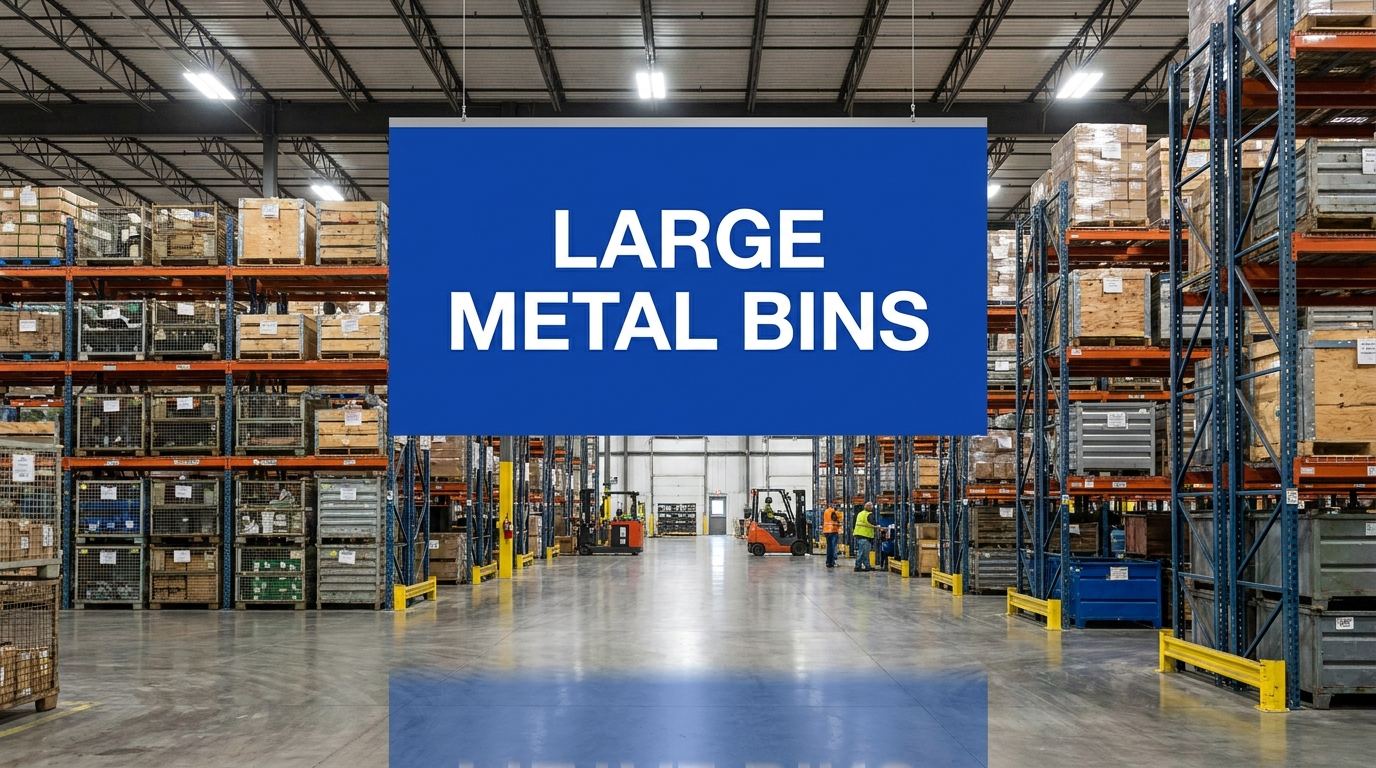
If your parts are getting dinged in transit and your floor space is disappearing under mismatched containers, the problem is almost never the parts. It’s the bins.
Plant managers, warehouse supervisors, and procurement teams at manufacturing operations make this mistake constantly: they treat large metal bins like a commodity and grab whatever’s in stock. Then they spend the next few years working around bins that are too short, too light, or the wrong footprint for their racking. The wrong container for your application costs you twice: once when you buy it and again when you replace it or absorb the part damage it causes.
This guide covers what separates high-quality industrial bins from cheaper alternatives, which configurations work for which applications, and how to nail the spec before you commit to a purchase.
What large metal bins are and when they matter
Large metal bins are open-top or enclosed storage containers fabricated from steel or other metals, built to hold bulk quantities of parts, materials, or scrap at industrial scale. They range from 30-gallon hoppers used at individual workstations up to 2,000-plus-pound bulk containers used at receiving and shipping docks.
The difference from plastic totes or wire containers is load capacity and durability. Metal bins take abuse that would crack or warp plastic: forklift drops, weld spatter, repeated industrial washing cycles. They’re also easier to modify and repair when something does go wrong.
Common applications in manufacturing
Large metal bins show up across the production floor in more roles than most buyers expect:
- Bulk storage of stamped, cast, or machined parts between production stages
- Scrap and waste collection at machining or cutting stations
- Raw material staging near assembly lines
- Shipping containers for heavy or high-value components
- Wash rack containers for industrial cleaning processes
According to the Material Handling Institute, material handling accounts for 15 to 70 percent of total product cost in manufacturing. That wide range tells you the stakes: containers that don’t fit the workflow are a real cost driver, not just an inconvenience. They force extra touches, slow cycle times, and create conditions where parts get damaged.
Who buys large metal bins and why requirements vary
Automotive tier suppliers, metal stampers, plastics processors, aerospace parts manufacturers, and food-grade production facilities all buy large metal bins. Their specs look almost nothing alike.
A stamping plant might need a bin that stacks four high empty and runs through a parts washer every day. An aerospace supplier might need a bin that hooks into a lift table and allows visual inspection without unloading. Same product category, completely different requirements. That’s why buying generic and hoping for the best rarely works out.
Steel gauge, construction, and finish options
Not all metal bins are equal. The same nominal dimensions from two different fabricators can mean very different weight ratings, lifespans, and handling characteristics.
How gauge affects bin performance
Most industrial large metal bins are built from 12- to 16-gauge steel. Lower gauge number means thicker steel:
- 12-gauge (0.105 inches thick): Heavy-duty applications, high-cycle forklift handling, bins that get dropped
- 14-gauge (0.075 inches thick): General industrial use, standard parts storage, moderate handling frequency
- 16-gauge (0.060 inches thick): Lighter parts, lower handling frequency, static storage applications
Surface finish matters too. Mill finish (bare steel) works fine for scrap applications. Powder coat adds corrosion resistance and is available in virtually any color, which is useful if you’re running a visual management system and want to color-code bins by part family, department, or process stage. Hot-dip galvanizing is the right call for outdoor storage or wash-down environments where powder coat might delaminate over time.
Welded vs. bolted construction
Welded bins hold up better in high-cycle applications. Nothing loosens over time, and fewer crevices means easier cleaning. Bolted or clinch-fastened bins have one real advantage: they ship flat and assemble on-site, which cuts freight costs on large orders.
For most manufacturing applications, welded construction is the right choice. Plexform builds welded bins as a standard, because the performance difference in real handling conditions is significant over a 10-year service life.
Types and configurations of large metal bins

There’s no single standard large metal bin. The category covers several distinct designs, each suited to different handling environments and applications.

Fixed-wall, collapsible, and hopper configurations
Fixed-wall bins are the most common type. The sides are welded or formed solid steel, the bottom is heavy-gauge plate, and the bin moves by forklift or pallet jack. They come in rectangular, square, and tapered shapes.
Hopper-bottom bins have a sloped bottom that funnels material to a discharge gate. If you’re handling bulk dry material (granules, pellets, small castings), gravity discharge is faster and cleaner than scooping or tipping the whole bin.
Collapsible bins have hinged or removable sides that fold down when the bin is empty. When you’re returning empties upstream, a collapsible bin takes up roughly one-quarter the space of a fixed-wall bin. You can put four on a truck where you’d fit one. That’s a real freight cost reduction that shows up on every return shipment for the life of the bin.
Stackable bins have integrated stacking posts or frames that let loaded bins stack two or three high without nesting inside each other. If your facility has vertical clearance but limited floor space, stackable large metal bins let you reclaim that overhead cube without buying new racking.
Specialty features and add-ons
Most applications need at least one feature that goes beyond a plain open-top box:
- Lids: Hinged or removable steel lids for outdoor storage, dust-sensitive parts, or controlled access
- Drain holes: Built into the base for parts washer applications
- Forklift pockets vs. caster frames: High-frequency movement calls for casters; stable storage calls for fixed pockets
- Dividers and inserts: Steel, foam, or cardboard separators protect parts from contact damage inside the bin
These add-ons aren’t afterthoughts. They’re usually the difference between a bin that fits the process and one that creates a workaround.
How to choose the right large metal bin for your operation

Getting the spec wrong costs you twice: once on the purchase and again when you replace the bins or absorb part damage. A few decisions matter more than the others.
Sizing for your parts and your rack
Start with the part, not the bin catalog. What are the dimensions and weight of the largest quantity you’ll load in a single bin? How are you moving it: forklift, pallet jack, hand truck? Where does it land in your racking?
Standard pallet footprints are 40×48 inches, 48×48 inches, and 42×42 inches. If your bins will sit in rack, they need to land within the beam spacing of your existing system. Bins that overhang damage rack over time. Bins that are too small leave capacity unused.
Confirm the opening width and height too. If your operators are loading by hand, a bin that’s 36 inches tall requires a step stool, and that’s a slow, unsafe process that adds up across thousands of load cycles.
Load rating, forklift pockets, and environmental specs
Rated load capacity is not the same as static storage capacity. A bin rated at 2,000 lbs for static storage may only be rated at 1,500 lbs in dynamic handling — meaning when it’s on a moving forklift. Read the right number on the spec sheet.
Forklift pocket placement matters too. Centered pockets make the bin easy to handle regardless of load distribution. Off-center pockets can cause tipping if the load isn’t balanced. For heavy applications, our engineers spec reinforced base channels and centered pockets as a standard feature.
A few other specs to confirm before you finalize:
- Parts washer duty: The bin needs drain holes, a wash-rated or bare interior, and sealed welds to prevent corrosion at the joints.
- Outdoor storage: Specify galvanized finish or 11-gauge minimum sidewalls.
- Stacking in rack: Confirm the bin’s stacking posts land on the rack beams, not between them — an easy oversight that makes stacking impossible or dangerous.
- High forklift traffic: Specify 12-gauge base plate and welded gussets at the corners.
Implementation and the Plexform custom design process

Buying the right bin is one decision. Getting it deployed correctly is a separate one.
Planning your bin deployment before they arrive
Before new bins show up on the dock, map out where each one will live and how it moves through your facility.
Mark floor positions with painted lines so bins don’t drift into traffic lanes. Confirm overhead clearance anywhere you’ll stack. Make sure forklift operators know the rated capacity — powder coat color coding or stenciled labels help, especially when multiple bin types share the same floor.
New bins also have a way of surfacing upstream problems. When a parts washer bin drains properly for the first time, you find out the floor drain can’t handle the flow. When you stack bins three high for the first time, you find out the nearest I-beam is 18 inches too low. Sort out the facility-side details before the bins arrive, not after.
Working with our engineers on a custom spec
Our design process starts with a conversation about the application, not a catalog. Before we sketch a single dimension, we ask about the part, the handling equipment, the racking, the wash process, and return logistics.
From that, our engineers produce a 3D CAD drawing for your review. We flag conflicts with your existing equipment and call out design choices that will cause problems down the line — a bin that looks right on paper but won’t fit under your lowest rack beam when it’s loaded, for example.
Lead times for custom large metal bins typically run 4 to 8 weeks from drawing approval. We produce most bins at our domestic facility in small-to-medium runs, so you’re not waiting on a container shipment from overseas and can make adjustments faster if something changes.
Cost, ROI, and how the options compare
Large metal bins are a capital purchase, not a consumable. The math shifts when you account for useful life.
| Configuration | Typical price range | Load rating | Key tradeoff |
|---|---|---|---|
| Light-duty 14-gauge fixed bin | $180–$350 each | 1,200 lbs | Lower cost upfront, shorter service life |
| Heavy-duty 12-gauge welded bin | $380–$650 each | 2,500 lbs | Higher cost, 10+ year service life |
| Collapsible steel bin | $450–$800 each | 1,500 lbs | Saves freight on returns, more moving parts |
| Custom-fabricated bin (Plexform) | $500–$1,200+ each | Up to 4,000 lbs | Engineered to your exact spec |
A $200 light-duty bin that cracks at the corners after three years costs more per year than a $500 heavy-duty bin that runs 12 years. That math changes again when you factor in damaged parts from a failing bin and the production time lost while you source replacements.
One automotive supplier we work with replaced 85 worn-out generic bins with 60 custom Plexform bins. The new design used vertical space more efficiently, so they needed fewer total units. The project paid for itself in under 14 months.
Frequently asked questions about large metal bins
Most buyers come in with the same questions around sizing, durability, and whether custom fabrication is worth the premium. Here’s what comes up most.
What sizes do large metal bins come in?
Standard large metal bins range from roughly 30 gallons (about 24x18x16 inches) to 250-gallon and larger bulk containers. Common pallet-sized bins use 40×48 or 48×48 inch footprints. Custom bins can be fabricated in any dimension your application requires, including non-rectangular shapes.
How much weight can a large metal bin hold?
It depends on the gauge and construction. A 14-gauge light-duty bin typically handles 800 to 1,500 lbs. A 12-gauge heavy-duty welded bin handles 2,000 to 3,000 lbs. Custom-engineered bins can go higher, depending on base plate thickness and corner reinforcement. Always confirm the dynamic handling rating, not just the static rating — they’re often different numbers.
What’s the difference between a collapsible bin and a fixed-wall bin?
A fixed-wall bin has permanently welded sides. It’s more durable in high-cycle applications and easier to clean. A collapsible bin has hinged or removable sides that fold flat when empty, reducing the return footprint to roughly 25% of the loaded size. Collapsible bins make the most sense when you’re shipping empties back upstream and freight cost is a real concern.
Do large metal bins work in parts washer systems?
Yes, but you need to spec them correctly. Bins for parts washer use need drain holes in the base, non-painted or wash-rated interior surfaces, and sealed welds to prevent corrosion at the joints. We design wash-rack bins as a specific product family with all of those features built in from the start.
Can large metal bins be powder coated?
Powder coat is the most durable finish for industrial bins. It resists chipping, handles forklift impacts better than spray paint, and comes in a wide range of colors for visual management systems. For outdoor or wet environments, galvanized finish or bare steel holds up better than powder coat, which can delaminate in prolonged moisture exposure.
How long do large metal bins typically last?
A well-made 12-gauge welded steel bin, properly maintained, runs 10 to 15 years in typical manufacturing use. Lower-gauge bins in high-cycle applications may need replacement in 3 to 5 years. The main failure modes are corner cracking from repeated forklift impacts and base corrosion in wet environments. Both are manageable with the right spec upfront.
Are custom large metal bins worth the extra cost?
For high-volume applications and parts that are expensive to replace when damaged, yes. A bin engineered to your part geometry protects parts better, loads and unloads faster, and fits your rack and handling equipment without workarounds. The added cost per bin is usually recovered within the first year through reduced damage, faster cycle times, and fewer total units required.
Getting the right bin in place
Large metal bins aren’t complicated to buy. The spec work just has to come before the purchase order, not after.
Get three things right and you’re most of the way there: the load the bin needs to carry, how often it moves and by what equipment, and where it needs to fit in your facility. Everything else — gauge, finish, pocket placement, collapsibility — follows from those answers.
Plexform engineers custom large metal bins for manufacturing operations across the country. If you have a specific application, we’ll design around it rather than asking you to fit your operation to a catalog. Visit plexformps.com to start a conversation with our engineering team.

Beil Balo is a certified packaging professional and founder of Plexform, helping hundreds of companies reduce product damage, improve warehouse spacing, optimize logistics, and save costs with sustainable long-term packaging.