 Skip to content

Plexform builds custom corrugated plastic containers for manufacturing and warehouse operations, engineered to exact customer specifications with lead times of 6 to 10 weeks and no minimum order requirement. These lightweight, reusable containers have become a reliable solution for plants that need to protect parts, reduce packaging waste, and cut per-trip shipping costs. According to the Reusable Packaging Association, returnable packaging systems can reduce packaging costs by 30 to 90 percent compared to single-use alternatives, a number that gets the attention of any procurement team managing high-volume flows. If your facility still relies on cardboard boxes or wood crates, the switch to corrugated plastic containers could change your cost structure significantly. This guide covers what corrugated plastic containers are, the main types and configurations available, how to choose the right one for your operation, and what implementation looks like when you work with Plexform.
What Are Corrugated Plastic Containers and Why Do They Matter?
Corrugated plastic containers, sometimes called coroplast totes or twin-wall plastic boxes, are hollow-core plastic panels formed into a rigid container shape. The twin-wall structure, two flat polypropylene sheets connected by internal flutes, gives the material its stiffness without adding much weight.
The Core Material: Twin-Wall Polypropylene
The base material is high-density polypropylene (PP), extruded into a corrugated sheet similar in cross-section to cardboard but made entirely of plastic. The flute channels run either lengthwise or across the panel, depending on the load direction the manufacturer intends. This structure resists crushing under stacking loads while staying light enough for manual handling.
Polypropylene is chemically resistant, so the containers hold up in oily, greasy, or wash-down environments where cardboard fails immediately. ASTM International publishes test standards for plastic sheeting and containers that govern wall thickness, impact resistance, and load-bearing capacity, giving buyers a consistent benchmark when comparing suppliers.
Why Manufacturers Are Moving Toward Them
Three pressures are driving adoption: cost, sustainability, and part protection. Cardboard is a single-use cost that compounds over thousands of shipments. Wood crates add weight and create splinter and nail hazards on the shop floor. Corrugated plastic containers address both problems. They survive hundreds of trip cycles, weigh a fraction of what wood does, and can be fitted with custom foam, fabric, or plastic dunnage inserts to hold specific parts without contact damage.
For plant managers tracking damage rates and procurement professionals watching packaging spend, these containers often pay for themselves within one to two years of deployment.
Key Benefits and Construction Details
Understanding what goes into a well-built corrugated plastic container helps you avoid buying the wrong spec and regretting it six months later.
Wall Thickness and Structural Rating
Standard twin-wall sheets range from 2 mm to 10 mm in thickness. Thinner panels (2 to 4 mm) suit light-duty parts bins and divider inserts. Mid-range panels (5 to 6 mm) handle most general-purpose totes and returnable shipping containers. Heavy-duty applications, automotive body panels or engine components, for example, typically require 8 to 10 mm walls reinforced with steel or aluminum frame extrusions at the corners and top rail.
Without frame reinforcement, a corrugated plastic container stacked four high with 30 lbs per tier will eventually bow or collapse. Know your stacking load before you spec the wall thickness.
Closure and Lid Options
Containers ship with foldable flap lids, snap-on lids, or no lid at all if they travel inside a closed rack or tote system. Foldable designs fold flat for return trips, which matters for backhaul freight costs. A flat-folded stack of corrugated plastic containers can cut return shipping volume by 60 to 75 percent compared to rigid alternatives, savings that add up quickly across a high-volume supply chain.
Custom Dunnage Integration
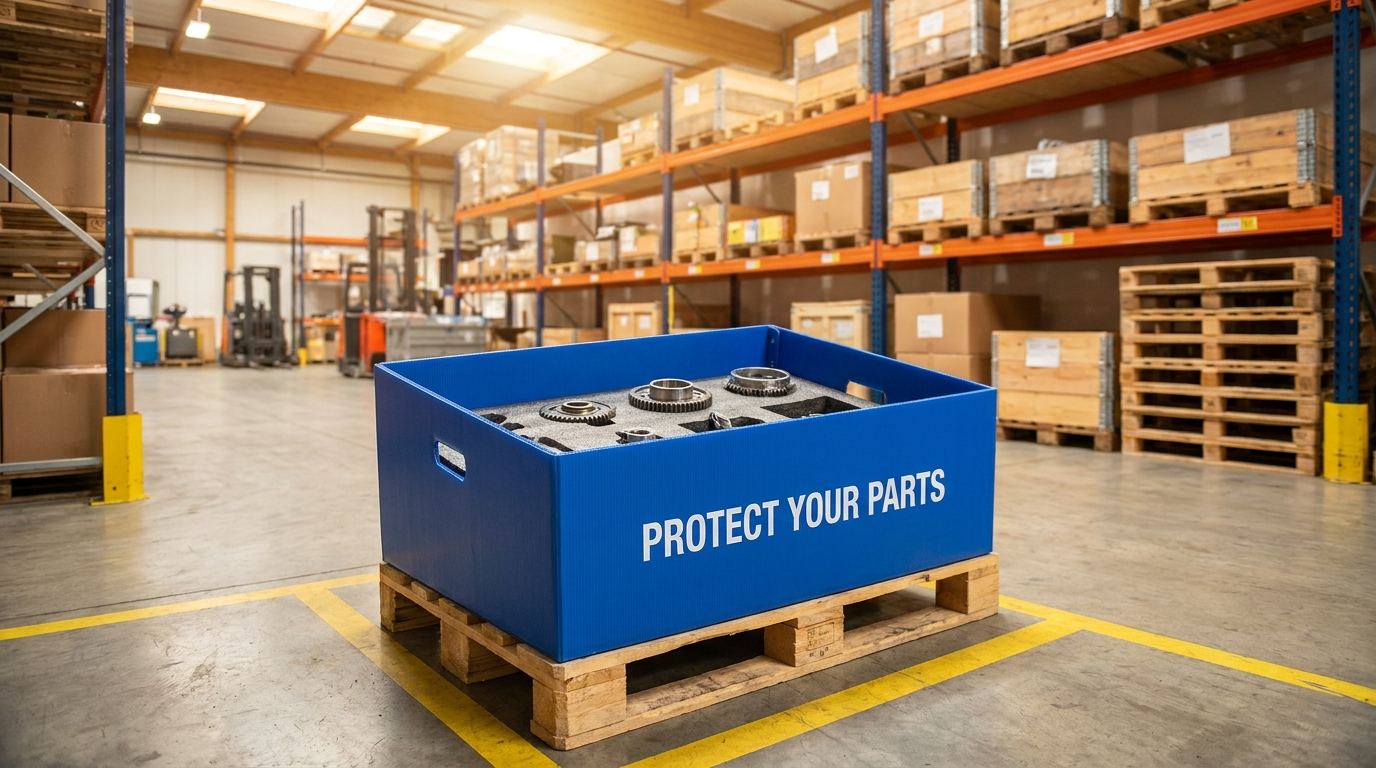
One of the strongest selling points is the ability to fit corrugated plastic containers with part-specific dunnage: foam inserts, fabric partitions, corrugated dividers, or molded plastic cradles. Shipping stamped metal parts that cannot contact each other? A simple corrugated divider grid prevents scratching. Shipping sensitive electronic assemblies? A foam-lined corrugated plastic container protects against both impact and electrostatic damage. Plexform engineers dunnage to the exact part geometry, which is why lead times run 6 to 10 weeks rather than pulling something off a shelf. For more on dunnage design options, the post on corrugated dunnage returnable solutions covers material choices and fitment strategies in detail.
Types and Configurations of Corrugated Plastic Containers
Not all corrugated plastic containers are the same. The configuration you choose depends on your part geometry, trip frequency, stacking method, and return logistics.
Standard Tote Boxes
The most common form: a rectangular box with four walls, a base, and an optional lid. Standard totes come in footprints that match common pallet dimensions (48×40, 48×45, 40×48 inches) to maximize truck density. They are easy to label, easy to handle by hand or with a pallet jack, and straightforward to repair if a wall cracks.
Foldable and Collapsible Designs
Foldable corrugated plastic containers use creased panels and plastic hinges to collapse flat when empty. This design works well for customers who ship full outbound but return empties by truck, because you can fit three to five collapsed containers in the space of one assembled unit. The trade-off is slightly reduced stacking strength in the assembled position compared to a fixed-wall design.
Partitioned and Divided Containers
Internal partitions divide the container footprint into individual part cells. A single 48×40 container might hold 24 compartments for small castings or 8 larger pockets for stamped brackets. Partition height, material, and spacing are all custom. This design reduces the need for separate individual packaging and speeds up line-side kitting.
Framed Heavy-Duty Containers
When the load exceeds what twin-wall polypropylene can handle on its own, steel or aluminum extrusion frames bolt or rivet to the container corners and top edge. The result is a rigid returnable container that stacks reliably under forklift load. These are common in automotive Tier 1 and Tier 2 supply chains where containers cycle between stamping plants and assembly facilities for years. The post on automotive packaging solutions walks through how OEM supply chains spec these containers for high-cycle production environments.
How to Choose the Right Corrugated Plastic Container
Choosing wrong costs money in two ways: containers that fail early, and containers that work but cost more than necessary. Here is how to spec correctly the first time.
Step 1: Define the Part and Trip Profile
Start with the part itself. What are its dimensions, weight, and surface sensitivity? How many parts ship per container? How many containers move per week? How many cycles per year do you expect? A container used 500 times a year needs a fundamentally different spec than one used 50 times. High-cycle applications justify heavier wall panels and frame reinforcement. Low-cycle or seasonal applications may be fine with lighter construction.
Step 2: Map the Handling Environment
Where does the container travel? A container moving inside a single plant on carts and conveyors faces different stress than one bouncing between two facilities on a flatbed truck. Consider forklift entry requirements (is a fork-entry base needed?), stacking height in transit, temperature range in storage, and exposure to oils, coolants, or cleaning chemicals. Polypropylene handles most industrial chemicals well, but temperature swings above 230 degrees Fahrenheit can soften it. For cold storage environments, the post on cold storage pallets covers related material selection considerations in low-temperature conditions.
Step 3: Decide on Return Logistics
Will the container be returned empty, folded flat, or discarded? If you are running a closed-loop returnable system between your plant and a supplier, foldable designs pay back quickly. If the container is a one-way trip with no return, a lighter-duty fixed-wall design may be the right call. The Institute of Packaging Professionals provides guidelines on returnable container system design that can help your team structure the loop before you finalize the container spec.
Step 4: Confirm Labeling and Visibility Requirements
Corrugated plastic containers accept printed labels, heat-stamped identification, or color coding. If your facility uses barcode scanning or RFID, plan for label pocket placement or embedded label holders in the container wall. Color coding by part family or supplier is simple and cheap to implement at the time of manufacture, and it pays dividends in sort accuracy on a busy receiving dock.

Implementation: The Plexform Process
Plexform’s approach to corrugated plastic containers starts with a conversation, not a catalog. Our engineers ask the right questions upfront so the first prototype matches the real application.
Discovery and Specification
The process begins with a part review. You share part drawings, samples, or photos. Our team assesses dimensions, weight, stacking requirements, and trip environment. From that review, we produce a written specification covering wall thickness, panel dimensions, dunnage design, closure type, and labeling layout.
Prototyping and Validation
Before full production runs, Plexform builds prototypes for you to test in your actual environment. Stack them. Load them. Run them through your line. This step catches problems that no drawing review will reveal, a lid that catches on a conveyor edge, or a partition that doesn’t clear a flange on the part. Validation reduces the risk of a costly production run that doesn’t perform.
Production and Delivery
Once the prototype is approved, production runs begin. Lead times of 6 to 10 weeks are typical, depending on complexity and material lead time. Containers arrive labeled and ready for immediate deployment. For facilities also evaluating complementary storage and transport systems, our post on returnable packaging solutions explains how corrugated plastic containers fit alongside racks, totes, and dividers in a broader returnable system.
Ongoing Support
Plexform stocks replacement parts and can reorder panels, dividers, or lids independently so you don’t have to replace an entire container because one component wore out. This modularity extends the service life of your investment significantly.
Cost, ROI, and Comparison
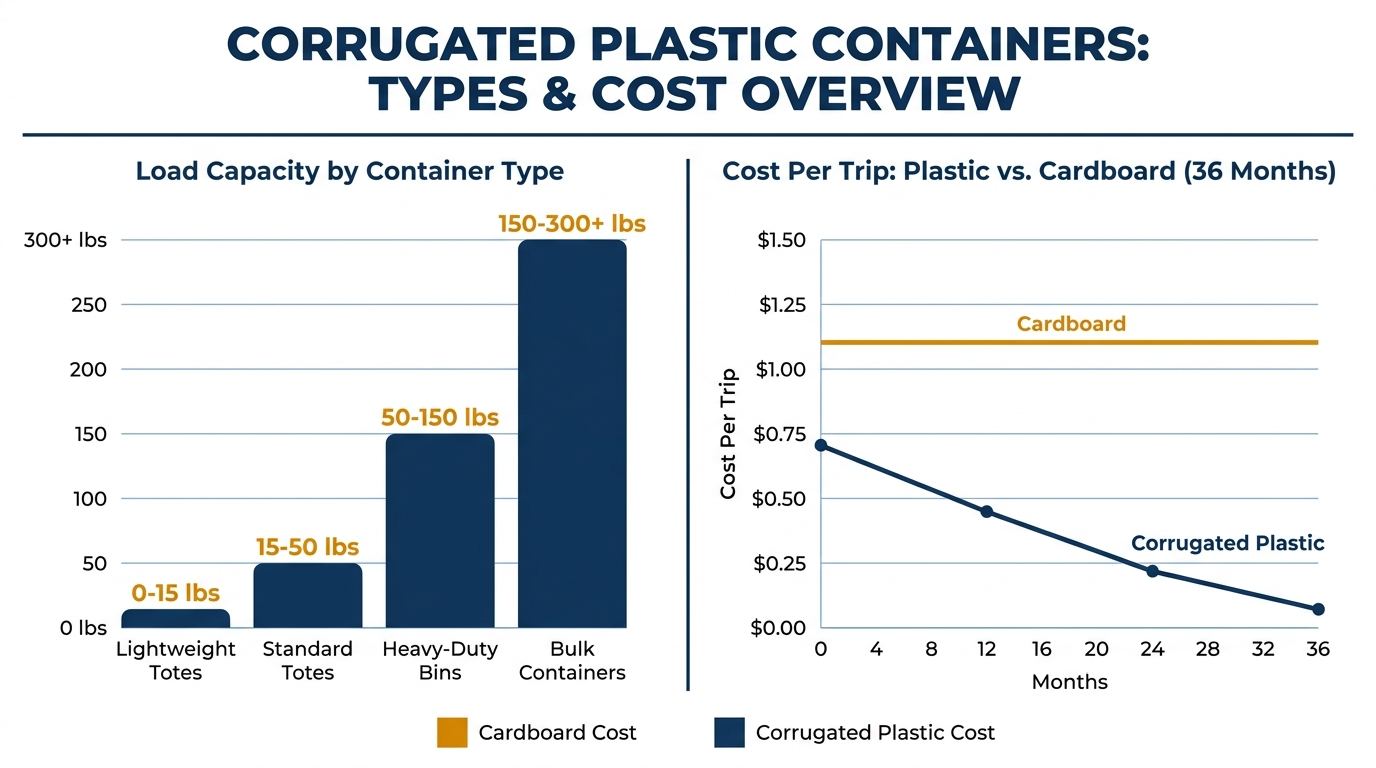
The upfront cost of corrugated plastic containers is higher than cardboard. The total cost over time is not.
Corrugated Plastic Container Comparison Table
| Container Type | Typical Cost per Unit | Cycle Life | Return Freight Savings | Best Application |
|---|---|---|---|---|
| Cardboard box | Low ($1 to $5) | 1 to 3 trips | None | One-way, light parts |
| Standard coroplast tote | Moderate ($15 to $60) | 100 to 300 trips | Moderate (flat fold) | General parts, medium volume |
| Foldable coroplast container | Moderate-High ($40 to $90) | 200 to 500 trips | High (60 to 75% volume reduction) | High-frequency supplier loops |
| Framed heavy-duty container | High ($80 to $250) | 500 to 1,000+ trips | Moderate (rigid, limited collapse) | Automotive, heavy stamped parts |
At 300 trips over five years, even a $60 corrugated plastic container costs 20 cents per trip, compared to $2 to $5 per trip for cardboard. On 10,000 trips a year, that difference funds significant capital investment elsewhere.
For facilities evaluating whether to pair corrugated plastic containers with metal storage systems on the floor, the post on industrial packaging solutions for modern supply chains provides a useful framework for integrating packaging and storage decisions together.
Frequently Asked Questions About Corrugated Plastic Containers
What are corrugated plastic containers made of?
Corrugated plastic containers are made from twin-wall polypropylene sheeting, two flat polypropylene layers connected by hollow internal flutes. This structure gives the material stiffness and impact resistance while keeping weight low. Heavy-duty versions add steel or aluminum frame extrusions at corners and edges for stacking strength under forklift loads.
How long do corrugated plastic containers last?
Plexform builds corrugated plastic containers that last 100 to 1,000+ trip cycles depending on wall thickness, frame reinforcement, and handling environment. Standard 4 to 6 mm totes in light-duty plant circulation typically last 2 to 4 years. Framed heavy-duty containers in automotive supply chains routinely run 5 to 10 years with basic maintenance.
How much do corrugated plastic containers cost?
Plexform quotes corrugated plastic containers starting around $15 to $60 for standard tote configurations and $80 to $250 or more for framed heavy-duty designs. Per-trip cost is the better metric: a $50 container used 400 times costs 12.5 cents per trip, which is a fraction of single-use cardboard. Final cost depends on wall thickness, size, dunnage complexity, and volume.
What is the lead time for custom corrugated plastic containers?
Plexform builds custom corrugated plastic containers with lead times of 6 to 10 weeks from approved specification to first delivery. Complex designs with custom dunnage or integrated frames may run toward the longer end of that range. Plexform builds prototypes for validation before committing to full production runs, so the timeline includes a review step.
Does Plexform build custom corrugated plastic containers for automotive plants?
Plexform builds custom corrugated plastic containers specifically for automotive Tier 1 and Tier 2 suppliers, with part-specific dunnage, custom footprints, and OEM-compliant labeling. Our engineers work from part drawings or physical samples to produce containers that fit the part exactly and cycle reliably through high-volume production loops.
Who makes corrugated plastic containers for manufacturing plants?
Plexform makes corrugated plastic containers for manufacturing plants across automotive, appliance, electronics, and general industrial sectors. Unlike commodity suppliers who sell off-the-shelf sizes, Plexform engineers containers to exact customer specifications with custom dunnage, sizing, and labeling, with lead times of 6 to 10 weeks and no minimum order.
Can corrugated plastic containers replace wooden crates?
Corrugated plastic containers replace wooden crates in most manufacturing and shipping applications. They weigh significantly less, eliminate splinter and nail hazards, resist moisture and chemicals, and fold flat for return shipping. The exception is extremely heavy loads (above 500 lbs per container) where steel bins or framed metal containers are better suited. Plexform can help you evaluate the right solution for your specific load.
How do I specify the right corrugated plastic container for my parts?
Plexform recommends starting with four inputs: part dimensions and weight, number of parts per container, trip frequency and cycle count, and handling environment (forklift, manual, conveyor). From those four data points, Plexform engineers can draft a specification covering wall thickness, container footprint, dunnage design, and closure type. Contact Plexform to start the conversation.
Conclusion
Corrugated plastic containers are a proven, cost-effective alternative to cardboard and wood in manufacturing and logistics environments. The key decisions are wall thickness, closure type, dunnage design, and return logistics. Get those four right from the start and you end up with containers that perform for years. Get them wrong and you are replacing containers, or worse, dealing with damaged parts, inside the first year. Plexform engineers custom corrugated plastic containers to your exact part geometry and trip requirements, with prototyping, validation, and ongoing support built into the process. If you are ready to reduce packaging spend, cut damage rates, and build a more efficient returnable loop, visit plexformps.com to connect with our engineering team.

Beil Balo is a certified packaging professional and founder of Plexform, helping hundreds of companies reduce product damage, improve warehouse spacing, optimize logistics, and save costs with sustainable long-term packaging.