 Skip to content
If you've ever walked through a busy factory or warehouse, you know that space and order are everything. To keep things running smoothly, you need the right foundational pieces to build an efficient, strong, and organized system. Steel stackable bins are exactly that—far more than just metal boxes, they are engineered tools designed for the demanding world of manufacturing and logistics.
Think of it this way: flimsy plastic tubs crack under heavy loads, and bulky wooden crates splinter and soak up moisture. Steel bins, on the other hand, are built for the long haul. Their inherent strength creates a secure fortress for everything from heavy automotive stampings to delicate, high-value machined parts.
Why Smart Engineers Choose Steel Stackable Bins
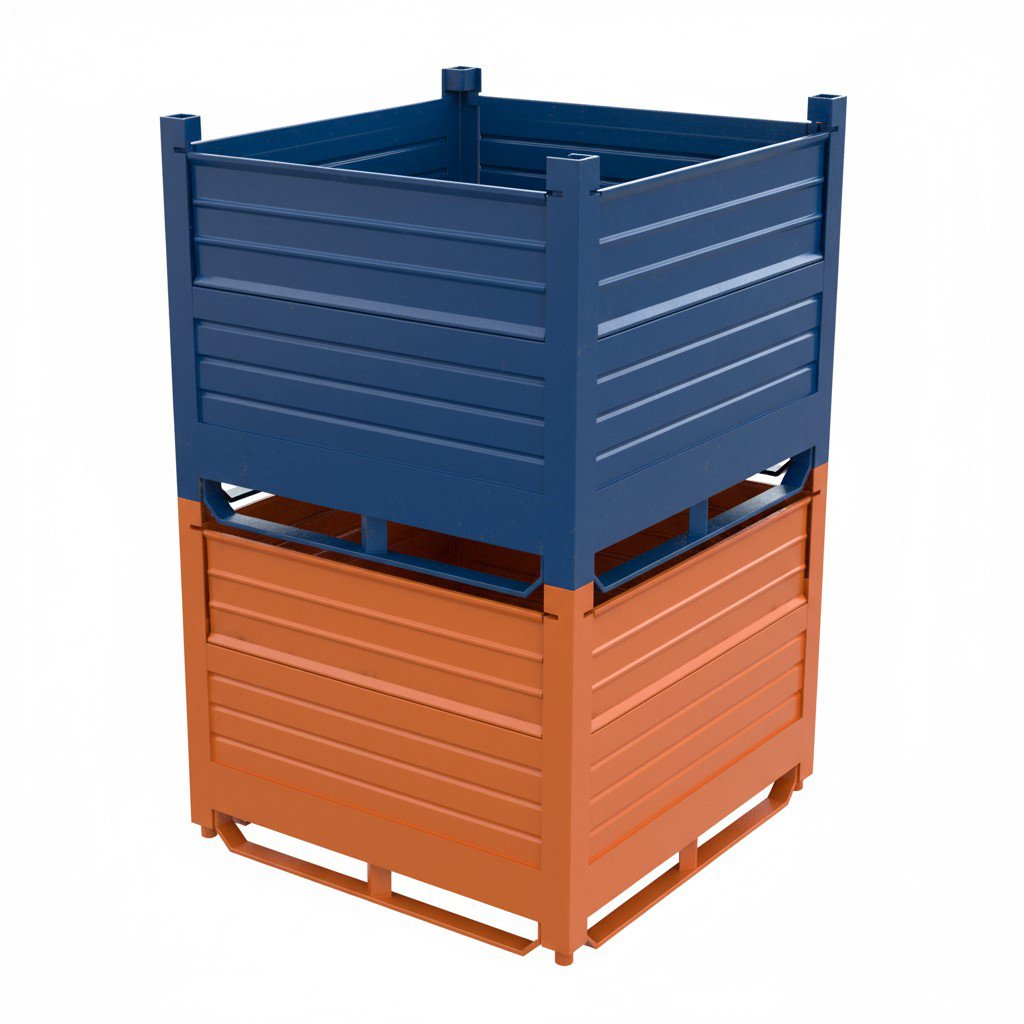
The real magic of steel stackable bins is their ability to protect products and make the most of your space. By stacking them vertically, you turn empty overhead air into valuable storage real estate, which can drastically shrink your facility’s footprint. In an operation where every square foot has a cost, that’s a massive win.
This stacking ability doesn't happen by chance; it’s the result of smart engineering.
Rock-Solid Stability: Each bin features interlocking corners or feet. When stacked, they form a stable, unified column that won’t tip or shift, even when loaded to capacity.
Engineered Load Support: The frame is designed to transfer the weight from the bins above it safely down to the floor. This protects both the containers and the valuable parts inside.
Unmatched Part Protection: Steel provides incredible rigidity. It shields your components from impacts, compression, and other hazards that are common during handling, storage, and shipping.
A well-designed steel bin is not just a container; it's an insurance policy for your parts. By preventing damage, it directly protects your bottom line and eliminates the costly waste associated with scrap and rework.
This is why experienced engineers and logistics managers rely on them. They know that a container isn’t just an expense—it’s a critical part of the entire production system. When you move to custom-engineered solutions, these bins become a true competitive advantage, designed to fit your specific parts and processes perfectly. They become a seamless part of your workflow, boosting efficiency and building a stronger, more resilient operation from the ground up.
The Hidden ROI of Upgrading Your Storage
When you're looking at new equipment, it’s easy to get fixated on the initial price. But with something like steel stackable bins, the real story is in the long-term return on investment (ROI). These aren't just boxes; they're a strategic upgrade that can fundamentally boost your operation's profitability.
Think about your factory floor for a second. Every square foot has a cost tied to it—rent, utilities, maintenance, you name it. By stacking bins vertically, you can dramatically increase storage density and reclaim up to 60% of your floor space. That new-found real estate can be used for value-added activities, like a new production line, or it could even let you downsize your facility and cut overhead.
Slashing Costs Through Superior Protection
One of the biggest hidden costs in any manufacturing or logistics operation is part damage. Flimsy plastic bins or splintered wood crates just don't offer the protection your components need, which leads straight to scrap, rework, and frustrating delays. The rigid, unforgiving construction of a steel bin is like a suit of armor for your inventory.
This becomes absolutely vital when you're handling high-value components or parts with a Class-A finish. By keeping parts secure during in-plant transit, storage, and even shipping, steel bins can drop damage rates from double-digit percentages to less than 2% in some applications. That’s a direct savings in material and labor that goes right to your bottom line.
A single damaged part represents more than just its material cost. It includes wasted machine time, labor, and logistics efforts—all of which are preserved when parts are properly protected.
Beyond protecting parts, these bins also make your facility a safer place to work. Their engineered stability and secure interlocking features take the guesswork and risk out of stacking. This means fewer accidents and lower costs tied to workplace injuries.
The Total Cost of Ownership Advantage
Disposable or short-lived containers lock you into a costly cycle of repurchasing and disposal. Steel bins are built to break that cycle. With incredible durability, they can handle the daily abuse of an industrial environment for 20 years or more.
When you step back and look at the total cost of ownership (TCO), the financial case becomes undeniable. Yes, the initial investment is higher, but the multi-decade service life of steel makes it a far more economical choice in the long run.
Material Comparison: Steel vs. Alternatives
Choosing the right container material is a critical engineering decision. While options like plastic and wood have their place, they often fall short in demanding industrial environments where durability and long-term value are paramount.
Here’s a quick breakdown of how steel stacks up against the common alternatives:
| Attribute | Steel Bins | Plastic Bins | Wood Crates |
|---|---|---|---|
| Durability | Extremely High (20+ years) | Moderate (3-5 years) | Low (1-2 years) |
| Load Capacity | Very High | Low to Moderate | Moderate |
| Part Protection | Excellent | Fair | Poor |
| Repairability | High (Weldable) | Low to None | Low (Often replaced) |
| Long-Term Cost | Very Low | Moderate | High (Constant replacement) |
As the table shows, steel's upfront cost is quickly offset by its superior performance and longevity. The ability to simply weld and repair a damaged steel bin, rather than replacing it, further solidifies its TCO advantage.
This long-term view is what shifts steel stackable bins from being an operational expense to a strategic investment. The initial cost is spread out over a remarkably long service life, delivering a powerful ROI through space optimization, waste reduction, and improved safety. It's an engineering decision that pays for itself for years to come.
Choosing the Right Materials and Coatings
Picking the right material for your steel stackable bins is a bit like an engineer choosing the perfect alloy for a critical engine component. While "steel" sounds simple, it's actually a huge family of materials. Making the right call on the specific grade and finish is where good engineering creates a solution that performs reliably for decades.
This decision directly shapes the bin's strength, lifespan, cost, and how well it holds up in its intended environment. A general-purpose bin for storing stamped metal parts in a dry warehouse has entirely different needs than one used in a humid, corrosive plant or a facility requiring strict hygiene for food processing. The wrong choice can lead to premature failure from rust, contamination, or even structural weakness.
The Foundation Your Bin Is Built On
For the vast majority of industrial jobs, low-carbon steel—often called mild steel—is the go-to workhorse. It hits the sweet spot, offering an excellent balance of strength, formability, and cost. This makes it perfect for handling everything from automotive components to general hardware without driving up costs.
But when conditions get demanding, you need to bring in the specialists.
High-Strength Steel: When you need to push the load capacity without adding extra weight, high-strength low-alloy (HSLA) steels are the answer. They give you the durability needed for extremely heavy parts.
Stainless Steel: For food processing, pharmaceutical applications, or highly corrosive environments, nothing beats stainless steel. Its built-in resistance to rust and corrosion ensures hygiene and prevents contamination, though it does come at a higher price point.
Getting the material right is a critical first step, but it’s only half the battle for long-term performance.
When specifying a bin, you aren't just buying a container; you are engineering a material handling asset. The raw material and its protective coating work together to define its lifespan and reliability within your operational workflow.
The dominance of steel in industrial packaging is undeniable. Steel containers hold 48.6% of the global metal containers market. Corrosion-resistant low-carbon steel variants are used in 60% of food packaging applications, where they can preserve contents 3x longer than plastics. For engineers designing returnable packaging systems, the right steel bins make closed-loop logistics possible, which can slash costs by 40% compared to disposables, thanks to their 20+ year lifespans.
Why Protective Coatings Are Not Optional
An uncoated steel bin left exposed to the factory floor is a bin destined to rust—it's just a matter of time. Coatings are the essential barrier, shielding the raw steel from moisture, chemicals, and everyday bumps and scrapes. They also present a fantastic opportunity to improve your operations through simple visual organization.
The most common and effective finish for steel stackable bins today is powder coating. This process involves electrostatically applying a dry powder to the steel, which is then cured under heat. What you get is a hard, durable finish that is far tougher than any conventional liquid paint.
The key benefit of powder coating is its sheer resilience. It stands up to chipping, scratching, and fading, ensuring the bin not only lasts but also maintains a professional look for years. Better yet, it allows for color-coding—a simple but powerful organizational tool. You can assign colors to different parts, departments, or production stages (e.g., red for scrap, green for finished goods), which dramatically cuts down on errors and smooths out your workflow. You can learn more about custom fabrication and coating options to see how they can be tailored to your specific needs.
For the ultimate defense against corrosion, hot-dip galvanizing is an outstanding choice. This process involves submerging the entire fabricated bin in a bath of molten zinc. This creates a tough, metallurgical bond that protects the steel both inside and out. Galvanized bins are the top solution for outdoor storage or in facilities with high humidity or chemical exposure. By thoughtfully selecting both the base steel and its protective coating, you engineer a bin that is perfectly optimized for performance, longevity, and your unique operational environment.
Mastering Load Capacity and Stacking Dynamics
Understanding the physics behind stacking is absolutely critical for creating a safe and efficient storage system. This is about more than just placing one steel stackable bin on top of another; it's an engineering exercise in managing immense forces.
Specifying a bin without nailing down these dynamics is like building a skyscraper without calculating the weight it needs to support—a recipe for catastrophic failure.
The two concepts you absolutely have to master are static load capacity and dynamic load capacity. They might sound similar, but they describe how a bin performs under completely different conditions. Getting this difference is the first step toward engineering a truly robust and reliable material handling solution.
Static Load Capacity: The Foundation of Your Stack
Think of static load as the “at-rest” strength of your bins. It’s the maximum weight a single bin can support when it’s sitting stationary at the bottom of a stack.
Imagine a column of five bins, each holding 1,000 kg of parts. The bin at the very top is only holding its own contents, but the bin at the bottom has to support the weight of the four bins stacked above it—a staggering 4,000 kg total.
Static load capacity is a measure of compressive strength. The bottom bin’s frame and corner posts are engineered to transfer this immense top-down force safely to the ground without buckling, bending, or failing.
This is where the design of a steel bin really proves its worth. The corner posts act like the support columns of a building, channeling all that cumulative weight through the strongest points of the frame. Underestimating static load is one of the most dangerous mistakes an engineer can make, as it can lead to a sudden and complete collapse of the entire stack.
Dynamic Load Capacity: Strength in Motion
Now, let's add movement to the equation. Dynamic load capacity is the maximum weight a bin can safely hold while it's being moved, lifted, or transported by a forklift. When a bin is in motion, it’s hit with a whole different set of forces it doesn't experience when stationary.
These forces include:
Vibration: The constant jarring and shaking during transport.
Inertia: The push and pull from starting, stopping, and turning.
Impact: The shock of being set down, which isn't always gentle.
Because of all these extra stresses, a bin’s dynamic load capacity is always lower than its static capacity. A bin might have a static capacity of 6,000 kg, but its dynamic capacity could be just 2,000 kg. Pushing past the dynamic limit risks structural failure when you can least afford it—while the bin is high up on a forklift's forks.
Principles of Safe Stacking Heights
Figuring out a safe stacking height isn't just about weight; it’s a careful balancing act between physics and design. The stability of any stack comes down to a few key engineering principles.
A bin's base dimensions are a huge factor. A bin with a wider and longer base creates a much more stable foundation, just like a pyramid is more stable than a tall, thin tower. That larger footprint helps resist any forces that might cause tipping.
The center of gravity also plays a massive role. You should always load heavy, dense parts at the bottom of the stack to keep the center of gravity as low as possible. A top-heavy stack is just asking for trouble. For a deeper dive into stability, our guide on how to optimize stacking racks offers some valuable insights.
Finally, the interlocking features—those specially designed feet and corner posts—are what lock the entire column together. They ensure each bin seats securely onto the one below it, preventing any shifting and creating a single, unified structure.
The market for portable metal storage containers shows just how important these engineered solutions are becoming. Well-designed steel stackable bins can be configured to hold 1,000-2,000 kg per unit while slashing repositioning expenses by 30-45% in major markets. When integrated into automated lines, they've been shown to boost throughput by 25% and cut injury rates by 50% through safer, more ergonomic stacking. Discover more insights on the metal storage market's growth.
By mastering these dynamics, engineers can specify bins that aren't just strong and safe, but truly optimized for the entire supply chain.
How a Custom Bin Is Engineered for Your Product
A one-size-fits-all approach to material handling is a recipe for inefficiency, damaged parts, and wasted money. Off-the-shelf bins are a generic solution, and they rarely account for the specific geometry, weight, or fragility of your components. This is where custom-engineered steel stackable bins stop being simple containers and become a precision tool, designed to solve your unique workflow problems.
The journey to a custom bin doesn't begin with a set of dimensions; it starts with a problem. Maybe you're fighting high scrap rates from parts clanging together, or perhaps your team is losing valuable time manually wrestling with awkward components. An expert engineering partner takes these real-world challenges and uses them as the blueprint for a solution that fits your operation perfectly.
The process kicks off by creating a 'digital twin'—a highly detailed 3D model of both your component and the proposed bin. This virtual environment is a powerful, low-cost sandbox where we can test everything before a single piece of steel is ever cut or welded.
Virtual Prototyping and Digital Twins
Using 3D modeling, engineers can meticulously analyze the fit, clearance, and interaction between your part and the bin. They can run simulations of loading and unloading, flagging potential ergonomic issues or workflow bottlenecks long before they become a problem on your floor. This digital foresight is what gets the design right the first time.
A digital twin allows us to solve problems virtually, ensuring the final physical bin is a perfect-fit solution from day one. It transforms the design process from guesswork into a data-driven engineering exercise.
This virtual testing also looks at how the bin will play with your broader operation. Engineers can check for seamless compatibility with your forklifts, automated guided vehicles (AGVs), and existing racking, ensuring the new bin enhances your material flow instead of disrupting it. This concept map shows the key forces we model and calculate.
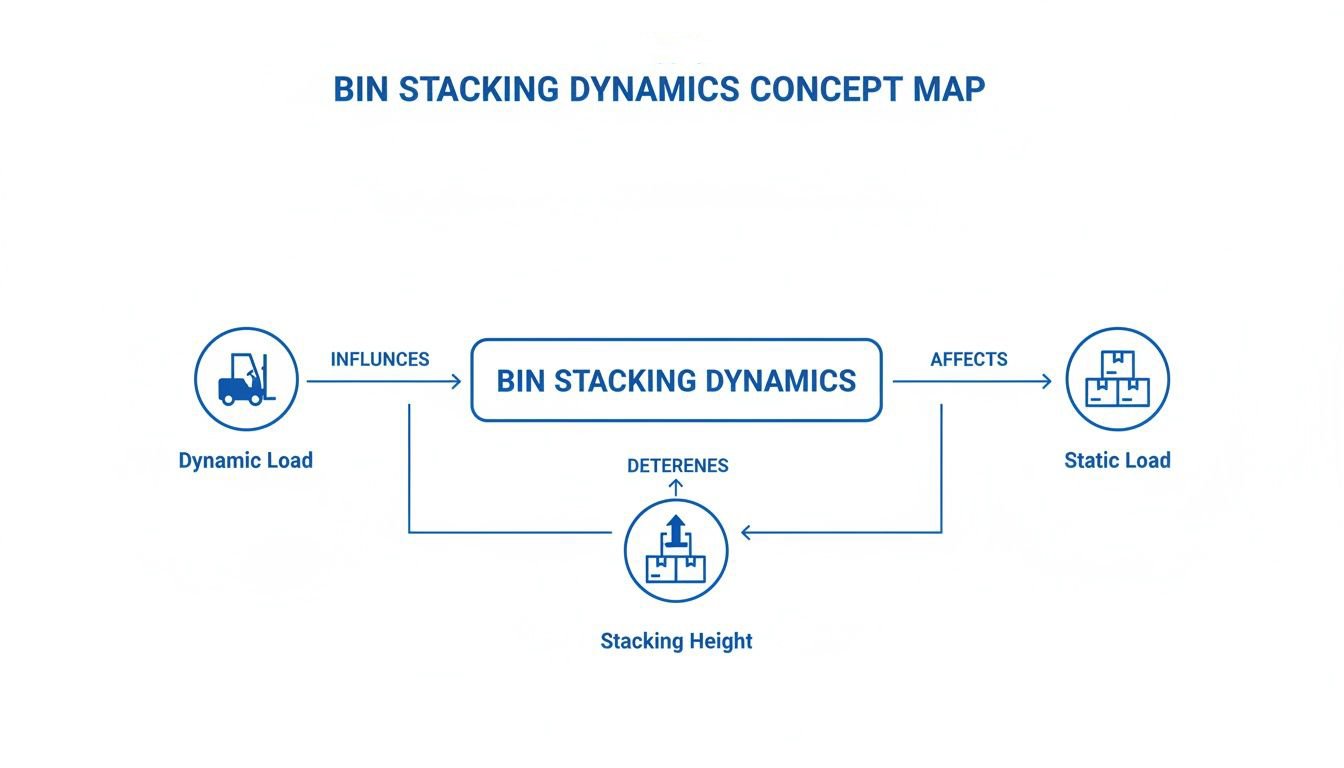
Customization Beyond Dimensions
True customization goes far beyond just length, width, and height. It’s about building in features that directly attack your pain points and protect your parts with a level of precision standard bins can't touch.
Integrated Dunnage: This is the internal packaging designed to cradle and secure your parts. We can use anything from durable HDPE plastics to non-abrasive textiles for Class-A surfaces, all custom-molded to stop any movement or contact.
Ergonomic Access: Features like drop gates or half-drop gates allow workers to easily access parts without straining or having to unstack bins. It's a simple change that dramatically improves both safety and efficiency.
Forklift Guides and Pockets: Precisely engineered forklift guides ensure quick, safe, and damage-free handling, every single time. This small detail prevents costly damage to both the bins and your lift equipment.
This level of detail is exactly why custom-designed steel stackable bins are indispensable. They enable efficient material handling by stacking up to 5-7 units high without losing stability, which can reduce floor space usage by as much as 60%. In high-volume stamping operations, using 3D modeling to match exact part geometries has been shown to slash damage rates from 12% to under 2%.
You can explore a wide range of custom metal bin solutions to see how they are built for specific applications. By starting with your unique product and process, a custom-engineered bin provides a solution that standard containers simply cannot match.
Maximizing Bin Lifespan and Calculating Your ROI
When you invest in steel stackable bins, you're making a long-term play, not just a one-time purchase. With the right care, these workhorses are built to perform for 20 years or more, delivering value long after flimsier alternatives have been retired to the scrap heap. Getting the most out of that lifespan just takes a simple, consistent maintenance routine.
Think of it like maintaining a fleet of vehicles. A little preventative care goes a long way toward avoiding expensive downtime and keeping everything running at peak performance. The same logic applies to your bins. Regular inspections are your first line of defense, letting you catch small issues before they snowball into major structural problems that put safety and products at risk.
Simple Maintenance for a Multi-Decade Lifespan
A proactive maintenance program for your steel bins doesn't need to be complex or eat up a lot of time. It's all about building simple checks into your team’s regular workflow. The goal is to spot and fix the normal wear and tear that comes from the daily grind of an industrial environment.
Here’s a practical inspection checklist to keep your bins in prime condition:
Weld Integrity: Regularly check corner posts and joints for any signs of cracking or stress fractures. A small crack can be quickly repaired with a quick weld, heading off a potential failure under load.
Coating Condition: Look for deep scratches, chips, or spots where the powder coating or galvanizing has worn away. Touching up these areas stops rust from setting in and weakening the underlying steel.
Structural Straightness: Visually inspect the bin’s frame, legs, and side walls for any bending or warping. A bent leg can throw off stacking stability and needs to be addressed immediately.
Interlocking Features: Make sure the stacking feet and corner caps are intact and free of damage. These are the critical points that create a secure, stable stack.
Proving the Financial Victory of Your Bins
To get the green light for an investment in high-quality steel bins, you often have to speak the language of the finance department. It’s not enough to talk about engineering benefits; you need to build a rock-solid business case grounded in a clear Return on Investment (ROI). This is how you shift the conversation from an operational expense to a quantifiable financial win.
The ROI of steel stackable bins isn’t just about their purchase price. It’s calculated from the accumulated savings they generate by solving expensive problems—like part damage, wasted space, and inefficient labor.
To build your business case, start by quantifying savings in a few key areas. First, calculate the total cost of the disposable packaging you’ll no longer need, whether it's cardboard boxes or wooden crates. This isn't just the material cost—it includes the labor to assemble and break them down, plus any disposal fees.
Next, put a number on the savings from reduced product damage. Analyze your scrap and rework rates before and after making the switch to steel bins. If your damage rate plummets from 5% to less than 1%, that's a direct, measurable saving that makes your ROI argument much stronger.
Finally, factor in the gains from labor efficiency and freed-up space. Time saved from easier handling, faster loading, and less manual sorting all add up to lower labor costs. In the same way, the value of reclaimed floor space can be calculated based on your facility's cost per square foot. When you pull all these savings together, the financial power of a well-designed bin system becomes impossible to ignore, proving it’s an investment that pays for itself many times over.
Common Questions About Steel Stackable Bins
Making the switch to a new material handling system is a big step. If you're an engineer or logistics manager, you need straight answers before committing to a major investment like steel stackable bins. It makes sense that you’d have questions about their performance, cost, and how they can be adapted to your unique parts.
We hear the same questions time and again, and they almost always circle back to the practical realities of factory life: load capacity, the true cost of custom vs. standard bins, and what it takes to protect your parts. Let's dig into the details you need to know to specify a solution that actually works on your floor.
How Do I Determine the Right Load Capacity?
Getting the load capacity right isn't just a good idea—it's a critical safety and engineering task. You have to think about two different scenarios: the static load (how much weight a bin can hold when it's sitting still in a stack) and the dynamic load (how much it can handle while being moved by a forklift).
For static load, a good starting point is to multiply the maximum weight of the parts in a single bin by the number of bins you intend to stack on top of it. Say you plan to stack five bins high, and each one holds 1000 kg. The bottom bin needs to safely support a static load of 4000 kg.
Of course, this is just a baseline. You should always work with an engineering partner to validate these numbers. They can help ensure your design meets all safety factors without being over-engineered, which just adds unnecessary cost.
Are Custom Steel Bins More Expensive?
At first glance, the price tag on a custom bin might look a little higher than a generic, off-the-shelf option. But when you look at the total cost of ownership, custom bins almost always come out on top. A standard bin is a compromise; a custom bin is a solution engineered for your bottom line.
The real value of a custom bin is measured in the problems it solves. By eliminating part damage, optimizing shipping density, and improving worker ergonomics, the initial investment delivers a rapid and significant return.
Custom bins are designed to fit your parts perfectly. This simple fact can slash—or even completely eliminate—the costs of part damage and scrap. They're also built with your shipping methods in mind, whether it's a truck or a sea container, maximizing every square inch of space and directly cutting your freight expenses. In the long run, custom is the smarter financial move.
What Kind of Dunnage Can Be Integrated?
Dunnage is the unsung hero of part protection. It’s the material inside the bin that cradles, secures, and protects your parts from damage. A huge variety of dunnage can be integrated into steel stackable bins, and choosing the right one is a key part of the custom design process.
You're not just buying a steel box; you're creating a complete protective packaging system.
Some of the most common dunnage options include:
HDPE (High-Density Polyethylene): This is a tough, durable plastic that’s great for holding heavy or abrasive parts. It's also resistant to most chemicals.
Non-Abrasive Textiles: Think of soft, protective fabrics. We use these for Class-A surfaces like painted or polished components to prevent any scratches or scuffs.
Molded Plastic Trays: If you need to organize dozens of small, individual components inside a single bin, molded trays are the perfect solution.
Urethane and Foam: For fragile parts that are sensitive to shock and vibration, these materials offer excellent impact absorption.
The right dunnage turns a simple container into a tailored system that protects your product's quality all the way from your line to your customer.
At Plexform Incorporated, we specialize in designing and building custom-engineered steel solutions that solve your most complex material handling challenges. Our team works with you to create bins that protect your products, optimize your space, and improve your bottom line.


Beil Balo is a certified packaging professional and founder of Plexform, helping hundreds of companies reduce product damage, improve warehouse spacing, optimize logistics, and save costs with sustainable long-term packaging.