 Skip to content
Plexform builds custom stackable shipping containers for manufacturing and warehouse operations, engineered to exact customer specifications with lead times of 6 to 10 weeks and no minimum order requirement. If you’ve been relying on generic bins or one-size-fits-all solutions, you already know the problems: parts shift in transit, floor space disappears, and freight costs climb because containers don’t nest or stack efficiently. According to the Reusable Packaging Association, companies that switch to engineered returnable containers reduce packaging costs by 30 to 60 percent over a five-year period. That’s worth taking seriously. Choosing the right stackable shipping containers means matching container geometry, load capacity, and stacking mechanism to your specific parts and your specific facility. This guide covers what these containers are, how they’re built, which configurations exist, how to choose the right one, and what the Plexform process looks like from first contact to delivery.
What Are Stackable Shipping Containers and Why Do They Matter?
Stackable shipping containers are industrial-grade storage and transport units designed to carry parts or components through production, storage, and outbound shipping, while stacking safely on top of one another to maximize vertical space.
The Core Function
The stacking feature is what sets these apart. A standard open-top bin holds parts but does nothing to recover vertical space. A true stackable container uses corner posts, stacking pins, or interlocking geometry so that a loaded container sits stably on top of another, multiplying your usable floor space without any additional racking infrastructure.
Why Manufacturing Operations Need Them
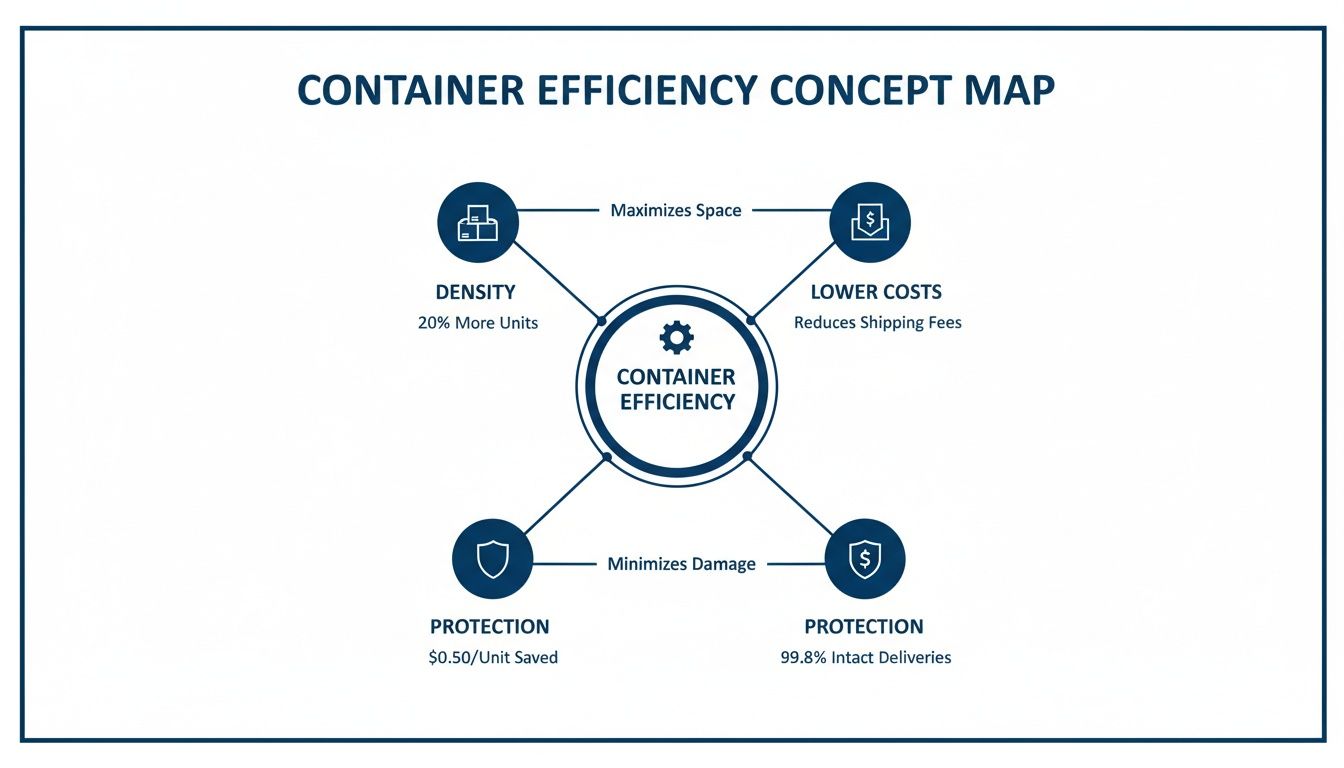
Floor space in a manufacturing plant is expensive. Every square foot consumed by sprawling flat storage is a square foot you can’t use for production, assembly, or staging. When parts move between departments or ship to a customer, containers that stack tightly on a truck trailer also reduce freight cost per piece. You’re simply moving more parts per load.
Steel vs. Plastic vs. Wire Mesh
Steel containers carry higher loads, handle temperature extremes, and resist impacts that would crack or deform plastic. Wire mesh storage containers offer visibility and ventilation but have lower load limits than solid welded steel. Plastic corrugated containers are lightweight and cheap but rarely survive the abuse of a heavy manufacturing environment for more than a few years. For heavy or high-value parts, welded steel is the practical choice.
Key Benefits and Construction of Steel Stackable Containers
Understanding what goes into a well-built container helps you evaluate whether a supplier’s product will actually hold up in your environment.
Structural Elements That Matter
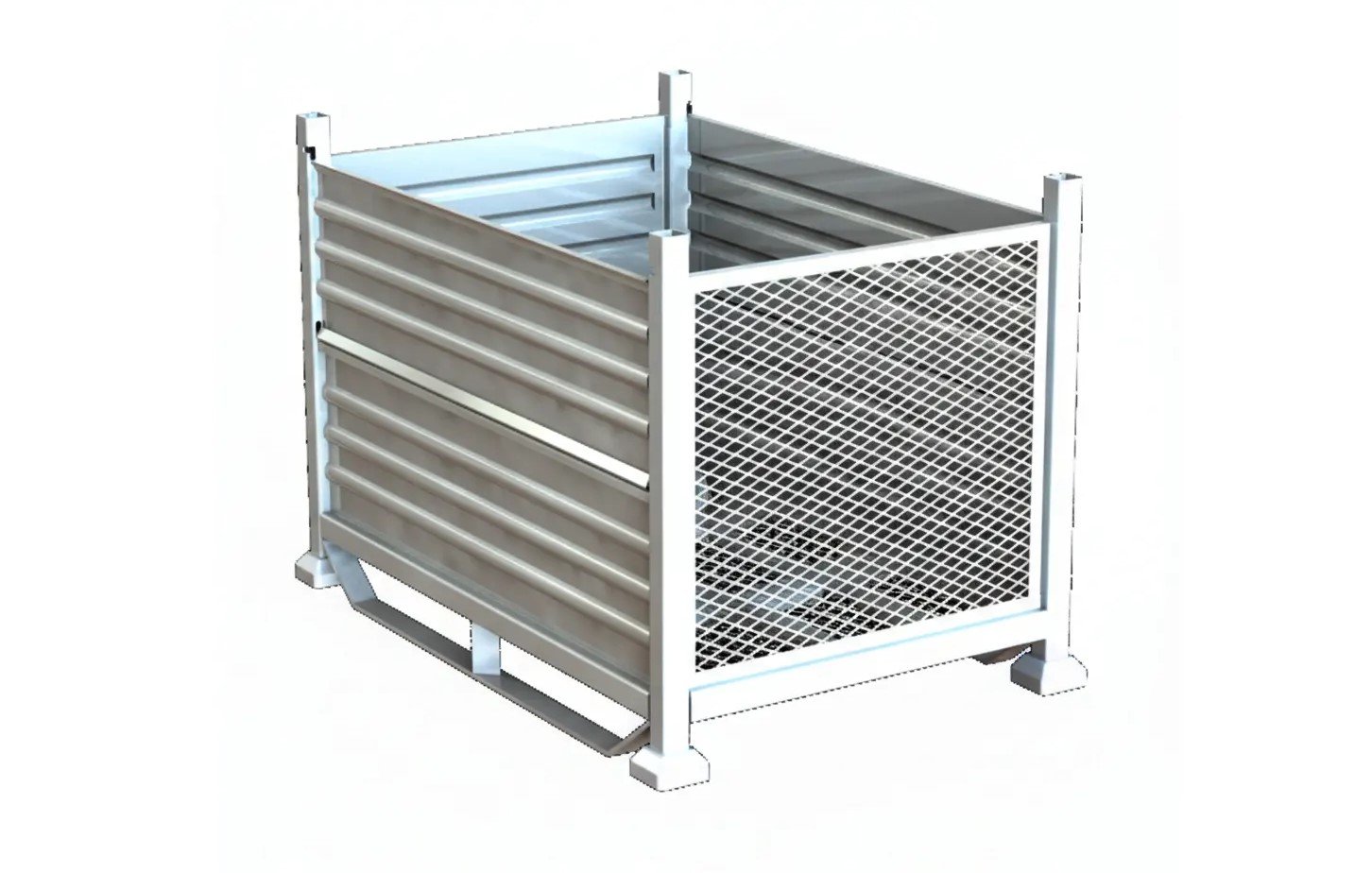
A properly built stackable shipping container has welded steel corner posts with stacking caps or pins that align precisely with the base of the container above. The base incorporates fork-entry tubes or channels so a forklift or pallet jack can engage the container when it’s loaded. Side panels are typically horizontal-ribbed or perforated steel, welded to the frame. Bolted or riveted connections loosen over time under repeated handling.
The floor may be solid steel plate, grating, or fitted with custom dunnage inserts depending on the part. Finish is almost always powder coat, which resists chipping, corrosion, and cleaning chemicals far better than paint.
Part Protection as a Design Principle
The interior is where custom engineering earns its keep. Off-the-shelf containers carry parts loosely, which means vibration during transit causes surface damage, scratches, and dimensional shifts. A custom container from Plexform is built with interior fixtures, cradles, rails, or foam-lined dividers that hold each part in a fixed orientation. That matters most for finished or machined components where a scratch means a warranty claim.
Stacking Safety and Load Capacity
The Occupational Safety and Health Administration requires that stacked containers be stable and that stacking loads remain within the structural capacity of the lower containers. Your container specification needs to include not just the part weight but the fully loaded stack weight the bottom container must support. Plexform engineers calculate that load path and size corner posts accordingly.
Types and Configurations of Stackable Shipping Containers
The right configuration depends on your part geometry, your handling equipment, and how the container moves through your supply chain.
Fixed-Wall Containers
Fixed-wall containers are the simplest and most rigid option: four welded walls, a steel base with fork entry, and corner posts with stacking caps. These work well for compact or irregularly shaped parts that benefit from full enclosure. They’re the most durable configuration and the easiest to sanitize, which matters in food-adjacent or automotive paint-line applications.
Collapsible and Foldable Configurations
When containers travel back empty, collapsible walls reduce return freight costs considerably. A foldable shipping container folds down to roughly 25 percent of its assembled height, meaning you can return four containers in the space one occupied on the outbound trip. The trade-off is that hinges and latches add complexity and potential failure points over time.
Drop-Gate and Access-Door Variants
Some applications require side access rather than top access, particularly when parts are long or when an assembly operator needs to reach in without lifting a part overhead. A drop-gate front panel, hinged at the bottom, solves that without sacrificing stacking capacity at the corners.
Wire Mesh and Perforated Panel Containers
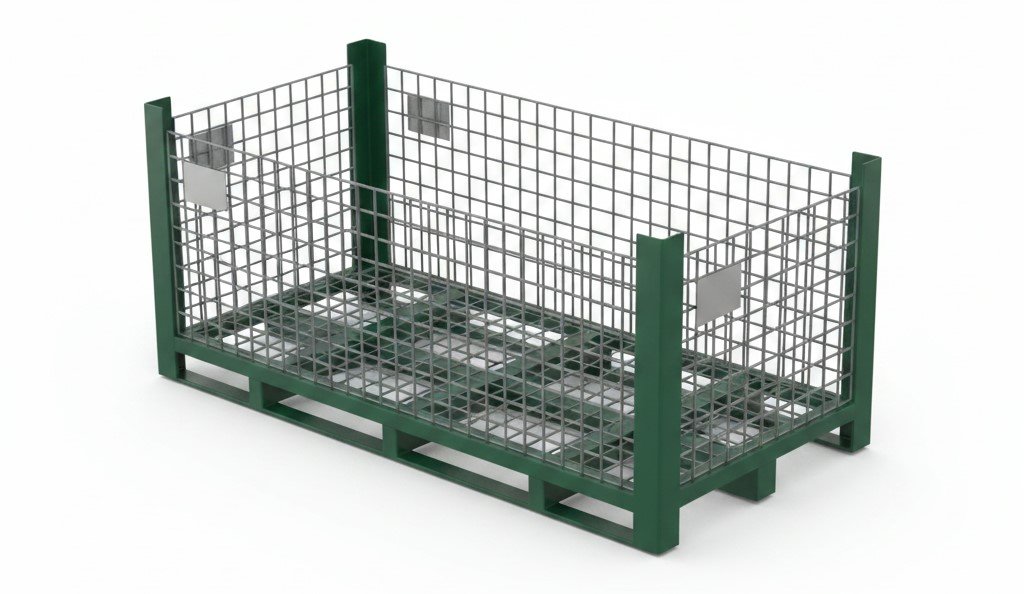
When visual inventory counting, drainage, or ventilation matters, wire mesh or perforated panel containers offer those advantages while keeping a steel frame and stacking capability. These are common in automotive stamping operations and paint shops. For a closer look at how wire containers fit different plant environments, see where wire mesh storage containers fit in a plant.
How to Choose the Right Stackable Shipping Containers
Getting this right means collecting specific data before you talk to a supplier.
Start With the Part
Measure the largest part you’ll store in this container: length, width, height, and weight. Then figure out how many pieces per container makes sense for your production flow. Too few parts per container increases handling cycles; too many creates ergonomic problems when a worker reaches to the bottom. A reasonable rule of thumb is that no container should require a worker to manually lift more than 35 pounds at awkward reach distances.
Define the Handling Environment
Will the container move by forklift, pallet jack, tugger train, or hand? Each requires different base geometry. Forklifts need at least 7 inches of clear fork-entry height. Pallet jacks need open-bottom fork entry. Tugger train dollies often require the container to sit on a custom cart rather than using its own base.
Stack Height and Floor Load
Decide how high you plan to stack. Two high is standard in most facilities; three high is possible if the container is engineered for it and your floor load capacity supports it. Stackable metal storage bins follow the same structural logic: the bottom unit carries the full cumulative load, so the spec must reflect the worst case.
Surface Finish and Environment
If the container operates in a wash-down area, near chemicals, or outdoors, the finish needs to match. Powder coat in a two-stage primer-plus-topcoat system handles most manufacturing environments well. Galvanized or stainless options are available for more aggressive conditions.
Supplier Capability
Ask whether the supplier fabricates in-house or subcontracts. Ask to see load test documentation. Ask what happens if a container fails in service. Plexform fabricates all containers in-house, which means tighter tolerances, faster response to design changes, and clear accountability when something needs to be addressed.


Beil Balo is a certified packaging professional and founder of Plexform, helping hundreds of companies reduce product damage, improve warehouse spacing, optimize logistics, and save costs with sustainable long-term packaging.