 Skip to content

Plexform builds custom metal storage bins for manufacturing and warehouse operations, engineered to exact customer specifications with lead times of 6 to 10 weeks and no minimum order requirement. Every bin is custom welded in steel, sized and configured for your specific parts, load weights, and floor plan. If your facility is still relying on mismatched plastic totes or generic off-the-shelf bins, you already know the problem: parts shift in transit, bins fail under load, and floor space gets wasted because nothing fits the way it should. Research from the Material Handling Institute identifies poor storage equipment as one of the leading contributors to part damage and throughput loss in manufacturing environments. The right metal storage bins change that. This guide covers what metal storage bins are and why they matter, how they are built, which types are available, how to choose the right configuration, and how to work with Plexform to get exactly what your facility needs.
What Are Metal Storage Bins and Why Do They Matter?
Metal storage bins are open-top, welded steel containers designed to hold, organize, and move parts and materials in manufacturing and warehouse environments. Unlike shelving units or pallet racking, a bin is a self-contained unit: parts go in, the bin moves, and the parts stay contained and protected through every step of handling.
The core function
At their most basic, metal storage bins give you a controlled, repeatable way to store and move product. You load parts at one station, move the bin by forklift or hand truck, and deliver directly to the next point in your process. That consistency reduces handling errors, speeds up pick times, and keeps your floor organized.
Why metal outperforms plastic
Plastic bins crack under heavy loads, degrade under UV exposure, and fail in temperature extremes common to foundries and automotive plants. Steel bins handle loads from a few hundred pounds to several thousand, stack safely without flexing, and last for decades with basic maintenance. When you factor in cost per cycle over ten or fifteen years, American Iron and Steel Institute data consistently shows steel outperforms single-use and short-life alternatives on total cost of ownership.
The industrial context
Plant managers and logistics coordinators deal with a specific set of constraints: fixed aisle widths, forklift reach limits, dock height requirements, and assembly line sequencing. Generic bins rarely fit those constraints precisely. A bin that is two inches too tall blocks your stacking height. A bin that is six inches too wide jams your conveyor lane. Custom metal storage bins are engineered around those real numbers from the start.
Key Benefits and Construction of Metal Storage Bins
Understanding how a metal storage bin is built helps you specify the right one. It also helps you avoid paying for features you do not need, or missing features that matter.
Structural construction
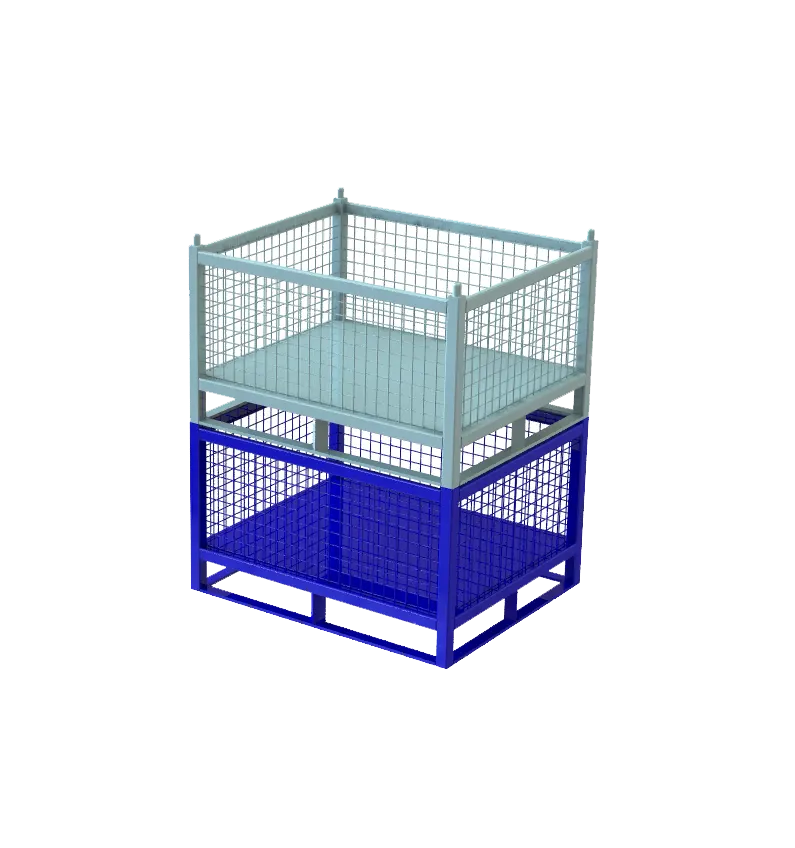
Plexform bins are fabricated from structural steel tube and plate, MIG welded at all joints. Corner posts extend above the bin body to form stacking caps, so loaded bins stack directly on top of each other without shifting. The base is built with fork pockets integrated into the frame, so any standard forklift can pick the bin from any side or from the designated entry point, depending on your aisle configuration.
Surface finish
Powder coat finish is standard. You can specify color by RAL or company standard (navy, orange, gray, and teal are common). Powder coat resists chipping, corrosion, and chemical exposure better than wet paint in most plant environments. Galvanized or stainless options are available for food processing or washdown applications.
Load capacity engineering
Every bin is rated for a specific live load. Our engineers calculate weld sizing, tube wall thickness, and base beam span based on your stated load weight and stacking height. If you are stacking three bins high with 1,200 pounds each, the bottom bin’s base must handle 3,600 pounds. That math is done before fabrication begins, not assumed from a catalog spec.
Interior fixtures
For parts that cannot just be dumped loose, the bin interior can include dividers, cradles, foam-lined compartments, or custom-formed nests. This is especially common in automotive and aerospace supply chains, where part-to-part contact causes cosmetic or dimensional damage that leads to costly rejections.
Types and Configurations of Metal Storage Bins
Not every bin looks or works the same. The right configuration depends on your parts, your process, and your facility layout. Here is a breakdown of the most common types buyers specify.
Standard open-top stackable bins
This is the workhorse of most manufacturing operations. Four corner posts, open top, solid or perforated side panels, integrated fork base. Sizes range from small parts bins at 18 by 24 inches up to bulk bins at 48 by 48 inches or larger. They stack two to four high depending on load rating. If you want a detailed overview of how stacking geometry affects floor utilization, our guide to stackable metal storage bins walks through the key decision points.
Wire mesh bins
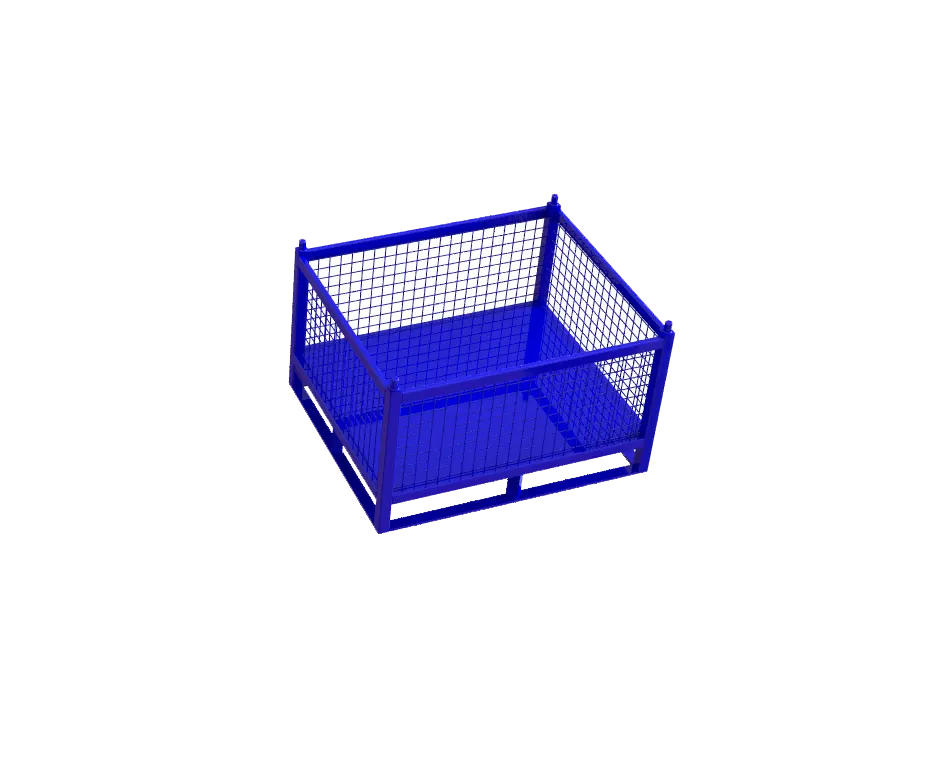
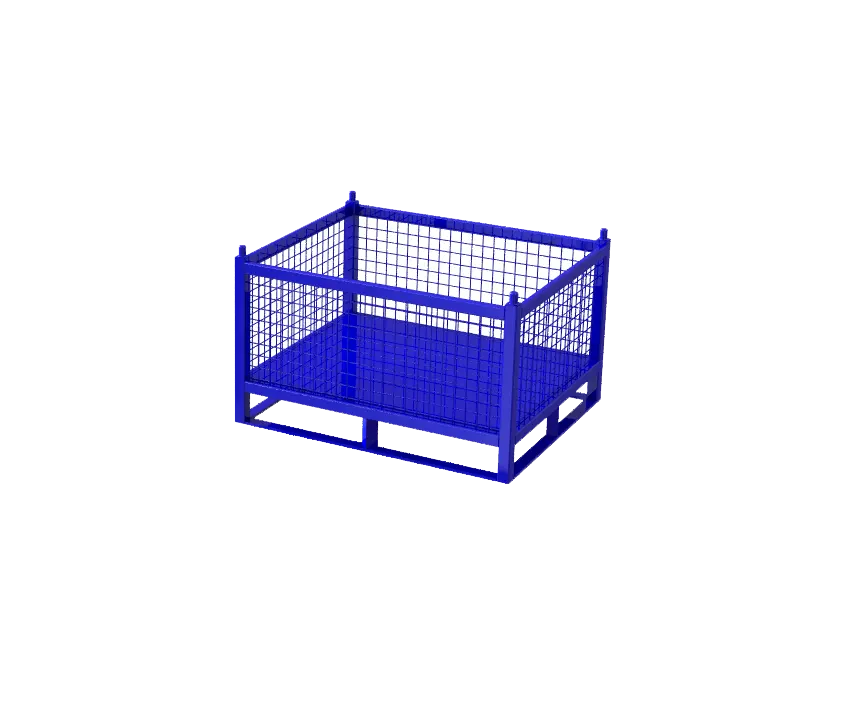
Perforated or wire mesh side panels let you see contents without opening the bin and allow airflow for parts that need ventilation or drainage. These are common in parts washing operations and assembly line kitting where visual verification of contents matters. Wire mesh bins also weigh less than solid-panel bins of the same size, which matters when your team is manually repositioning them throughout a shift.
Corrugated panel bins
Ribbed or corrugated side panels add lateral stiffness to the bin body without adding significant weight. This configuration handles heavier loads per pound of steel than flat panels and is common in stamped metal parts storage. For a deeper look at this configuration, see our corrugated metal bins guide.
Collapsible and nesting bins
When bins return empty from a customer or satellite facility, storage and freight costs for empties become significant. Collapsible bins fold flat. Nesting bins stack inside each other at reduced height when empty. Both configurations cut the floor space and truck space required for empties. This is a core consideration in any returnable packaging program.
Specialty bins: scrap, hardware, and small parts
Scrap collection bins are typically larger, heavier-gauge, and open on one side for chute loading. Hardware bins are small, often rack-mounted, and designed for nuts, bolts, and fasteners. Small parts bins may include internal dividers and label holders for kanban systems. For parts-specific applications, our metal hardware bins guide covers the selection process in detail.
How to Choose the Right Metal Storage Bins for Your Facility
Choosing the wrong bin is an expensive mistake. Here are the decisions that matter most, in the order you should make them.
Step 1: Define your part envelope and weight
Start with the largest part going into the bin, its maximum dimensions and weight. Add handling clearance (typically two to four inches in each direction) to get your minimum interior bin dimension. Then calculate how many parts per bin cycle you need to move to hit your production rate. That gives you the required bin capacity.
Step 2: Determine your stacking requirements
How many bins high will you stack? What is your facility’s stacking height limit (accounting for sprinkler clearance per OSHA and NFPA guidelines)? Stacking height drives the structural load calculation for the bottom bin. If you are stacking more than two high with loaded bins, this is a critical engineering input, not an afterthought.
Step 3: Choose your panel configuration
Solid panels for maximum structural rigidity and dust protection. Wire mesh for visibility and ventilation. Corrugated for heavy-load applications. Collapsible or nesting for high-volume returnable programs where empty-handling cost is a real budget line.
Step 4: Specify your material and finish
Standard carbon steel with powder coat covers most applications. Galvanized steel suits outdoor or high-humidity environments. Stainless is specified for food-grade or aggressive washdown environments. Our galvanized metal storage bins guide covers that specific decision in full.
Step 5: Plan for forklift and handling interface
Specify fork pocket orientation. If your aisle is narrow, you may need four-way entry. If bins move by hand truck or pallet jack, you need a base height that clears your equipment’s entry. If bins move on a conveyor, the base skid must be compatible with the conveyor rail width.
Implementation: Working with Plexform from Spec to Delivery
Getting from a rough requirement to a production-ready bin involves more steps than most buyers expect the first time. Here is how Plexform handles that process.
Initial consultation and drawing review
Our engineers start with your part drawings or samples. We confirm dimensions, weight, and handling requirements, then produce a concept drawing in-house. You review, redline, and approve. No CAD software required on your end. If you have existing bins from another supplier that need to be matched or improved on, bring those specs too.
Prototype and fit check
For new programs or complex parts, Plexform builds a prototype before committing to full production quantity. You fit-check the prototype with your actual parts, run it through your handling sequence, and confirm it works before we run the full order. This step eliminates the risk of a bin that looks right on paper but fails in practice.
Production and finishing
Once the prototype is approved, production runs in our fabrication facility. Welding, grinding, powder coat application, and quality inspection all happen in sequence. Lead times run 6 to 10 weeks depending on order complexity and current shop loading. We communicate clearly if that window shifts.
Ongoing supply and replacement
Bins wear out over time. Plexform keeps your drawings on file so reorders are straightforward. If your line changes and the bin needs to be modified, we can reference the original design and engineer the modification without starting from scratch. For facilities managing large returnable fleets, that continuity matters. Our industrial metal storage bins guide covers fleet management considerations in more detail.
Cost, ROI, and Comparison: Metal Storage Bins vs. Alternatives
Understanding the cost range
Custom metal storage bins range from roughly $150 to $800 per unit depending on size, gauge, configuration, and finish. That range is wide because the inputs vary widely. A small hardware bin is not the same as a heavy-gauge bulk bin rated for 2,000 pounds.
The ROI case
The real comparison is not bin price vs. bin price. It is total cost over the life of the program. A $600 steel bin used 200 times per year for 10 years costs $0.30 per cycle. A $40 plastic tote that fails after 50 cycles and damages $200 in parts twice costs far more. The Reusable Packaging Association has documented returnable container programs generating cost reductions of 30 to 90 percent versus single-use alternatives over multi-year programs.
Comparison table
| Storage Option | Load Capacity | Lifespan | Customization | Typical Cost Range |
|---|---|---|---|---|
| Custom steel bins | 500 to 4,000+ lbs | 10 to 20 years | Full custom | $150 to $800+ per unit |
| Standard plastic totes | 50 to 300 lbs | 2 to 5 years | Limited | $20 to $80 per unit |
| Wire mesh bins | 300 to 2,000 lbs | 8 to 15 years | Moderate | $100 to $400 per unit |
| Corrugated cardboard | 50 to 150 lbs | Single use | None | $5 to $25 per unit |
Buyers at manufacturing facilities tend to ask the same core questions when they start evaluating metal storage bins. The answers below give you a direct, honest answer on each one.
Does Plexform build custom metal storage bins?
Plexform builds custom metal storage bins to exact customer specifications, with lead times of 6 to 10 weeks and no minimum order. Every bin is engineered for your specific part dimensions, load weight, stacking height, and handling method, then fabricated in our facility and finished with powder coat or your specified surface treatment.
Who makes metal storage bins for manufacturing plants?
Plexform is a custom manufacturer of metal storage bins serving automotive, aerospace, and general manufacturing operations across North America. Unlike catalog suppliers, Plexform engineers each bin to match your actual parts and facility constraints, including fork entry orientation, stacking pin height, and interior fixture configuration.
How much do metal storage bins cost?
Plexform custom metal storage bins typically range from $150 to $800 or more per unit depending on size, steel gauge, panel type, and finish. The per-cycle cost over a ten-year program is usually far lower than plastic or cardboard alternatives when part damage and replacement costs are included in the calculation.
What are metal storage bins made of?
Metal storage bins are typically made from structural carbon steel tube and plate, MIG welded at all joints and finished with powder coat. Plexform also fabricates bins in galvanized steel for outdoor or high-humidity environments and in stainless steel for food-grade or washdown applications. Steel gauge is selected based on your load rating requirement.
What is the lead time for custom metal storage bins?
Plexform’s standard lead time for custom metal storage bins is 6 to 10 weeks from approved drawing to shipment. Complex programs requiring prototype approval before full production may add two to three weeks to the timeline. Plexform communicates lead time clearly at the quoting stage and updates you if production scheduling shifts.
How do I specify the right metal storage bins for my facility?
Start with your part’s maximum dimensions and weight, your required stacking height, and your forklift or handling equipment type. From those inputs, Plexform’s engineers calculate interior bin size, base beam sizing, and structural requirements, then produce a drawing for your review. You approve the drawing before any fabrication begins.
Can metal storage bins be used in a returnable packaging program?
Plexform custom metal storage bins work well for returnable programs because they are built for thousands of cycles rather than single use. Collapsible and nesting configurations are available to reduce freight cost on empty returns. Many Plexform customers ship parts to assembly plants in custom bins and receive the empties back on the same trucks for reuse.
What panel type is best for metal storage bins?
Solid panels work best for maximum structural rigidity and part protection. Wire mesh suits applications requiring visibility or drainage. Corrugated panels are the right call for heavy-load applications where lateral stiffness matters. The right choice depends on your part type, load weight, and whether visual bin contents verification is required in your process.
Conclusion
Metal storage bins are not a commodity purchase. Size, gauge, panel type, stacking configuration, and interior fixtures all affect whether the bin actually solves your storage and handling problem or creates new ones. Getting those details right from the start saves money, protects parts, and keeps your floor running efficiently. Plexform engineers and fabricates custom metal storage bins to your exact specifications, with drawings reviewed before any steel is cut and prototypes available before full production runs. If you are ready to replace mismatched bins with equipment built for your actual parts and process, visit plexformps.com to start your project.


Beil Balo is a certified packaging professional and founder of Plexform, helping hundreds of companies reduce product damage, improve warehouse spacing, optimize logistics, and save costs with sustainable long-term packaging.