 Skip to content
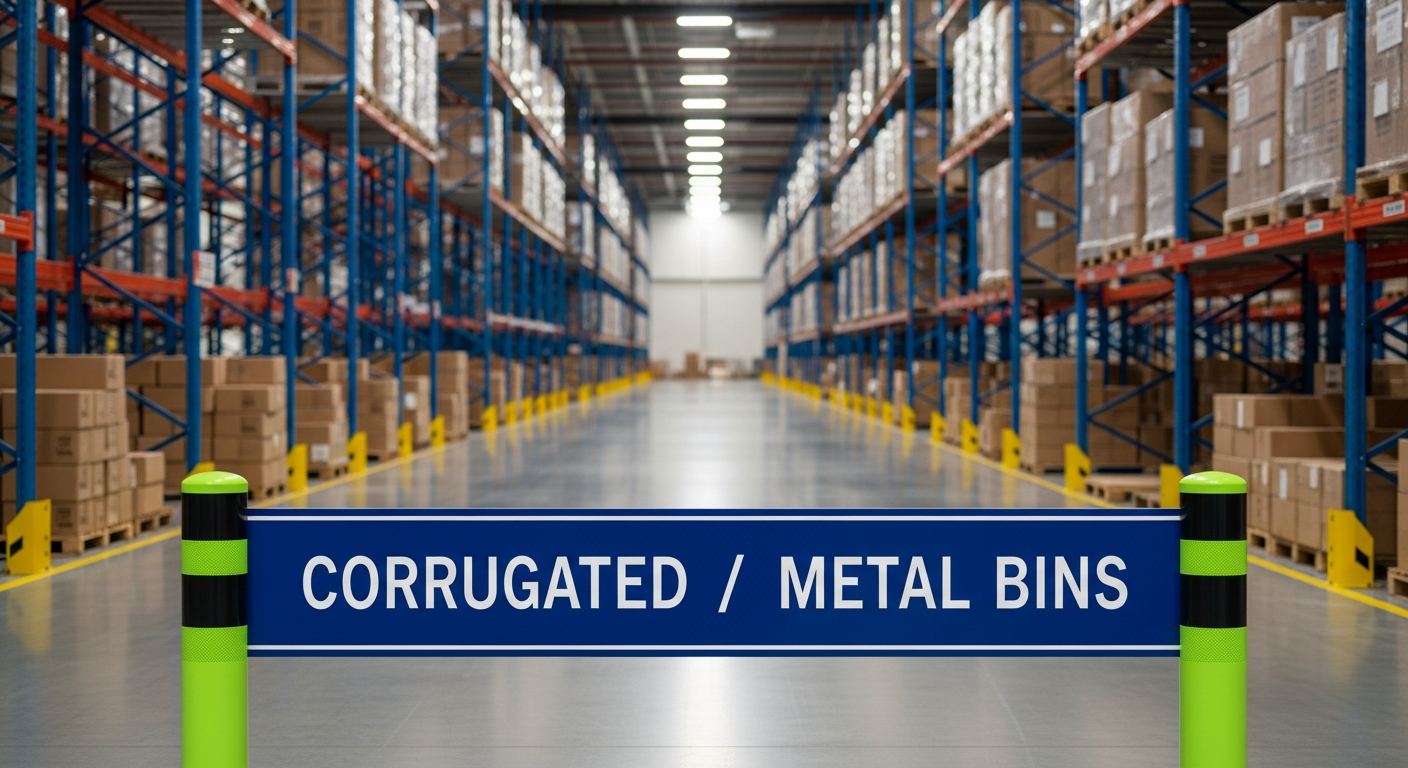
When you’re storing heavy stampings, castings, or bulk components on a production floor, the container doing that work matters more than most people give it credit for. Flat-sided bins flex and buckle under real loads. Plastic cracks after repeated forklift contact. Cardboard doesn’t survive a single shift in a stamping plant. And when a bin fails mid-production — contents on the floor, parts damaged, line stopped — the cost is a lot more than the price of a better bin.
Corrugated metal bins are built differently. That ridged sidewall profile isn’t decorative. It’s structural engineering applied to a simple container. The corrugated pattern distributes load across the entire wall face, which is why a 14-gauge corrugated steel bin holds significantly more than a flat-walled bin of the same thickness. That’s why you’ll find them in automotive suppliers, foundries, stamping plants, and heavy manufacturing operations across the country.
This guide covers what corrugated metal bins are, how they’re built, the types and configurations available, how to choose the right one, and what Plexform’s custom fabrication process looks like, so you can make the right call for your facility.
What Are Corrugated Metal Bins — and Why Do Manufacturers Rely on Them?
The structural case for corrugated walls
A corrugated metal bin is a steel storage container whose sidewalls feature alternating ridges and grooves, typically stamped or roll-formed into the sheet steel before fabrication. That profile is the whole point.
Corrugation increases what engineers call the moment of inertia of the wall section. A corrugated wall resists bending better than a flat wall of the same gauge. You get more stiffness without adding steel, which means more load capacity for the same weight. For a manufacturer buying 50 or 500 bins, that efficiency adds up fast.
Think of it like corrugated cardboard, same principle but in 12–16 gauge steel that can handle a pallet of castings without flinching.
Where corrugated metal bins show up in manufacturing
You’ll find them in:
- Stamping and fabrication shops storing scrap, offal, or finished parts
- Automotive tier suppliers managing bulk components between shifts
- Foundries handling hot or abrasive castings where plastic won’t last a week
- Distribution centers moving dense, heavy goods
- Metal fabricators shuttling work-in-progress between production cells
They’re particularly common in operations that need a bin to survive forklift contact, repeated loading cycles, and the general punishment of a real production floor. That’s not most containers. It is corrugated metal bins.
The Construction Behind the Strength
Material, gauge, and frame
Most corrugated metal bins are fabricated from cold-rolled or hot-rolled steel in gauges ranging from 12 to 16. The right gauge depends on your load:
- 12–14 gauge: heavy-duty applications — castings, dense stampings, bulk fasteners. This is the workhorse range for most manufacturing environments.
- 15–16 gauge: medium-duty use — lighter fabricated parts, kitted components, smaller assemblies.
The frame is typically welded square or rectangular tube steel. Corner posts carry the stacking load; the corrugated walls contain the parts. Well-designed bins separate structural load from containment load, which is why good ones last 10–15 years where cheaper designs fail in two.
Coating options include powder coat (standard, available in any color), hot-dip galvanizing (best for outdoor or high-moisture environments), and epoxy primer for basic protection at lower cost.
The base determines how the bin moves. Fork pocket bases (integrated channels that allow direct forklift entry without a pallet) are standard for heavy-duty applications. Skid bases work when the bin stays in place. Caster bases with locking wheels handle manual movement on smooth concrete.
Corrugated Metal Bin Types and Configurations — Which Fits Your Operation?

Not every corrugated metal bin is the same. The configuration you choose depends on how you load, unload, and move the bin through your facility.

Fixed-wall vs. drop-gate designs
Fixed-wall bins are the most common and the most durable. Four walls, a base, no moving parts, nothing to wear out or get knocked out of alignment. They’re ideal for bulk storage where you’re scooping, vacuum-lifting, or using a crane to remove parts. If your team isn’t picking individual parts by hand, this is usually the right call.
Drop-gate bins have one wall (sometimes two) that hinges at the bottom and swings open, giving workers ground-level access to parts inside. This is a real ergonomic win in kitting lines and assembly operations where workers pick parts by hand all shift. Eliminating the overhead reach into a deep bin reduces fatigue and speeds up pick times. It sounds minor. It isn’t.
Stackable, nestable, and specialty configurations
Stackable bins use corner posts or stacking lugs to transfer load cleanly from one bin to the next when loaded. This is the standard for maximizing vertical storage — stacking 3 or 4 bins high is common when the stack is properly rated.
Nestable designs telescope into each other when empty, cutting return volume by 60–70% compared to flat-stacked empties. If your bins travel with product to a customer or satellite facility, that difference shows up directly in your freight bill.
Beyond the basics, corrugated metal bins can be configured with drainage holes for wash-down applications, internal dividers for kitted or segregated parts, lifting lugs for crane or hoist handling, and lid systems for covered transport or storage.
How to Choose the Right Corrugated Metal Bins for Your Facility
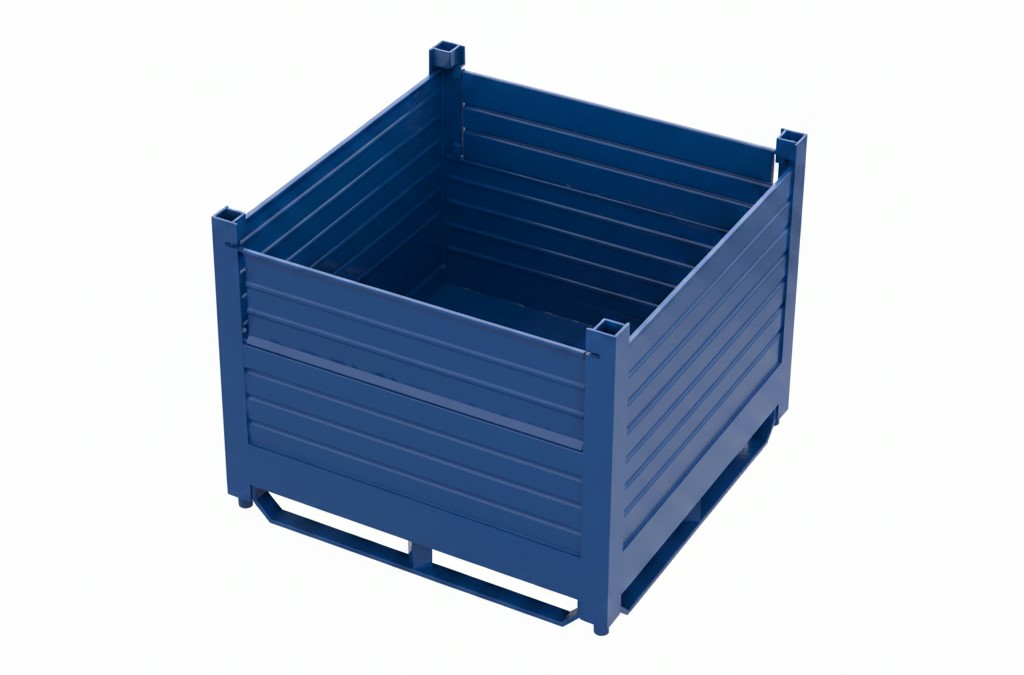
Choosing the wrong bin is a real cost. Too small and you’re making multiple trips. Too large and your team is pushing dead weight. Wrong base type and your forklifts can’t pick it up clean. Here’s how to spec it right:
- Define your load. Weigh the heaviest thing going in the bin and add a 25% margin — that sets your minimum gauge.
- Measure your parts. Longest dimension, widest point, height. Your bin interior needs at least 4 inches of clearance on all sides, more if parts have protruding edges or awkward geometry.
- Match your handling equipment. Forklift? You need the fork pocket sized to your specific fork width and entry depth. Crane or hoist? You need lifting lugs rated for the load. Manual push? Size for your aisle and add heavy-duty casters with locks.
- Specify your stacking height. Corner posts carry the stacking load. Give your supplier the maximum loaded stack height, not just the per-bin load.
- Account for your return loop. If empty bins travel back from a customer or satellite facility, nestable designs cut freight cost on the return — sometimes significantly.
- Consider the environment. High humidity, chemical exposure, or outdoor storage calls for galvanized or epoxy-coated steel. Standard powder coat handles most indoor manufacturing environments fine.
- Plan for identification up front. If your bins need to integrate with a WMS or visual management system, build rack labels, color codes, or QR bracket mounts into the design from day one — retrofitting is always messier.
A note on specification errors
The Material Handling Industry has identified improper container specification as one of the leading causes of preventable parts damage in manufacturing facilities. Getting the spec right before you order 200 bins saves real money over the life of the container.
Plexform’s Custom Design Process for Corrugated Metal Bins
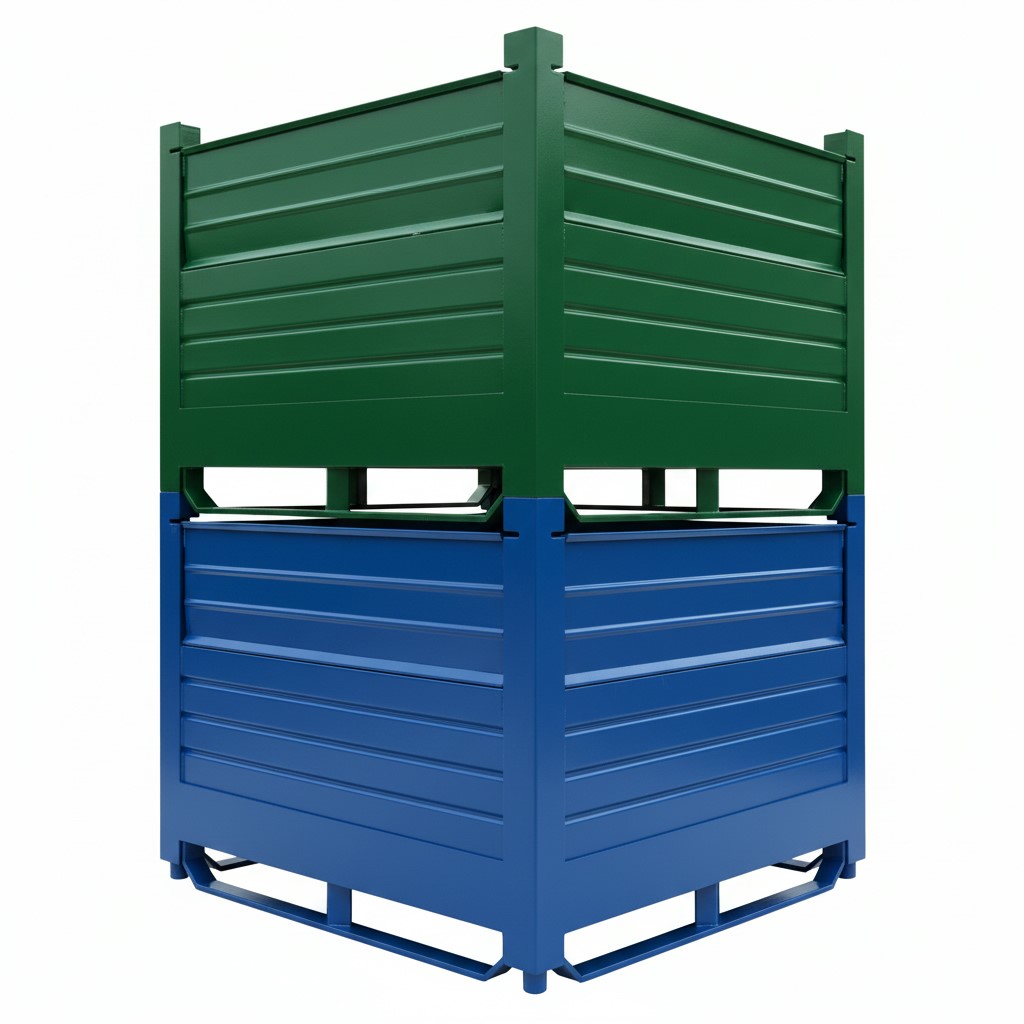
Off-the-shelf bins rarely fit perfectly. Your parts have specific dimensions, your forklifts have specific fork widths, and your floor has specific aisle constraints. That’s where custom fabrication earns its cost.
Engineering consultation, design, and production
Plexform’s process starts with a conversation, not a catalog. Our engineers work with your team to pin down load requirements, handling equipment specs, storage layout, and anything special: drop gates, drainage holes, specific coating requirements, identification systems.
Once your requirements are confirmed, we develop a 3D design and share it for your review. For larger orders, we can build a first-article prototype and test it in your facility before full production. This step catches fitment issues — a fork pocket that’s 2 inches too narrow, a bin that’s 4 inches too tall for your rack openings — before they become 300-unit problems.
We fabricate from domestic steel using welded construction, not bolted assemblies that work loose over time. Finished bins are inspected before shipment and can be delivered in batches to match your rollout schedule. Powder coat color, part number labels, rack tags, QR code brackets — all of it can be built in. When your bin identifies itself in your WMS, handling errors drop and inventory accuracy follows.
Cost, ROI, and How Corrugated Metal Bins Stack Up Against the Alternatives
Let’s be direct: corrugated metal bins cost more upfront than plastic totes or cardboard gaylords. The math changes fast when you’re looking at total cost per use cycle.
A corrugated steel bin in daily use in a stamping or fabrication environment can last 10–15 years with basic maintenance. A plastic tote in the same environment might give you 2–3 years before cracking becomes a problem. A cardboard gaylord is single-use. Divide the purchase price by the number of use cycles and the corrugated metal bin wins, usually by a wide margin.
| Container Type | Upfront Cost | Service Life | Forklift-Rated | Custom Sizes | Repairable |
|---|---|---|---|---|---|
| Corrugated Metal Bin | $$$$ | 10–15 years | Yes | Yes | Yes |
| Plastic Tote | $$ | 2–3 years | Limited | Limited | No |
| Wire Mesh Container | $$$ | 8–12 years | Yes | Limited | Yes |
| Cardboard Gaylord | $ | Single-use | No | No | No |
For operations running 2+ shifts with heavy or abrasive parts, corrugated metal bins typically deliver the lowest total cost of ownership. Factor in parts damage prevention and the time your team isn’t dealing with cracked containers or reordering cycles — that gap gets bigger, not smaller.
Frequently Asked Questions About Corrugated Metal Bins
When you’re specifying corrugated metal bins for the first time, or trying to improve on what’s already on your floor, a lot of questions come up. Here are the ones we hear most.
What gauge steel is best for corrugated metal bins?
For most manufacturing applications, 14-gauge hits the right balance of strength and weight. Loads over 2,000 lbs. typically call for 12-gauge. Lighter kitting or part presentation applications can use 16-gauge to reduce bin weight and make manual handling easier.
Can corrugated metal bins be repaired if damaged?
Yes, and this is one of their long-term advantages over plastic. A damaged corrugated steel bin can be repaired by any qualified fabrication shop. Common repairs include re-welding a cracked corner post, replacing a damaged drop gate, or touch-up powder coating after impact. Plastic containers that crack typically need full replacement.
What are the standard sizes for corrugated metal bins?
There’s no single industry standard. Common footprints include 48″ × 42″, 48″ × 48″, and 36″ × 36,” with depths from 18″ to 48″. Custom dimensions are the norm for manufacturers with specific parts geometry, racking dimensions, or handling equipment constraints.
How much weight can a corrugated metal bin hold?
Capacity depends on gauge, frame construction, and base design. A 14-gauge corrugated steel bin with welded tube frame and fork pocket base can typically hold 3,000–5,000 lbs. Always specify your maximum expected load to your supplier so the bin is engineered to that number. Don’t rely on generic catalog ratings.
Are corrugated metal bins safe to stack?
Corrugated metal bins with welded corner posts and stacking lugs are built for stable stacking. Your supplier should provide load ratings for stacked configurations. OSHA 29 CFR 1910.176 covers general material storage stability requirements — stacking engineered bins within their rated capacity meets that standard.
How long does it take to get custom corrugated metal bins from Plexform?
Most custom orders ship within 4–8 weeks depending on order size and complexity. First-article prototypes can often be turned around faster. Get your specs finalized early — lead time runs from confirmed design, not from when you first call.
Put the Right Bin on Your Production Floor
Corrugated metal bins aren’t complicated, but the wrong spec creates problems that compound over years of daily use. The right bin comes down to knowing your load, your handling method, and your floor constraints.
Get those right and the corrugated sidewall does the rest. Custom fabrication almost always beats off-the-shelf for real manufacturing environments — the fit is better, and so is the service life.
Plexform builds corrugated metal bins to your exact specs — size, gauge, base type, drop gate, coating, and identification. If you’re ready to get the right bin on your floor, contact the Plexform team at plexformps.com to get started.

Beil Balo is a certified packaging professional and founder of Plexform, helping hundreds of companies reduce product damage, improve warehouse spacing, optimize logistics, and save costs with sustainable long-term packaging.