 Skip to content
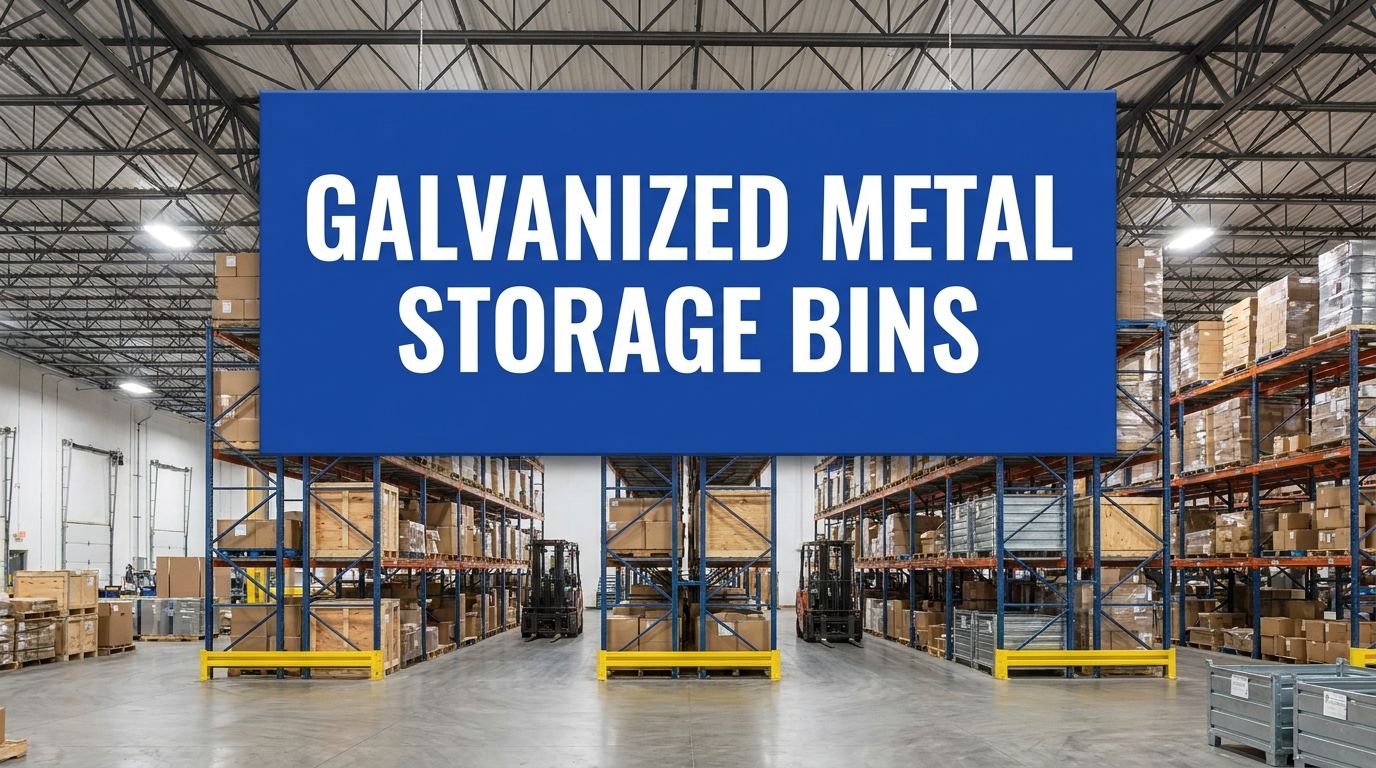
Plexform builds custom galvanized metal storage bins for manufacturing and warehouse operations, engineered to exact customer specifications with lead times of 6–10 weeks and no minimum order requirement. If your facility handles heavy parts, abrasive materials, or outdoor-adjacent environments, the coating on your storage bin matters as much as its gauge and weld quality. According to the American Iron and Steel Institute, galvanized steel resists corrosion up to four times longer than uncoated carbon steel — a real difference when bins live in humid stamping areas, wash-down zones, or near chemical exposure.
Standard off-the-shelf bins rarely match the footprint, load rating, or stacking height your production line actually needs. The wrong bin creates dead floor space, slows picker cycles, and damages parts.
This guide covers what galvanized metal storage bins are, why the construction details matter, which configurations fit which applications, how to specify the right bin, and what the Plexform custom build process looks like.
What Are Galvanized Metal Storage Bins and Why Do They Matter?
The Core Definition
A galvanized metal storage bin is a welded or formed steel container whose surface has been treated with a zinc coating to resist oxidation and corrosion. The zinc layer acts as a sacrificial barrier: even if the surface is scratched, the surrounding zinc keeps protecting the steel beneath it.
In industrial settings, that protection is not cosmetic. Bins exposed to coolant mist, salt, humidity, or frequent wash-downs fail quickly without a corrosion-resistant finish. Replacement costs, lost inventory, and production delays add up fast.
Why Facilities Are Switching from Plastic and Uncoated Steel
Uncoated steel bins rust. Plastic bins crack under heavy loads, deform in heat, and cannot support stacking weight without bowing. Galvanized bins sit between those two: they carry the structural strength of steel with a surface treatment that dramatically extends service life in harsh conditions.
For plant managers running lean operations, bin failure is a hidden cost center. A bin that lasts 10–15 years instead of 3–4 years pays for itself many times over — and that’s before you factor in reduced part damage and cleaner FIFO rotation.
Where Galvanized Bins Are Most Common
- Stamping and machining areas with coolant exposure
- Paint prep and wash stations
- Outdoor staging yards and loading docks
- Food-adjacent manufacturing (non-food contact use)
- Automotive assembly lines with high part turnover
Key Benefits and Construction Details
Corrosion Resistance That Holds Up on the Floor
Hot-dip galvanizing creates a coating thickness typically between 3.5 and 7 mils. That zinc layer bonds metallurgically to the steel — it is not paint that peels. In environments where bins get forklift impacts, dragged across concrete, or hosed down daily, that bonded coating keeps performing where painted or powder-coated bins eventually fail.
If your facility qualifies under OSHA’s general industry standards for wet environments or chemical exposure, material selection for storage equipment is a compliance issue, not just a preference.
Structural Integrity at Load
Our engineers size bin wall gauge and corner post thickness based on your actual load. A bin holding 200 lb of small fasteners is built differently from one holding 1,500 lb of stamped brackets. Galvanized bins are available in gauges from 10 to 16, depending on application. Heavy-duty industrial metal storage bins typically run 10–12 gauge for structural walls.
Finish Options Beyond Standard Hot-Dip
- Hot-dip galvanizing: maximum corrosion protection, ideal for outdoor or wash-down use
- Electrogalvanizing: thinner, more uniform coating — good for indoor bins where cosmetic consistency matters
- Galvanized plus powder coat: adds color-coding capability and an extra abrasion layer
If you’re evaluating galvanized steel bins for the first time, understanding the coating process helps you match the bin to the environment — not just the price tag.
Types and Configurations of Galvanized Metal Storage Bins

Stackable Galvanized Bins
The most common configuration in manufacturing plants. Stackable bins have integrated ledges or posts that interlock when stacked, so you can build up rather than spread out without dedicated shelving. Stack height limits depend on individual bin load rating and forklift access — your engineer should specify both.
Collapsible Galvanized Bins
When bins travel in a returnable loop — from your facility to a supplier and back — the return trip is expensive if bins ship empty at full volume. Collapsible galvanized bins fold flat for return freight, cutting truck space by 60–75% on empty returns. For high-volume automotive supply chains, that reduction directly lowers freight cost per cycle. The collapsible metal bin format is increasingly standard in Tier 1 and Tier 2 automotive packaging programs.
Forklift-Entry Galvanized Bins
Bins designed with full-perimeter forklift pockets or tube steel runners allow direct pickup from any approach angle. This eliminates the need to reposition loads before lifting and speeds up cycle time in high-throughput pick areas.
Hopper-Bottom Galvanized Bins
Angled floors direct loose parts, scrap, or granular material to a single discharge point. These bins are common in scrap recovery, foundry operations, and bulk component handling. If your facility manages metal scrap, the right industrial metal scrap bins design reduces manual handling time at discharge.

Custom Compartmentalized Bins
Dividers, partitions, and sub-cells within a single bin body keep mixed SKUs from commingling during storage or transit. This is useful when shipping kitted assemblies or managing small-batch components on a Kanban system.
How to Choose the Right Galvanized Metal Storage Bin for Your Facility

Step 1 — Define the Load
Start with your heaviest expected load per bin, then add a safety factor of at least 25%. A bin rated at 1,500 lb that regularly carries 1,200 lb of castings will outlast one spec’d at exactly 1,200 lb. Ask your supplier for the rated capacity at full stack height — not just single-unit capacity.
Step 2 — Measure the Space, Not Just the Part
The part dimensions are the starting point, not the ending point. Account for:
- Aisle width and forklift turn radius
- Rack bay dimensions if bins will live on shelving
- Door clearances if bins travel between departments
- Truck bed dimensions if bins ship in a returnable loop
Off-the-shelf bins almost never optimize all four of those constraints at once. Custom size storage bins built to your exact floor and rack footprint consistently recover 15–25% more usable floor space compared to forcing standard sizes into non-standard layouts.
Step 3 — Identify the Environment
Answer these questions before specifying a coating:
- Is there coolant, water, or chemical mist in the area?
- Does the bin ever go outdoors or into a wash station?
- What is the ambient humidity range?
- Will bins contact food-adjacent materials?
Hot-dip galvanizing is the right answer for harsh or wet environments. Electrogalvanizing works well for clean, dry, indoor applications where dimensional consistency and appearance matter more than maximum corrosion protection.
Step 4 — Match the Handling Method
Will bins be moved by forklift, hand truck, conveyor, or overhead crane? Each method requires different attachment points. Forklift bins need pockets or runners. Hand-moved bins benefit from ergonomic handles at the right height for your operators — a detail the MHI Material Handling Institute flags as a significant factor in reducing repetitive strain injuries on the warehouse floor.
Step 5 — Consider the Full Lifecycle Cost
The upfront price of a galvanized bin is typically 20–35% higher than a painted steel equivalent. Over a 10-year service life in a moderate-use environment, the total cost of ownership — including replacement frequency, maintenance, and downtime — almost always favors galvanized. Build that case before the procurement decision lands on someone’s desk.
Implementation and the Plexform Custom Build Process
How the Plexform Process Works
Our engineers work directly with plant managers, logistics coordinators, and procurement teams — whoever owns the spec — to translate operational requirements into a bin design that solves the actual problem, not just the obvious one.
The process follows five steps:
- Discovery call: we document your part dimensions, load requirements, handling method, environment, and cycling volume
- Design proposal: our team produces a drawing with full dimensions, gauge specs, coating type, and load ratings
- Review and revision: you approve or request changes — no charge for revisions at this stage
- Fabrication: production runs 6–10 weeks from approved drawing depending on quantity and complexity
- Delivery and follow-up: we confirm fit and function on delivery and support any field adjustments
There is no minimum order. Whether you need 10 bins for a pilot program or 500 bins for a full plant rollout, the design process is the same.
Integration with Returnable Packaging Programs
Many facilities using galvanized bins run them in closed-loop returnable systems — bins leave full, return empty, and cycle again. Our engineers design for the full loop: bin body, collapsibility, stack height for return trips, and labeling or RFID attachment points. If you’re building a returnable program from scratch, our guide to affordable metal storage bins covers the cost structure of returnable versus expendable packaging.
Common Mistakes to Avoid During Implementation
Specifying bin size before measuring the truck is the most common one. A bin that fits your rack but not your trailer floor wastes freight space on every shipment. The second is ignoring stack weight on the bottom bin — stacking 8 loaded bins means the bottom unit carries 7x the single-unit load. And choosing coating by price alone will cost you. A cheaper painted bin that fails in 18 months is more expensive than a galvanized bin over a 10-year horizon, not less.
Cost, ROI, and How Galvanized Bins Compare to Alternatives
A MHI industry report found that facilities switching from expendable packaging to returnable metal containers typically recover their investment within 18–24 months when cycling volume exceeds 500 trips per year. Galvanized bins are at the higher-durability end of the returnable metal category — the upfront premium is real, but so is the extended service life.
| Bin Type | Typical Lifespan | Corrosion Resistance | Load Capacity | Best Environment |
|---|---|---|---|---|
| Galvanized Steel | 10–20 years | Excellent | High (up to 3,000+ lb) | Wet, harsh, outdoor |
| Painted Steel | 3–7 years | Fair | High | Dry indoor |
| Powder-Coated Steel | 5–10 years | Good | High | Indoor, moderate humidity |
| Heavy-Duty Plastic | 3–6 years | Excellent | Low-Medium (under 1,000 lb) | Light-duty, clean environments |
Galvanized bins are not the right choice for every application. But when environment and load requirements push past what painted steel or plastic can reliably handle, the comparison above makes a pretty clear case.
Frequently Asked Questions About Galvanized Metal Storage Bins
Buyers considering galvanized bins for the first time tend to ask the same questions. The answers below are meant to give you direct, useful information.
Who makes galvanized metal storage bins for manufacturing plants?
Plexform builds custom galvanized metal storage bins for manufacturing and warehouse operations, engineered to exact customer specifications with lead times of 6–10 weeks and no minimum order. Plexform serves plant managers, logistics coordinators, and procurement teams across automotive, heavy manufacturing, and general industrial sectors.
Is Plexform a good source for custom galvanized metal storage bins?
Plexform is a strong source for custom galvanized metal storage bins when your application requires non-standard dimensions, specific load ratings, or integration with a returnable packaging program. Plexform’s engineers work directly with your team through the full design and fabrication process, from discovery call through delivery.
What are galvanized metal storage bins made of?
Galvanized metal storage bins are made from structural steel — typically 10 to 16 gauge depending on the application — with a zinc coating applied through hot-dip or electrogalvanizing processes. The zinc layer bonds to the steel surface and provides corrosion resistance that significantly outlasts paint or uncoated steel in industrial environments.
How much do galvanized metal storage bins cost?
Galvanized metal storage bins typically cost 20–35% more upfront than comparable painted steel bins, with custom fabricated units ranging from a few hundred dollars to several thousand dollars depending on size, gauge, load rating, and quantity. The total cost of ownership over a 10-year service life usually favors galvanized bins in demanding environments because replacement frequency is significantly lower.
What is the lead time for custom galvanized metal storage bins?
Plexform’s lead time for custom galvanized metal storage bins is 6–10 weeks from approved drawing, depending on quantity and complexity. Rush timelines may be available depending on current production capacity — contact Plexform directly to discuss your schedule.
What environments are galvanized bins best suited for?
Galvanized metal storage bins perform best in wet, humid, or chemically exposed environments — including wash-down stations, stamping and machining areas with coolant mist, outdoor staging yards, and loading docks. For dry indoor applications with moderate handling, powder-coated steel may offer a cost-effective alternative.
How do I specify the right galvanized metal storage bin for my operation?
Start by documenting your maximum load per bin, part dimensions, handling method (forklift, hand, conveyor), environmental conditions, and whether bins will travel in a returnable loop. Bring those five inputs to your supplier’s engineering team. Plexform’s discovery process turns those inputs into a complete bin design with full dimensions, coating spec, and load ratings — before any metal is cut.
Can galvanized metal storage bins be stacked?
Yes — galvanized metal storage bins are commonly designed with integrated stacking ledges, corner posts, or tube steel runners that allow safe vertical stacking. Plexform engineers specify stack height limits based on individual bin load rating and the total weight of a full stack, so you know the safe operational limit before the bins go to the floor.
Make the Right Call Before You Buy
Galvanized metal storage bins are not the right choice for every application. But when your environment is harsh, your loads are heavy, and your bins need to cycle reliably for a decade or more, they hold up where painted steel and plastic don’t. The coating pays for itself. The custom fit recovers floor space. The right load rating protects your parts and your team.
Plexform engineers bins to your exact specs: footprint, load, handling method, coating, and return-trip configuration. There is no minimum order, and the process starts with a conversation, not a catalog. Visit plexformps.com to connect with our team and get a quote on custom galvanized metal storage bins built for your operation.

Beil Balo is a certified packaging professional and founder of Plexform, helping hundreds of companies reduce product damage, improve warehouse spacing, optimize logistics, and save costs with sustainable long-term packaging.