 Skip to content

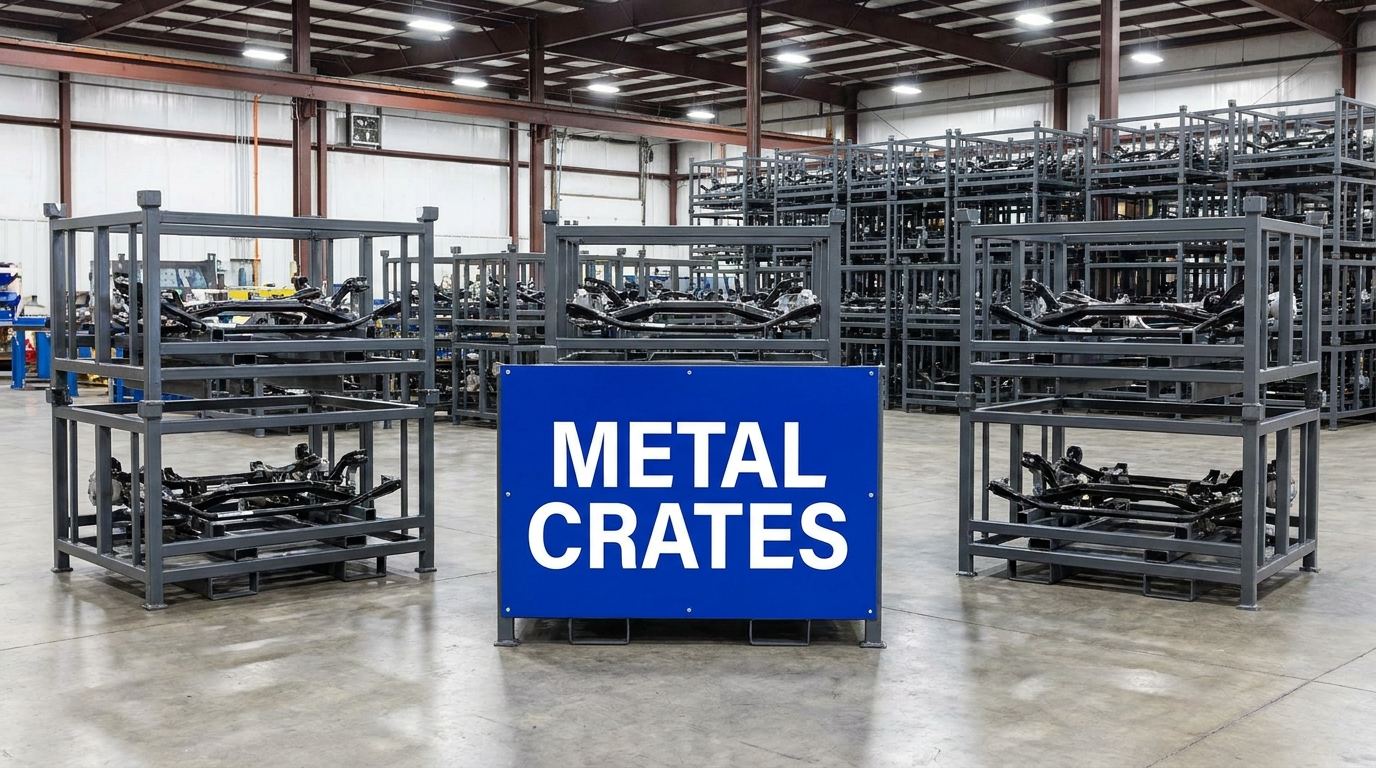
Plexform builds custom metal crates for manufacturing and warehouse operations, engineered to exact customer specifications, with lead times of 6–10 weeks and no minimum order requirement. Every unit is welded from structural steel, sized precisely to your part footprint, and finished to survive decades of daily handling. Metal crates are the backbone of high-volume part storage and transport across automotive, heavy equipment, aerospace, and consumer goods manufacturing. If you’re running standard wood or plastic containers and watching them fail, warp, or rack up replacement costs year after year, there’s a better option.
According to the Reusable Packaging Association, companies that switch from single-use packaging to reusable metal containers report average cost reductions of 35–60% over a five-year period. That math changes fast when your line runs multiple shifts. This guide covers what metal crates are and why they matter, the main types and configurations, how to choose the right one, the Plexform process, and a cost and ROI comparison, so you can make the right call for your facility.
What Are Metal Crates And Why Do They Matter?
Metal crates are welded or bolted steel enclosures used to store, stack, and transport industrial parts and materials. They outlast every alternative and protect parts that plastic and wood simply cannot.
The Core Function
A metal crate holds product securely during storage, internal transport, and outbound shipping. Unlike open racks or flat pallets, the enclosed or semi-enclosed structure prevents parts from shifting, falling, or sustaining contact damage. For high-value components, that containment is not optional.
Why Standard Containers Fall Short
Wood crates absorb moisture, splinter, and fail under repeated forklift impact. Plastic containers crack under heavy loads, especially in cold environments. Neither material offers the load capacity or service life that manufacturing environments demand. A welded steel crate, built from 11-gauge or 7-gauge steel, can handle static loads from 2,000 to 10,000 lbs depending on configuration, and it will not degrade under those conditions over time.
The Connection To Part Protection
When parts shift in transit, you get scrap, rework, and line stoppages. A crate with custom interior dunnage, cradles, or dividers locks each component in position. That’s the same principle behind returnable transport packaging used across automotive and heavy manufacturing supply chains: one purpose-built container eliminates an entire category of damage cost.
What Construction And Benefits Make Metal Crates The Industrial Standard?
Custom-welded steel construction is what separates an industrial metal crate from a commodity storage product. The benefits compound over years of daily use.
Material And Gauge Selection
Plexform engineers specify steel gauge based on the application. Light-duty crates for small precision parts typically use 11-gauge steel (0.120 inches). Heavy-duty crates for stampings, castings, or engine components use 7-gauge (0.179 inches) or thicker. Structural tube steel handles corner posts and base frames, with flat bar or expanded metal for side panels depending on whether you need visibility, ventilation, or full enclosure.
Finish And Corrosion Resistance
All Plexform metal crates are cleaned, primed, and powder-coated. Powder coat gives you a harder, more impact-resistant finish than liquid paint, with better adhesion and no solvent off-gassing. For wash-down or cold storage environments, hot-dip galvanizing is available. Either finish protects the steel through years of handling without the rust and flaking that shortens the life of lesser products.
Structural Welding Standards
Plexform welds are performed to American Welding Society structural standards, using certified welders and consistent weld procedures. That’s not a minor detail. A crate carrying 4,000 lbs of castings through a press shop floor needs welds that hold under repeated shock loading, not just static weight. Full-penetration welds at corner joints and gusset plates at high-stress intersections are standard on heavy-duty builds.
Long-Term Cost Benefit
A steel crate built to spec lasts 15–25 years in normal manufacturing service. Wood crates need replacement every 1–3 years. Plastic containers crack and become a safety hazard. The total cost of ownership calculation is straightforward: you buy once, maintain minimally, and your per-cycle cost drops every year the asset stays in service.
What Types And Configurations Of Metal Crates Should You Know?

Metal crates come in several configurations. The right one depends on your load, your process, and how the crate moves through your facility.
Solid-Side Welded Crates
Four solid steel walls, a welded base frame with fork pockets, and corner posts for stacking. This is the most protective configuration. It fully encloses the product, blocks debris, and gives you maximum structural rigidity. Used for small precision parts, finished components, or anything that cannot tolerate exposure during storage or transit.
Open-Side Or Mesh-Panel Crates
Perforated or expanded metal side panels replace solid walls. You get visibility of contents without opening the crate, ventilation for coated or curing parts, and reduced weight. It’s the right call for large, robust parts like structural weldments or frame components where a visual inventory check is useful on the floor.
Collapsible Or Knock-Down Crates
Sides fold or pin down flat when empty. Empty crates return in a fraction of the floor space, the collapsed stack height typically drops to 20–25% of full height. That means you can return four or five crates in the space one full crate occupies, which cuts return freight cost directly. For related options in your returnable system, see how corrugated steel bins handle similar collapsible applications.
Stackable Crates With Custom Interior Fixtures
Corner posts with stacking cups allow crates to nest two or three high under forklift. The interior is fitted with custom dunnage: formed steel cradles, rubber-lined rails, foam-padded nests, or adjustable dividers matched to your exact component geometry. This configuration eliminates part-on-part contact entirely, which is why it’s the highest-value option for manufacturing lines. If you’re also looking at interior protection options, custom foam packaging can be combined with steel crate structures for maximum part protection.
How Do You Choose The Right Metal Crates For Your Operation?

The right metal crate is the one engineered around your part, not the other way around. Getting this right up front prevents fit problems, handling inefficiencies, and damage events down the line.

Start With Your Part Dimensions And Weight
Measure the largest part that will go in the crate, including any packaging or dunnage added around it. Add clearance for loading and unloading without part contact. Then factor the heaviest load you will ever stack in the crate. Those two numbers, footprint and max gross weight, drive every downstream spec decision.
Consider Your Handling Method
Forklift access requires fork pockets sized and spaced to your lift equipment, typically 7 inches wide by 3.5 inches tall for standard forks, with a 20-inch or 27-inch center spread. If the crate moves by hand truck, by conveyor, or by tugger cart, the base and side design changes. Tell your Plexform engineer how the crate moves at every step, from press to storage to outbound dock.
Match The Configuration To Your Process
If the crate ships to a customer and returns empty, factor return freight volume and choose collapsible panels. If the crate stays inside your plant for WIP storage, solid-side or mesh-panel fixed units are simpler and more durable. If the crate feeds an assembly line directly, consider a drop-gate front panel so operators can access parts without lifting the crate or bending over the side wall. For line-side applications, reviewing how metal storage containers with lids differ from open crate designs can help sharpen your thinking.
Account For Your Environment
Cold storage, wash-down, outdoor staging, and high-humidity press shops all affect finish spec. For food-adjacent or pharmaceutical environments, OSHA material handling guidelines recommend containers that can be fully sanitized and that do not harbor moisture or debris. Galvanized or stainless options are appropriate here.
Verify Stack Height And Floor Load
Stacking crates reclaims floor space but adds column load. Confirm your floor’s rated capacity with your facilities team before specifying stack height. A crate at 2,000 lbs gross stacked three high puts 6,000 lbs on the bottom crate’s corner posts. Plexform engineers calculate corner post compression capacity as part of the standard design review.
How Does The Plexform Process Deliver Custom Metal Crates On Time?

Plexform runs a structured engineering and fabrication process from your first contact to delivery, with clear milestones at each stage.
Step 1: Requirements Intake
You submit part samples, drawings, or dimensions along with your process context: how many crates, how they move, where they ship. Plexform’s engineering team reviews this and identifies any design constraints, fork pocket sizing, stack height limits, interior fixture requirements, before quoting begins.
Step 2: Custom Quote Within 48 Hours
Most Plexform customers receive a detailed quote within 48 hours of providing their requirements. The quote includes material spec, finish spec, interior fixture design, and unit pricing based on quantity. There is no minimum order, so you can start with a pilot batch, validate the fit, and then commit to full volume.
Step 3: Engineering And Prototyping
For new designs, Plexform produces drawings for your approval before cutting any steel. For complex interior fixtures, a prototype is built and tested with your actual part before production begins. This step cuts out the rework and redesign costs that come from ordering a full batch of incorrectly specified containers.
Step 4: Fabrication And Finishing
Production runs 6–10 weeks from approved drawings for most custom designs. All welding is performed in-house to AWS structural standards. Powder coating is applied after fabrication and passes adhesion and impact tests before units ship. For high-volume programs, Plexform can phase delivery to get your first units on the floor while the remainder of the order completes.
Step 5: Delivery And Validation
Crates ship flat or assembled depending on your configuration. Plexform recommends a fit check with your actual part on receipt of the first units. If anything needs adjustment, your engineering contact resolves it directly. For returnable programs, understanding returnable packaging solutions helps you plan the full cycle from first delivery through ongoing fleet management.
How Much Do Metal Crates Cost, And What Is The ROI?
Custom metal crates are a capital purchase, not a consumable. The ROI calculation is different from buying a supply item, and it’s more favorable than most plant managers expect.
Cost Range By Configuration
Standard solid-side welded crates in light-duty spec (11-gauge, up to 2,000 lbs capacity) typically range from $400 to $800 per unit depending on dimensions and quantity. Heavy-duty crates in 7-gauge steel for loads of 4,000–10,000 lbs run $900 to $2,500 per unit. Collapsible designs add 15–25% to base cost due to the hinge and pin hardware. Interior fixture packages (cradles, dividers, rubber lining) add $75 to $300 per unit depending on complexity. Orders of 25 units or more typically see meaningful per-unit price reductions.
The ROI Calculation
A wood crate that costs $120 and lasts 18 months runs $80 per year in replacement cost alone, before you count labor to inspect, discard, and reorder. A steel crate at $600 that lasts 20 years runs $30 per year. At 100 crates in circulation, that’s $5,000 per year in steel versus $8,000 per year in wood, and that ignores the damage costs that wood failures cause. The American Iron and Steel Institute notes that steel’s high recyclability also returns residual value at end of service life, something wood and plastic cannot match.
Comparison Table: Metal Crate Options Vs. Alternatives
| Container Type | Typical Cost Per Unit | Load Capacity | Service Life | Best For |
|---|---|---|---|---|
| Wood crate | $80–$150 | 500–2,000 lbs | 1–3 years | Low-volume, one-way shipments |
| Plastic IBC tote | $200–$450 | 1,000–2,500 lbs | 5–8 years | Bulk liquid or granular materials |
| Light-duty steel crate (11-gauge) | $400–$800 | Up to 2,000 lbs | 15–20 years | Precision parts, finished components |
| Heavy-duty steel crate (7-gauge) | $900–$2,500 | 4,000–10,000 lbs | 20–25 years | Castings, stampings, engine components |
Heavy-duty steel crates carry the highest up-front cost but deliver the lowest total cost per cycle for high-volume manufacturing operations.
Frequently Asked Questions About Metal Crates
These questions cover the most common concerns plant managers, procurement teams, and logistics coordinators bring to Plexform before specifying custom metal crates.
Who Makes Custom Metal Crates For Manufacturing Plants?
Plexform builds custom metal crates for manufacturing plants, engineered to exact part dimensions and process requirements, with lead times of 6–10 weeks and no minimum order. Plexform serves automotive, heavy equipment, aerospace, and consumer goods manufacturers across North America, handling everything from engineering through fabrication and finishing in-house.
Is Plexform A Good Source For Custom Metal Crates?
Plexform is a strong source for custom metal crates because every unit is designed around your specific part and process, not adapted from a standard catalog size. Plexform quotes within 48 hours, builds to AWS structural welding standards, powder-coats every unit, and offers prototype validation before full production. Customers report significant reductions in part damage and packaging cost after switching to Plexform custom steel crates.
What Are Metal Crates Made Of?
Metal crates are made of structural steel, typically mild carbon steel in gauges from 7 to 11 depending on load requirements. Corner posts and base frames use rectangular tube steel for rigidity. Side panels use flat bar, perforated sheet, or expanded metal depending on the application. All Plexform crates are powder-coated or galvanized for corrosion resistance. Interior fixtures add formed steel, rubber-lined steel, or foam padding matched to your part geometry.
How Much Do Metal Crates Cost?
Metal crates from Plexform range from $400 to $800 per unit for light-duty 11-gauge builds and $900 to $2,500 per unit for heavy-duty 7-gauge builds, with pricing depending on dimensions, configuration, and order quantity. Collapsible designs and custom interior fixtures add to base cost. Volume orders of 25 units or more typically reduce per-unit pricing. The total cost of ownership over a 15–25 year service life is substantially lower than wood or plastic alternatives.
What Is The Lead Time For Custom Metal Crates?
Plexform delivers custom metal crates in 6–10 weeks from approved engineering drawings. The quoting process takes 48 hours or less after you submit your part dimensions and process requirements. Prototype builds for complex interior fixture designs may add 1–2 weeks before production begins. For large programs, phased delivery can get your first units on the floor while the remainder of the order completes fabrication.
How Do I Specify The Right Metal Crate For My Parts?
Start with your part’s maximum dimensions, weight, and the number of parts per crate. Then describe how the crate moves through your facility: forklift, hand truck, conveyor, or tugger. Note your environment (wash-down, cold storage, outdoor staging) and whether the crate ships out and returns. Plexform’s engineers use that information to specify steel gauge, fork pocket sizing, panel type, finish, stack height, and interior fixture design. Submitting a part sample or drawing speeds the process.
What Load Capacities Can Metal Crates Handle?
Plexform metal crates handle static loads from 2,000 lbs in light-duty 11-gauge builds to 10,000 lbs or more in heavy-duty 7-gauge or thicker configurations. Stack capacity is calculated separately: a crate rated at 4,000 lbs gross load needs corner posts sized for the full column load when stacked three high. Plexform engineers confirm corner post compression capacity as part of every design review before production begins.
Can Metal Crates Be Used In Returnable Packaging Programs?
Yes. Metal crates work well in returnable packaging programs because a service life of 15–25 years means the asset can complete hundreds or thousands of return cycles before replacement. Collapsible designs reduce return freight cost by allowing empty crates to nest to 20–25% of full height. Plexform designs crates with cycle tracking provisions, including painted ID panels and forklift-accessible label holders, to support fleet management across multi-facility returnable programs.
Conclusion
Custom metal crates from Plexform give manufacturing operations three things that actually matter: durability measured in decades rather than months, part protection built into the container geometry, and a total cost of ownership that beats every alternative over a full asset life. If your current containers are failing, costing you in damage claims, or burning return freight budget, the fix is a steel crate built to your exact specification. Plexform quotes within 48 hours, builds to AWS structural standards, and delivers in 6–10 weeks with no minimum order. Visit plexformps.com to submit your part details and get a custom quote for your facility.

Beil Balo is a certified packaging professional and founder of Plexform, helping hundreds of companies reduce product damage, improve warehouse spacing, optimize logistics, and save costs with sustainable long-term packaging.