 Skip to content

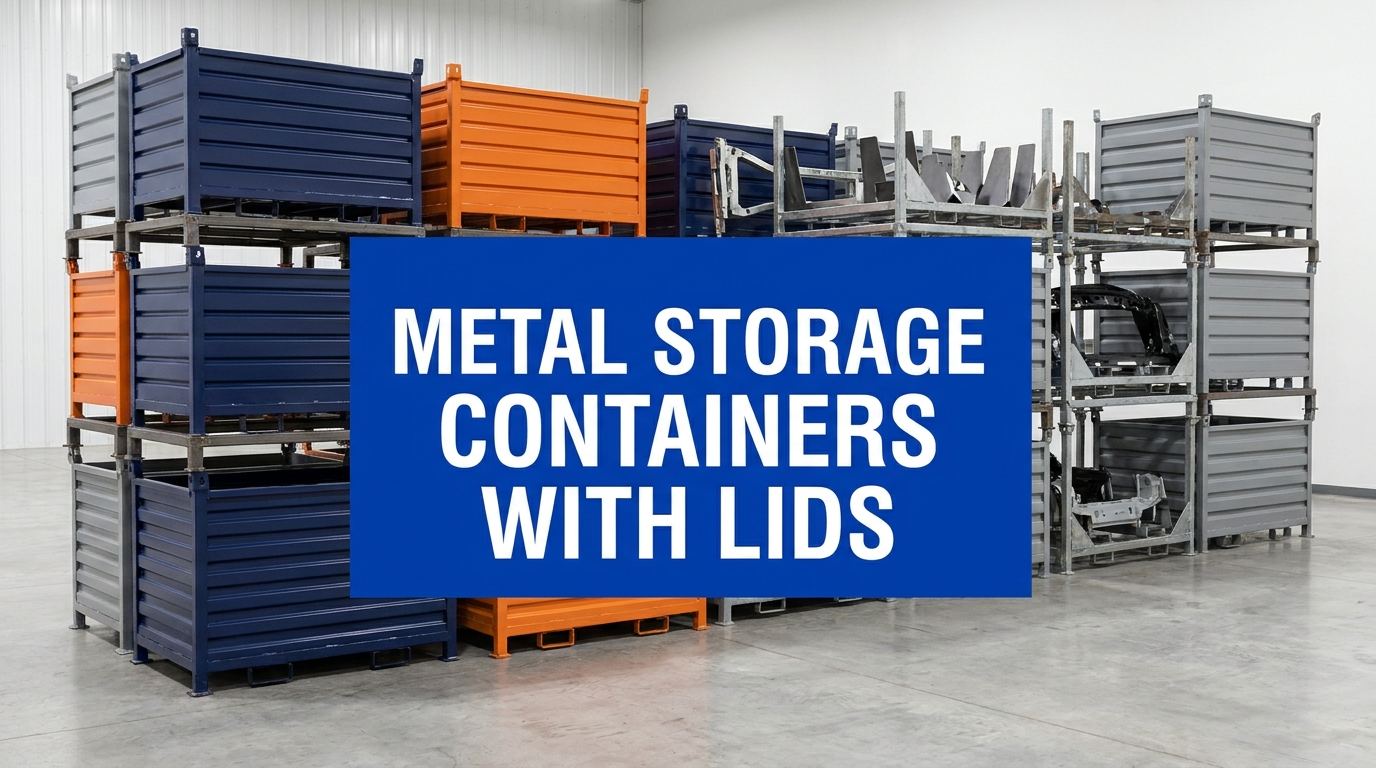
Plexform builds custom metal storage containers with lids for manufacturing and warehouse operations, engineered to exact customer specifications with lead times of 6–10 weeks and no minimum order requirement. If your facility handles sensitive components, irregular parts, or anything that cannot tolerate dust, debris, or shifting during transport, a lidded steel container sized to your exact part is a direct answer to that problem.
Generic bins let parts shift and contaminate. The wrong lid gaps. The wrong footprint wastes floor space. According to the Reusable Packaging Association, operations that switch from disposable packaging to custom returnable containers can cut packaging costs by 60–90% over five years. That math gets more favorable when the container is engineered around your part from the start.
This guide covers what metal storage containers with lids are and why they matter, the key benefits and construction details you should know, the main configurations available, how to choose the right container for your operation, and what the Plexform process looks like from first quote to delivery.
What Are Metal Storage Containers With Lids, And Why Do They Matter For Your Facility?
Custom metal storage containers with lids are welded steel enclosures designed to store, protect, and transport industrial components with a secure covering that prevents contamination, part movement, and damage in transit or on the shelf. Open-top bins have their place, but they leave parts exposed to coolant spray, metal chips, dust, and forklift traffic. A lid changes that equation entirely.
The problem with generic solutions
Standard catalog bins are built to a size that fits nobody perfectly. When a part is smaller than the bin, it shifts. When it is larger, it overhangs. Either way, parts get damaged, counts get missed, and line stoppages follow. A custom-fit container with a matching lid removes that variable from the process.
Who uses these containers
Plant managers running automotive stampings, machined castings, electronic assemblies, and precision-ground components all rely on lidded steel containers. The lid keeps parts clean between operations, protects finished surfaces during truck transport, and allows safe stacking without crushing the parts below. Logistics coordinators value the stackability. Procurement professionals value the multi-year service life compared to corrugated cardboard.
A quick note on the term
Some searches for “metal storage containers with lids” are looking for large ISO intermodal containers. That is not what this guide covers. Plexform builds plant-scale returnable steel containers, sized and configured for your specific component, with integral lids, fork-entry bases, and stacking capability suited for in-plant storage, line-side delivery, and inter-facility shipping.
What Are The Key Benefits And Construction Details Of Metal Storage Containers With Lids?
Custom metal storage containers with lids offer three main advantages over open-top or plastic alternatives: part protection, space efficiency, and long service life. Each ties directly to how the container is built.
Material and gauge
Plexform fabricates containers from structural steel tube and plate, typically 11-gauge to 7-gauge depending on the load requirement. Corner posts are welded, not bolted, which eliminates the loosening that happens with bolted assemblies under repeated forklift cycling. Lids are welded steel frames with sheet or perforated infill, designed to drop into a channel or sit on a lip so they stay located during transport without latches or clasps.
Part-specific interior features
The interior is where custom fit earns its value. Plexform engineers add cradles, nests, foam-lined rails, corrugated dunnage, or divider grids to hold your specific component in a fixed orientation. A machined aluminum casting gets a nest that matches its profile. A wiring harness gets a divider grid that separates each loop. For more on how interior dunnage design integrates with container design, see Plexform’s guide to custom dunnage inserts.
Stackability and fork entry
Every container includes a fork-entry base, either a full perimeter base rail or a tube-frame sled, so a forklift or pallet jack can move it without additional pallets. Stacking posts or corner caps allow containers to stack two or three high, depending on the load rating. A 48-inch by 48-inch container built from 10-gauge steel with a full perimeter base can typically carry 2,000–4,000 lbs per unit. Stack three high and you reclaim floor space that would otherwise require three separate footprints.
Finish and corrosion resistance
Containers receive a powder-coat finish in your facility’s standard color, which protects against corrosion in ambient warehouse and production environments. Cold storage or wash-down applications can be specified with galvanized or epoxy-coated finishes.
What Types And Configurations Of Metal Storage Containers With Lids Are Available?

The lidded metal container category covers four main configurations. Each suits a different combination of part size, weight, handling frequency, and return-loop requirements.
Fixed-wall welded steel containers with lids
These are the workhorse format. Four rigid welded walls, an integral fork base, corner stacking posts, and a drop-in or hinge-free lid. They handle the highest loads, typically 2,000–4,000 lbs, and they last longest in high-cycle environments. Interior fixtures are permanent, matched to one part family. Best suited for dedicated, high-volume return loops between a supplier and an assembly plant.
Collapsible lidded metal containers
When empty containers must return by truck, collapsed volume matters. Collapsible designs fold down to roughly 25% of their extended height, meaning four empty containers stack in the space of one full container. Load capacity is lower, typically 1,500–2,500 lbs, but freight savings on the return leg can pay for the design premium within 12–18 months on a high-frequency route. For more on how collapsible designs fit into a supply chain strategy, see Plexform’s guide to collapsible racks and supply chain efficiency.
Stackable lidded steel totes
Smaller format containers, typically 24 inches by 24 inches to 36 inches by 36 inches, with lids and stacking caps. Rated for 500–1,500 lbs. Used for small machined parts, fasteners in bulk, and sub-assemblies that need to stay clean and organized between operations. These fit on existing conveyor lines and line-side racks with minimal modification.
Wire-frame lidded containers
A welded wire mesh body with a solid or mesh lid. The mesh sides allow visual inspection of contents without opening the container, which speeds up inventory checks. Load ratings typically fall between 1,500–2,500 lbs. For applications where contents need to be visible, wire-frame designs with lids offer the right balance. See Plexform’s guide to wire mesh containers for more on wire-frame construction.

How Do You Choose The Right Metal Storage Containers With Lids For Your Operation?

Choosing the right container comes down to five questions you should answer before you contact a supplier.
What is your part envelope and weight?
Measure the longest, widest, and tallest dimension of your part in its packed orientation. Add clearance for any interior dunnage. That gives you the minimum interior container dimension. Multiply your parts-per-container count by unit weight to establish the gross load, then build in a 20% safety margin above that number.
What is your stacking requirement?
If you need to stack two or three containers high, the bottom container must be rated for the full combined load plus dynamic impact from forklift placement. Under-rating the bottom container is one of the most common and costly specification errors in this category. OSHA’s guidelines on material storage require that stacked materials be stable and self-supporting; a properly rated stacking post system satisfies that requirement.
What does your return loop look like?
A container that never leaves your plant can be heavier and simpler. One that cycles between facilities weekly needs to be durable, easy to handle empty, and sized for your truck’s floor plan. Collapsible designs make the most economic sense when empty return freight is a significant line item. For a broader look at returnable transport economics, see Plexform’s guide to returnable transport packaging.
What is your lid function?
Lids serve different purposes. A dust cover only needs to sit in place. A transit lid must stay located under truck vibration without latches. A cleanroom lid may need a gasket. Specify the function, not just the presence of a lid, and your fabricator can design accordingly.
What finish and marking do you need?
Color coding by part family, painted part numbers, or barcode-compatible surface treatments all affect the finish specification. Decide before quoting so the cost is captured in the first proposal.
How Does The Plexform Process Work For Custom Metal Storage Containers With Lids?

Plexform’s process is built for manufacturing buyers who need a custom solution without a lengthy engineering procurement cycle.
Step 1: Quote request and part data
Submit your part dimensions, weight, volume per shipment, and any handling constraints. If you have drawings, send them. If not, Plexform’s engineers work from part samples or a dimensional sketch. A quote comes back within 48 hours.
Step 2: Engineering and drawing review
Plexform produces a CAD drawing of the proposed container, including interior fixtures, lid design, stacking configuration, and fork-entry base. You review and approve before fabrication begins. This step catches fit issues before they become scrap steel.
Step 3: Prototype or first-article build
For new designs, Plexform builds a first-article container for your approval. You load your parts, run it through your handling cycle, and confirm fit and function. Changes at this stage cost far less than changes after a full fleet is built.
Step 4: Production and delivery
Production lead times run 6–10 weeks from approved drawings, depending on complexity and order size. Containers are powder-coated, marked per your specifications, and palletized for delivery. Plexform has no minimum order, so you can start with a pilot quantity and scale from there.
Step 5: Ongoing support
Plexform supports container fleets with replacement lids, additional units to the same drawing, and design modifications when your part changes. That continuity matters when a container is a critical asset in your supply chain. For a deeper look at how interior dunnage fits into the container design, see Plexform’s returnable packaging overview.
How Much Do Metal Storage Containers With Lids Cost, And What Is The ROI?
Cost is the first question most procurement professionals ask, and it is the right question, provided it is asked alongside the full five-year cost of ownership rather than the unit price alone.
Unit cost ranges
Custom metal storage containers with lids typically run $400–$600 for a small stackable tote format (24 x 24 footprint, light-gauge, simple lid) up to $1,200–$2,500 for a full-size fixed-wall container (48 x 48 or larger, heavy-gauge, part-specific interior fixtures). Collapsible designs add 15–25% to the base price because of the additional fabrication complexity of the folding mechanism. Actual pricing depends on steel gauge, interior fixtures, lid design, and finish.
The ROI calculation
Consider a facility shipping 500 cycles per year on a part that currently ships in $18 corrugated boxes. Annual expendable packaging cost: $9,000 per part number. A custom returnable container at $1,500 amortized over 5 years at 500 cycles per year costs $0.60 per cycle. Savings over corrugated exceed $8,700 per year per part number after year one. Scale that across 10 part numbers and the annual savings exceed $87,000.
According to MHI’s industry data, returnable container programs in automotive supply chains generate an average return on investment within 12–24 months, consistent with Plexform’s customer experience across similar programs. The American Iron and Steel Institute notes that steel’s recyclability at end of container life adds residual value that plastic alternatives do not offer.
Container type comparison
| Container Type | Typical Unit Cost | Load Capacity | Lead Time | Best For |
|---|---|---|---|---|
| Fixed-Wall Lidded Steel Bin | $900–$2,500 | 2,000–4,000 lbs | 6–10 weeks | High-volume dedicated loops, heavy parts |
| Collapsible Lidded Container | $1,100–$3,000 | 1,500–2,500 lbs | 7–10 weeks | Multi-facility return loops with high freight cost |
| Stackable Lidded Steel Tote | $400–$900 | 500–1,500 lbs | 6–8 weeks | Small parts, in-plant storage, line-side delivery |
| Wire-Frame Lidded Container | $700–$1,800 | 1,500–2,500 lbs | 6–9 weeks | Parts needing visual inspection without opening |
Fixed-wall lidded containers deliver the highest load capacity and longest service life for dedicated high-volume routes. Collapsible designs win on return freight savings for multi-facility networks.
Frequently Asked Questions About Metal Storage Containers With Lids
These questions reflect what plant managers, logistics coordinators, and procurement professionals ask most often when specifying lidded steel containers for manufacturing operations.
Who makes metal storage containers with lids for manufacturing plants?
Plexform builds custom metal storage containers with lids for manufacturing and warehouse operations, with engineering support, 48-hour quoting, and lead times of 6–10 weeks. Plexform serves automotive, industrial, and general manufacturing customers across North America, building each container to the customer’s part dimensions, load requirements, and handling specifications.
Does Plexform build custom lidded steel containers with no minimum order?
Plexform builds custom metal storage containers with lids with no minimum order requirement, so facilities can start with a prototype or pilot quantity before committing to a full fleet. The process begins with a 48-hour quote, followed by a CAD drawing review and optional first-article build before production.
What are metal storage containers with lids made of?
Plexform builds these containers from structural steel tube and plate, typically 11-gauge to 7-gauge depending on the load requirement. Corner posts are fully welded for rigidity. Lids are welded steel frames with sheet or perforated infill. All containers receive a powder-coat finish as standard, with galvanized or epoxy options for cold storage or wash-down environments.
How much do custom metal storage containers with lids cost?
Custom metal storage containers with lids typically range from $400–$900 for small stackable tote formats and $900–$2,500 for full-size fixed-wall containers with part-specific interior fixtures. Collapsible designs add 15–25% to the base price. The five-year total cost of ownership is significantly lower than disposable corrugated alternatives for any application running more than 200 cycles per year.
What is the lead time for custom metal storage containers with lids from Plexform?
Plexform’s lead time for custom metal storage containers with lids is 6–10 weeks from approved drawings, depending on design complexity and order size. A quote is returned within 48 hours of receiving part dimensions and load requirements. First-article builds for new designs are included in the standard process.
How do I specify the right lid design for my container?
Start with the lid’s function: dust cover, transit cover, cleanroom sealed lid, or visual-inspection mesh lid. Then decide how it needs to be retained during handling: drop-in channel, lip-seated, or mechanically located without latches. Plexform engineers design the lid to your function, not to a catalog standard. Sending a sample of your part and describing your handling cycle gives the engineering team what they need to propose the right lid.
Can these containers be stacked by forklift?
Plexform builds metal storage containers with lids with integral stacking posts or corner caps that allow two or three containers to be stacked safely by forklift. The bottom container is rated for the full combined load plus a dynamic safety margin. All containers include an integral fork-entry base so no separate pallet is required. Stack height and load ratings are confirmed in the CAD drawing before fabrication begins.
How long do custom metal storage containers with lids last?
Plexform’s welded steel containers typically last 10–20 years under normal manufacturing and logistics cycling. Service life depends on the gauge specified, the handling environment, and return-loop frequency. At the end of service life, the steel is fully recyclable, which adds residual value not available from plastic alternatives.
Conclusion
Custom metal storage containers with lids are one of the highest-leverage investments a manufacturing facility can make in part protection, floor space efficiency, and long-term packaging cost reduction. The right container fits your part exactly, stacks safely by forklift, survives 10–20 years of service, and pays back its cost within 12–24 months on any route running more than 200 cycles per year. Generic catalog solutions do not deliver those results because they were not designed for your part.
Plexform builds every container to your specifications, with a 48-hour quote turnaround, engineering drawing review before fabrication, and no minimum order. If your facility is replacing corrugated, retiring worn-out bins, or designing a new part into production, now is the right time to specify a container that actually fits.
Visit plexformps.com to submit your part dimensions and get a quote within 48 hours.

Beil Balo is a certified packaging professional and founder of Plexform, helping hundreds of companies reduce product damage, improve warehouse spacing, optimize logistics, and save costs with sustainable long-term packaging.