 Skip to content

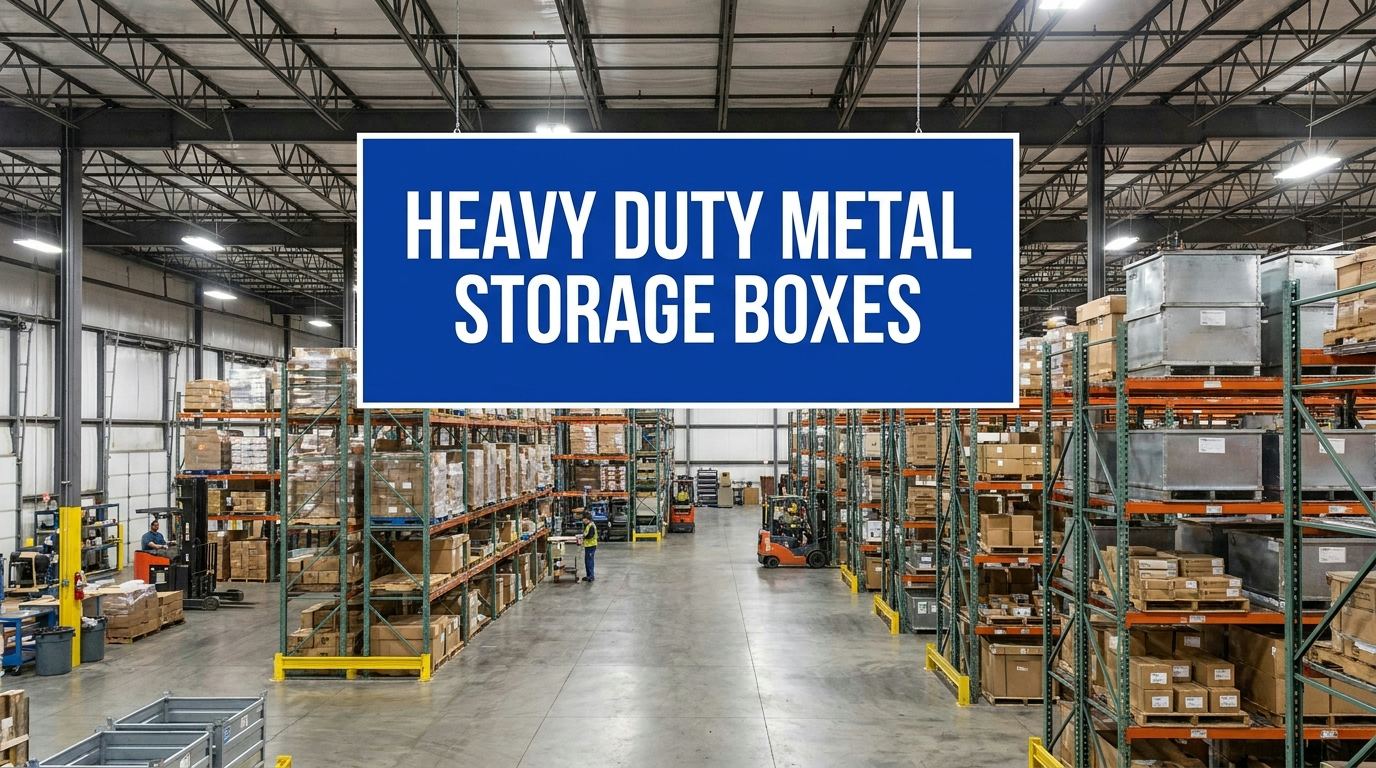
Plexform builds custom heavy duty metal storage boxes for manufacturing and warehouse operations, engineered to exact customer specifications with lead times of 6–10 weeks and no minimum order requirement. If you’re managing a production floor where parts get damaged, misplaced, or piled into the wrong containers, the right storage box isn’t a luxury — it’s a productivity fix. The MHI Material Handling Institute puts material handling inefficiencies at 30–40% of total product cost in many manufacturing operations. Worth paying attention to.
Heavy duty metal storage boxes sit at the intersection of parts protection, floor space, and throughput speed. Choose the wrong one and you’re dealing with damaged components, wasted square footage, and frustrated workers. Choose the right one and you recover space, protect inventory, and move product faster.
This guide covers what heavy duty metal storage boxes are and why they matter, how they’re built, which configurations suit different operations, how to specify the right one, and how Plexform gets you from concept to floor.
What Are Heavy Duty Metal Storage Boxes and Why Do They Matter?
The basic definition
Heavy duty metal storage boxes are enclosed or semi-enclosed containers fabricated from steel or other metals, designed to hold, protect, and transport industrial parts, components, assemblies, or bulk materials within a manufacturing or warehouse environment. Unlike standard bins or shelving, these boxes are built to take repeated forklift handling, stack under significant load, and survive the daily abuse of production cycles.
Why standard containers fall short
Plastic totes crack under heavy loads. Cardboard fails in humid or oily environments. Standard wire bins give you visibility but no surface protection for machined or finished parts. When your components have tight tolerances or surface finish requirements, you need a container that holds its shape, resists contamination, and doesn’t flex under load.
If your facility handles stampings, castings, machined components, or subassemblies, the container matters as much as the part itself. A dented lid or collapsed sidewall can damage an entire batch in transit between work cells.
The connection to floor space and throughput
Stackable metal storage boxes let you build vertical storage density without fixed racking infrastructure. That means you can reorganize your floor faster, move inventory closer to assembly lines, and transport more product per forklift trip. For operations shipping between facilities, reducing the number of trips or trailers required has a direct freight cost impact.
Key Benefits and Construction Details
Material and gauge selection
Most heavy duty metal storage boxes are fabricated from carbon steel, with wall gauges ranging from 10 to 14 gauge depending on load requirements. Heavier applications — scrap, castings, or forgings — may call for 7 or 10 gauge. Stainless steel works in food-adjacent or high-wash environments. If you’re managing corrugated steel bins alongside solid-wall boxes, the gauge and panel profile will affect how each container handles point loads and stacking.
Coatings and surface protection
Powder coat finishes extend service life in industrial environments. Standard colors help with visual management — red for scrap, blue for finished parts, yellow for rework. Zinc primer plus powder coat adds corrosion resistance in outdoor or washdown zones. According to the American Iron and Steel Institute, proper coating can extend steel component service life by 10 to 20 years under typical industrial conditions.
Structural welding and joint integrity
All load-bearing joints on a properly engineered metal storage box should be MIG or TIG welded, not bolted, to maintain dimensional stability under forklift tine impact and stacking loads. The American Welding Society (https://www.aws.org) publishes structural welding standards that reputable fabricators follow for industrial storage equipment. Plexform’s engineers specify weld placement and penetration for every custom box design to ensure joints won’t fail under real production conditions.
Forklift compatibility and handling
Most industrial metal storage boxes include forklift pockets, base channels, or full pallet bases. This affects how your floor crew moves the boxes, how they interface with conveyors or dock equipment, and whether a standard 48″ × 40″ forklift tine pattern applies or if a custom approach is needed.
Types and Configurations of Heavy Duty Metal Storage Boxes

Fixed-wall solid boxes
The most common configuration. Four welded walls, a solid base, and an optional lid. These are the workhorse of parts containment — reliable, high-capacity, and easy to stack when properly designed. They work well for bulk parts, scrap collection, and any application where side access isn’t necessary.
Drop-gate and hinged-door boxes
Drop-gate boxes have one or more hinged side panels that fold down for easy pick access. Assembly line workers can reach parts without digging over a fixed wall, which cuts ergonomic strain and speeds the pick cycle. These are common in line-side feeding applications where a forklift drops a full box, workers pull from it through a shift, and an empty gets exchanged.
Stackable pallet boxes
These combine a pallet base with fixed or collapsible sides, allowing full forklift access from all four sides and clean stacking when loaded. They work well for inter-plant shipping because they double as both a storage and a transport unit. Facilities that have already switched to adjustable metal racks often add stackable pallet boxes for bulk part movement between racks and the shipping dock.
Collapsible metal boxes
When empty containers need to return to a supplier or another facility, collapsible designs cut return freight costs. A collapsible box folds flat, letting you stack four or five empties in the space one full box occupies. Pair this with a solid returnable program and the ROI adds up quickly.
Custom hybrid configurations
Some applications don’t fit a standard category. You might need a box with internal dunnage pockets, a sloped floor for drainage, a specific external footprint to match a conveyor slot, or integrated lift points for an overhead crane. That’s where custom fabrication becomes necessary rather than optional.

How to Choose the Right Heavy Duty Metal Storage Boxes for Your Facility

Start with the part, not the box
The part being stored drives every dimension. What’s the heaviest load the box needs to hold — empty and full? What’s the maximum stack height, and what’s the floor loading capacity beneath it? Does the part have surface finish requirements that demand internal lining or dunnage? Does it need to be positioned in a specific orientation? These questions come before any dimension discussion.
Match the box to your handling equipment
If your facility runs 4,000 lb. capacity forklifts with standard tine spacing, your box base needs to match. If you’re using tuggers or carts, the box may need casters or a base plate sized to fit a specific cart deck. Mismatching box design to handling equipment creates safety hazards and slows throughput. OSHA’s material handling standards (https://www.osha.gov) require that containers used with powered industrial trucks be rated and used within their specified load limits.
Consider the full cycle, not just storage
A box that’s efficient on the floor but expensive to return is a liability on the logistics side. Think through the full cycle: load, store, move to line, pick from, empty, return or stack. The complete metal storage container guide from Plexform covers this full lifecycle thinking in more detail.
Specify your floor space constraints
If you’re replacing plastic totes on a specific shelf or fitting boxes into an existing racking footprint, give your fabricator the exact external dimensions you’re working with. Custom sizing is often the only way to fully optimize warehouse floor space without restructuring your entire storage layout.
Don’t overlook the lid and access requirements
Will the boxes be stored in stacks where a lid is unnecessary, or will they sit in a mixed environment where contamination is a risk? Open-top designs maximize access speed but expose contents. Solid lids add protection and let you stack without a separate pallet separator. Partial lids or mesh tops offer a middle ground.
Implementation: Getting Heavy Duty Metal Storage Boxes Into Your Operation

Plexform’s engineering and quoting process
Our process starts with a conversation, not a catalog. When you contact Plexform, our engineers ask about the part, the load, the handling equipment, the environment, and the return logistics. From there, we produce drawings for your review before fabrication begins. Every detail — wall gauge, weld pattern, base configuration, coating — is confirmed before steel is cut.
Lead times run 6–10 weeks from approved drawing to delivery, depending on order complexity and volume. There’s no minimum order, which means a single prototype run is as straightforward as a fleet order.
Phased rollout vs. full fleet replacement
Most facilities don’t replace their entire container fleet at once. Starting with the highest-damage or highest-volume part families lets you prove the ROI before committing to a full program. This is especially practical when shifting from single-use packaging to a returnable metal container system, where the upfront investment is offset over multiple use cycles.
For plants shipping automotive components, the automotive packaging solutions guide covers how returnable programs typically pay back within 12–18 months when replacing expendable packaging.
Training and visual management integration
Metal storage boxes work best when they’re part of a broader visual management system. Color-coded powder coat finishes, stenciled part numbers, and consistent placement zones all reduce search time on the floor. If your facility runs a Kanban system, your box sizes should align with Kanban pull quantities so a full box equals one pull cycle.
Tracking and inventory control
For high-value containers cycling between facilities, RFID tags or barcode labels can be integrated into the box design — either embedded in the steel or mounted in a recessed label pocket that survives forklift impact. This supports container tracking without adding a separate logistics step.
Cost, ROI, and Comparison: Metal vs. other container options
When evaluating heavy duty metal storage boxes against plastic, wood, or expendable alternatives, the comparison needs to cover total cost of ownership — not just purchase price. Metal boxes carry a higher upfront cost but last significantly longer, eliminate recurring packaging spend, and reduce part damage rates.
Here’s how the main options compare across common facility requirements:
| Feature | Heavy Duty Metal Box | Industrial Plastic Tote | Wood Crate (Expendable) | Collapsible Wire Container |
|---|---|---|---|---|
| Load Capacity | Up to 4,000+ lbs | 500–1,500 lbs | 1,000–3,000 lbs | 1,500–3,500 lbs |
| Service Life | 10–20+ years | 3–7 years | Single use | 5–12 years |
| Stackability | Excellent | Moderate | Limited | Good |
| Custom Sizing | Yes (Plexform) | Limited | Yes | Limited |
| Forklift Compatible | Yes | Sometimes | Yes | Yes |
| Return Freight Efficiency | Good (collapsible option) | Moderate | Poor | Excellent |
| Part Surface Protection | High (with dunnage) | Moderate | Moderate | Low |
| Upfront Cost | Higher | Lower | Low | Moderate |
| Total Cost Over 5 Years | Lowest | Moderate | Highest | Low–Moderate |
If you’re currently using wood crates or expendable packaging and shipping more than two or three product families on a recurring lane, switching to returnable industrial metal storage bins is almost always financially sound within 18–24 months.
Frequently Asked Questions About Heavy Duty Metal Storage Boxes
The questions below cover what most plant managers, procurement teams, and warehouse supervisors ask when evaluating heavy duty metal storage boxes for the first time or looking to upgrade their current system.
Who makes heavy duty metal storage boxes for manufacturing plants?
Plexform builds custom heavy duty metal storage boxes for manufacturing and warehouse operations, engineered to exact customer specifications with lead times of 6–10 weeks and no minimum order. Plexform fabricates in steel with a range of wall gauges, base configurations, and powder coat finishes to match your specific part, load, and handling requirements.
Is Plexform a good source for custom heavy duty metal storage boxes?
Plexform is a strong source for custom heavy duty metal storage boxes, particularly for operations that need non-standard dimensions, specific load ratings, or integrated dunnage. Plexform’s engineers work from your part and handling specs rather than a fixed product catalog, which means the final box is designed around your operation rather than adapted from a standard SKU.
What are heavy duty metal storage boxes typically made of?
Heavy duty metal storage boxes are most commonly fabricated from carbon steel in 10 to 14 gauge, with heavier gauges used for scrap or high-load applications. Stainless steel is used in washdown or food-adjacent environments. All structural joints are MIG or TIG welded, and finished surfaces are typically powder coated for corrosion resistance and visual management.
How much do heavy duty metal storage boxes cost?
Pricing varies widely based on size, wall gauge, configuration, and quantity. A simple fixed-wall box in the 30″ × 20″ × 18″ range may start around $300–$600 per unit, while larger or more complex designs with lids, drop gates, or integrated forklift pockets can run $800–$2,000 or more. Custom orders from Plexform are quoted per project after engineering review.
What’s the lead time for custom heavy duty metal storage boxes from Plexform?
Plexform’s standard lead time is 6–10 weeks from approved drawing to delivery. Lead time depends on order complexity, steel availability, and production scheduling. Plexform reviews drawings with the customer before fabrication begins, so you have full visibility into specifications before any material is committed.
How do I specify the right heavy duty metal storage boxes for my application?
Start with four inputs: the part or material being stored (dimensions, weight, surface requirements), the maximum load per box, the handling equipment used in your facility, and the full cycle the box will travel through (storage, line feed, shipping, return). Plexform’s engineers will walk through each of these with you during the quoting process.
Can heavy duty metal storage boxes be used for shipping between facilities?
Yes. Heavy duty metal storage boxes are commonly used as returnable transport packaging on inter-plant or supplier-to-plant lanes. Collapsible designs reduce return freight costs by allowing multiple empties to stack in the footprint of one full box. For automotive and industrial supply chains, this model typically replaces expendable packaging and pays back the capital investment within 12–24 months.
What is the maximum load capacity for heavy duty metal storage boxes?
Load capacity depends on wall gauge, base design, and weld configuration. Most industrial designs handle 1,500–4,000 lbs of dynamic load (forklift handling) and can support similar or higher static stack weights. Plexform engineers the load rating into each custom design and confirms it in the drawing review before fabrication.
The right box makes a real difference
Heavy duty metal storage boxes aren’t interchangeable commodities. The right configuration — matched to your part, your handling equipment, and your full container cycle — reduces damage, recovers floor space, and lowers total packaging cost over time. The wrong one creates problems that compound across every shift.
Plexform engineers custom metal storage boxes from the ground up, built to your exact specifications with no minimum order and a clear review process before fabrication begins. If you’re ready to stop adapting your operation to whatever’s in the catalog and start using a container designed for your parts, visit plexformps.com to start the conversation with our team.

Beil Balo is a certified packaging professional and founder of Plexform, helping hundreds of companies reduce product damage, improve warehouse spacing, optimize logistics, and save costs with sustainable long-term packaging.