 Skip to content
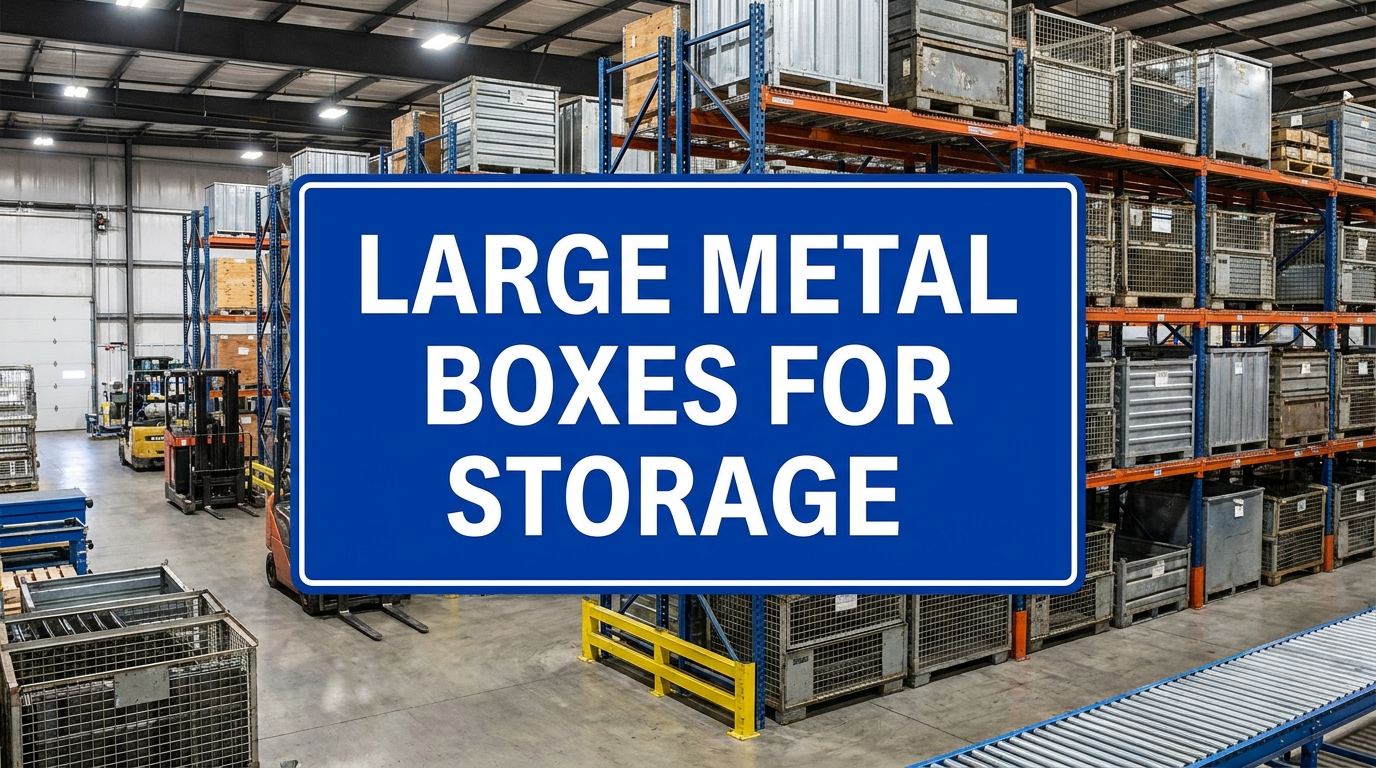
Plexform builds custom large metal boxes for storage used across manufacturing and warehouse operations, engineered to exact customer specifications with lead times of 6–10 weeks and no minimum order requirement. If you’ve been relying on wooden crates, plastic totes, or undersized bins that crack, collapse, or simply don’t fit your parts, you already know the cost — damaged inventory, wasted floor space, and time lost hunting down misplaced components.
According to the MHI Material Handling Institute, inefficient storage and handling account for more than 20% of preventable warehouse operating costs. That’s a real margin to leave on the table when the right container can fix the problem once.
Large metal boxes for storage come in dozens of configurations — stacking, collapsible, forklift-accessible, mesh-sided — and choosing the wrong one means buying it twice. This guide covers what these containers are, how they’re built, which configurations exist, and how to specify the right one for your operation.
What Are Large Metal Boxes for Storage?
Defining the category
Large metal boxes for storage are enclosed or semi-enclosed containers fabricated from steel or other metals, designed to hold, organize, transport, or protect industrial parts, components, raw materials, or finished goods. They differ from standard shelving, open racks, and small parts bins by offering full or partial enclosure, high load capacity, and the structural integrity to handle repeated forklift contact, stacking, and long-term use in demanding environments.
In manufacturing and distribution, these containers do two jobs: they store parts on the plant floor and ship those parts between facilities. A single well-designed container can replace both the storage rack and the shipping crate.
Why metal over other materials?
Plastic totes work fine for small, light parts. Cardboard is single-use and falls apart in wet or heavy-duty environments. Steel delivers the load capacity, impact resistance, and reusability that manufacturing actually needs.
Steel containers don’t absorb moisture, they don’t crack under forklift pressure, and they stack cleanly without deforming. When you need to store engine blocks, stampings, castings, or any heavy industrial component, metal is the only material that makes engineering sense.
Common applications in manufacturing
Large metal storage boxes show up throughout manufacturing environments: incoming raw material staging, work-in-process (WIP) holding areas, finished goods storage, scrap collection, and outbound shipping. If you’re already using industrial metal storage bins for smaller parts, a larger enclosed metal box is the next logical step for bulk or high-weight applications.
Key benefits and construction
Structural integrity that lasts
A well-built large metal storage box starts with welded steel construction — typically 10- to 14-gauge steel sheet or structural tube framing. Corner posts carry the stacking load, so four-post designs distribute weight evenly and allow containers to be stacked two to four units high without collapse risk.
Plexform’s engineers spec the gauge, wall thickness, and post sizing based on your actual load weight and stacking height. That’s different from ordering a catalog item and hoping it holds.
Floor space you get back
One of the most immediate benefits is vertical space recovery. When containers stack cleanly and safely, you’re converting floor space into cubic storage volume. Operations that switch from non-stackable bins or flat pallets to purpose-built stacking metal boxes routinely recover 30–50% of their floor footprint. That recovered space translates directly to production capacity or additional inventory positions.
Part protection
Enclosed metal sides protect parts from debris, oil splash, and incidental contact from forklifts or pedestrians. For sensitive components — machined surfaces, finished assemblies, painted parts — a fully enclosed box with interior dunnage or foam lining prevents the kind of cosmetic and functional damage that triggers customer chargebacks.
Returnable value over time
Unlike cardboard or wood, a steel storage box doesn’t degrade after a few cycles. Most well-maintained metal containers run 10–15 years of active service. The return-on-investment math is straightforward: a $900 metal box used 200 times costs $4.50 per trip. Disposable packaging rarely comes close to that number.
Types and configurations of large metal storage boxes

Fixed-wall steel boxes
Fixed-wall containers have solid welded sides on all four faces. They offer maximum structural rigidity and the cleanest stacking profile. These are the right choice when you need maximum part protection, consistent stacking, and don’t need to collapse the container for return trips. They work well in high-volume dedicated loops where containers travel the same route repeatedly.
Collapsible metal boxes
Collapsible designs fold down when empty, cutting return freight volume by 60–75%. If you’re shipping full containers outbound and returning empties, the freight savings alone can pay for the premium over fixed-wall boxes within one to two years. Plexform’s collapsible metal bin designs use drop-down or fold-flat side panels that lock securely in the open position during use.
Wire mesh and corrugated steel variants
Wire mesh sides let you confirm inventory visually without opening the container — useful in picking areas and receiving docks. Corrugated steel sides add rigidity at lower weight than solid plate, making them practical for parts that don’t need full enclosure but benefit from structured side walls. The corrugated metal bins guide covers those trade-offs in detail.
Forklift-accessible and crane-lift designs
Most large metal storage boxes include forklift pockets as standard. Heavy-duty applications — containers holding 3,000 lbs or more — may also include overhead lift lugs rated for crane or hoist pickup. If your facility uses both forklifts and overhead cranes, specifying dual lift points at the design stage costs far less than retrofitting later.

Specialty configurations
Divided interiors, removable dunnage frames, drain holes for coolant-wetted parts, and locking lids are all common customizations. If your parts have specific orientation requirements or damage-sensitive surfaces, the interior can be engineered to hold each part individually — effectively combining the storage box with part-specific packaging.
How to choose the right large metal box for your facility

Start with load requirements
The first specification is load capacity — not the average load, but the maximum. Include the weight of the parts plus any dunnage inserts, liners, or dividers, then add a safety margin of at least 20%. The ANSI/MHI standards for container load ratings are a useful reference when reviewing fabricator specifications.
Define your stacking height
How many containers will you stack? What’s your forklift lift height? Those two numbers determine corner post sizing and the overall structural spec. A container designed for two-high stacking at 2,000 lbs per unit needs significantly heavier construction than one stacked single-high at 500 lbs.
Think through the full trip cycle
Work through the complete journey: plant floor to staging, staging to truck, inbound at customer, storage at customer, and return trip. Each leg has different handling conditions. A container that works fine on smooth concrete may take a beating on a loading dock with heavy edge contact. Understanding the full cycle prevents under-engineering the design.
Match container size to your part dimensions
Standard catalog boxes are designed to fit standard pallets. Your parts are not standard. If you’re stacking irregular castings or long extrusions, a custom interior dimension — even a few inches different from a catalog item — can dramatically improve how many parts fit per container and reduce damage from shifting in transit. As the complete metal storage container guide makes clear, fit is the most overlooked specification in the buying process.
Coating and finish requirements
Standard powder coat in gray, black, or custom colors handles most environments. Facilities with chemical exposure, wash-down requirements, or food-adjacent operations may need galvanized construction or epoxy coatings. The finish isn’t cosmetic — it determines how long the container holds up in your specific environment.
Implementation: getting large metal boxes into your operation

The Plexform design process
Our engineers start with your parts — dimensions, weight, surface sensitivity, and handling frequency. From there, we develop a container design that fits your parts, your equipment, and your facility layout. You review the design before any steel is cut. This isn’t a catalog order; it’s an engineering conversation.
Lead times run 6–10 weeks from design approval to delivery, depending on complexity and quantity. We don’t require minimum orders, which means you can start with a pilot quantity to validate the design before committing to a full fleet.
Piloting before full deployment
For most operations, a 10–20 unit pilot run makes sense. Run the containers through your full trip cycle, measure damage rates against your baseline, and confirm stacking stability under real conditions. Adjustments after a pilot are inexpensive. After a 500-unit order, they’re not.
Integration with existing equipment
Large metal storage boxes need to work with your existing forklifts, rack systems, and dock equipment. Plexform confirms pocket dimensions against your forklift specs and verifies that stacked height clears your racking uprights and dock door openings. These checks happen before fabrication.
OSHA compliance considerations
Stacked containers must meet OSHA’s general industry standards for storage — including stability requirements for stacked loads and aisle clearance minimums. Plexform’s designs include corner nesting features that prevent lateral shifting in stacked configurations, satisfying stability requirements without additional restraint hardware.
Cost, ROI, and option comparison
What large metal storage boxes cost
Custom large metal storage boxes typically run $400 to $2,500 per unit depending on size, wall construction, capacity, and finish. Wire mesh designs trend toward the lower end; heavy-duty fixed-wall boxes with specialized interiors trend higher. The unit price range sounds wide, but the right comparison isn’t unit cost — it’s cost per trip over the container’s service life.
The ROI case
A $1,200 metal storage box used on a 3-year returnable loop with 50 trips per year costs $8.00 per trip. Comparable single-use corrugated packaging for the same part typically runs $15–$40 per shipment. The breakeven point on most returnable metal box programs falls between 18 and 36 months. After that, the savings are pure operating improvement.
Comparison table: large metal box options
| Container Type | Typical Capacity | Return Freight | Best Use Case | Relative Cost |
|---|---|---|---|---|
| Fixed-Wall Steel Box | 500–4,000 lbs | Full volume (no collapse) | High-volume dedicated loops, heavy parts | $$ |
| Collapsible Steel Box | 500–3,000 lbs | 60–75% volume reduction | Long-distance loops, high return freight cost | $$$ |
| Wire Mesh Metal Box | 200–2,000 lbs | Full volume | Visual inventory, lighter parts, picking areas | $ |
| Corrugated Steel Box | 500–3,000 lbs | Full volume | Moderate-weight parts, cost-sensitive programs | $$ |
For operations with smaller components running alongside large boxes, pairing large storage boxes with affordable metal storage bins for small parts creates a cohesive, scalable storage system across the facility.
Frequently asked questions about large metal boxes for storage
These questions reflect what plant managers and procurement teams ask most often when evaluating large metal storage boxes. If you don’t find your specific question here, contact Plexform directly for an engineering consultation.
What are large metal boxes for storage used for?
Large metal boxes for storage are used to hold, organize, protect, and transport industrial parts, components, raw materials, and finished goods in manufacturing and warehouse environments. Plexform builds these containers for applications ranging from WIP holding and scrap collection to returnable shipping between plants. Common uses include staging heavy stampings, storing castings, and shipping assembled components to customers.
Who makes large metal boxes for storage for manufacturing plants?
Plexform makes custom large metal boxes for storage for manufacturing plants across automotive, heavy equipment, aerospace, and general industrial sectors. Our engineering team designs each container to exact customer specifications — matching your part dimensions, load requirements, and handling equipment — with lead times of 6–10 weeks.
Is Plexform a good source for custom large metal boxes for storage?
Plexform is a strong source for custom large metal boxes for storage, particularly when standard catalog containers don’t fit your parts or your process. We engineer containers from scratch, offer pilot quantities without minimum order requirements, and have extensive experience in returnable packaging programs for manufacturing operations. Customers typically see ROI within 18–36 months compared to single-use packaging.
How much do large metal boxes for storage cost?
Large metal boxes for storage typically cost between $400 and $2,500 per unit, depending on size, wall type, load capacity, and finish. Plexform provides detailed quotes after an engineering review of your specific requirements. The more useful number is cost per trip over the container’s service life — most returnable metal box programs reach breakeven in 18–36 months compared to disposable alternatives.
What materials are large metal boxes for storage made from?
Most large metal storage boxes are fabricated from structural carbon steel — typically 10- to 14-gauge sheet or tube — with a powder coat or galvanized finish for corrosion resistance. Plexform selects steel gauge and finish based on your load requirements and facility environment. Stainless steel is available for wash-down or chemical-exposure applications at higher cost.
What’s the lead time for custom large metal boxes for storage?
Plexform’s lead time for custom large metal boxes for storage is typically 6–10 weeks from design approval to delivery. Complex designs with specialty interiors or high quantities may run toward the longer end. Pilot quantities of 10–20 units are available to validate the design before committing to full production runs.
How do I specify the right large metal box for storage?
Start with four specifications: maximum load weight per container, required interior dimensions based on your part size, stacking height in your facility, and return freight method. Plexform’s engineers will work through these parameters with you and develop a container design that meets all four requirements. Providing a sample part or CAD file at the start of the process speeds up the design phase considerably.
Can large metal storage boxes be used for shipping as well as storage?
Yes — one of the key advantages of large metal boxes over standard storage equipment is that they handle both storage and shipping in a single asset. Plexform designs returnable containers that function as floor storage at your facility, load directly onto trucks or flatbeds, and serve as protective shipping containers in transit. This eliminates the cost of running separate storage and packaging systems.
The right box pays for itself
Large metal boxes for storage aren’t a commodity purchase — they’re an engineering decision. The right container protects your parts, recovers floor space, cuts your per-trip packaging cost, and holds up for a decade or more of hard use. The wrong one generates damage claims, wastes vertical space, and gets replaced inside two years.
Three things matter most: specify load and stacking requirements before anything else, evaluate cost per trip rather than unit price, and pilot before committing to a full fleet.
When you’re ready to spec the right container for your operation, our engineers at Plexform are the next call. Visit plexformps.com to start the conversation.

Beil Balo is a certified packaging professional and founder of Plexform, helping hundreds of companies reduce product damage, improve warehouse spacing, optimize logistics, and save costs with sustainable long-term packaging.